








What Is Gold Bullion Trading? A Plain-English Overview
gold bullion trading is the buying, selling, and storing of physical gold, in the form of bars, coins, or rounds, based on the metal’s purity and weight rather than its appearance or collectible appeal.
Here is a quick summary of how it works:
- What it is: Buying or selling physical gold (bars, coins, rounds) at a price tied to the live “spot” price of gold, plus a small premium
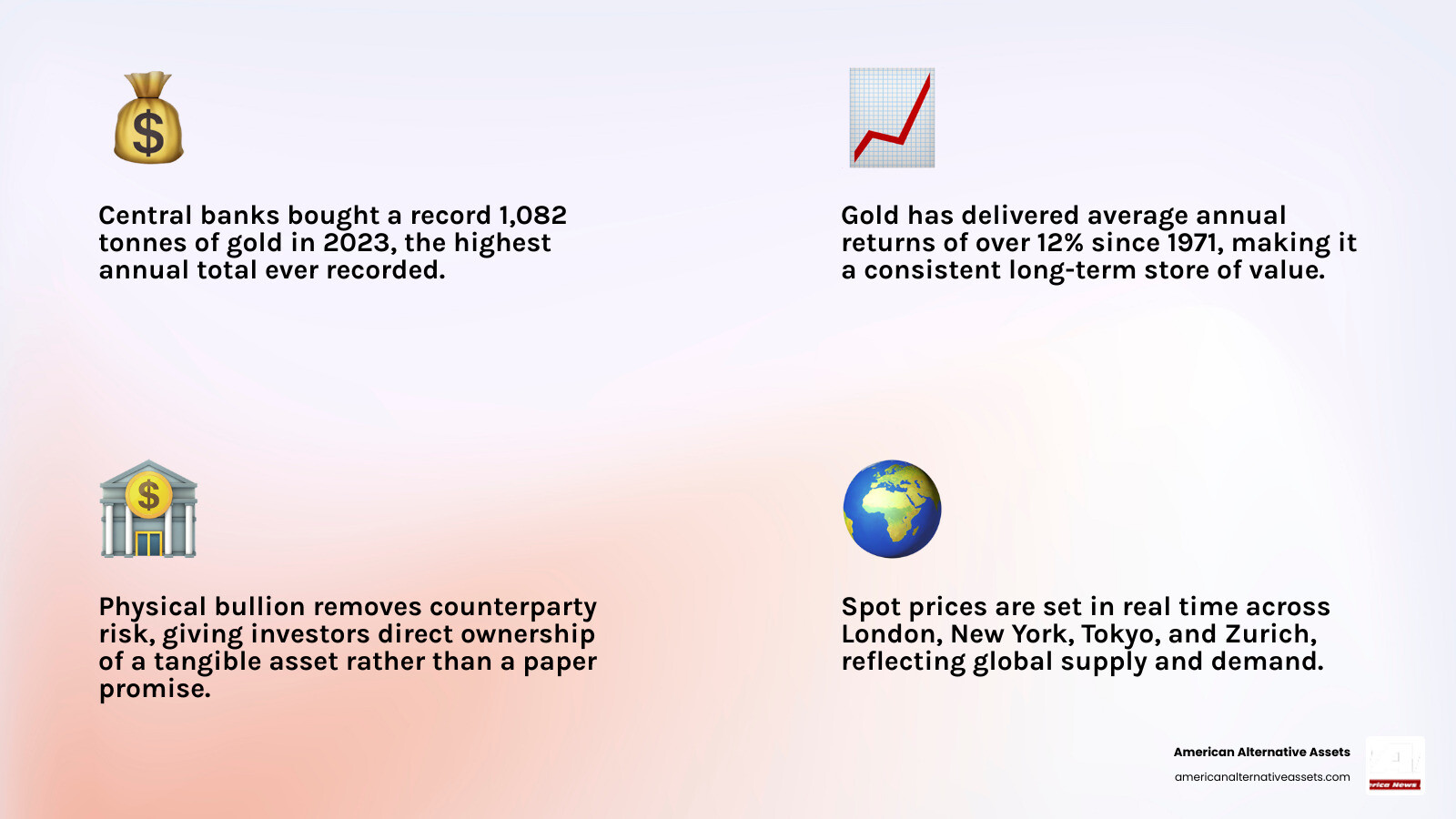
- Who does it: Individual investors, retirement savers, and central banks (which purchased a record 1,082 tonnes of gold in 2023)
- Why people do it: To preserve wealth, hedge against inflation, and diversify away from risky paper-based assets like stocks and ETFs
- How prices are set: By the global spot price, updated in real time across markets in London, New York, Tokyo, and Zurich
- Key advantage of physical gold: You own a tangible asset outright, with no counterparty risk attached to it
Gold has delivered average annual returns of over 12% since 1971, making it one of the most consistent stores of value in modern financial history. Yet many investors are still unsure how to buy it, store it, or trade it safely.
This guide walks you through everything, from product types and pricing to storage, taxes, and retirement account options, so you can make informed decisions about adding physical gold to your portfolio.
I’m Shanon Davis, founder of American Alternative Assets, and my background in venture capital, combined with my personal commitment to physical wealth preservation, has made gold bullion trading a cornerstone of the financial education I provide to everyday Americans. Let’s get into the details.
Know your gold bullion trading terms:
Understanding the Fundamentals of Gold Bullion Trading
When we talk about bullion, we are referring to physical precious metals of exceptionally high purity. For gold, the industry standard requires a minimum purity of 99.5 percent, though many investment-grade bars and coins are minted at 99.9 percent or even 99.99 percent purity. This high standard distinguishes bullion from decorative gold, such as jewelry, which is often mixed with other metals for durability.
The global demand for physical gold remains remarkably robust. Central banks around the world have been accumulating gold at historic rates. In 2023, central bank purchases reached a record 1,082 tonnes, highlighting the role of physical gold as a primary reserve asset. This institutional backing, combined with an average annual return of over 12 percent since the end of the gold standard in 1971, underscores why physical gold is widely seen as a hedge during times of economic uncertainty.
For a deeper look into these core principles, you can explore our resource on Investing in Bullion: A Comprehensive Guide.
Many modern investors confuse physical gold ownership with paper-based gold products. Paper gold, which includes exchange-traded funds, gold mining stocks, and futures contracts, represents a claim on gold rather than ownership of the metal itself.
When you invest in paper assets, you are exposed to counterparty risks, fund management decisions, and market liquidations. If the financial institution managing your fund faces systemic issues, your paper contract may not protect you.
Physical gold, on the other hand, carries no counterparty risk. When you hold a physical gold bar or store it in an allocated vault, you own a tangible asset that cannot go bankrupt or be erased by a computer glitch. This direct ownership is the primary reason why seasoned physical investors prefer tangible bullion over paper alternatives.
Types of Physical Gold Bullion Products
As you begin your journey in gold bullion trading, you will encounter three primary formats of physical gold: bars, coins, and rounds. Each format serves a specific purpose in an investment portfolio, and understanding their differences is crucial for maximizing the value of your capital.
- Gold Bars: These are refined gold ingots, typically rectangular, produced by private refineries or sovereign mints. They are designed for efficient storage and carry the lowest premiums over the spot price because they require less intricate design work to manufacture.
- Gold Coins: These are struck by sovereign government mints and carry a legal tender face value. Because governments guarantee their weight and purity, they are highly trusted and incredibly easy to trade globally. However, their detailed designs and official backing mean they carry higher minting premiums.
- Gold Rounds: Produced by private mints, rounds look like coins but do not have legal tender status or a face value. They offer a middle ground, providing the circular shape of a coin with premiums that are closer to those of gold bars.
To help you compare these options at a glance, we have compiled a comparison table:
| Attribute | Gold Bars | Sovereign Gold Coins | Gold Rounds |
|---|---|---|---|
| Purity | Typically 99.99% | 91.67% to 99.99% | Typically 99.9% to 99.99% |
| Premium Level | Lowest | Highest | Moderate |
| Legal Tender | No | Yes | No |
| Liquidity | High | Very High | Moderate to High |
| Best For | Bulk accumulation | Global recognition | Budget-conscious buyers |
Gold bars themselves can be manufactured in two different ways. Cast bars are made by pouring molten gold into a mold, giving them a rustic, natural appearance. Minted bars start as cast bars but are pressed and cut by high-precision machinery, resulting in a polished, uniform finish with sharp details. Minted bars often come packaged in protective assay cards that verify their weight and purity.
The Role of Sovereign Coins in Gold Bullion Trading
Sovereign coins play a vital role in gold bullion trading due to their unmatched liquidity and global recognition. Because they are produced by government entities, buyers around the world accept them without the need for expensive chemical testing.
The American Gold Eagle and the Canadian Gold Maple Leaf are two of the most popular sovereign gold coins in the world. The American Gold Eagle is minted from 22-karat gold, containing a full troy ounce of pure gold mixed with small amounts of silver and copper for durability. The Canadian Gold Maple Leaf is minted from 24-karat gold with a purity of 99.99 percent, making it highly prized for its pure gold content.
Other notable sovereign coins include the South African Krugerrand, the Austrian Philharmonic, and the Australian Gold Kangaroo. For a detailed breakdown of which coins make the most sense for your portfolio, read The Ultimate Guide to Best 1 oz Gold Coin to Buy.
Evaluating Gold Bars for Efficient Gold Bullion Trading
For investors focused on acquiring the maximum amount of physical gold for their dollar, gold bars are often the preferred choice. Because they are easier to produce than coins, refineries pass the savings on to the buyer in the form of lower premiums.
Gold bars come in a wide variety of sizes to fit different budgets. High-net-worth investors often look toward kilo gold bars (which contain 32.15 troy ounces) to move large amounts of capital into physical assets efficiently. On the other end of the spectrum, 5-gram gold bars offer a highly accessible starting point for those building their holdings over time.
To understand the benefits of pure, 24-karat gold bars, you can read The Golden Standard: Everything You Need to Know About 24k Bullion.
If you are considering larger acquisitions, check out Everything You Need to Know Before Buying Kilo Gold Bars.
For those looking to start small, we recommend reading Small but Mighty: Why 5 Gram Gold Bullion is a Smart Start for Investors.
How Gold Bullion Prices and Premiums are Determined
To trade physical gold successfully, you must understand how pricing works. The price you pay for a gold coin or bar is composed of two parts: the spot price and the premium.

The spot price is the current market price at which a troy ounce of raw, unrefined gold can be bought or sold for immediate delivery. It fluctuates constantly throughout the trading day based on global supply and demand, currency movements, inflation expectations, and geopolitical events.
The premium is the additional cost charged above the spot price. This fee covers the cost of refining, minting, packaging, shipping, insurance, and the dealer’s operational margin.
The bid-ask spread is another key concept. The “ask” is the price at which a dealer is willing to sell gold to you, while the “bid” is the price at which they are willing to buy gold back from you.
To see how real-time spot pricing works in the institutional market, you can review the data provided by US Spot Gold | Interactive Brokers LLC .
Finding Competitive Prices and Avoiding High Premiums
Minimizing the premiums you pay is one of the easiest ways to improve your long-term returns in gold bullion trading. To do this, you should compare prices across reputable national and local dealers.
When shopping online, look for established dealers who offer transparent pricing with no hidden fees, and take advantage of wholesale rates or bulk discounts whenever possible. Many dealers also offer “spot deals” for first-time buyers, allowing you to purchase a small amount of gold with no premium.
If you are located in the Southern California area, you can research verified businesses through the Precious Metals Products near Woodland Hills, CA – BBB directory to find reputable local resources.
For practical strategies on sourcing cost-effective gold bars, read our guide A Quick Start Guide to Buy Cheap Gold Bars.
Additionally, if you are balancing a budget and considering other precious metals alongside gold, you can learn more about entry-level options like physical silver to diversify your holdings.
Storage, Security, and Liquidity in the Bullion Market
Once you acquire physical gold, storing it securely becomes your top priority. Physical gold is a highly concentrated form of wealth, meaning a significant amount of value can fit into a very small space. This makes it incredibly easy to store, but it also makes security paramount.

There are three primary options for storing your physical gold:
- Home Storage: Storing gold in a high-security, fireproof safe at home offers maximum privacy and immediate access. However, it also exposes you to personal security risks and may require specialized insurance riders to cover theft or loss.
- Bank Safe Deposit Boxes: While secure, bank safe deposit boxes do not offer the same level of accessibility, as you can only access your gold during bank operating hours. Furthermore, bank safe deposit boxes are not automatically insured by the FDIC.
- Professional Depositories: Third-party depositories offer the highest level of security. These facilities utilize state-of-the-art security, 24-hour monitoring, and comprehensive insurance.
When utilizing professional storage, you must choose between allocated and unallocated storage. Allocated storage means your specific coins or bars are physically segregated, and you retain sole legal title to those exact items. Unallocated storage pools your gold with the metal of other investors, meaning you own a share of a larger pool. For maximum security, physical investors should always insist on allocated storage.
The physical gold market is one of the most liquid asset markets in the world. Because gold is globally recognized and universally valued, you can convert your physical bullion into cash almost anywhere in the world, regardless of local economic conditions.
How the Buyback Process Works for Physical Gold
When the time comes to liquidate your physical holdings, the process is straightforward. Most reputable precious metals dealers offer a guaranteed buyback policy, meaning they will purchase back the metals they sold to you at their current bid price.
To sell your gold, you simply request a buyback quote from your dealer, secure your metals in protective packaging, and ship them via an insured carrier or bring them to a secure local facility. Once the dealer verifies the authenticity, weight, and purity of your gold, they will release your funds, typically via wire transfer or check.
If you are located in Southern California and prefer an in-person transaction, you can find local precious metals dealers and buyers in the area to facilitate immediate liquidations.
To avoid common pitfalls and ensure you receive a fair price for your metals, we recommend reading Convert Gold to Cash: A Beginner’s Guide to Not Getting Ripped Off.
You can also learn more about the mechanics of liquidating your metals by reading How Does the Buyback Process Work?.
Tax Implications and Retirement Account Options
Understanding the tax rules surrounding physical precious metals is essential for protecting your investment gains. In the United States, the IRS classifies physical gold bullion as a “collectible” for capital gains tax purposes.
If you hold physical gold for more than one year, any profits you realize upon selling are taxed at your marginal rate, up to a maximum collectibles tax rate of 28 percent. Short-term capital gains, on gold held for one year or less, are taxed at standard ordinary income tax rates.
Fortunately, there is a highly tax-efficient way to hold physical gold through a Precious Metals IRA. This specialized self-directed retirement account allows you to invest in physical gold, silver, platinum, or palladium while enjoying the same tax advantages as a traditional or Roth IRA.
With a Precious Metals IRA, your physical gold is held in a highly secure, IRS-approved depository, and you can build your physical precious metals holdings using pre-tax dollars (with traditional IRAs) or tax-free growth (with Roth IRAs).
To learn more about setting up these accounts and avoiding common marketing traps in the industry, check out our analysis: Beyond the Hype: Are Free Gold IRA Kits Worth It?.
Frequently Asked Questions about Gold Bullion Trading
What is the difference between gold bullion and gold jewelry?
Gold bullion is valued strictly for its weight and purity, containing at least 99.5 percent pure gold with minimal artistic markup. Gold jewelry is typically made of lower-purity gold alloys (such as 14-karat or 18-karat) to make the metal durable enough to wear. Jewelry also carries high design and manufacturing markups, which are rarely recovered when you sell the piece for its raw metal content.
Is physical gold bullion better than a gold ETF?
Yes, physical gold bullion is widely considered superior for wealth preservation because it represents direct, tangible ownership. A gold ETF is a paper asset that exposes you to counterparty risk, management fees, and potential fund liquidations. If you do not hold the physical metal, you do not truly own it, you merely own a share of a financial trust.
How do I verify the authenticity of gold bullion?
You can verify the authenticity of physical gold through several non-destructive testing methods. These include verifying the exact weight using a digital scale, measuring the dimensions with a caliper, and conducting a density test. Reputable dealers also use advanced electronic metal analyzers to verify the purity of the gold without damaging the coin or bar.
Conclusion
Physical gold has stood the test of time as a reliable store of value and a cornerstone of sound financial planning. By understanding the fundamentals of gold bullion trading, choosing the right physical products, and utilizing secure storage, you can take control of your financial future and build a portfolio designed to withstand economic volatility.
At American Alternative Assets, we specialize in helping clients secure their wealth through physical precious metals. From our offices in Woodland Hills, California, we provide a white-glove, relationship-first service built on trust, transparency, and ethical practices. We believe in providing real privacy and protection for your wealth, ensuring you have the support you need at every step of your gold trading journey.
If you are ready to take the next step in preserving your hard-earned savings, we invite you to explore your options with us.
Secure Your Wealth with a Precious Metals IRA
This article is for informational purposes only and does not constitute financial advice. Please consult your financial advisor before making investment decisions.
Investing in precious metals involves risk. Past performance does not guarantee future results.