Precious Metals IRA Accounts: The Complete 2026 Guide
If you’re reading this, you’ve probably realized that “diversifying your retirement portfolio” doesn’t mean what it used to. With gold trading at record highs, the dollar’s purchasing power continuing to decline, and Congress moving forward on stablecoin legislation that will reshape the digital dollar landscape, more retirees are asking a simple question: how do I actually move part of my IRA into physical precious metals?
This is the complete 2026 guide to precious metals IRA accounts — written for people aged 45-65 who want clear answers on how the accounts actually work, what they cost, which custodians are reputable, and what the IRS will (and won’t) allow.
No marketing fluff. No “limited time” pressure tactics. Just the mechanics, the fees, the rules, and the warnings.
What Is a Precious Metals IRA Account?
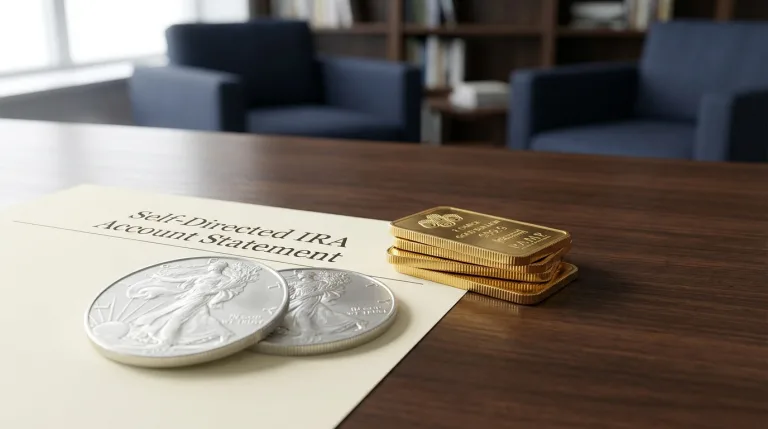
A precious metals IRA is a self-directed individual retirement account that holds physical gold, silver, platinum, or palladium instead of stocks, bonds, or mutual funds. The tax advantages are identical to a traditional or Roth IRA — your contributions and earnings grow tax-deferred (or tax-free in the case of a Roth) until you withdraw.
What’s different is what’s inside the account. Instead of paper assets that depend on a company’s earnings or a government’s promises, a precious metals IRA holds actual bullion — coins and bars stored in an IRS-approved depository on your behalf.
Three terms you’ll see throughout this guide:
- Self-directed IRA — An IRA that allows alternative investments (like precious metals, real estate, or private equity) instead of only stocks and bonds.
- Custodian — The IRS-approved trustee that holds and administers the account. You can’t be your own custodian.
- Depository — The secure, IRS-approved storage facility where your physical metals are held. Common examples are the Delaware Depository, Brink’s, and Texas-based facilities.
Why do retirees use them? Three common reasons: as an inflation hedge (gold has held purchasing power across centuries), as a hedge against currency policy decisions (Fed rate changes, dollar devaluation, capital controls), and as portfolio diversification away from correlated paper assets.
The 4 Types of Precious Metals You Can Hold in an IRA
The IRS allows four metals in a precious metals IRA, each with strict purity requirements. Anything below the purity threshold — even by a fraction of a percent — is not eligible.
| Metal | Minimum Purity | IRS-Approved Examples | Typical Allocation |
|---|---|---|---|
| Gold | 99.5% (.995 fine) | American Gold Eagle, Canadian Gold Maple Leaf, PAMP Suisse bars, Credit Suisse bars | 60–70% |
| Silver | 99.9% (.999 fine) | American Silver Eagle, Canadian Silver Maple Leaf, Austrian Silver Philharmonic | 20–30% |
| Platinum | 99.95% (.9995 fine) | American Platinum Eagle, Australian Platinum Koala, Canadian Platinum Maple Leaf | 0–10% |
| Palladium | 99.95% (.9995 fine) | Canadian Palladium Maple Leaf, American Palladium Eagle (limited availability) | 0–10% |
An important note about the American Gold Eagle: it’s the one exception to the 99.5% purity rule. Gold Eagles are 91.67% pure (22-karat) but are specifically allowed by the IRS due to their status as official US legal tender. This is one of the most common IRA-eligible coins because of its government backing and liquidity.
Numismatic (collector) coins, jewelry, and most pre-1933 US gold coins are not eligible — only investment-grade bullion that meets the purity standards.
Top 5 Precious Metals IRA Custodians Compared (2026)
You cannot be your own custodian for a precious metals IRA — the IRS requires an approved trustee. Below are five of the most established custodians in the precious metals space, with the fee structures and storage options most relevant to retirees:
| Custodian | Setup Fee | Annual Admin | Storage (annual) | Minimum | Storage Locations |
|---|---|---|---|---|---|
| Equity Trust | $50 | $225 (asset-based, capped) | $100–$300 | None | Delaware, Salt Lake City |
| STRATA Trust | $50 | $95 + $100 metals fee | $100–$150 | None | Delaware, Texas |
| Kingdom Trust | $0 | $165 | $125 (commingled) / $290 (segregated) | None | Delaware |
| GoldStar Trust | $50 | ~1.25% asset-based | Included in admin | None | Delaware, Texas |
| Madison Trust | $50 | $100 (up to $100K) + $1 per $1K above | $100 minimum | None | Delaware Depository |
How to read this table: “Commingled” storage means your metals are pooled with other clients’ identical bullion (you own a share, not specific bars). “Segregated” storage means your specific bars and coins are kept in their own labeled compartment. Segregated costs more but gives you ownership of identifiable physical pieces — important if you ever want to take physical delivery.
Fee structures change. Always confirm current fees directly with the custodian before opening an account. We work with several of these custodians and can make introductions based on which structure fits your situation best.
Precious Metals IRA Fees: The Real Numbers for 2026
Marketing materials often focus on “no setup fee” promotions while burying annual costs. Here’s what you’ll actually pay across the first three years for a $100,000 precious metals IRA at three representative cost tiers:
| Low Cost | Mid Range | Premium (Segregated) | |
|---|---|---|---|
| Setup fee (one-time) | $50 | $200 | $300 |
| Annual admin fee | $80 | $150 | $250 |
| Annual storage | $100 (commingled) | $150 (commingled) | $290 (segregated) |
| Transaction fees (avg 2/yr) | $40 each = $80 | $80 each = $160 | $0 (included) |
| Year 1 total | $310 | $660 | $840 |
| Year 2 & beyond | $260 | $460 | $540 |
Two honest observations about fees:
- Storage is the biggest variable. Allocated/segregated storage costs roughly 2x to 3x commingled storage. For accounts under $250,000, commingled is generally the most cost-effective option. Above that threshold, the cost differential becomes more justifiable for the audit trail.
- Watch for “free first year” promotions with locked-in renewals. Some custodians waive year 1 fees but require multi-year contracts at higher tiers in year 2+. Always confirm the post-promotional renewal rate before committing.
How to Roll Over a 401(k) or IRA into a Precious Metals Account
The rollover process follows a sequence the IRS has codified, and most of the complexity is administrative rather than complicated. Here’s the six-step process:
- Open the self-directed IRA with a custodian. This is paperwork — name, SSN, beneficiary, signature. Typically completed in 1–2 business days.
- Submit transfer or rollover paperwork. The custodian will provide forms to authorize the transfer from your current 401(k) administrator or traditional IRA custodian.
- Funds move. A direct transfer (trustee-to-trustee) is the safest option — no taxes withheld, no 60-day clock. An indirect rollover (funds come to you, you redeposit within 60 days) is allowed but riskier and limited to once per 12 months.
- Choose your metals. Work with a reputable dealer (like American Alternative Assets) to select IRS-eligible bullion that meets your allocation strategy.
- Custodian pays the dealer. The dealer ships the metals directly to the IRS-approved depository. You never physically touch the metals during this process — and that’s the point.
- Metals arrive at the depository. The custodian confirms receipt, your account is funded, and you receive statements showing your holdings at spot value.
Critical IRS rules to know:
- 60-day rollover rule: If you take an indirect rollover, you have 60 days from receipt to redeposit the funds into a new IRA, or the entire amount is treated as a taxable distribution.
- One-rollover-per-year rule: Per IRS Notice 2014-32, you can only complete one indirect 60-day rollover per 12-month period across all your IRAs. Direct trustee-to-trustee transfers are unlimited.
- Prohibited transactions: You cannot personally benefit from the IRA assets before distribution (no taking the gold home, no borrowing against it, no using IRA funds to purchase from a “disqualified person” like a family member’s business).
What About “Home Storage” Precious Metals IRAs?
This is the section that some precious metals companies don’t want you to read.
You’ll see advertisements promising “home storage gold IRAs” or “checkbook IRAs” that supposedly let you keep your gold at home in a safe. The IRS has consistently rejected these arrangements.
The most important case to know is McNulty v. Commissioner, 157 T.C. No. 10, decided by the US Tax Court on November 18, 2021. The facts: Donna McNulty opened a self-directed IRA, formed an LLC owned by the IRA, used the LLC to purchase $411,000 in American Eagle gold and silver coins, and stored those coins in a safe at her home. She labeled the coins as property of the IRA-owned LLC and kept detailed records.
Judge Robert Goeke ruled that physically storing the coins at home gave Donna McNulty “unfettered control” of the IRA assets — and unfettered control is legally equivalent to a taxable distribution. The court treated the entire $411,000 as a distribution in the year the coins were received. With back taxes and penalties, McNulty’s total liability exceeded $300,000.
The ruling was unambiguous: “The statute requires that precious metals owned by an IRA be held in the physical possession of a bank, federally insured credit union, or other IRS-approved trustee or custodian.” An LLC owned by the IRA does not satisfy this requirement.
The takeaway: any structure that gives you physical access to your IRA’s precious metals — even through an LLC, even with meticulous records — risks disqualification of the entire IRA. The legitimate path is depository storage with an IRS-approved custodian. That’s not a marketing position; it’s tax law.
2026 IRS Rules for Precious Metals IRAs
Precious metals IRAs are subject to the same contribution limits and distribution rules as traditional and Roth IRAs:
- 2026 contribution limit: $7,500 for individuals under age 50.
- Catch-up contribution (age 50+): Additional $1,100, for a total of $8,600.
- Required Minimum Distributions (RMDs): Begin at age 73 for those born 1951–1959; begin at 75 for those born 1960 or later.
- Roth precious metals IRAs: Allowed. Contributions are after-tax, growth is tax-free, no RMDs during the original owner’s lifetime.
- Income-based limitations: If you or your spouse are covered by a workplace plan, traditional IRA deductibility phases out at higher income levels. Roth IRA contribution eligibility phases out at $153,000-$168,000 (single) / $242,000-$252,000 (married filing jointly) for 2026.
When you take a distribution from a precious metals IRA, you have two options: have the custodian sell the metals and distribute cash, or take physical delivery of the metals (at which point they become a taxable distribution at fair market value).
Get Your Free 2026 Precious Metals IRA Kit
If you’d like the custodian comparison tables, IRS rule summary, and fee benchmarks in a printable format — along with a complimentary 20-minute consultation with a precious metals specialist — request our free 2026 Precious Metals IRA Kit.
The kit is genuinely free — no obligation, no high-pressure follow-up. If, after reviewing it, you’d like to proceed, we can introduce you to the custodian that best fits your situation. If not, you keep the kit and the conversation ends there.
→ Request the Free 2026 Precious Metals IRA Kit
Precious Metals IRA Accounts: Frequently Asked Questions
What is a precious metals IRA account?
A precious metals IRA is a self-directed individual retirement account that holds IRS-approved physical gold, silver, platinum, or palladium instead of traditional paper assets. It carries the same tax advantages as a conventional IRA.
How does a precious metals IRA differ from a traditional IRA?
The structure is the same (tax-advantaged retirement account, same contribution limits, same RMD rules), but the assets held are physical bullion stored at an IRS-approved depository instead of stocks, bonds, or mutual funds.
Can I take physical possession of the gold in my IRA?
Not while it’s still inside the IRA. Per McNulty v. Commissioner, physical possession by the account owner is treated as a taxable distribution. To physically hold your IRA’s gold, you must first take a formal distribution — which becomes a taxable event at fair market value.
What metals can I hold in a precious metals IRA?
Gold (99.5% pure or higher, with American Gold Eagles as the exception), silver (99.9%), platinum (99.95%), and palladium (99.95%). Specific approved coins and bars are listed in IRS Publication 590-A.
How much does a precious metals IRA cost per year?
Annual costs typically range from $220 to $540 for accounts up to roughly $250,000, depending on the custodian and whether you choose commingled or segregated storage. See the fee tables above for specific breakdowns.
Who is the best precious metals IRA custodian?
There’s no single “best” — it depends on your account size, storage preference, and how you weigh fees against service. Equity Trust and STRATA Trust are commonly chosen for cost-effective commingled storage. Kingdom Trust is often preferred for segregated storage. We can help you compare based on your specific situation.
Is a home storage gold IRA legal?
No. The 2021 Tax Court ruling in McNulty v. Commissioner established that physical possession by the account holder — even through an IRA-owned LLC — disqualifies the IRA and creates a taxable distribution of the entire account value.
Can I roll over my 401(k) into a precious metals IRA?
Yes, if your current 401(k) plan allows rollovers (most do, especially after separation from the employer). A direct trustee-to-trustee transfer is the safest method — no taxes withheld, no 60-day window risk.
What’s the difference between a gold IRA and a precious metals IRA?
A “gold IRA” is colloquial — it almost always refers to the same self-directed precious metals IRA structure, just one funded primarily with gold. A precious metals IRA can hold any combination of gold, silver, platinum, and palladium.
What percentage of my portfolio should be in precious metals?
This depends on your age, risk tolerance, other assets, and macroeconomic outlook. Common ranges fall between 5% and 25% of total retirement assets. Anyone telling you a single “right” number without knowing your situation is selling, not advising.
What are the 2026 contribution limits?
For 2026, the annual contribution limit across your traditional and Roth IRAs is $7,500, or $8,600 if you’re age 50 or older, including the $1,100 catch-up. Contributions generally can’t exceed your taxable compensation for the year. The $11,250 higher catch-up for eligible participants ages 60-63 in certain employer plans does not apply to a Traditional or Roth Precious Metals IRA.
Can I have a Roth precious metals IRA?
Yes. The Roth structure works the same way — after-tax contributions, tax-free growth, no RMDs during the original owner’s lifetime. Income phase-outs apply.
What happens to my IRA when I die?
The account passes to your designated beneficiaries. Under SECURE Act rules, most non-spouse beneficiaries must distribute the entire account within 10 years. Spouse beneficiaries have more flexibility and can typically treat the IRA as their own.
What’s the minimum investment to open a precious metals IRA?
Most custodians have no IRA minimum, but dealers typically have practical minimums of $10,000–$25,000 to make the setup costs economically rational relative to the bullion premium.
Are precious metals IRAs FDIC insured?
No. FDIC insurance covers bank deposits, not physical assets. However, IRS-approved depositories carry private insurance (typically Lloyd’s of London) on the full value of metals stored, plus they’re audited regularly by independent third parties.
Why Retirees Choose American Alternative Assets
American Alternative Assets is a Woodland Hills, California-based precious metals dealer that specializes in working with retirement-age investors who want to allocate part of their portfolios into physical gold, silver, platinum, and palladium.
- BBB A+ rated with accredited business status
- Thousands of American families served
- Direct relationships with multiple IRS-approved custodians and depositories — no markup on custodian setup fees
- No high-pressure sales scripts. If a precious metals IRA isn’t the right move for your situation, we’ll tell you that.
- Full transparency on fees — including the actual annual costs across the custodian options that fit your account size
If you’d like to talk through whether a precious metals IRA makes sense for your situation, you can request our free 2026 kit (link above) or call us directly at (888) 503-1553. We answer the phone — and there’s no obligation in talking.
This article is for educational purposes and does not constitute financial, tax, or legal advice. Consult a qualified professional regarding your specific situation. American Alternative Assets is a precious metals dealer; we do not act as a custodian, trustee, or fiduciary.