







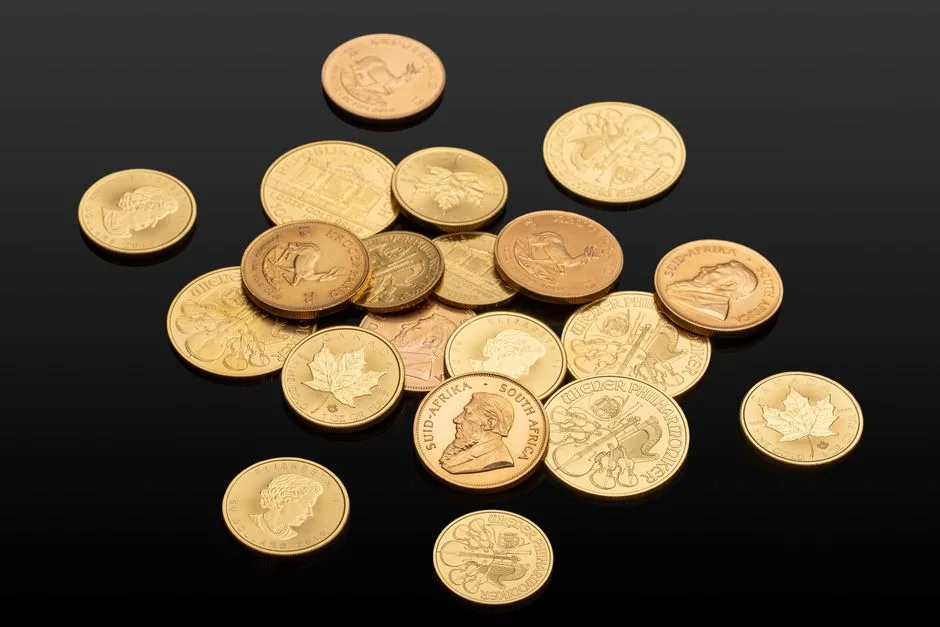
Why Choosing the Best 1 oz Gold Coin to Buy Matters for Your Wealth
If you’re researching the best 1 oz gold coin to buy, here’s a quick answer:
| Rank | Coin | Purity | Best For |
|---|---|---|---|
| 1 | American Gold Eagle | .9167 (22K) | US investors, IRA eligibility, liquidity |
| 2 | Canadian Gold Maple Leaf | .9999 (24K) | Purity seekers, global recognition |
| 3 | Austrian Gold Philharmonic | .9999 (24K) | European market, low premiums |
| 4 | Australian Gold Kangaroo | .9999 (24K) | Collectors, diversification |
| 5 | South African Krugerrand | .9167 (22K) | Budget-conscious buyers, history |
Owning physical gold is one of the oldest forms of wealth preservation. It doesn’t depend on a company’s earnings, a bank’s solvency, or a government’s fiscal decisions. It simply holds value, in your hands, across generations.
That’s very different from risky paper-based gold products like ETFs or gold stocks. Those only give you paper exposure to gold prices, not the actual metal itself, leaving you vulnerable to counterparty risk and market liquidation. When markets seize up, paper assets can fail completely in ways physical coins never can. For true security, physical precious metals held in a Gold, Silver, and Precious Metals IRA are the only reliable choice.
The 1 oz gold coin is the most practical size for most investors. It’s large enough to hold real value, small enough to stay liquid, and widely recognized by dealers around the world.
But not all 1 oz gold coins are equal. Purity, premiums, IRA eligibility, and global liquidity vary significantly between options. Choosing the wrong coin can cost you more than you realize, both when you buy and when you eventually sell.
I’m Shanon Davis, founder of American Alternative Assets, and after years in venture capital watching wealth evaporate on paper, I built this company to help everyday Americans find the best 1 oz gold coin to buy for long-term security. In this guide, I’ll walk you through everything you need to know to make a confident, informed decision.

What is the Best 1 oz Gold Coin to Buy for Long-Term Security?
When we talk about long-term security, we are talking about more than just the shine of the metal. We are looking for a coin that can be easily sold anywhere in the world, holds its value during economic storms, and is highly resistant to counterfeiting.
For most physical gold buyers, the decision comes down to a classic head-to-head match: the American Gold Eagle versus the Canadian Gold Maple Leaf. Both are incredibly popular, but they serve slightly different investor preferences.
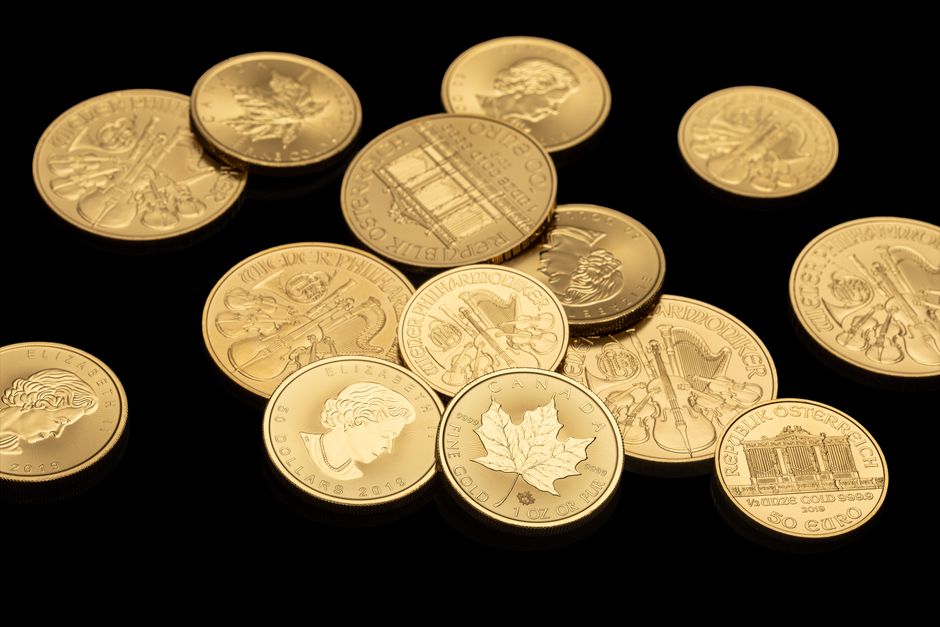
Evaluating the right asset for your portfolio requires looking at three core pillars: liquidity, global recognition, and ease of storage. High liquidity ensures that when you are ready to sell, you can find a buyer in minutes, not days. Global recognition means a coin shop in Tokyo, Munich, or Los Angeles will instantly recognize your coin and offer a fair price based on the current gold spot price.
If you are looking for a complete overview of how to navigate these choices, we recommend reading our guide on Your Treasure Hunt: Finding the Perfect Gold Coins for Sale.
The American Gold Eagle: The Best 1 oz Gold Coin to Buy in the US
For investors based in the United States, the American Gold Eagle is widely considered the best 1 oz gold coin to buy. Released by the United States Mint in 1986, it is the official gold bullion coin of the United States. Its legal tender status and backing by the U.S. government for weight and purity make it an incredibly secure asset.
The American Gold Eagle is a powerhouse in the global bullion market. Annual sales of American Gold Eagles regularly exceed 1 million ounces, making it one of the highest-volume bullion coin programs globally. This massive trading volume translates directly into unmatched liquidity. Because so many of these coins are bought and sold every single day, you can always expect a tight spread between the buying and selling price.
To learn more about this iconic coin, you can explore our dedicated article on American Gold Eagle Bullion.
The Canadian Gold Maple Leaf: The Best 1 oz Gold Coin to Buy for Purity
If your primary goal is absolute purity, the Canadian Gold Maple Leaf is the undisputed champion. First issued by the Royal Canadian Mint in 1979, the Gold Maple Leaf was the first bullion coin to achieve .9999 fine purity, often referred to as “four nines” pure gold.
Unlike the American Gold Eagle, which contains alloyed metals for durability, the Canadian Gold Maple Leaf contains nothing but pure gold. It is consistently ranked among the top three bullion coins in the world for trading volume and global recognition.
The Royal Canadian Mint has also made this coin a global leader in anti-counterfeiting technology. Since 2013 and 2015 respectively, the mint has added laser-engraved security marks and radial lines to the coin’s finish. The micro-engraved maple leaf on the reverse contains a hidden two-digit numeral representing the year of issue, which is visible only under magnification.
Furthermore, the Royal Canadian Mint utilizes Bullion DNA technology, which uses laser micro-engraved dies and encrypted digital signatures. This allows registered dealers to instantly verify the authenticity of any Gold Maple Leaf minted after 2014.
For more details on the 2026 release of this pure gold masterpiece, you can view the official details on the 2026 Gold Maple Leaf Coin, 1 oz. 99.99% Pure (Bullion) | The Royal Canadian Mint.
To understand why 24-karat gold is so highly valued by purists, read our deep-dive article on The Golden Standard: Everything You Need to Know About 24k Bullion.
Comparing the Top 1 oz Gold Coins: Eagle, Maple Leaf, and Philharmonic
To help you decide which coin fits your investment strategy, let us compare the specifications, origins, and unique traits of the world’s leading 1 oz gold coins.
| Coin | Mint | Purity | Composition | Key Feature |
|---|---|---|---|---|
| American Gold Eagle | United States Mint | .9167 (22K) | 91.67% Gold, 3% Silver, 5.33% Copper | Unmatched US liquidity, scratch-resistant |
| Canadian Gold Maple Leaf | Royal Canadian Mint | .9999 (24K) | 99.99% Pure Gold | Bullion DNA anti-counterfeiting |
| Austrian Philharmonic | Austrian Mint | .9999 (24K) | 99.99% Pure Gold | European favorite, beautiful musical design |
| Australian Kangaroo | Perth Mint | .9999 (24K) | 99.99% Pure Gold | Annual design changes, highly collectible |
| South African Krugerrand | Rand Refinery | .9167 (22K) | 91.67% Gold, 8.33% Copper | The original modern bullion coin, low premium |
While the Eagle and the Maple Leaf dominate the North American market, other coins offer excellent value. The Austrian Philharmonic, first introduced in 1989, features a stunning design celebrating the Vienna Philharmonic Orchestra. It is the only widely traded bullion coin denominated in Euros.
The Australian Gold Kangaroo, struck by the historic Perth Mint, is unique because its reverse design changes every year, adding a layer of numismatic collectibility to its pure gold content.
If you want to compare these high-purity options further, check out our guide on Pure Gold, Pure Investment: Shop the Best 24k Bullion Options.
22K vs 24K Gold Composition and Durability
One of the most common points of confusion for new gold buyers is the difference between 22-karat (22K) and 24-karat (24K) gold coins.
A 24K gold coin, like the Canadian Maple Leaf or the Austrian Philharmonic, is made of .9999 pure gold. It contains no other metals. While this purity is highly desirable, pure gold is naturally very soft and malleable. It can scratch, dent, or bend easily if handled without care.
A 22K gold coin, like the American Gold Eagle or the South African Krugerrand, is made of a 22-karat alloy. This means the coin is composed of 91.67% gold, with the remaining portion consisting of harder metals. In the case of the Gold Eagle, the alloy contains 3% silver and 5.33% copper. The Krugerrand uses 8.33% copper, which gives it a distinct reddish-gold hue.
The addition of these alloy metals makes 22K coins much more durable and scratch-resistant. This is a significant advantage if you plan to handle your coins or store them in a way where they might rub against one another.
It is vital to understand that both coins contain exactly one troy ounce of pure gold. The 22K coin simply weighs more in total because of the added weight of the copper and silver alloys.
If you are interested in comparing the durability and storage of coins versus larger pure gold products, you can read Everything You Need to Know Before Buying Kilo Gold Bars.
American Gold Eagle Specifications and Sizes
To ensure you are buying authentic U.S. Mint products, it helps to be familiar with the exact physical specifications of the American Gold Eagle. Because the coin contains alloyed metals, its gross weight is heavier than a standard troy ounce of pure gold.
- Gross Weight: 1.0909 troy ounces (33.931 grams)
- Pure Gold Content: 1.0000 troy ounce (31.103 grams)
- Diameter: 32.7 mm
- Thickness: 2.87 mm
- Face Value: $50 USD
The American Gold Eagle is also available in fractional sizes for investors who prefer smaller entry points or want greater flexibility when liquidating their holdings. These fractional sizes include:
- 1/2 oz Gold Eagle: Gross weight of 0.5455 troy oz, face value of $25.
- 1/4 oz Gold Eagle: Gross weight of 0.2727 troy oz, face value of $10.
- 1/10 oz Gold Eagle: Gross weight of 0.1091 troy oz, face value of $5.
While fractional coins are highly portable, they do carry higher dealer premiums per ounce compared to the 1 oz version. For collectors interested in special editions of these fractional coins, you can view the official product page for the American Eagle 2026 One-Half Ounce Gold Proof Coin | US Mint.
Key Investment Considerations for Gold Coin Buyers
Before you make a purchase, it is important to understand the different finishes available on the market. Mints produce gold coins in three primary finishes: bullion, proof, and burnished.

- Bullion Coins: Struck specifically for investors. They are priced based on the weight of the gold plus a small dealer premium. They do not have a limited mintage, and their value is tied directly to the moving spot price of gold.
- Proof Coins: Struck multiple times using specially prepared dies, resulting in a mirror-like background and frosted details. They are packaged in protective capsules and display boxes. Proofs are minted in limited quantities and carry much higher premiums, making them more appealing to collectors than pure bullion investors.
- Burnished Coins: Produced using hand-fed, polished blanks, giving them a matte finish. Like proofs, they are highly collectible and carry a premium that reflects their scarcity rather than just their gold weight.
For a physical Gold, Silver, and Precious Metals IRA or a pure wealth preservation strategy, standard bullion coins are almost always the most cost-effective option because you get the most gold for your dollar.
Type 1 vs Type 2 American Gold Eagles
In 2021, to celebrate the 35th anniversary of the American Eagle coin program, the United States Mint introduced a new reverse design. This created two distinct styles of Gold Eagles that you will encounter on the market:
- Type 1 (1986 to 2021): Features the classic reverse design by Miley Busiek, showing a male bald eagle carrying an olive branch to a nest containing a female eagle and her hatchlings.
- Type 2 (2021 to Present): Features a highly detailed, close-up profile portrait of a bald eagle, designed by artistic infusion program artist Jennie Norris.
For pure investment purposes, both Type 1 and Type 2 coins contain the exact same amount of gold and are highly liquid. However, Type 1 coins on the secondary market can sometimes carry slightly different premiums depending on dealer inventory and collector demand.
Understanding Dealer Premiums and Market Disruptions
When you buy physical gold, you will never pay the exact “spot price” you see on financial news networks. The spot price is a paper-market price for wholesale contracts. Physical gold must be mined, refined, minted, transported, insured, and sold by a dealer.
The difference between the spot price of gold and the retail price you pay is called the dealer premium. For a standard 1 oz American Gold Eagle, typical dealer premiums run between 5% and 7% over spot.
However, these premiums are not static. During periods of extreme economic uncertainty or market disruptions, physical demand can skyrocket while supply chains tighten. When this happens, physical premiums can spike dramatically. For example, during the market disruptions of 2020 and 2021, premiums on physical Gold Eagles surged far higher than normal as investors rushed to secure physical assets.
This disconnect highlights why physical gold is a true safe haven. While paper gold prices on Wall Street can fluctuate wildly due to speculative trading, the physical market reflects real-world supply and demand.
To learn more about how to navigate these premiums and build a resilient portfolio, explore our guides on How to Invest in Gold and Silver, Investing in Precious Metals, and our comprehensive Precious Metals Guide.
IRA Eligibility and Regulatory Exceptions for Gold Coins
One of the most powerful ways to secure your retirement is by holding physical gold within a self-directed Gold, Silver, and Precious Metals IRA. This allows you to enjoy the tax advantages of a traditional or Roth IRA while holding tangible, physical wealth.
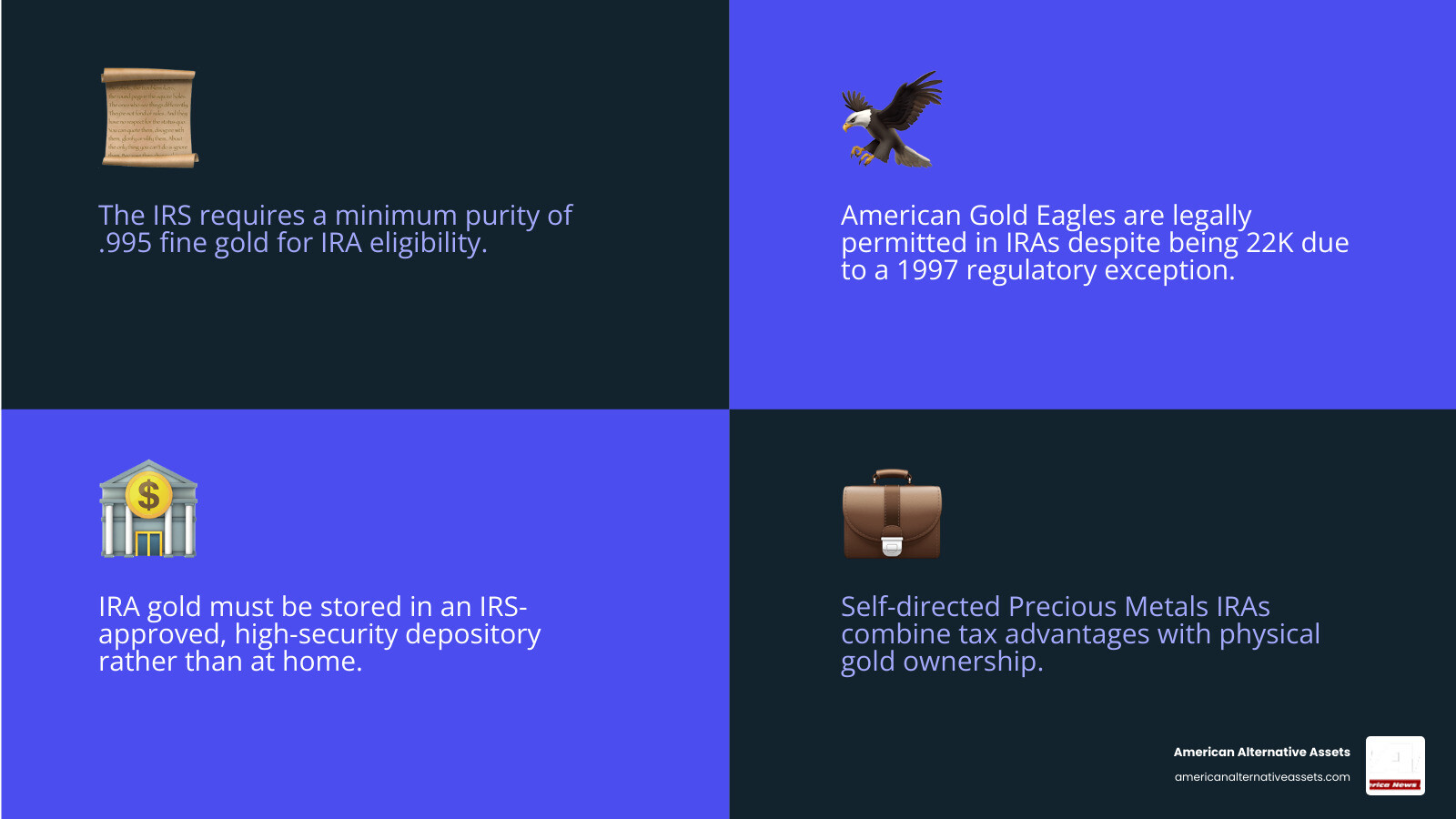
Normally, the Internal Revenue Service (IRS) has very strict rules regarding the purity of precious metals allowed in an IRA. Under the Internal Revenue Code, gold bullion must have a minimum purity of .995 fine to be eligible for retirement accounts.
This rule would technically disqualify the American Gold Eagle, which is only .9167 fine (22K). However, the Taxpayer Relief Act of 1997 created a specific regulatory exception for the American Gold Eagle. Because it is the official gold bullion coin of the United States, the IRS permits American Gold Eagles of all sizes to be held within an IRA, despite their 22K composition.
To take advantage of this, your gold must be held in a self-directed Gold, Silver, and Precious Metals IRA and stored in an IRS-approved, high-security depository. You cannot store IRA gold in a safe at home.
To learn more about how to set up a self-directed account and protect your retirement with physical gold, read our Gold IRA Investing Guide and The Definitive Guide to Buying Gold for IRA.
Frequently Asked Questions About Buying 1 oz Gold Coins
Why are American Gold Eagles IRA-eligible despite being 22K gold?
The American Gold Eagle is IRA-eligible due to a specific statutory exception written into the Taxpayer Relief Act of 1997. While the IRS generally requires gold bullion to be at least .995 fine (99.5% pure) for retirement accounts, the law specifically exempts federally minted American Eagle coins. Because they are the official gold bullion coins of the United States, backed by the U.S. government for weight and purity, they are fully approved for self-directed Gold, Silver, and Precious Metals IRAs.
Where are the best places to buy 1 oz gold coins at competitive prices?
The best way to buy physical gold is through a trusted, accredited precious metals partner that specializes in physical delivery and self-directed IRAs. Working with an established partner ensures you get authentic coins, transparent pricing, and secure shipping.
For local buyers near our physical headquarters in Woodland Hills, California, there are local options such as Gold Buyers in Woodland Hills or BST Gold And Silver – Woodland Hills, CA – MapQuest for quick physical transactions. However, for long-term wealth preservation and retirement accounts, working with a national specialist like American Alternative Assets to establish a physical Gold, Silver, and Precious Metals IRA ensures you get the white-glove service and regulatory compliance needed for secure storage.
How do gold coin premiums behave during economic uncertainty?
During times of economic crisis, geopolitical tension, or high inflation, the demand for physical gold often rises sharply. Because mints can only produce a finite number of coins per day, this sudden surge in physical demand can outstrip supply. As a result, dealer premiums can spike significantly above their normal 5% to 7% range. This is why it is often wise to acquire physical gold during calmer market periods, rather than waiting for a crisis when premiums are at their highest.
Conclusion
When it comes to securing your hard-earned wealth, physical gold remains one of the most reliable hedges against inflation and economic instability. Unlike highly risky paper-based assets, ETFs, or stocks, which expose you to corporate failures and market volatility without giving you ownership of any real metal, physical gold carries absolutely no counterparty risk. It is a tangible asset that you own outright.
Choosing the best 1 oz gold coin to buy depends on your personal goals. If you want the ultimate liquidity and backing of the U.S. government, the American Gold Eagle is an unmatched choice. If you demand absolute 24-karat purity and cutting-edge security features, the Canadian Gold Maple Leaf is an exceptional alternative.
At American Alternative Assets, we specialize in helping clients protect their wealth through physical Gold, Silver, and Precious Metals IRAs. Our unique selling proposition is our white-glove, relationship-first service. We build our business on trust, transparency, and ethical practices, ensuring you get real privacy and protection for your retirement savings.
Protect Your Wealth with a Gold, Silver, and Precious Metals IRA
This article is for informational purposes only and does not constitute financial advice. Please consult your financial advisor before making investment decisions. Investing in precious metals involves risk. Past performance does not guarantee future results.