








Why More Retirement Savers Are Looking to Buy Gold for IRA Accounts
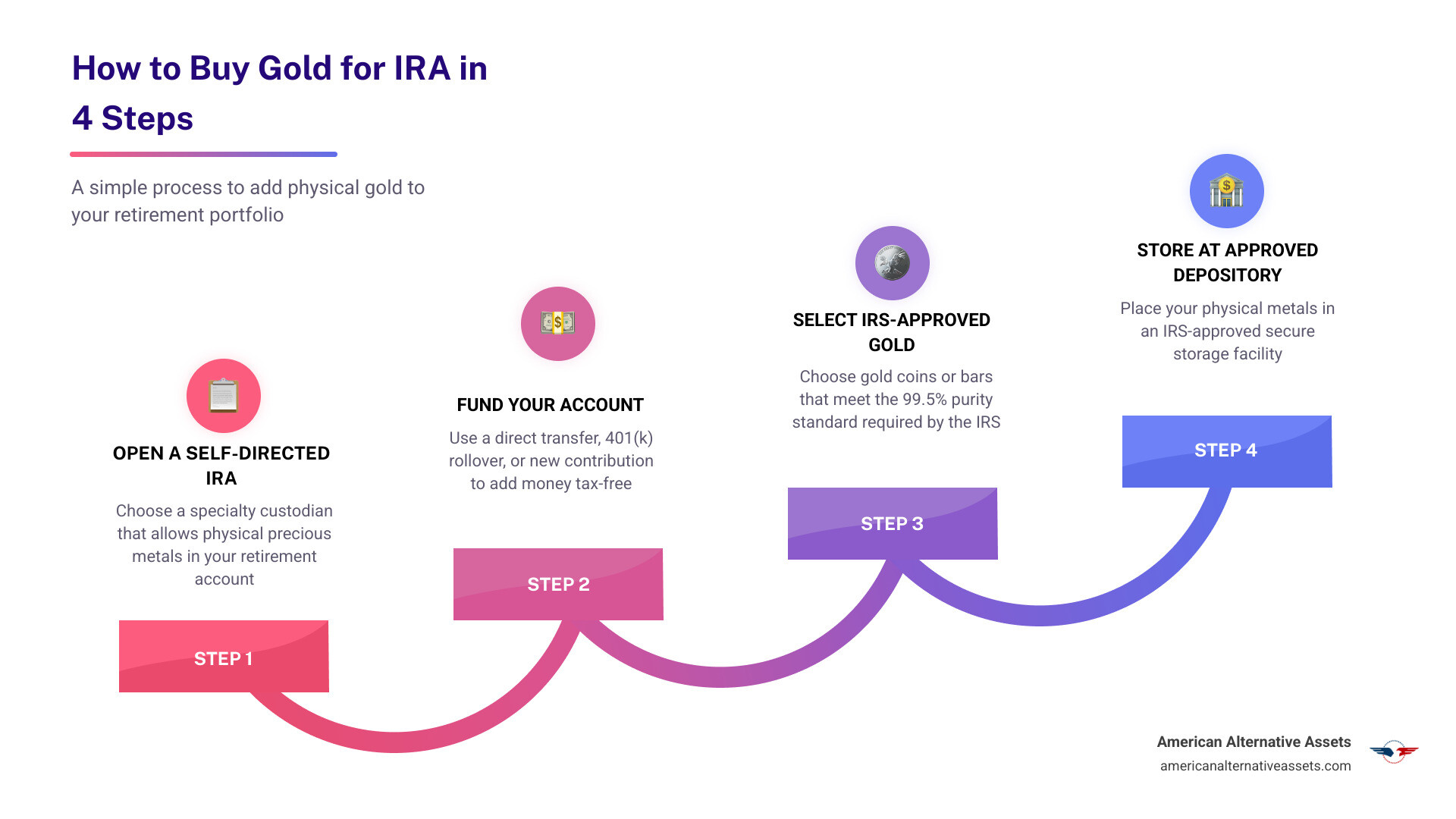
Buying gold for an IRA is more straightforward than most people think. Here is a quick overview of how it works:
- Open a self-directed IRA with a specialty custodian that handles physical precious metals
- Fund your account via direct transfer, IRA rollover, or new contribution
- Select IRS-approved gold products that meet purity standards, 99.5% minimum fineness
- Store your metals at an IRS-approved depository, not at home
Economic uncertainty has a way of focusing the mind. When markets swing hard and inflation erodes purchasing power, many retirement savers start asking a simple question: is my money actually safe?
Physical gold has been seen as a store of value for thousands of years. And since the Taxpayer Relief Act of 1997, the IRS has allowed investors to hold physical gold, silver, platinum, and palladium inside a self-directed IRA. That means you can potentially enjoy the tax advantages of a retirement account while holding tangible physical precious metals that do not depend on a company’s stock price, a fund structure, or a bank’s balance sheet.
Gold prices have reflected that growing interest. After trading above $2,000 per ounce through 2023 and 2024, gold spiked to around $3,200 per ounce in 2025, a roughly 44% increase in a single year. Analysts currently project prices between $3,000 and $3,700 per ounce by mid-2026, driven by inflation concerns, tariffs, and broader trade uncertainty.
That said, past performance does not guarantee future results. Gold can and does experience periods of flat or declining prices. A Gold IRA is not a get-rich-quick strategy. It is a physical precious metals diversification tool and, for many investors, a way to add a tangible, non-correlated asset that can reduce dependence on stocks, bonds, ETFs, and other paper-based claims.
I’m Shanon Davis, and my path to precious metals started long before I ever heard the term self-directed IRA. After years in venture capital watching paper assets swing on sentiment rather than fundamentals, I built American Alternative Assets specifically to help people understand how to buy gold for an IRA with clarity and confidence. This guide walks you through everything you need to know to do it right with physical Gold, Silver, and Precious Metals IRAs.
Key Buy gold for IRA vocabulary:
What is a Gold IRA and Why Choose Physical Metals?
A Gold IRA is a self-directed individual retirement account that allows you to hold IRS-approved physical precious metals, including gold, silver, platinum, and palladium. It can be structured as a Traditional IRA, Roth IRA, SEP IRA, or in some cases another qualifying retirement account type.
The key difference is simple:
- A conventional IRA usually confines savers to paper assets, such as stocks, bonds, mutual funds, or similar financial products that depend on issuers, market structure, and financial intermediaries.
- A Gold, Silver, or broader Precious Metals IRA holds physical precious metals, such as eligible gold and silver coins and bars, through a qualified custodian and approved depository.
That physical ownership is the heart of the strategy.
Paper-based gold exposure, such as gold stocks, funds, or ETFs, should not be confused with owning physical gold in a retirement account. Those paper products can introduce counterparty exposure, management decisions, fund structure risk, trading behavior, and other variables that separate the investment from the metal itself.
With a physical Precious Metals IRA, your IRA owns actual IRS-approved coins or bars. You do not store them under the mattress, which is good because mattresses are terrible vaults and even worse tax plans. Instead, the metals are purchased through the IRA and stored in an IRS-approved depository.
Physical gold and silver are widely considered useful for:
- Retirement diversification
- Inflation hedging
- Long-term purchasing power preservation
- Reducing dependence on paper-based markets
- Adding tangible assets to a retirement portfolio
Gold does not pay dividends or interest, and its price can fluctuate. Still, many investors value it because it often behaves differently than traditional paper assets. For example, gold spot prices outperformed the S&P 500 and Dow Jones Industrial Average for the 20-year period ending in 2022. Gold has also experienced periods of flat or declining prices, which is why physical precious metals are best viewed as a long-term diversification tool rather than a short-term speculation.
That is why we view physical Gold, Silver, and Precious Metals IRAs as a practical way to strengthen retirement diversification with tangible assets.
For deeper background, see our guide to Precious Metals IRAs and our breakdown of Gold IRA pros and cons.
How to Buy Gold for IRA: A Step-by-Step Guide
Buying gold, silver, or other approved physical precious metals for an IRA follows a specific process because the IRS has rules about account structure, product eligibility, custody, and storage. The good news is that the process is manageable when you have the right guidance.
At American Alternative Assets, we help clients understand each step with a white-glove, relationship-first approach. Our goal is to make the process clear, compliant, and comfortable, not confusing.

Here is the simple roadmap.
Step 1: Choose a Specialty Custodian to Buy Gold for IRA
To buy gold for IRA accounts, you need a self-directed IRA custodian that permits physical precious metals. Most conventional brokerage IRAs are built around paper claims, which is why they usually do not provide direct ownership of physical gold coins, silver coins, or bullion bars.
A specialty custodian helps with:
- Opening the self-directed IRA
- Handling account paperwork
- Processing transfers or rollovers
- Maintaining required IRA records
- Coordinating purchases and storage
- Supporting IRS reporting requirements
The custodian is not the same as the precious metals dealer. The custodian administers the IRA. The dealer helps source eligible metals. The depository stores the metals.
Think of it like a three-part team:
- Custodian: Keeps the retirement account compliant
- Precious metals provider: Helps you purchase eligible physical metals
- Depository: Securely stores the IRA-owned metals
When choosing a custodian, look for experience with self-directed precious metals IRAs, clear communication, and a smooth funding process. We believe transparency matters because retirement decisions should never feel like you need a decoder ring.
You can also review our setup guide, Your Golden Ticket: The Easy Way to Set Up a Gold IRA.
Step 2: Fund Your Account via Rollover or Transfer
Once the self-directed IRA is opened, the next step is funding it. Common funding methods include:
- New annual IRA contribution
- Direct IRA-to-IRA transfer
- Rollover from an eligible employer plan, such as a 401(k)
- Transfer from an existing Traditional, Roth, SEP, or SIMPLE IRA, when eligible
A direct trustee-to-trustee transfer is often used when moving money from one IRA to another IRA. Funds move directly between custodians, which helps avoid the 60-day deadline that applies to some indirect rollovers.
A direct rollover is commonly used for employer-sponsored plans, such as a 401(k), when the funds move directly from the plan to the new IRA custodian.
An indirect rollover is different. In that case, funds may be sent to you first, and you generally have 60 days to redeposit them into an eligible retirement account. Missing that deadline can create taxes and penalties. For employer plan distributions, withholding rules may also apply. Because of that, many investors prefer direct movements when available.
When completed properly, a rollover or transfer into a Gold IRA can be tax-free. However, tax treatment depends on your account type and specific situation, so it is wise to confirm with your tax professional.
For more on moving retirement funds, read Can Your 401k Shine with Gold? Understanding Precious Metals IRAs.
Step 3: Select and Buy Gold for IRA Approved Products
Not all gold qualifies for an IRA. The IRS sets purity and product standards.
In general, IRA-eligible gold must meet a minimum fineness of 99.5%, also written as .995. However, American Gold Eagle coins are a notable exception because they are specifically allowed even though they are 91.67% pure.
Common IRA-approved gold products may include:
- American Gold Eagle coins
- American Gold Buffalo coins
- Canadian Gold Maple Leaf coins
- Austrian Gold Philharmonic coins
- Australian Kangaroo coins
- Certain gold bars and rounds from approved refiners or mints
The gold must be purchased by the IRA, not contributed from your personal collection. In other words, you generally cannot take coins you already own, drop them into your IRA, and call it a day. The IRA must buy eligible metals through the proper process.
Eligible physical metals may also include silver, platinum, and palladium, provided they meet IRS fineness standards:
- Gold: 99.5% minimum fineness, with the American Gold Eagle exception
- Silver: 99.9% minimum fineness
- Platinum: 99.95% minimum fineness
- Palladium: 99.95% minimum fineness
For a deeper look at choosing metals, see our Gold IRA Investing Guide.
Step 4: Store Your Gold in an IRS-Approved Depository
Physical gold, silver, platinum, and palladium in an IRA must be stored through an approved depository arrangement. You cannot store IRA metals at home, in your personal safe, or in a safe-deposit box under your control.
This is one of the most important Gold IRA rules.
The IRS requires IRA-owned physical metals to remain under qualified custody. If you personally take possession of the metals before a valid distribution, the IRS may treat it as a taxable distribution. If you are under age 59 1/2, an additional early withdrawal penalty may apply.
Depository storage may be:
- Segregated: Your metals are stored separately and identified as belonging to your IRA.
- Non-segregated or commingled: Your metals are stored with similar metals owned by other IRA accounts, while your ownership is tracked by records.
Both arrangements are designed to support secure storage and account reporting. The right option depends on the custodian, depository, product type, and your preferences.
When reviewing storage options, always confirm current IRS rules and account requirements with your custodian and tax professional.
IRS Rules, Purity Standards, and Storage Requirements
Gold IRAs are powerful, but they are rule-based. The IRS gives investors access to physical precious metals inside retirement accounts, but only when the account follows specific requirements. For general IRS background on IRA account rules, you can review the IRS resource on Individual Retirement Arrangements.
Here are the major rules to know.
| Category | IRA Requirement | Notes |
|---|---|---|
| Gold purity | Generally 99.5% minimum fineness | American Gold Eagles are specifically allowed as an exception |
| Silver purity | 99.9% minimum fineness | Must be IRS-approved bullion or coins |
| Platinum purity | 99.95% minimum fineness | Applies to approved products only |
| Palladium purity | 99.95% minimum fineness | Applies to approved products only |
| Storage | IRS-approved depository | Home storage is not permitted |
| Ownership | IRA owns the metals | Personal metals generally cannot be contributed |
| Custody | Qualified IRA custodian required | Conventional brokerage IRAs usually do not support physical bullion |
| Distributions | Subject to IRA rules | Traditional IRA RMDs generally begin at age 73 |
A major tax court case, McNulty v. Commissioner, reinforced the issue of personal possession. In that case, personal control over IRA-owned metals was treated as a taxable distribution. The lesson is simple: if the metals belong to the IRA, keep them in the proper custody and storage structure.
For 2026, research sources indicate IRA contribution limits of $7,500 for eligible individuals, plus a $1,100 catch-up contribution for those age 50 or older. Since IRS limits can change and may depend on account type and income, confirm current guidance before contributing.
SEP IRAs and certain employer-related plans may have different contribution rules. If you are self-employed or own a business, a SEP Gold IRA may allow a different contribution structure, but it must still follow precious metals custody and storage rules.
Also remember that a Gold IRA follows the tax treatment of the IRA structure:
- Traditional Gold IRA: Contributions may be tax-deductible, growth is tax-deferred, and distributions are generally taxed as ordinary income.
- Roth Gold IRA: Contributions are made with after-tax dollars, and qualified distributions may be tax-free.
- SEP Gold IRA: Designed for self-employed individuals and business owners, with separate contribution rules.
For more advanced education, visit Beyond the Basics: Demystifying Gold IRAs for Smart Investors and Discover the Power of a Self-Directed Precious Metals IRA Today.
Portfolio Allocation: How Much Gold is Prudent?
There is no one-size-fits-all answer to how much gold belongs in a retirement portfolio. Your ideal allocation depends on your age, goals, risk tolerance, income needs, market outlook, and retirement timeline.
That said, many Precious Metals IRA discussions use allocations around 5% to 10% of retirement assets as a diversification range. Some investors choose less. Some choose more. The key is that the allocation should be intentional, focused on physical precious metals, and not emotional.

Gold can help diversify because physical metals do not depend on corporate earnings, fund sponsors, ETF share creation, or stock-market liquidity. Research commonly shows gold having a low correlation to paper equity markets such as the S&P 500. That low correlation is one reason investors consider physical precious metals during periods of inflation, currency concern, or market stress.
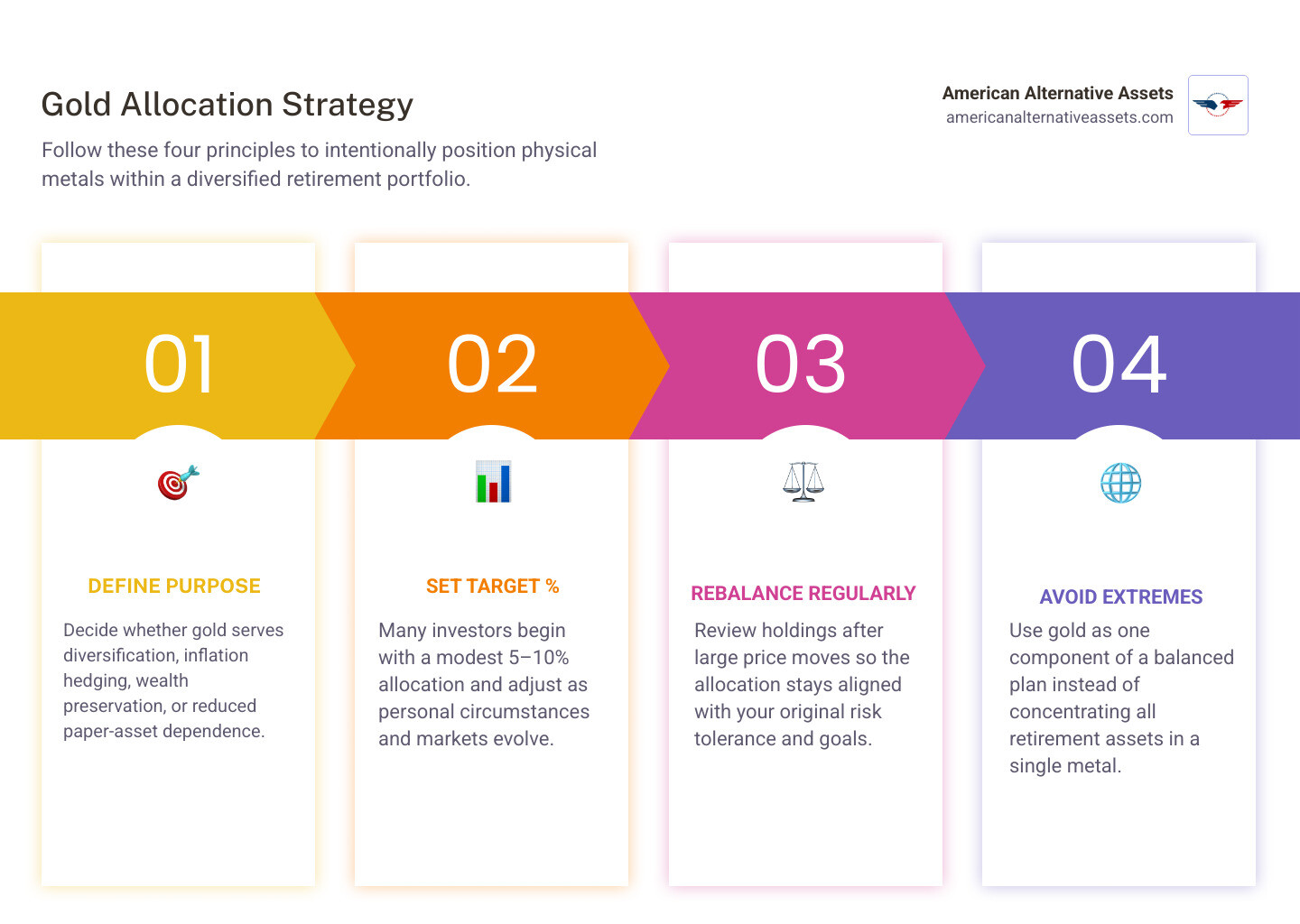
A prudent physical metals allocation approach may include:
Define the purpose of gold in your portfolio
- Is it for diversification?
- Inflation hedging?
- Long-term wealth preservation?
- Reducing dependence on paper assets?
Choose a target percentage
- Many investors start with a modest percentage.
- Revisit the allocation as markets and life circumstances change.
Rebalance periodically
- If gold rises sharply, it may become a larger share of your portfolio.
- If gold declines, your allocation may shrink.
- Rebalancing helps keep your plan aligned with your original goals.
Avoid all-or-nothing thinking
- Gold can be valuable without being your entire plan.
- Diversification means using physical gold, silver, and other approved precious metals thoughtfully, not betting the farm, the tractor, and the barn cat on one asset.
Gold has had impressive periods. It rose above $2,000 per ounce in 2020, remained above $2,000 into early 2024, and surged around 44% in 2025. But it has also had periods of underperformance. This is why we view physical Gold, Silver, and Precious Metals IRAs as part of a tangible retirement diversification strategy.
For more help thinking through allocation, read What Percentage of My Portfolio Should Be Allocated to Gold?.
Frequently Asked Questions about Buying Gold for IRA
Can I store my Gold IRA coins at home in a personal safe?
No. IRA-owned gold must be stored through an approved depository arrangement. Storing Gold IRA coins at home, in a personal safe, or in a safe-deposit box under your control can create serious tax consequences.
The IRS requires qualified custody for IRA assets. If you take personal possession of the metals before a valid distribution, the IRS may treat it as a distribution from the IRA. That may trigger ordinary income taxes, and if you are under age 59 1/2, a 10% early withdrawal penalty may also apply.
This rule is one of the biggest differences between buying gold personally and buying gold for an IRA. Personally owned gold can be stored however you choose. IRA-owned gold must follow IRA custody and storage rules.
What are the contribution limits for a Gold IRA in 2026?
For 2026, research sources indicate the annual IRA contribution limit is $7,500, with an additional $1,100 catch-up contribution for those age 50 and older.
A few important notes:
- These limits generally apply across your IRAs combined, not separately to each IRA.
- Your eligibility may depend on earned income and account type.
- Roth IRA contribution eligibility may be affected by income.
- SEP IRAs and employer plans follow different contribution rules.
- IRS limits can change, so always verify current rules before contributing.
A rollover or transfer from an existing retirement account is different from a new annual contribution. Rollovers and transfers are not counted the same way as annual contributions when completed properly.
Can I roll over an existing 401(k) into a physical Gold IRA?
Yes, many investors can roll over eligible 401(k) funds into a self-directed IRA that holds physical precious metals. Whether you can roll over your current 401(k) depends on the plan rules, your employment status, and the type of account involved.
A direct rollover is often the preferred structure because funds move from the employer plan to the new IRA custodian without you personally receiving the money. When handled correctly, this can help preserve the tax-deferred status of the funds.
Eligible source accounts may include:
- Traditional IRAs
- Roth IRAs
- SEP IRAs
- SIMPLE IRAs, subject to timing rules
- 401(k) plans
- 403(b) plans
- 457(b) plans
- Thrift Savings Plan accounts, when eligible
The process usually involves opening the self-directed IRA, requesting rollover paperwork, coordinating with the current plan administrator, and directing the new custodian to purchase approved physical gold, silver, and other precious metals once funds arrive.
For a broader overview, see our Precious Metals IRA Complete Guide and Heavy Metal Retirement: A Guide to Precious Metals IRAs.
Are paper-based gold assets the same as owning physical gold in an IRA?
No. Paper-based gold assets are not the same as owning physical gold in a Precious Metals IRA.
A paper gold product offers, at most, indirect exposure to gold prices, mining companies, or gold-related financial markets. It does not provide direct ownership of physical coins or bars. Paper products may involve counterparty exposure, fund structure risk, share pricing, management decisions, and market trading behavior that can separate the investment from the metal itself.
A physical Gold IRA focuses on IRS-approved bullion, coins, and bars held through a qualified custodian and stored in an approved depository. That distinction matters for investors who want tangible precious metals as part of their retirement diversification strategy.
At American Alternative Assets, our focus is physical precious metals, not paper substitutes. We believe physical ownership offers a more direct way to add gold and silver to a retirement strategy.
Conclusion
Learning how to buy gold for IRA accounts is really about understanding the rules, choosing the right support, and staying focused on your retirement goals.
A Gold IRA can help you hold physical precious metals inside a tax-advantaged retirement account. Gold, Silver, and broader Precious Metals IRAs may support diversification, provide a potential hedge during inflationary periods, and reduce total reliance on paper-based markets. But they must be done properly. That means using a self-directed IRA custodian, selecting IRS-approved physical metals, and storing those metals in an approved depository.
At American Alternative Assets, we specialize in helping clients navigate physical Precious Metals IRAs with clarity, discretion, and care. Our approach is built around white-glove service, trust, transparency, and ethical practices. We are based in Woodland Hills, California, and we work with clients who want real education before making important retirement decisions.
If you are ready to explore physical gold and silver for your retirement strategy, start here: Buy Gold and Silver.
This article is for informational purposes only and does not constitute financial advice. Please consult your financial advisor before making investment decisions.
Investing in precious metals involves risk. Past performance does not guarantee future results.