








What Is a Precious Metals IRA? (And Why It Matters for Your Retirement)
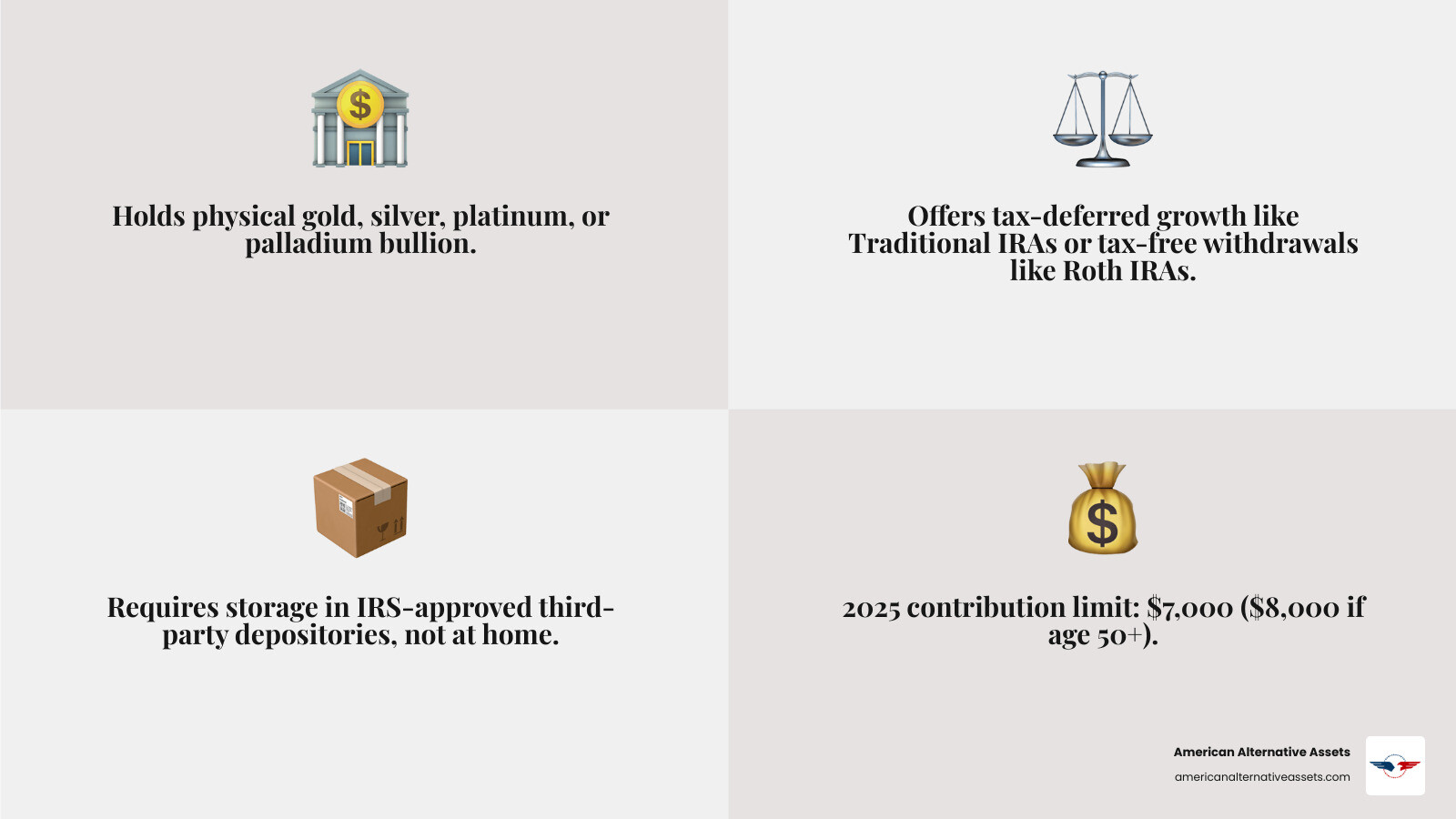
A precious metals IRA is a self-directed individual retirement account that lets you hold physical gold, silver, platinum, or palladium, giving you the same tax advantages as a traditional IRA but with tangible assets you can actually own.
Here is a quick overview of what you need to know:
| What You Want to Know | The Short Answer |
|---|---|
| What is it? | A self-directed IRA holding physical precious metals |
| Who can open one? | Anyone with earned income and an existing or new IRA |
| What metals qualify? | Gold, silver, platinum, and palladium meeting IRS purity standards |
| Where are metals stored? | In an IRS-approved third-party depository, not at home |
| Tax treatment | Same as traditional or Roth IRAs, depending on account type |
| 2025 contribution limit | $7,000 (under 50) or $8,000 (age 50 and older) |
Most retirement accounts are built entirely on paper. Stocks, bonds, mutual funds. They rise and fall with markets, sentiment, and decisions made by people you will never meet. For many investors, that feels like building a foundation on sand.
Physical precious metals work differently. Gold and silver have held value across thousands of years of economic disruption. They are not someone else’s promise. They are not a balance on a screen. They are real, tangible weight in your hands.
That is not a guarantee of future performance. But it is a meaningful distinction, especially when markets get unstable and paper assets lose value fast.
This guide is designed to walk you through everything, from how a precious metals IRA is structured to IRS rules, storage requirements, rollovers, and how to avoid costly mistakes.
I’m Shanon Davis, founder of American Alternative Assets, and my journey into physical precious metals started long before I understood what a precious metals IRA even was. After years in venture capital watching wealth evaporate on paper during the 2008 financial crisis, I built this company to help everyday Americans protect what they’ve earned with assets that don’t depend on anyone else’s promises.
This article is for informational purposes only and does not constitute financial advice. Please consult your financial advisor before making investment decisions. Investing in precious metals involves risk. Past performance does not guarantee future results.
Understanding the Mechanics of a Precious Metals IRA
To understand how a precious metals IRA works, we first have to talk about the “Self-Directed” IRA (SDIRA). While a standard IRA at a big bank usually limits you to stocks and bonds, an SDIRA opens the door to alternative assets.
The legal foundation for this was strengthened by the Taxpayer Relief Act of 1997, which expanded the types of precious metals allowed in retirement accounts. This act transformed the landscape, allowing investors to move away from purely digital wealth and toward tangible ownership of physical bullion.
When you invest through a precious metals IRA, you aren’t just buying a “gold fund.” You are purchasing specific, physical bars or coins. These assets provide a layer of asset protection because they are physical property held in your name within the tax-advantaged shell of the IRA.
The Role of a Directed Custodian
In a standard retirement account, the bank or brokerage acts as the custodian. For a precious metals IRA, you need a specialized “directed custodian.”
A directed custodian provides passive oversight. They don’t pick your investments or offer financial advice. Instead, they handle the administrative heavy lifting, such as reporting to the IRS, managing the movement of funds, and ensuring your account stays compliant with federal law.
Companies like NDTCO (New Direction Trust Company) perform these duties by holding the assets in custody for your benefit. It is vital to understand that the custodian’s role is administrative. As noted in their Custodial Agreement and Account Disclosures, they do not perform due diligence on the dealers or the specific metals you choose. You are the driver; they are the pit crew making sure the car stays street-legal in the eyes of the IRS.
IRS Compliance: Purity Standards and Approved Products
The IRS is quite particular about what can go into your “treasure chest.” You cannot simply buy any gold coin you find at a garage sale and put it in your IRA. To qualify, metals must meet strict fineness requirements.
According to the Individual Retirement Arrangements (IRAs) Guidelines, the purity standards are:
- Gold: Minimum purity of .995 (99.5% pure).
- Silver: Minimum purity of .999 (99.9% pure).
- Platinum: Minimum purity of .9995 (99.95% pure).
- Palladium: Minimum purity of .9995 (99.95% pure).
There is one notable exception to these rules: the American Gold Eagle. Even though it is 22-karat (.9167 pure), the IRS specifically allows it in a precious metals IRA because it is a legal tender coin of the United States.
Approved Coins and Bars
Beyond purity, the products must be produced by a national government mint or an accredited refiner. This ensures the weight and purity are verified.
Commonly approved coins include the Canadian Maple Leaf, the Australian Kangaroo, and the Austrian Philharmonic. If you prefer bars, they must come from COMEX-approved refiners or manufacturers with ISO 9001 certification to ensure quality control.
Items that are generally not allowed include collectible or “numismatic” coins, such as pre-1933 gold coins or certain proof sets that carry high premiums based on rarity rather than metal content. The IRS wants your IRA to be based on the actual value of the metal, not its “cool factor” as a collectible.
Funding and Managing Your Account
Setting up your account is a straightforward process, but how you fund it matters for your taxes. There are three primary ways to get money into your precious metals IRA:
- Direct Transfer: This is a custodian-to-custodian move. If you have an existing IRA, the funds move directly from your current bank to your new precious metals custodian. This is usually the cleanest method because the money never touches your personal bank account, meaning there are no tax triggers.
- Indirect Rollover: You receive a check from your old retirement plan and must deposit it into the new IRA within 60 days. We generally caution against this because if you miss that 60-day window, the IRS treats the whole amount as a taxable distribution, which could come with a 10% penalty if you are under age 59.5.
- Annual Cash Contributions: You can simply fund the account with new cash, provided you have earned income for that year.
Contribution Limits for a Precious Metals IRA
The IRS sets limits on how much new money you can put into an IRA each year. These limits apply across all your IRAs combined.
- For 2025: The limit is $7,000. If you are age 50 or older, you can make a “catch-up” contribution of an additional $1,000, bringing your total to $8,000.
- For 2026: The limit increases slightly to $7,500 for those under 50, and $8,600 for those 50 and older.
To contribute, you must have “earned income,” which generally means wages, salaries, or self-employment income.
Rolling Over a 401k into a Precious Metals IRA
If you have a 401k, 403b, or TSP (Thrift Savings Plan) from a previous employer, you can often roll those funds into a precious metals IRA. This is a popular strategy for people who want to move their retirement savings out of the stock market and into physical assets without paying immediate taxes.
The most efficient way to do this is through a direct custodian-to-custodian transfer. This ensures the movement of wealth is tax-free and penalty-free. Once the funds arrive at your new custodian, you can then direct them to purchase the gold or silver products of your choice.
Physical Security: Storage and Custodianship
One of the most important rules of a precious metals IRA is that you cannot hold the metals yourself. Federal law requires that the assets be held by a qualified third party.
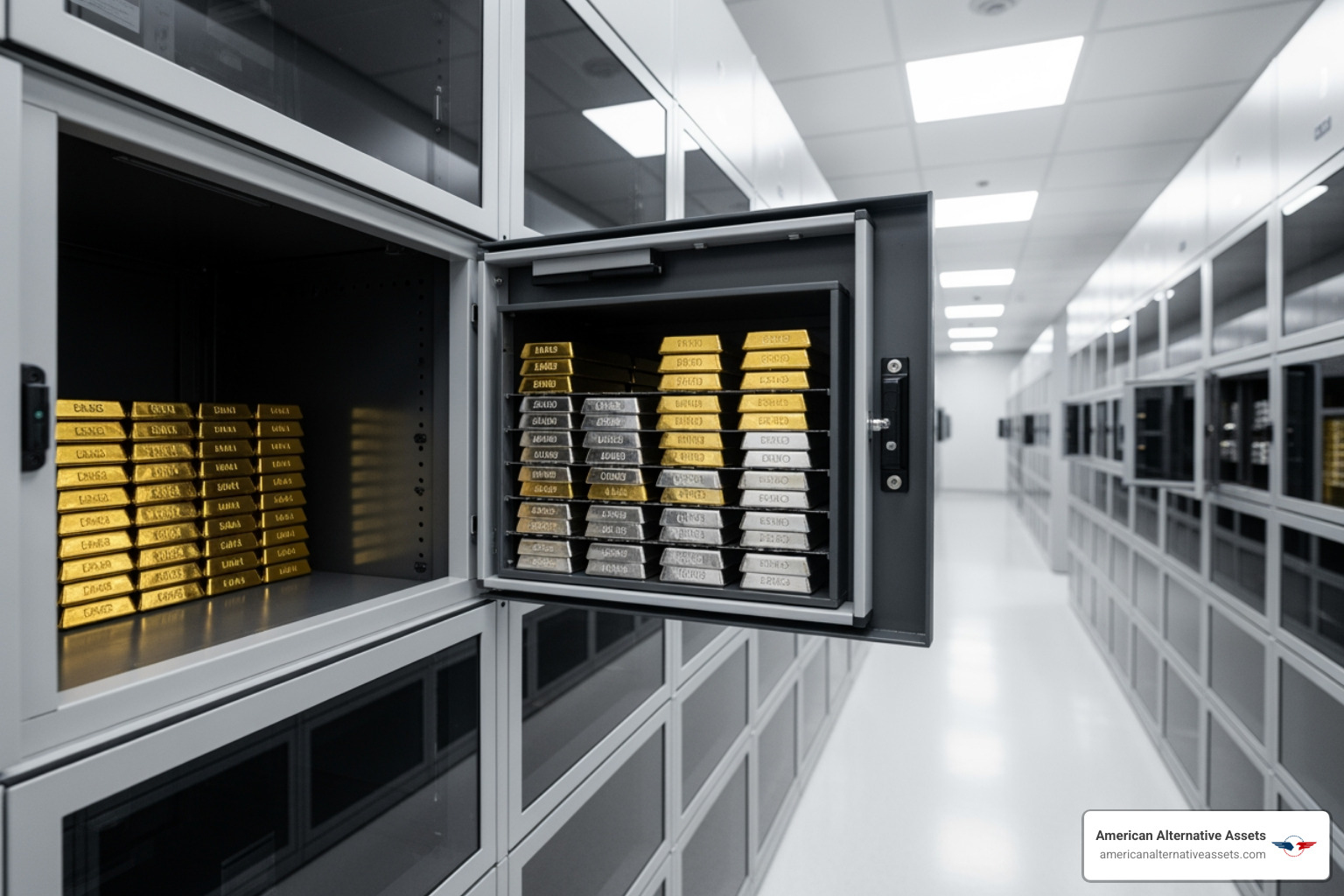
These metals are stored in IRS-approved depositories. These are high-security facilities, similar to Fort Knox, equipped with 24/7 monitoring, armed guards, and advanced motion sensors. Reputable names in this space include Brink’s Global Services and the Delaware Depository.
When you store your metals, you usually have two choices:
- Segregated Storage: Your metals are kept in a separate, individual lockbox or area. You get back the exact same bars or coins you put in.
- Commingled (or Non-Segregated) Storage: Your metals are stored with the same types of metals owned by other investors. While you still own the same amount of metal, you might receive different (but identical) coins or bars upon withdrawal.
The SEC Investor Alert on Precious Metals emphasizes that choosing a reputable depository and custodian is essential for your due diligence.
Why Home Storage is Prohibited
We often hear the question: “Can’t I just keep the gold in a safe at home?” The short answer is no.
According to IRS Publication 590, IRA assets must be held by a trustee or custodian. If you take physical possession of the metals, the IRS views it as a “taxable distribution.” This means you would owe income tax on the total value of the metals, and if you are under 59.5, you’d likely get hit with a 10% early withdrawal penalty.
While some companies promote “Home Storage IRAs” using complex LLC structures, the IRS has signaled that these are highly risky and could lead to the disqualification of your entire account. For true wealth protection, professional third-party storage is the only compliant path.
Physical Metals vs. Paper Assets
When people think about investing in gold, they often look at Gold ETFs (Exchange-Traded Funds) or mining stocks. While these are common, they lack the inherent security of a physical precious metals IRA.
| Feature | Physical Bullion (IRA) | Precious Metals ETF |
|---|---|---|
| Ownership | You own the specific, physical metal | You own a share in a fund that tracks the price |
| Counterparty Risk | None; the metal is yours | High; depends on the fund manager and brokers |
| Tangibility | Real asset you can hold | Paper/Digital asset |
| Security | Stored in a secure vault | Subject to market and systemic risks |
| Liquidity | High (can be sold or taken in-kind) | Subject to market volatility and rapid price swings |
The main drawback of paper assets is “counterparty risk.” If the company managing the ETF or the bank holding the paper fails, your investment could be at risk. Physical bullion in a precious metals IRA eliminates this. It is a tangible security that acts as a long-term preservation tool and a hedge against the inflation that often eats away at the value of paper currency.
Withdrawals, Distributions, and Tax Advantages
A precious metals IRA offers the same tax-deferred growth as a traditional IRA. This means you don’t pay taxes on the appreciation of your gold or silver while it stays in the account. If you choose a Roth version, your qualified distributions in retirement could even be tax-free.
When it comes time to take a distribution, you have two choices:
- Cash Liquidation: You ask the custodian to sell your metals and send you the cash.
- In-Kind Distribution: You have the actual physical gold or silver shipped directly to your home.
Either way, the value of the distribution is reported to the IRS and taxed based on your account type (Traditional or Roth).
Required Minimum Distributions (RMDs)
Under the SECURE 2.0 Act, if you have a Traditional precious metals IRA, you must begin taking Required Minimum Distributions (RMDs) starting at age 73.
Since your IRA holds physical assets, you need to plan for liquidity. You can either sell a portion of your metals to cover the RMD amount in cash or take the physical metal as an in-kind distribution. It is important to work with your custodian to get an updated valuation of your metals each year to ensure your RMD calculations are accurate.
Frequently Asked Questions about Precious Metals IRAs
Can I store my IRA metals at home?
No. As we discussed, storing IRA-owned metals at home is considered a prohibited transaction by the IRS. It can result in the immediate taxation of your entire account and heavy penalties. All metals must be held in an IRS-approved depository.
What happens to my 401k during a rollover?
During a rollover, your 401k funds are moved into your new precious metals IRA. If you do a direct transfer, the process is tax-free. Your old 401k provider sends the funds to your new custodian, and you then use those funds to purchase physical gold or silver. You do not lose the tax-advantaged status of your savings.
Which metals are best for retirement diversification?
Gold is the most popular choice because of its historical role as a “safe haven” and its relatively low volatility compared to other metals. Silver is also a common choice, often favored for its industrial demand and lower price point. Platinum and palladium are rarer and can be more volatile, but they offer additional diversification. Most advisors recommend a mix that fits your personal risk tolerance.
Conclusion
At American Alternative Assets, we believe that retirement planning should be about more than just numbers on a screen. It should be about peace of mind. Our white-glove, relationship-first approach is designed to help you navigate the complexities of a precious metals IRA with total transparency.
We pride ourselves on ethical practices and a commitment to helping our clients achieve real privacy and protection for their hard-earned wealth. Whether you are looking to diversify a portion of your portfolio or protect your entire nest egg from the volatility of paper markets, we are here to provide the guidance you need.
Secure your future with a Precious Metals IRA
This article is for informational purposes only and does not constitute financial advice. Please consult your financial advisor before making investment decisions. Investing in precious metals involves risk. Past performance does not guarantee future results.