







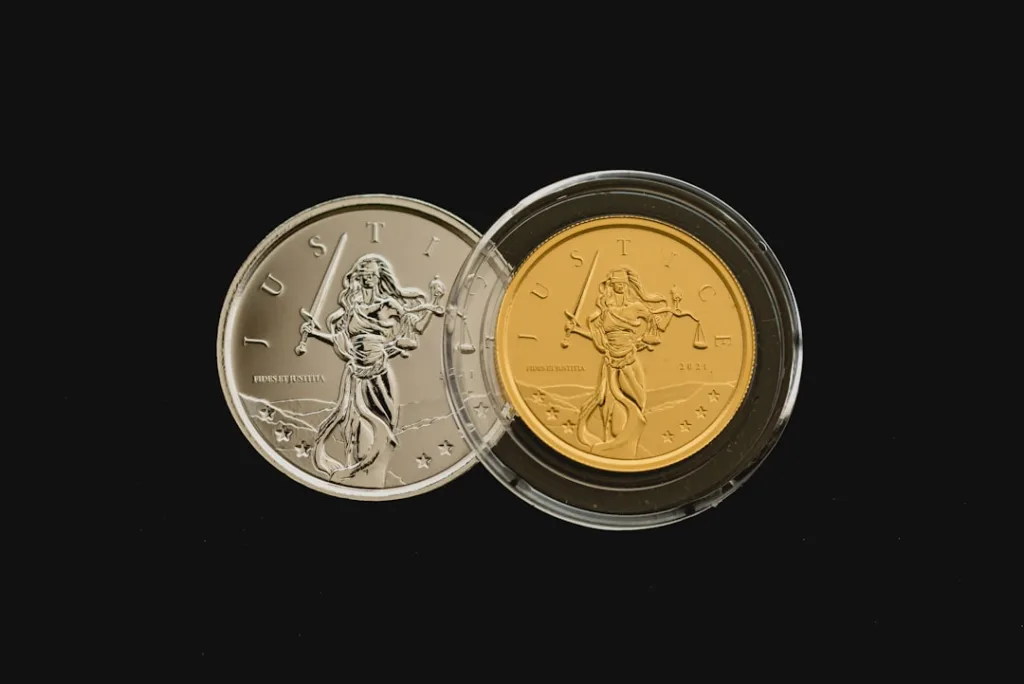
Why Millions of Investors Are Turning to Gold and Silver in 2026
Learning how to invest into gold and silver is one of the most practical steps you can take to protect your wealth from inflation, currency debasement, and market volatility. Here is a quick overview of your main options:
The primary ways to invest in gold and silver:
- Physical bullion (coins and bars), held directly or stored in a professional vault
- Precious Metals IRA, a self-directed retirement account holding IRS-approved physical metals
- ETFs and mining stocks, which offer price exposure but no actual metal ownership (paper assets with counterparty risk)
For investors focused on true wealth protection, physical ownership, either directly or inside a Precious Metals IRA, is the approach that eliminates reliance on third-party financial institutions.
Gold prices rose 65% in 2025, the strongest annual gain since 1979. Silver climbed 190% per ounce since the start of 2024. Central banks around the world have been buying gold at record pace, purchasing over 1,000 tonnes annually since 2022, compared to an average of 473 tonnes per year in the prior decade.
These are not short-term trends. They reflect something deeper: a growing loss of confidence in fiat currencies and traditional financial systems.
A dollar from 1971 now buys roughly 12 cents of what it bought then. That is an 87% loss in purchasing power over 55 years. Gold in 1971 was fixed at $35 an ounce. Today, that same ounce is worth approximately 125 to 130 times more in dollar terms.
Physical gold and silver have preserved purchasing power across centuries. Paper money has not.
This guide walks you through everything you need to know, from the differences between gold and silver, to physical bullion options, to how a Precious Metals IRA works, to storage, costs, and smart allocation strategies.
I’m Shanon Davis, founder of American Alternative Assets. My background in venture capital, combined with the lessons of the 2008 financial crisis, showed me why learning how to invest into gold and silver is one of the most important financial decisions a person can make. I built this company to give ordinary Americans a clear, trustworthy path to holding real, tangible wealth outside a fragile financial system.
Gold vs. Silver: Key Differences for Your Portfolio
When deciding how to allocate your hard-earned savings, it is essential to understand that gold and silver behave differently within a portfolio. While both are historical monetary metals, they have unique economic drivers.
Silver demand is heavily driven by industrial applications, whereas gold is primarily driven by monetary demand, central bank accumulation, and wealth preservation. This fundamental difference affects their price volatility, liquidity, and overall role in your financial strategy.
To make an informed choice, we must look at how these metals trade relative to one another. Investors often use the gold-to-silver ratio, which measures how many ounces of silver it takes to purchase a single ounce of gold, to determine which metal may be undervalued at any given time. For a deeper dive into choosing between these two metals, you can read our guide on Which Precious Metal Wins the Gold Medal for Your Portfolio.
To understand how these differences shape your investment journey, let us examine the core characteristics of each metal. For a broader institutional perspective on this decision, you can also explore the Gold vs Silver: 4 Key Differences You Should Know guide.
Understanding Gold as a Safe-Haven Asset
Gold is the ultimate global safe-haven asset. It has no counterparty risk, cannot be printed by decree, and is not dependent on any government or corporation to maintain its value.
In recent years, we have seen massive structural shifts in the global financial landscape. Central banks have roughly doubled their gold purchases since 2022, acquiring over 1,000 tons annually. This represents about 20% of global gold demand. Central banks are choosing physical gold to diversify away from fiat currencies and protect their national reserves.
For individual investors, gold serves the exact same purpose. It acts as a shield against currency debasement and systemic banking risks. To understand the foundational mechanics of gold ownership, take a look at The Ins and Outs of Investing in Gold.
Understanding Silver as an Industrial and Monetary Metal
Silver is a unique double-agent. It is a recognized monetary metal, but it is also an irreplaceable industrial commodity.
Industrial fabrication accounted for 680.5 million ounces of silver demand in 2024, representing approximately 59% of the total global silver demand of 1.16 billion ounces. Silver is the most electrically and thermally conductive metal on earth, making it indispensable for modern technology.
A major catalyst for silver is green energy. Solar photovoltaic manufacturing alone consumed roughly 232 million ounces of silver in 2024, a massive surge from the 94 million ounces consumed in 2020.
Because of this intense industrial demand, the silver market has run a structural supply deficit for five consecutive years (2021 to 2025), and 2026 is projected to extend this streak. However, because silver is a much smaller financial market than gold, its price volatility can be two to three times greater than that of gold on any given day. To explore whether this high-upside metal belongs in your portfolio, check out our analysis on Is Silver a Good Investment.
How to Invest into Gold and Silver: Physical vs. Paper Assets
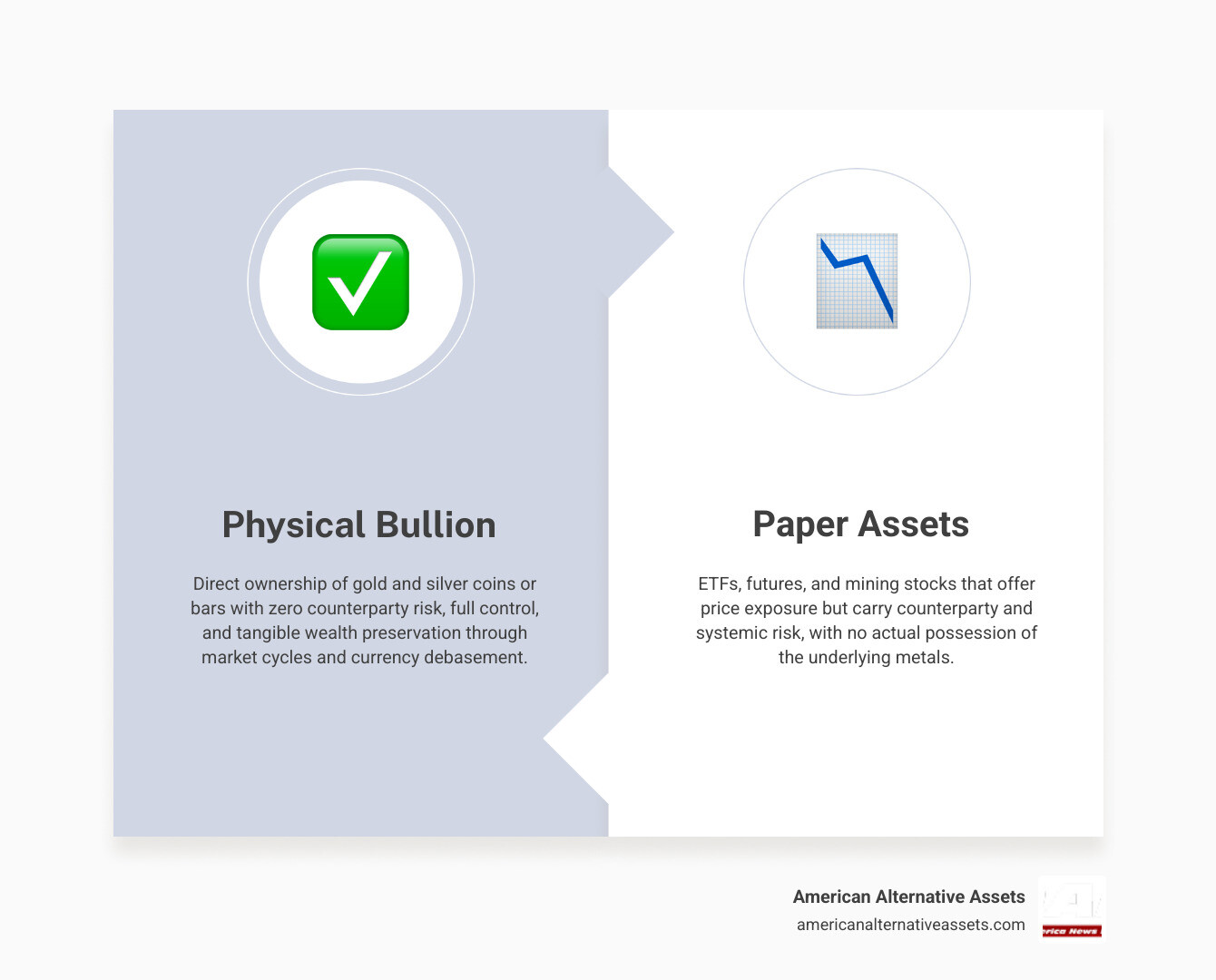
As you research how to invest into gold and silver, you will quickly find two paths: physical assets (real coins and bars you can hold) and paper assets (financial instruments that track the price).
We firmly believe that direct physical ownership is the only way to achieve true financial protection. When you own physical metals, you have an asset with zero counterparty risk. Paper precious metals, on the other hand, expose you to the very financial system you may be trying to hedge against.
| Feature | Physical Precious Metals (Coins & Bars) | Paper Assets (ETFs, Mining Stocks, Futures) |
|---|---|---|
| Direct Ownership | Yes, you own the actual physical metal. | No, you own shares or contractual agreements. |
| Counterparty Risk | None. The value is inherent to the metal. | High. Dependent on fund managers, brokers, and banks. |
| Systemic Risk Protection | High. Remains valuable even during banking crises. | Low. Can be frozen, liquidated, or heavily diluted. |
| Tangibility | Real, physical wealth outside the digital banking system. | Purely digital entries on a ledger. |
| Operational Fees | Standard vault storage and one-time premiums. | Ongoing management fees and trading commissions. |
The Risks of Paper Gold and Silver (ETFs, Mining Stocks, and Futures)
Many financial institutions steer investors toward exchange-traded funds (ETFs) or mining stocks because they are easy to trade. However, these paper vehicles carry significant hidden risks and are highly disadvantageous compared to physical ownership.
When you buy a gold or silver ETF, you do not own the metal. You own shares in a trust that tracks the price. You cannot demand delivery of your gold or silver unless you are an institutional investor holding massive blocks of shares. Furthermore, these funds charge ongoing management fees that slowly erode your principal over time.
Mining stocks introduce even more risk. While gold mining stocks have historically moved at about twice the rate of change of the price of gold bullion (due to operational leverage), they also bring management risk, labor disputes, high-debt balance sheets, and geopolitical risks in the countries where they operate. For example, during market crashes, mining stocks often drop alongside the broader stock market, even if physical gold is rising, because they are equities first. To understand the structural differences between these vehicles, read Investing in Gold and Silver: A Comprehensive Guide.
A Beginner’s Guide on How to Invest into Gold and Silver with Physical Bullion
For those who want true peace of mind, physical bullion is the gold standard. It is tangible, private, and has survived every financial crisis in human history.
When buying physical bullion, beginners should focus on highly liquid, widely recognized products:
- Sovereign Coins: Minted by government mints (such as the American Gold Eagle or Canadian Maple Leaf), these coins have legal tender status, guaranteed purity, and excellent liquidity.
- Bullion Bars: Produced by accredited private refiners, bars typically carry lower premiums than coins, making them highly efficient for acquiring larger quantities of metal.
- Private Mint Rounds: These are silver or gold pieces minted by private refineries that look like coins but do not carry legal tender face values. They offer a cost-effective way to accumulate physical metal.
By focusing on physical bullion, you eliminate the risks of institutional failures and market closures. To learn more about starting your physical portfolio, read our guide on Investing Physical Gold.
Retirement Wealth Protection: Precious Metals IRAs
Many retirement savers do not realize they can hold physical gold and silver inside a tax-advantaged account. A Self-Directed IRA (SDIRA), often referred to as a Precious Metals IRA, allows you to diversify your retirement savings away from standard paper assets while maintaining the exact same tax benefits as a traditional or Roth IRA.
This is a powerful tool for long-term wealth preservation. Instead of watching your retirement balance fluctuate based on the volatile stock market, you can anchor a portion of your savings in tangible, physical assets. For a full breakdown of how this works, take a look at our Precious Metals IRA Complete Guide.

How to Invest into Gold and Silver Through a Self-Directed IRA
Setting up a Precious Metals IRA is a straightforward process when you work with a dedicated, white-glove partner like American Alternative Assets. We walk you through every step of the process:
- Establish a Self-Directed IRA: We help you set up an account with an IRS-approved custodian who specializes in alternative assets.
- Fund the Account: You can fund your new IRA via a tax-free rollover or transfer from an existing 401(k), 403(b), traditional IRA, or Roth IRA. This process does not trigger any tax penalties.
- Select Your Metals: You choose which IRS-approved gold and silver coins or bars you want to add to your account.
- Secure Storage: The physical metals are shipped securely directly to an IRS-approved, third-party depository vault, where they are held safely in your name.
To learn more about the mechanics of this process, read our detailed guide on How Does a Gold IRA Work.
IRS Rules and Approved Purity Standards for Precious Metals
The IRS has strict rules regarding the physical metals allowed inside an IRA. You cannot simply buy any gold or silver coin and place it in your retirement account. To qualify for a Precious Metals IRA, the metals must meet specific purity standards:
- Gold Purity: Must be at least .995 fine (99.5% pure). The only exception is the American Gold Eagle coin, which is approved for IRAs despite being .9167 fine.
- Silver Purity: Must be at least .999 fine (99.9% pure).
Additionally, the physical metals must be held by an approved custodian and stored in an IRS-sanctioned depository. Attempting to store IRA-owned metals at home can result in severe tax penalties and immediate disqualification of the account. To see which metals qualify, read The Complete Guide to Best Metals for IRA.
Storage, Security, and Costs of Physical Metals
One of the most important aspects of physical ownership is planning where and how your metals will be stored. Because physical gold and silver are highly valuable, tangible assets, ensuring their security is paramount to your peace of mind. For a comprehensive overview of physical bullion logistics, explore Investing in Bullion: A Comprehensive Guide.
Home Storage vs. Professional Vault Storage
New investors often debate whether to store their metals at home or in a professional vault.
While keeping a small amount of gold or silver in a high-quality home safe can be useful for emergencies, storing larger amounts at home carries significant risks. Standard homeowners insurance policies rarely cover precious metals unless you purchase expensive riders. Furthermore, home storage can make you a target for theft.
Bank safe-deposit boxes are another option, but they have major limitations. Banks do not insure the contents of safe-deposit boxes, and during a systemic banking crisis or holiday, you may not be able to access your box.
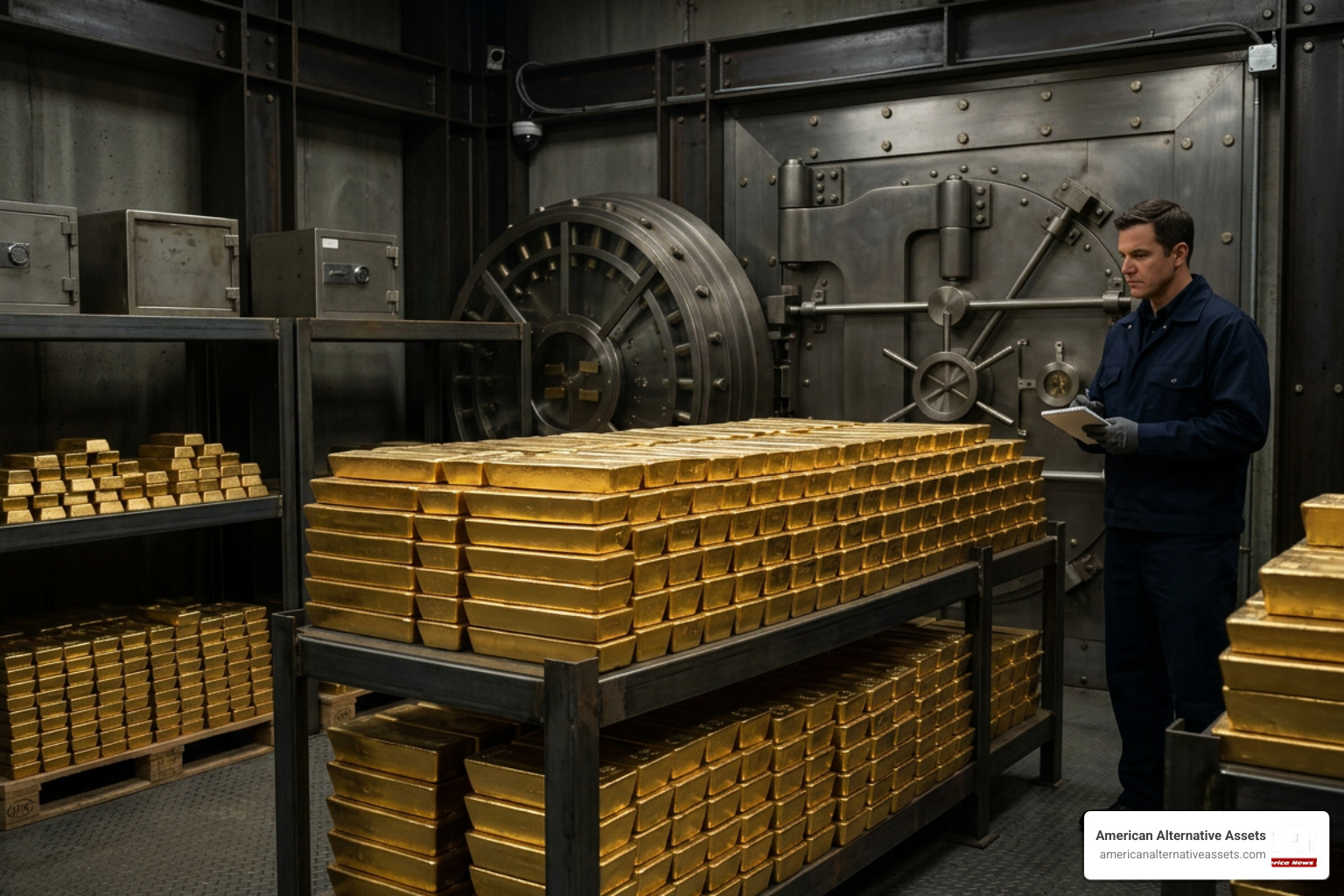
For significant holdings, we strongly recommend professional, IRS-approved depository vaults. These facilities offer:
- Class 3 Security: State-of-the-art security systems, armed guards, and multi-layered access controls.
- All-Risk Insurance: Your metals are fully insured against theft, physical loss, or damage.
- Allocated and Segregated Storage: Your metals are held in your name, off the depository’s balance sheet, meaning you are never treated as an unsecured creditor.
Understanding Premiums, Shipping, and Insurance Fees
When buying physical metals, you will encounter costs beyond the raw market price (known as the spot price):
- The Spot Price: The current global market price for one troy ounce of raw, unrefined metal, set continuously on global exchanges.
- Dealer Premiums: The amount charged over the spot price to cover the costs of refining, minting, shipping, insurance, and the dealer’s operational costs. Sovereign coins typically carry higher premiums than plain bullion bars due to their official minting process.
- Shipping and Vaulting Fees: When storing in a professional depository, you will pay a secure shipping fee and an annual storage fee, which typically includes full insurance coverage.
Portfolio Allocation and Valuation Strategies
Adding precious metals to your financial strategy requires a structured approach. Rather than treating gold and silver as speculative trades, they should be viewed as long-term wealth insurance. To build a resilient portfolio, check out our Precious Metals Investment Guide 2026.
Determining Your Precious Metals Allocation Percentage
How much of your portfolio should be in gold and silver? While there is no single answer for everyone, many conservative financial professionals suggest an allocation of 5% to 15% of your total investable assets to physical precious metals.
This range is widely seen as an effective sweet spot. It provides enough weight to offset losses in the stock or bond markets during a severe downturn, without over-concentrating your wealth in non-yielding assets. Your ideal percentage depends on your personal risk tolerance, retirement timeline, and overall financial goals.
Using the Gold-to-Silver Ratio and Dollar-Cost Averaging
Two classic strategies can help you optimize your physical precious metals purchases over time:
- The Gold-to-Silver Ratio: Historically, this ratio has fluctuated widely. When the ratio is exceptionally high, it suggests that silver is undervalued relative to gold, making it an opportune time to acquire silver. When the ratio contracts, gold may be the more attractive buy.
- Dollar-Cost Averaging (DCA): Rather than trying to time the absolute bottom of the market, you can invest a fixed dollar amount into physical metals on a regular schedule (monthly or quarterly). This strategy helps smooth out price volatility, ensuring you buy more ounces when prices are low and fewer when prices are high.
Frequently Asked Questions about Precious Metals Investing
To help you navigate your options, we have compiled answers to some of the most common questions we receive from investors. For a deeper look at common misconceptions, explore Precious Metals IRA Myths Debunked.
Is physical gold a better investment than a gold ETF?
Yes, for investors seeking true wealth protection and a hedge against systemic financial risk, physical gold is structurally superior to an ETF. When you own physical gold, you have a tangible asset with zero counterparty risk and direct ownership.
With an ETF, you own paper shares in a financial trust, meaning you are exposed to broker failures, fund management risks, and market closures. ETFs offer price exposure, but they do not offer the safety of physical possession.
Can I store my Gold IRA metals at home?
No. The IRS strictly prohibits storing IRA-owned precious metals at home. All physical gold and silver held within an IRA must be stored in an IRS-approved, secure depository vault. Attempting to take physical possession of your IRA metals at home is treated as an unapproved distribution, which can trigger immediate taxes and heavy penalties.
What is the best way for beginners to start buying gold and silver?
For beginners, the most practical approach is to start with highly recognizable, sovereign-minted bullion coins like the American Gold Eagle or Canadian Silver Maple Leaf. These coins are easy to verify, highly liquid, and widely accepted by dealers worldwide.
Starting with a small, manageable purchase from a trusted, reputable dealer allows you to get comfortable with the process before scaling your position.
Conclusion
Learning how to invest into gold and silver is one of the most proactive steps you can take to insulate your wealth from a volatile global economy. By choosing physical ownership over paper substitutes, you remove your hard-earned savings from a fragile financial system and place them into tangible assets that have preserved purchasing power for thousands of years.
At American Alternative Assets, based in Woodland Hills, California, we are dedicated to helping you secure your financial future. Our white-glove, relationship-first service is built on trust, transparency, and ethical practices. We do not believe in high-pressure sales. Instead, we focus on educating our clients and providing real privacy and protection for their wealth.
Whether you are looking to set up a secure Precious Metals IRA or acquire physical bullion for direct ownership, we are here to guide you every step of the way.
If you are ready to take control of your financial future, explore our comprehensive guide, A Practical Guide to How to Invest in Gold and Silver, or contact our team of specialists today to discuss your wealth protection goals.
Disclaimer: This article is for informational purposes only and does not constitute financial advice. Please consult your financial advisor before making investment decisions. Investing in precious metals involves risk. Past performance does not guarantee future results.