







Why Choosing the Right Metals for Your IRA Can Make or Break Your Retirement Strategy
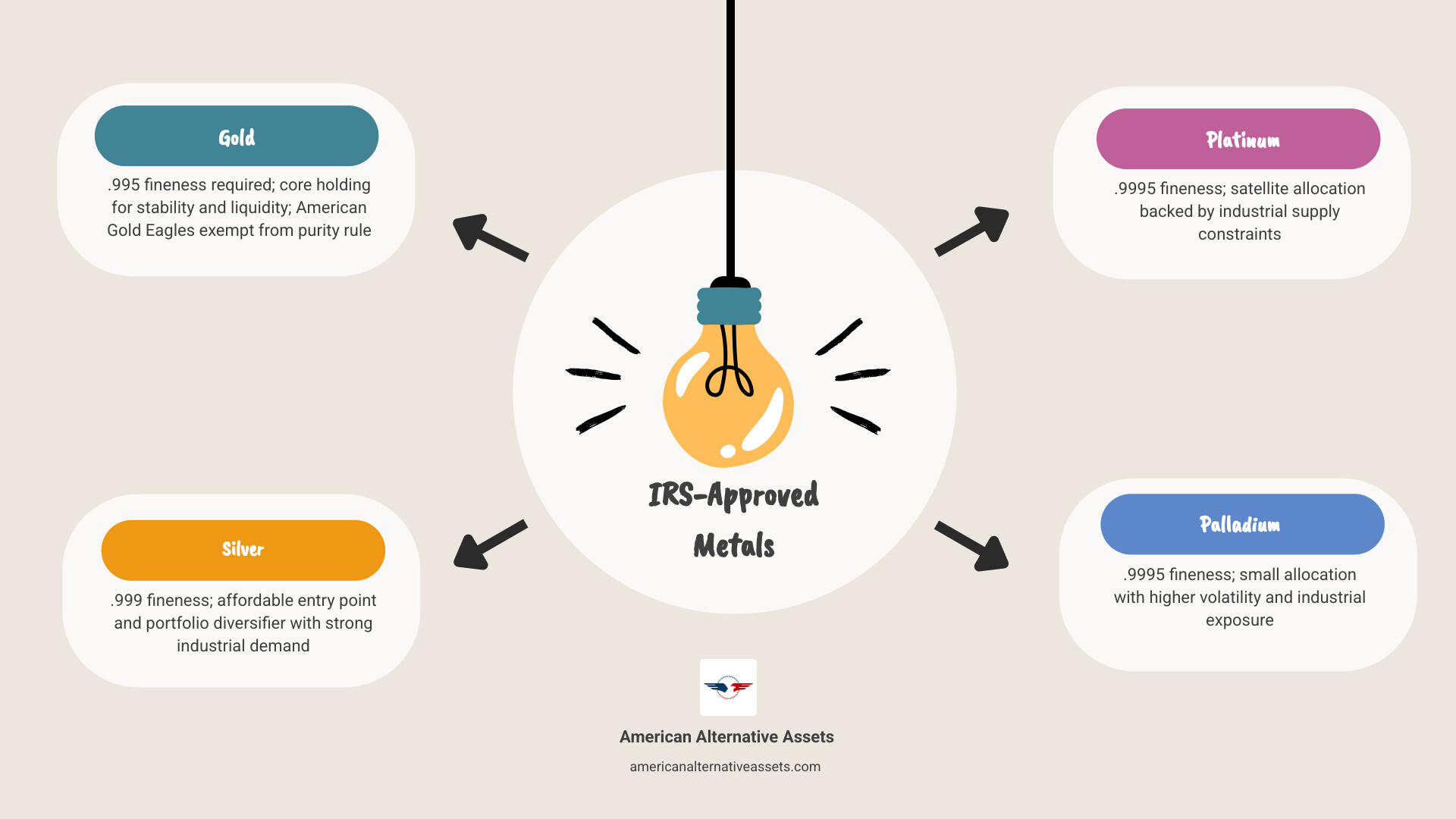
The best metals for IRA investing are gold, silver, platinum, and palladium, but not all of them are equal, and the IRS has strict rules about which products actually qualify.
Here is a quick answer to get you started:
| Metal | IRS Purity Requirement | Role in a Metals IRA |
|---|---|---|
| Gold | .995 fineness (American Gold Eagle exempt) | Core holding, most widely used |
| Silver | .999 fineness | Diversifier, affordable entry point |
| Platinum | .9995 fineness | Satellite position, industrial demand |
| Palladium | .9995 fineness | Small allocation, higher volatility |
Only physical bullion coins and bars that meet these purity standards are permitted. Collectible coins, jewelry, and home-stored metals do not qualify.
For many retirement savers, the idea of holding real, tangible assets inside a tax-advantaged account is appealing, especially when paper markets feel unstable. A precious metals IRA, also called a self-directed IRA, lets you do exactly that. But the rules around which metals qualify, how they must be stored, and how to set everything up can feel overwhelming at first.
This guide breaks all of it down clearly, so you can make an informed decision about whether physical precious metals belong in your retirement plan.
I’m Shanon Davis, founder of American Alternative Assets. My background spans venture capital and over a decade of helping everyday Americans understand how to hold real, lasting value through physical precious metals IRAs, because finding the best metals for IRA investing is exactly the kind of decision that deserves clear education.
This article is for informational purposes only and does not constitute financial advice. Please consult your financial advisor before making investment decisions. Investing in precious metals involves risk. Past performance does not guarantee future results.
Best Metals for IRA: What Qualifies and What Works Best
The IRS allows only four precious metals in a self-directed IRA: gold, silver, platinum, and palladium. Each must meet minimum purity standards, and the metal has to be held as approved bullion coins or bars through a qualified custodian and approved depository.
That last part matters. In a metals IRA, we are talking about physical ownership, not a paper promise tied to metal prices.
In practical terms, the best choice usually comes down to three questions:
- Is the metal IRS-approved?
- Does it fit your risk tolerance and time horizon?
- Is the product a standard bullion coin or bar with strong liquidity?
If you want a broader foundation before choosing products, our guide to precious metals IRAs is a helpful next read.
Why gold is often the foundation of the best metals for IRA
Gold is usually the starting point because it has the longest track record as a store of value and safe-haven asset. It is also the most recognized precious metal globally, which helps with liquidity and pricing transparency.
Recent market history helps explain why retirement investors still look to gold. Research shows gold surged 64% during a period marked by recession concerns and geopolitical conflict, while stocks and bonds had very different outcomes. Gold also moved above $2,000 per ounce in 2020 and remained above that level into 2024, showing how strongly it can react when uncertainty rises.
Gold’s strengths in an IRA include:
- Broad recognition and demand
- Deep global liquidity
- Lower volatility than silver, platinum, or palladium
- A long history as a diversification tool
- Strong fit as a core metals holding
For IRA eligibility, gold generally must be at least .995 fine. The famous exception is the American Gold Eagle, which is specifically allowed by law even though it is .9167 fine.
Common IRA-eligible gold products include:
- American Gold Eagle
- American Gold Buffalo
- Canadian Gold Maple Leaf
- Austrian Gold Philharmonic
- Australian Gold Kangaroo
- Certain gold bars from accredited refiners

Why silver belongs in the best metals for IRA conversation
Silver often gets treated like gold’s energetic younger cousin. It can be more volatile, but that is exactly why many investors include it.
Silver brings two things gold does not bring in the same way:
- Lower cost per ounce, which can make position building easier
- Strong industrial demand, which can create different price drivers
That mix can make silver a valuable complement inside a metals IRA. Research also points to periods when silver outperformed gold after the gold-silver ratio became unusually stretched. In plain English, when silver gets very cheap relative to gold, some investors see a potential rebalancing opportunity.
Silver in an IRA can make sense for those who want:
- More ounces for the same dollar amount
- Added diversification beyond gold
- Exposure to both monetary and industrial demand
- A more active rebalancing opportunity over time
Silver must be at least .999 fine to qualify. IRA-eligible products commonly include American Silver Eagles and certain bars and rounds that meet IRS standards.
For a deeper silver-focused breakdown, visit our Silver IRA account guide.
When platinum and palladium can make sense
Platinum and palladium are allowed in IRAs, but they are usually smaller positions rather than the foundation.
Why? Because they are more heavily tied to industrial use and often have sharper price cycles. That can create upside, but also more volatility.
Platinum can appeal to investors who want:
- Additional diversification
- Exposure to supply constraints
- A metal that has, at times, traded at a discount to gold
Palladium can appeal to investors who understand:
- Its market is narrower
- Its price swings can be more dramatic
- It works better as a small satellite position than a core retirement holding
Both metals must be .9995 fine to qualify. For many retirement savers, they make sense only after a core gold or gold-and-silver allocation is already in place.
IRS-approved coins and bars to look for
Not every shiny coin belongs in an IRA. That is where many beginners get tripped up.
Generally, you want standard bullion products, not collectibles. The IRS permits certain coins and bars that meet purity standards and come from approved mints or accredited refiners.
Common examples include:
- American Gold Eagle
- American Gold Buffalo
- Canadian Maple Leaf
- Austrian Philharmonic
- Australian Kangaroo
- British Britannia, for qualifying years and purity
- Approved bullion bars from recognized refiners
What usually does not qualify:
- Most collectible or numismatic coins
- Rare coins sold mainly for story value
- Jewelry
- Metals stored at home
If you want a product-by-product reference, see The Definitive List IRA Approved Silver Coins Bars and Bullion.
How a Gold IRA Works, Benefits, Risks, and Why Physical Metals Matter
A Gold IRA is a type of self-directed IRA that allows physical precious metals inside a retirement account. It can be structured as a Traditional IRA, Roth IRA, or SEP IRA, depending on your situation.
The account works like this:
- You open a self-directed IRA with a custodian that handles precious metals.
- You fund it through a transfer, rollover, or contribution.
- You select IRS-approved physical metals.
- The metals are purchased and shipped directly to an approved depository.
- The custodian reports the account and holdings for tax purposes.
That structure is important because the account owns the metals, not you personally while the IRA is active.
For more background, read our Gold IRA investing guide.
How to open a Gold IRA step by step
Opening a Gold IRA is usually simpler than people expect.
Choose a self-directed IRA custodian
Make sure the custodian supports physical precious metals and works with approved depositories.Complete the account application
You choose the IRA type, Traditional, Roth, or SEP.Fund the account
This can happen through:
- A direct transfer from another IRA
- A rollover from an eligible 401(k) or retirement plan
- A new annual contribution, subject to IRS limits
Choose your metals
Select IRS-approved bullion coins or bars that match your goals.Coordinate purchase and storage
The metals are purchased and sent directly to the approved depository. They do not stop at your house for a quick selfie.

Key benefits of holding physical precious metals in an IRA
Physical precious metals continue to attract retirement investors for a reason.
Key benefits include:
- Diversification away from stocks and bonds
- A tangible asset with no issuer attached
- A long history of being used as a store of value
- Potential resilience during inflation or market stress
- The ability to take in-kind distributions in retirement
Physical ownership matters because it removes layers of paper dependency. A stock, fund, or ETF may track metal prices, but it is still a security tied to an issuer or market structure. A physical metals IRA holds actual bullion stored in your IRA’s name through the proper custody chain.
Key risks and tradeoffs investors should understand
Precious metals are not magic, and they are not a substitute for a diversified plan.
Important tradeoffs include:
- Price volatility, especially in silver and palladium
- No dividend or interest income
- Concentration risk if metals become too large a share of the portfolio
- Liquidity timing, because selling physical assets is a process
- Required minimum distribution planning for Traditional IRAs beginning at age 73
- Traditional IRA distributions are taxed as ordinary income
History also offers perspective. Gold can perform strongly during stress periods, while paper assets can suffer from market shocks, issuer risk, or tracking issues. That is one reason many investors use physical precious metals as a durable complement within retirement planning.
Best metals for IRA vs paper precious metals
At American Alternative Assets, we focus on physical precious metals because direct ownership is the point.
Paper-based precious metal products may track price movements, but they do not give you direct bullion ownership inside the retirement account. They also add layers of issuer, fund, or market structure risk that physical bullion is meant to reduce. Physical bullion offers:
- Tangible asset ownership
- No reliance on a corporate issuer
- Access to in-kind distributions
- Clear custody and storage structure
If your goal is true physical exposure in a retirement account, bullion coins and bars are the lane to stay in.
Fees, Storage Options, and IRS Rules for Physical Metals in an IRA
A metals IRA includes several moving parts: the custodian, the depository, the metal purchase, and ongoing account administration. The exact schedule depends on the provider and storage arrangement, but the categories are fairly standard.
What fees to expect in 2026
Investors should expect to review:
- One-time account setup fees
- Annual custodian or administrative fees
- Storage and insurance fees
- Transaction-related costs or dealer spreads
- Possible differences between flat-fee and asset-based fee models
The key is clarity. We always encourage investors to request a written fee schedule and understand how all account costs work together.
IRS purity standards and storage requirements
The IRS rules are straightforward once you strip away the jargon:
- Gold must generally be .995 fine
- Silver must be .999 fine
- Platinum must be .9995 fine
- Palladium must be .9995 fine
The legal framework traces to IRC Section 408(m), which defines what types of bullion and coins can be held in an IRA.
Storage rules are just as important:
- Metals must be held by an approved trustee or custodian
- Metals must be stored at an IRS-approved depository
- Home storage is not allowed for an active IRA
That last point is not optional. Court decisions, including the McNulty case, reinforced that personal possession of IRA metals can be treated as a taxable distribution.
Segregated vs commingled storage
Once metals are stored, you will usually choose between segregated and commingled storage.
| Storage Type | How It Works | Best For |
|---|---|---|
| Segregated | Your specific coins and bars are held separately | Investors who want exact item tracking |
| Commingled | Your metals are stored with like metals from other accounts | Investors focused on efficiency and standard custody |
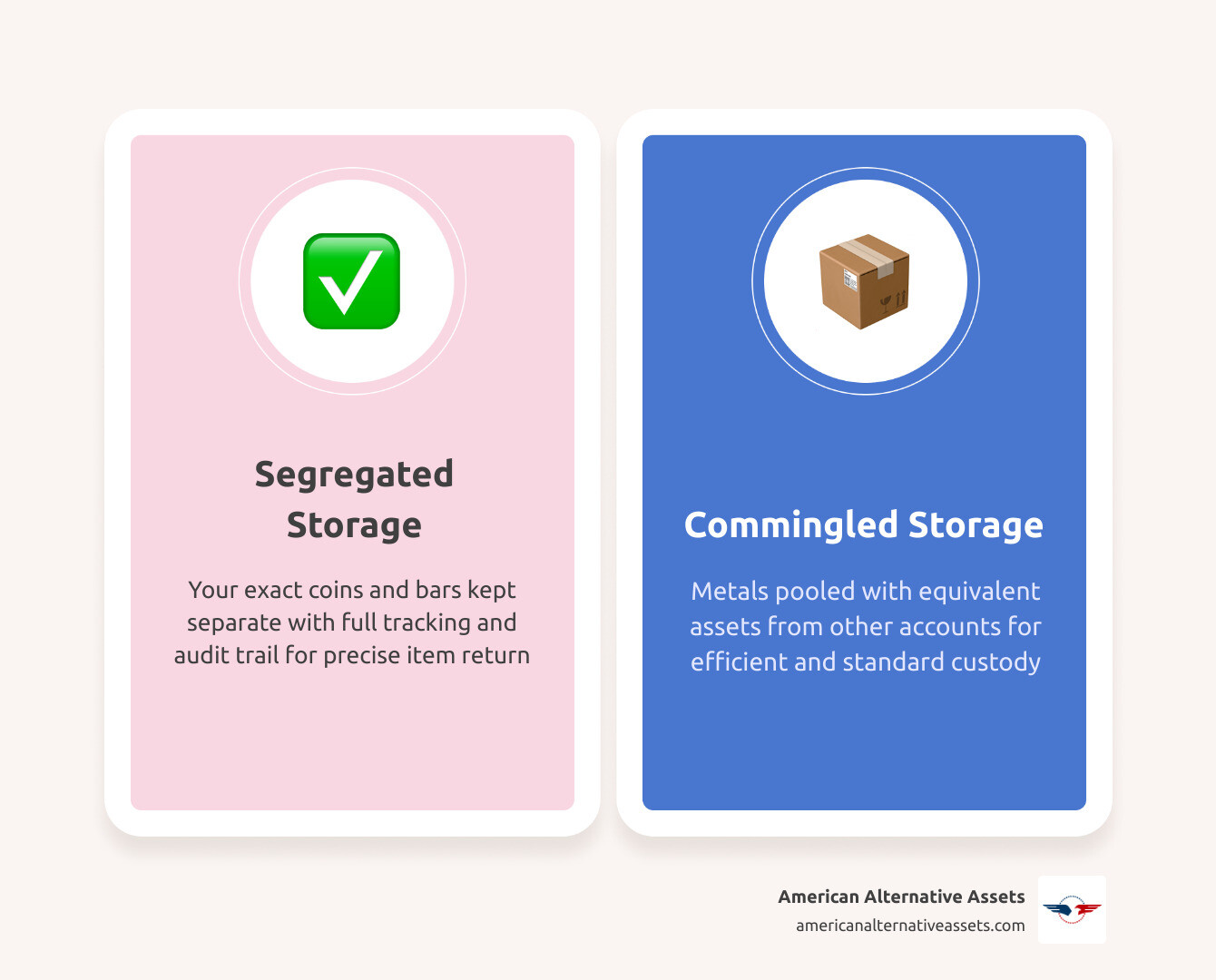
Segregated storage emphasizes exact-bar or exact-coin return. Commingled storage emphasizes pooled custody of equivalent assets. Both can be fully insured and professionally administered through approved depositories.
Contribution limits, rollovers, and distributions
For 2026, research referenced a standard IRA contribution limit of $7,000, with an additional $1,000 catch-up contribution for those age 50 and older. Always verify the current IRS rules before funding.
Other important mechanics:
- 401(k) assets can often be rolled into a self-directed metals IRA
- Direct trustee-to-trustee transfers are commonly preferred for simplicity
- Traditional IRAs are subject to required minimum distributions starting at age 73
- Distributions can be taken in cash or, in some cases, in kind as physical metal
Top Gold IRA Companies for 2026 and How to Compare Them
There are many companies in this space, and investors researching 2026 options will see a range of well-known names and comparison articles online. Third-party rankings can be a starting point for research, but they should not replace a careful review of any provider’s process, disclosures, and support. For example, broad consumer-finance roundups like Money’s best gold IRA companies overview can help you understand common comparison criteria before you narrow your list.
When evaluating any company, focus on whether it clearly supports physical precious metals ownership through a compliant IRA structure. That means transparency around custodians, depositories, approved bullion products, and account servicing.
What to compare before choosing a Gold IRA company
When comparing providers, we suggest focusing on:
- Clear explanation of the account process
- Written disclosure of annual and one-time costs
- Access to approved depositories
- Range of IRS-approved bullion products
- Responsiveness and support during rollover paperwork
- Storage options and reporting clarity
- Buyback process and liquidation support
- Educational quality
Top-rated names investors will see in 2026
Different rankings use different criteria. Some focus on education. Others focus on accessibility, product variety, or service.
Rather than chasing a single “best” company badge, look at how each provider handles:
- Fee transparency
- Product selection
- Minimum investment thresholds
- Customer support
- Storage choices
- Reputation across multiple review sources
That comparison method is much more useful than a trophy graphic.
Red flags and green flags in a provider comparison
Green flags:
- Transparent documentation
- Strong educational support
- Clear IRA-approved inventory
- Straightforward storage options
- Consistent communication
Red flags:
- Vague documentation
- Unclear product eligibility
- Weak explanations of custody and storage
- Confusing account support process
At American Alternative Assets, we believe the best relationship is one built on trust, transparency, and patient guidance, especially when retirement money is involved.
How to Choose the Right Metal Mix for Your Retirement Goals
There is no one-size-fits-all answer to the best metals for IRA question. A lot depends on whether you want stability, growth potential, broader diversification, or a mix of all three.
For many investors, precious metals work best as a modest slice of the total portfolio, often around 5 to 15 percent. That range appears often in educational materials because it aims to support diversification without turning the IRA into a one-asset bet.
For more perspective, see Which Precious Metal Wins the Gold Medal for Your Portfolio and The Best Ways to Invest in Silver Without Getting Tarnished.
Conservative approach: gold-led allocation
A conservative metals allocation often leans heavily toward gold.
Why it works:
- Gold is the most established monetary metal
- It tends to be less volatile than silver
- It has broad global recognition
- It is a natural core holding for many retirement savers
This approach may appeal to investors who want simplicity and stability first.
Balanced approach: gold and silver together
A balanced mix often combines gold and silver.
That can create a useful blend of:
- Gold’s stability and recognition
- Silver’s affordability and upside potential
- More flexibility when rebalancing
- Broader precious metals exposure
Opportunistic approach: adding platinum or palladium
For more experienced investors, a small allocation to platinum or palladium can add another layer of diversification.
That said, these metals are usually best treated as satellite positions because:
- Their markets are smaller
- Their price cycles are sharper
- Industrial demand plays a bigger role
In other words, they can be useful spices, but they are rarely the whole meal.
Practical rules for building a metals IRA
A few simple rules can keep the process grounded:
- Start with standard bullion, not collectibles
- Build around gold first, then add silver if appropriate
- Keep platinum and palladium modest
- Rebalance over time as allocations drift
- Stay focused on long-term retirement goals
- Verify product eligibility before purchase
Our article on precious metals IRA myths can help clear up a few common misconceptions.
Frequently Asked Questions About the Best Metals for IRA
What is the single best metal for an IRA?
For most investors, gold is the foundation. It is the most common core holding because of its liquidity, recognition, and long history as a store of value. Silver is often the best complement. Platinum and palladium can play a role, but usually in smaller amounts.
Can I keep IRA metals at home?
No. IRA-owned metals must be held at an approved depository under the control of the custodian. If you take personal possession while the IRA is active, the IRS can treat that as a taxable distribution.
Is copper a precious metal for IRA investing?
No. Copper is not treated as an IRA-eligible precious metal for this purpose. The IRS-approved list for physical precious metals IRAs is limited to gold, silver, platinum, and palladium.
Conclusion
The best metals for IRA investing usually start with gold, often include silver, and sometimes add platinum or palladium for a smaller diversification sleeve. The real key is not chasing novelty. It is choosing IRS-approved physical bullion, using proper custody and storage, and building a mix that fits your long-term retirement strategy.
If you want help understanding how a physical precious metals IRA works, or you want a clearer path through the setup process, we invite you to learn more about our Gold IRA services.
You can also continue your research with our related resources:
- Heavy Metal Retirement A Guide to Precious Metals IRAs
- Precious Metals IRA Complete Guide
- The Ultimate Gold and Silver Calculator Guide
At American Alternative Assets, we believe physical precious metals deserve a clear, thoughtful place in the retirement conversation. No hype, no mystery, just real assets and real education.
This article is for informational purposes only and does not constitute financial advice. Please consult your financial advisor before making investment decisions.
Investing in precious metals involves risk. Past performance does not guarantee future results.