







The US Dollar vs BRICS: What’s Actually Happening to Global Finance?
The battle of the US dollar vs BRICS is one of the most important economic shifts of our time, and it’s already affecting how countries trade, save, and store wealth.
Here’s the short version:
| Factor | US Dollar | BRICS Bloc |
|---|---|---|
| Share of global reserves (Q1 2026) | 56.3% (down from 71% in 1999) | Growing, but no single alternative |
| Global forex transactions | Used in 88% of all trades | Local currencies rising fast |
| Intra-bloc trade in local currencies | N/A | 67% of intra-BRICS trade |
| Key financial tools | SWIFT, US Treasuries | CIPS, mBridge, BRICS Pay, The Unit |
| Gold reserves | 8,134 tonnes (US) | 6,000+ tonnes (BRICS+ combined) |
| Global GDP share (PPP) | Declining relative share | ~39% and growing |
The dollar is still dominant. But its grip is loosening, and the infrastructure being built around it is changing fast.
BRICS nations, which now include Brazil, Russia, India, China, South Africa, and several new members, are actively building payment systems, settlement tools, and reserve alternatives designed to reduce their dependence on the dollar. This isn’t a conspiracy theory. It’s a documented, measurable process backed by IMF data, central bank purchase records, and bilateral trade agreements.
What’s driving it? A mix of geopolitical frustration, sanctions exposure, and genuine economic ambition. When the US and its allies froze $300 billion in Russian central bank reserves in 2022, it sent a clear message to every country holding dollar assets: those reserves can be turned off. That single event accelerated de-dollarization faster than decades of summit declarations ever had.
For everyday Americans, especially those planning for retirement, this shift raises real questions about purchasing power, inflation, and whether traditional savings vehicles are as safe as they seem.
I’m Shanon Davis, founder of American Alternative Assets, and my background in venture capital, combined with a long-standing belief in tangible, hold-in-your-hand assets, gives me a front-row seat to why the US dollar vs BRICS conversation matters deeply for anyone trying to protect long-term wealth. In the sections below, we’ll break down exactly what’s changing, what it means for your financial future, and why physical precious metals held in a Gold, Silver, or Precious Metals IRA deserve a serious look in this environment.
Terms related to us dollar vs brics:
The Rise of De-Dollarization: US Dollar vs BRICS
To truly grasp the dynamics of the us dollar vs brics rivalry, we have to look at the hard data. For decades, the US dollar enjoyed an unchallenged position as the world’s primary reserve currency. However, recent figures from the International Monetary Fund (IMF) COFER database show a clear, steady erosion of this status.
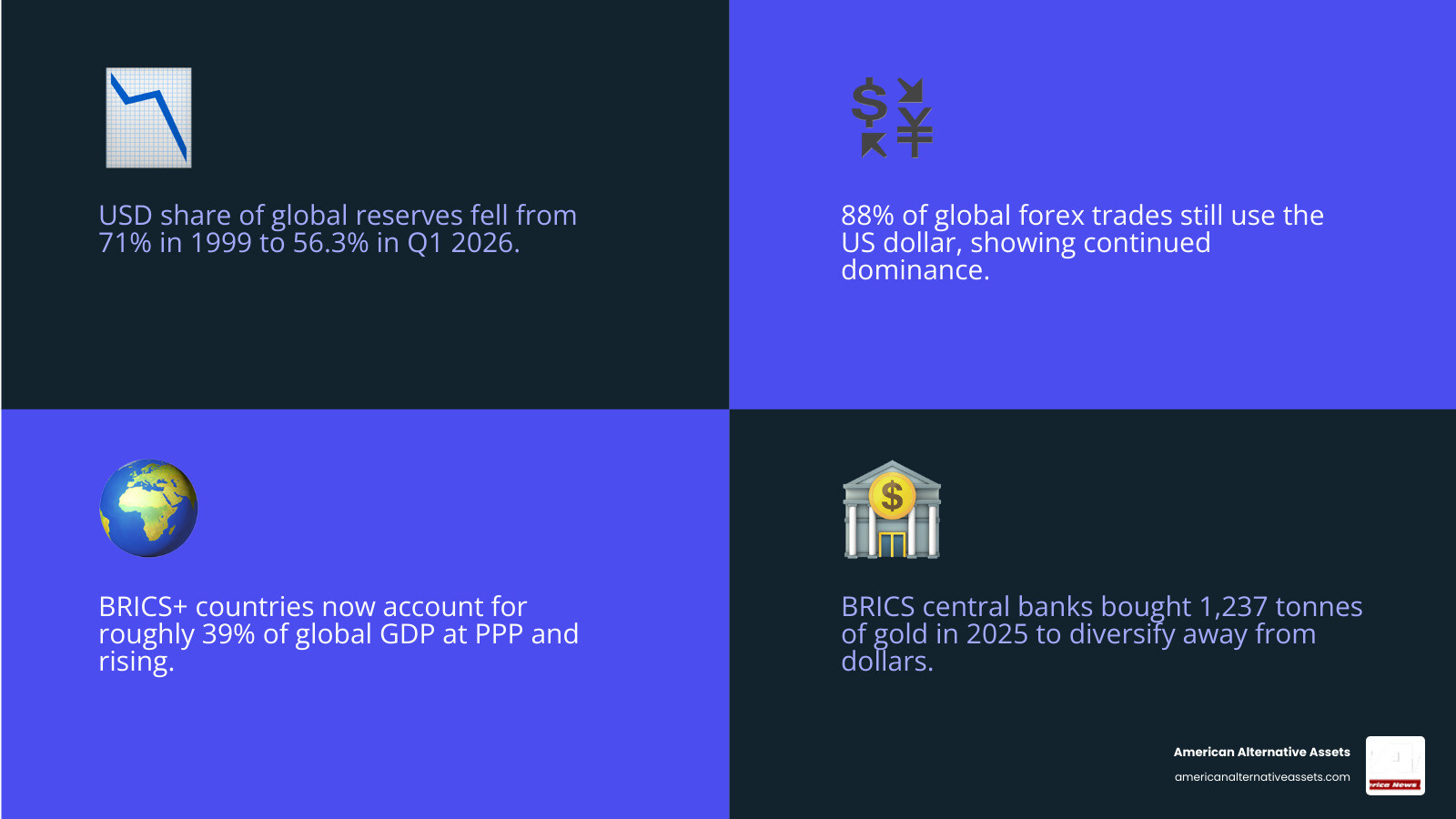
In the first quarter of 2026, the US dollar’s share of global foreign exchange reserves fell to 56.3%. To put that in perspective, the dollar held a commanding 71% of global reserves back in 1999, and stood at 59% as recently as 2020. This is not a sudden collapse, but rather a structural, long-term decline.

This shift is heavily driven by the rise of the BRICS bloc. What started as an acronym for emerging markets has evolved into a powerful economic alliance. To learn more about the foundations of this group, you can explore our guide, All About BRICS Nations. In recent years, the bloc has expanded its reach, bringing in new economic players and energy producers. If you want to understand who is driving this expansion, take a look at The New BRICS Members You Need to Know About.
This expanded coalition, often referred to as BRICS+, has moved aggressively from political rhetoric to practical trade integration. The most visible sign of this is the dramatic increase in local currency trade. Today, BRICS+ nations conduct an impressive 67% of their intra-bloc trade in local currencies, a massive leap from under 20% just a decade ago.
By bypassing the dollar in bilateral trade, these nations are actively reducing their transaction costs and shielding themselves from US monetary policy. For a deeper analysis of how these shifts are playing out on the global stage, you can read about The Rise of BRICS and the Fall of the US Dollar and explore the broader mechanics of this trend in this article on What Is De-Dollarization and Why BRICS Is Challenging the Dollar.
The Catalysts: Sanctions, the Petrodollar, and Gold Accumulation
While de-dollarization has been a slow-burning trend, certain geopolitical events have acted as major accelerators. The most significant turning point occurred in 2022, when Western allies froze approximately $300 billion in Russian central bank reserves.
This move sent shockwaves through central banks worldwide. It demonstrated that holding reserves in Western bank accounts or US Treasuries comes with a major political risk, if a nation’s foreign policy misaligns with Washington, its sovereign wealth can be frozen overnight. This weaponization of the financial system forced non-aligned countries to aggressively seek alternatives to secure their wealth.
Simultaneously, the foundational petrodollar system is experiencing unprecedented pressure. Since the 1970s, the global dominance of the dollar was reinforced by an agreement where major oil producers priced their crude exclusively in US dollars. Today, that arrangement is fraying. Saudi Arabia has diversified its partnerships, choosing not to renew exclusive dollar arrangements and opting to price a growing portion of its crude exports to China in Chinese yuan.
With BRICS+ countries now controlling a massive share of global energy production, the decline of the petrodollar is a major milestone in global finance. To understand the wider political implications of these maneuvers, you can read The BRICS’ Move Away From US Dollar: The Implications For International Politics.
As trust in fiat reserve assets declines, central banks are returning to the ultimate historical anchor of wealth: gold. In 2025, global central banks purchased a staggering 1,237 tonnes of gold. BRICS+ nations have been at the forefront of this movement, now holding 17.4% of global gold reserves, up from 11.2% in 2019.
This massive accumulation is widely seen as a strategic hedge against a declining dollar and potential sanctions. For more details on this historic shift, you can read BRICS De-Dollarization: USD Reserve Share Below 57% in 2026.
Furthermore, the rise of gold highlights a growing skepticism toward Western debt instruments. For a closer look at this trend, explore The Dollar’s Slow Death and Gold’s Relentless Rise: What Wall Street Won’t Say Out Loud. If you want to understand how political leadership reacts to these developments, you can read about Why Trump is Targeting BRICS and What it Means for the Dollar and Your Wealth.
BRICS Financial Infrastructure: BRICS Pay, CIPS, and the Unit
To successfully reduce their reliance on the dollar, BRICS nations have realized they cannot just talk about de-dollarization, they must build the actual plumbing to support it.
The bloc has focused on developing independent payment rails that bypass Western-controlled systems like SWIFT. One of the primary pillars of this strategy is China’s Cross-Border Interbank Payment System (CIPS). In 2025, CIPS processed over ¥180 trillion, which is approximately $24.5 trillion, representing a 43% increase year-on-year. CIPS now connects thousands of indirect participant banks across more than a hundred countries, offering a fully operational alternative for clearing transactions in yuan.
Another major technological development is Project mBridge, a multi-central bank digital currency (mCBDC) platform led by the Bank for International Settlements along with the central banks of China, Thailand, the UAE, and Saudi Arabia. By early 2026, Project mBridge had processed over $55 billion in cumulative transactions. This system allows participating nations to settle cross-border trade instantly and directly using digital currencies, completely bypassing Western intermediary banks and the dollar.
Alongside these networks, the bloc has introduced BRICS Pay, a decentralized payment and messaging system designed to integrate the national retail payment systems of member states. To learn how these payment systems are reshaping global trade patterns in 2026, you can read Dollar Reserve Share Below 57%: BRICS+ Reshapes Global Finance in 2026. For an analysis of whether these systems can truly challenge the greenback, see Will the BRICS Currency Actually Break the Buck?.
How the BRICS Unit Impacts the US Dollar vs BRICS Balance
Perhaps the most talked-about development in the us dollar vs brics dynamic is the introduction of “The Unit.”
The Unit is not designed as a paper currency for everyday retail transactions. Instead, it is a digital, blockchain-based settlement instrument intended for wholesale international trade. Its structure is unique, it is backed 40% by physical gold and 60% by a basket of BRICS+ member currencies.
By anchoring 40% of its value directly to physical gold, the Unit aims to solve the trust and volatility issues that plague many emerging market currencies. It operates on a decentralized blockchain ledger, meaning transactions can be cleared instantly, securely, and without the need for a centralized Western clearinghouse.
While still in its rollout phase for wholesale trade, the Unit provides a concrete template for how non-Western nations can conduct billions of dollars in trade without ever touching a US dollar or relying on Western banking infrastructure.
Limits to the Challenge: Internal Divisions and Dollar Dominance
Despite these rapid developments, the US dollar is not going to disappear overnight. The dollar still retains massive structural advantages that make a complete replacement highly unlikely in the near future.
For instance, the dollar is still involved in roughly 88% of all global foreign exchange transactions and accounts for 58% of global trade invoicing. The network effects of the dollar are incredibly deep, and the global financial system is built on its liquidity.
Furthermore, the BRICS bloc faces severe internal divisions that limit its ability to act as a cohesive monetary union. The most prominent obstacle is the geopolitical tension between India and China. India is highly wary of any financial initiatives that might inadvertently increase China’s regional dominance or turn the yuan into the default currency of the Global South. In fact, India has occasionally resisted settling trade in yuan, and has even signed trade agreements with Western partners to limit its exposure to Chinese-dominated supply chains.
Additionally, many BRICS currencies, most notably the Chinese yuan, operate under strict capital controls. Foreign investors cannot easily move large amounts of capital in and out of China, which severely limits the yuan’s viability as a primary global reserve currency.
To explore the arguments surrounding the viability of a unified BRICS currency, you can read why some experts believe A BRICS currency replacing the dollar is a ‘ridiculous’ idea. For a broader look at the historical search for alternatives, check out The Global Search for a New Reserve Currency.
| Feature | US Dollar | Proposed BRICS Unit / Basket |
|---|---|---|
| Backing | Fiat (backed by the full faith and credit of the US government) | 40% physical gold, 60% basket of member currencies |
| Capital Mobility | Fully open capital accounts, high liquidity | Restricted capital accounts (especially China), limited convertibility |
| Infrastructure | SWIFT, Fedwire, established Western clearinghouses | CIPS, mBridge, BRICS Pay, decentralized blockchain |
| Geopolitical Alignment | Western allies, G7, highly centralized | Diverse, non-aligned nations with internal rivalries (e.g., India vs. China) |
Why the US Dollar vs BRICS Rivalry Remains Asymmetrical
The fundamental asymmetry in the us dollar vs brics rivalry comes down to institutional trust and market depth.
The United States possesses the largest, most liquid, and most transparent debt market in the world. When foreign central banks accumulate reserves, they need a place to park those funds where they can earn yield and be liquidated instantly if a crisis hits. US Treasuries have served this role for generations.
The BRICS bloc simply does not have a comparable, unified bond market. A central bank cannot easily hold billions of dollars worth of Brazilian reals or South African rands without facing massive liquidity risks and currency volatility. Until the bloc can offer a highly liquid, stable, and widely trusted asset class that is easily convertible worldwide, the dollar’s role as the default global store of value will remain highly resilient, even as its market share gradually declines.
What De-Dollarization Means for Your Retirement and Wealth Protection
While the geopolitical chess match of the us dollar vs brics plays out in international summits, its real-world consequences are starting to hit closer to home. For everyday Americans, a declining global demand for the US dollar is not just an academic concern, it directly impacts your purchasing power and the long-term value of your retirement savings.
When foreign central banks and international corporations reduce their holdings of US dollars, those excess dollars eventually find their way back to the United States. This potential dollar glut, combined with persistent national deficits, can put upward pressure on domestic inflation.
Furthermore, as global demand for US Treasuries softens, the US government may have to offer higher interest rates to attract buyers for its debt. This can lead to permanently higher borrowing costs for mortgages, car loans, and business expansion, slowing down economic growth.
In this environment of shifting monetary regimes, relying solely on paper-based assets can expose your savings to unique risks. Traditional retirement accounts are often heavily concentrated in paper assets like stocks, mutual funds, and dollar-denominated bonds. These paper assets are highly vulnerable to currency depreciation and counterparty risk. Unlike physical precious metals, paper assets can lose their value overnight if the issuing institution fails or the stock market crashes. Even paper-based gold proxies, such as gold ETFs or mining stocks, carry significant counterparty risks. They represent mere contractual claims on gold rather than actual ownership of the physical metal itself, and their prices can be heavily dragged down by stock market volatility and poor corporate management decisions. They are simply not a safe or valid substitute for holding the real asset.
This is why many proactive investors are shifting their focus to direct physical ownership of tangible assets through a Gold, Silver, or Precious Metals IRA. Physical gold and silver coins and bars have no counterparty risk, they cannot be frozen by a foreign bank, and they cannot be inflated out of existence by central banks. Historically, physical precious metals held within a secure Precious Metals IRA are widely seen as the ultimate hedge during times of economic transition and currency instability.
At American Alternative Assets, based in Woodland Hills, California, we specialize in helping clients navigate these global shifts by diversifying their portfolios with physical precious metals, primarily through Gold, Silver, and Precious Metals IRAs. Our unique selling proposition is our white-glove, relationship-first service. We believe in building partnerships based on trust, transparency, and ethical practices, ensuring real privacy and protection for your hard-earned wealth.
To understand the broader implications of these macroeconomic shifts on your personal savings, you can read The Dollar’s Decline: A Massive Shift in Global Wealth You Can’t Ignore.
Frequently Asked Questions About the US Dollar vs BRICS
What is the current US dollar share of global reserves?
As of the first quarter of 2026, the US dollar’s share of global foreign exchange reserves stands at 56.3%, according to IMF COFER data. This represents a historic decline from 71% in 1999 and 59% in 2020, illustrating a steady, long-term trend toward a multipolar reserve system.
How does the BRICS Unit work?
The Unit is a proposed digital settlement token designed for wholesale cross-border trade. It is structured as a basket-backed instrument, where 40% of its value is anchored to physical gold and the remaining 60% is backed by a basket of BRICS+ member currencies. It operates on a decentralized blockchain ledger, allowing member countries to clear transactions instantly without using Western financial rails.
Can a BRICS currency fully replace the US dollar?
It is highly unlikely that a single BRICS currency will completely replace the US dollar in the near future. The dollar’s deep liquidity, massive network effects, and the absence of capital controls in the US give it a significant advantage. Instead, we are moving toward a multipolar financial system where the dollar remains prominent but shares the stage with regional currencies, gold, and alternative digital settlement systems.
Conclusion
The ongoing rivalry of the us dollar vs brics signals a clear shift in how global wealth is managed and stored. While the greenback remains a powerful player in global trade, its declining share of global reserves and the rapid development of alternative payment systems like CIPS, mBridge, and the Unit show that the world is actively preparing for a multipolar financial future.
In times of structural transition, waiting to see how things play out can leave your hard-earned savings vulnerable to inflation and currency depreciation. Proactive wealth preservation is about taking control of your financial future before global shifts dictate the terms.
At American Alternative Assets, we are dedicated to helping you protect your retirement through direct, physical ownership of gold and silver within a Gold, Silver, or Precious Metals IRA. Our team in Woodland Hills, CA, is ready to provide the transparent, white-glove guidance you need to secure your legacy.
To learn more about how you can add physical gold and silver to your portfolio, explore the American Alternative Assets Gold IRA.
This article is for informational purposes only and does not constitute financial advice. Please consult your financial advisor before making investment decisions.
Investing in precious metals involves risk. Past performance does not guarantee future results.