








Is the BRICS Nations vs US Dollar Rivalry Actually a Threat to Your Wealth?
The BRICS nations vs US dollar dynamic is one of the most consequential financial stories of our time, and here is what you need to know right now:
Quick Answer: Where Things Stand in April 2026
| Question | Short Answer |
|---|---|
| Is BRICS challenging the dollar? | Yes, actively, but the dollar still dominates |
| Dollar share of global reserves | ~58% (down from 71% in 1999) |
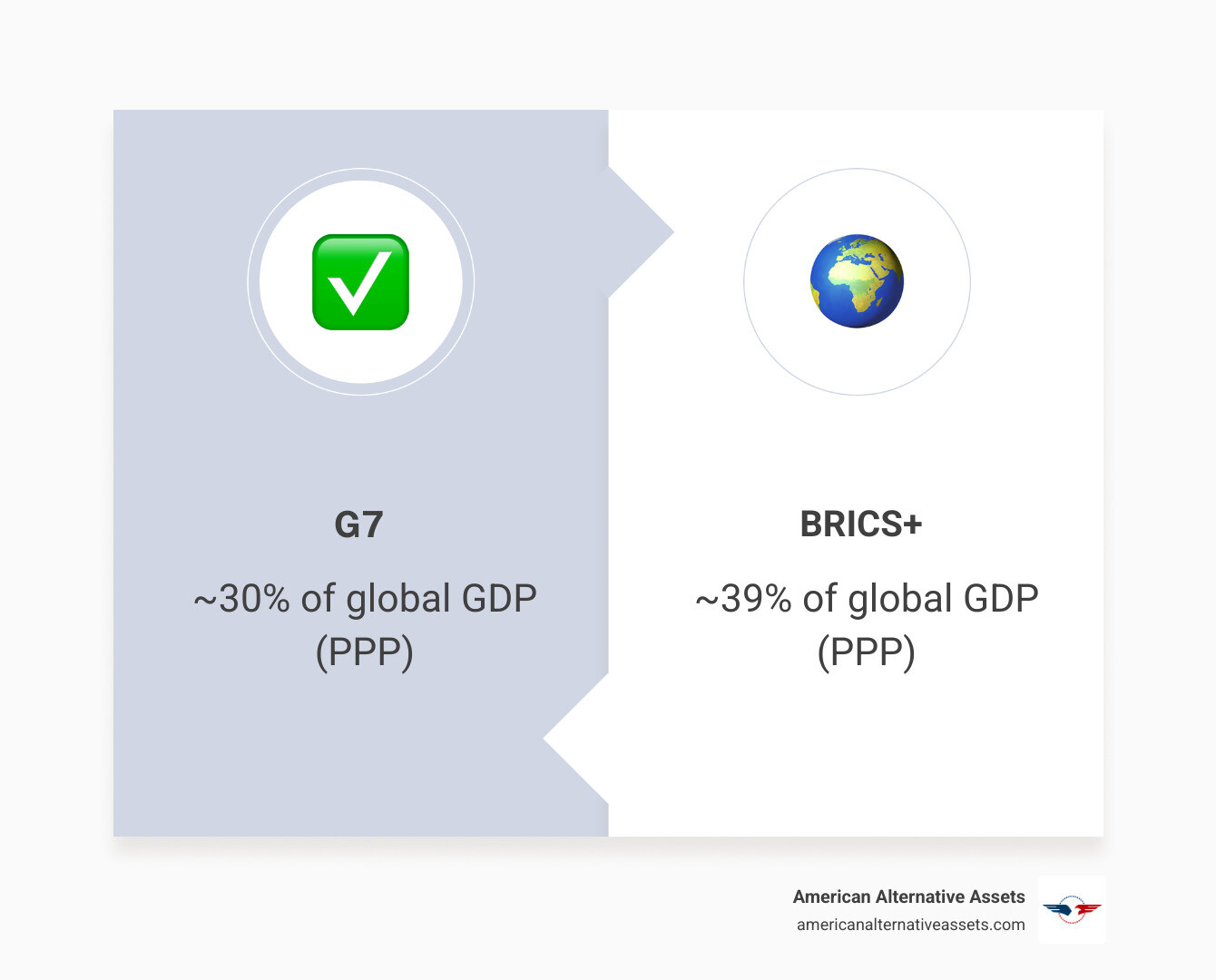
| BRICS+ share of global GDP (PPP) | ~39%, compared to G7’s ~30% |
| Is a BRICS currency imminent? | No, significant hurdles remain |
| Biggest risk to the dollar | US policy missteps as much as BRICS pressure |
| What does this mean for savers? | Currency uncertainty makes diversification into a Gold IRA worth considering |
For decades, the US dollar has been the undisputed foundation of global trade and finance. But that foundation is showing cracks. A growing coalition of nations, operating under the BRICS banner, is actively building alternatives: new payment systems, local currency trade agreements, and proposals for a gold-backed settlement instrument called the “Unit.”
This is not just geopolitical noise. It is a slow, structural shift that could affect the purchasing power of your savings, the cost of borrowing, and the stability of the financial system you depend on for retirement. This is why many are turning to a Precious Metals IRA to protect their future.
Is the dollar doomed? Almost certainly not anytime soon. But is the rivalry real, and does it carry genuine risks for ordinary Americans? Absolutely worth understanding clearly.
I’m Shanon Davis, and my background spans venture capital and a long-standing focus on how macro financial shifts, including the evolving BRICS nations vs us dollar rivalry, erode the value of paper-based wealth over time. That perspective shapes everything I share here at American Alternative Assets, where we focus on the security of physical assets like those found in a Gold or Silver IRA.
Brics nations vs us dollar vocab explained:
The Rise of BRICS+ and the De-Dollarization Movement
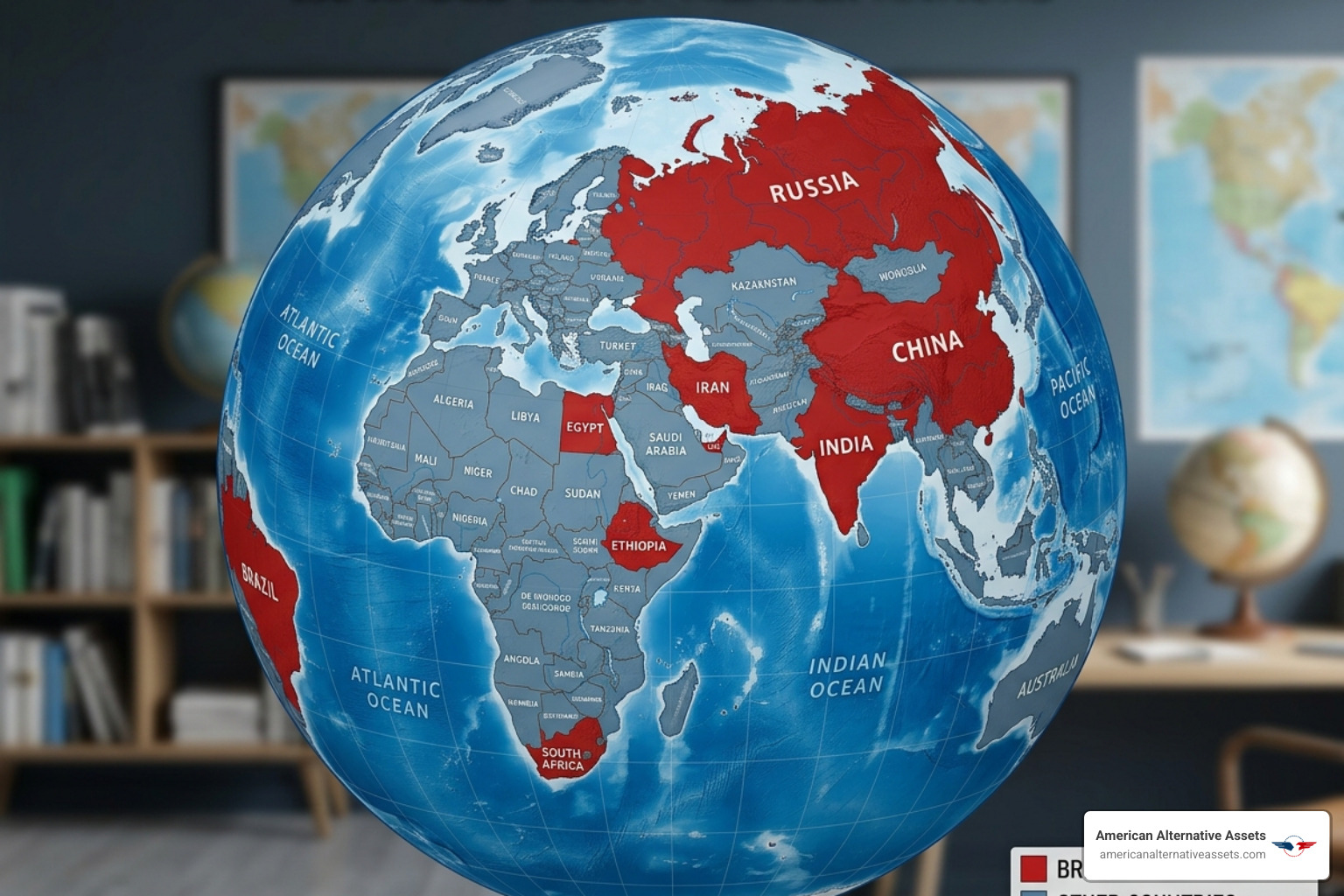
The landscape of global power has shifted dramatically since the original BRIC acronym was coined. What started as a marketing term for emerging markets has evolved into a formidable geopolitical bloc. As of April 2026, the group is officially known as BRICS+, following a massive expansion that brought in heavy hitters from the Middle East and Africa. This shift is prompting many to secure their savings through a Precious Metals IRA.
The core members, Brazil, Russia, India, China, and South Africa, have been joined by Egypt, Ethiopia, Iran, and the United Arab Emirates. This expansion isn’t just about adding names to a list; it is about creating a trade network that functions independently of Western oversight. For instance, the new BRICS members you need to know about include major energy producers like the UAE and Iran, which fundamentally changes the “petrodollar” math. Even nations closer to home are looking at the bloc, as seen with Cuba’s bold move to join BRICS, which signals a desire for a multipolar financial world right in the Western Hemisphere.
The Economic Scale of BRICS Nations vs US Dollar Dominance
To understand the gravity of the brics nations vs us dollar rivalry, we have to look at the raw numbers. BRICS+ countries now account for roughly 39 percent of global GDP based on Purchasing Power Parity (PPP). To put that in perspective, the G7 nations, including the US, UK, and Germany, account for about 30 percent. According to the Dollar Dominance Monitor from the Atlantic Council, while the dollar remains the primary reserve currency, its share of global reserves has seen a steady decline over the last two decades. This decline underscores the importance of diversifying into a Gold IRA rather than relying on paper-based assets.
Furthermore, the bloc represents 48.5 percent of the world’s population and controls a staggering share of natural resources. We are talking about 72 percent of rare earth reserves and a massive portion of global oil production. When nearly half the world’s population decides they might want to trade in something other than the greenback, the “network effect” that keeps the dollar on top begins to face its first real challenge in eighty years.
Weaponization of the Greenback
Why is this happening now? Much of the momentum behind de-dollarization stems from what many nations call the “weaponization” of the US dollar. When the US and its allies froze roughly $300 billion of Russia’s foreign reserves and excluded their banks from the SWIFT messaging system, it sent a shockwave through central banks worldwide.
Many leaders in the Global South began to ask: “If it happened to them, could it happen to us?” This fear has turned de-dollarization from a philosophical goal into a matter of national security. By moving toward local currency settlements and alternative payment systems, these nations are seeking trade autonomy to protect themselves from future US sanctions. As we explore in our analysis of the rise of BRICS and the fall of the US dollar, the use of the dollar as a political tool has arguably been the greatest catalyst for its own decline, making the case for a physical Precious Metals IRA stronger than ever compared to vulnerable paper wealth.
The Proposed BRICS ‘UNIT’ and the Return to Gold-Backed Trade
Perhaps the most discussed development in the brics nations vs us dollar saga is the proposal for a new settlement instrument known as the “UNIT.” Unlike the Euro, which replaced national currencies, the UNIT is designed as a basket-backed instrument for wholesale cross-border trade. As explored in recent reports on how a new BRICS currency would affect the US dollar, this move represents a significant shift in international trade strategy.
The proposed structure is a fascinating return to “sound money” principles. It is intended to be backed 40 percent by gold and 60 percent by a basket of BRICS+ national currencies. This design aims to provide stability and trust that individual fiat currencies like the ruble or the yuan sometimes lack. By anchoring the UNIT to gold, the BRICS nations are attempting to create a system that cannot be easily manipulated by any single government’s printing press. This global return to gold highlights why physical ownership through a Gold IRA is becoming essential for individual savers who want to avoid the risks of paper-based trade instruments.
Digital Infrastructure and Project mBridge
A currency is only as good as the pipes it travels through. To bypass the US-led SWIFT system, BRICS+ is leaning heavily into blockchain technology. Project mBridge is a prime example. This is a multi-central bank digital currency (CBDC) platform that allows for instant, cross-border payments without needing a middleman in New York or London.
By November 2025, Project mBridge had already processed over $55 billion in transactions. Combined with “BRICS Pay” and China’s CIPS (Cross-Border Interbank Payment System), the bloc is building a digital financial fortress. These systems allow nations to settle trades in seconds using local currencies, effectively cutting the dollar out of the loop entirely.
Central Bank Gold Accumulation
While the world watches digital developments, the real movement is happening in gold vaults. BRICS nations have been on a record-breaking gold buying spree. China and India alone accumulated over 570 tonnes of gold between 2019 and 2024. As of early 2026, the expanded BRICS+ bloc holds over 6,100 tonnes of gold.
This shift suggests that central banks are preparing for a world where the dollar is no longer the “risk-free” asset. By increasing their gold holdings, these nations are building a foundation of tangible value. We have often discussed the dollar’s slow death and gold’s relentless rise, and the current data supports the idea that gold is reclaiming its role as the ultimate hedge against currency instability, particularly when held in a physical Precious Metals IRA rather than in paper-based gold proxies.
Why the BRICS Nations vs US Dollar Rivalry is Accelerating in 2026
As we move through 2026, the friction between the brics nations vs us dollar is reaching a fever pitch. It isn’t just about long-term goals anymore; we are seeing real-world shifts in how commodities are priced. For decades, the “petrodollar” system ensured that oil was bought and sold almost exclusively in USD. That era is ending.
In 2023, one-fifth of global oil trades used non-dollar currencies. Today, we see “petroyuan” deals becoming more common, and Saudi Arabia has signaled an openness to trading in multiple currencies. This shift reduces the global demand for dollars, which has historically allowed the US to run large deficits without immediate consequences.
Impact of US Trade Policies and Tariffs
Domestic US politics have also added fuel to the fire. The threat of 100 percent tariffs against nations that move away from the dollar has created a “join or die” mentality in some parts of the world. While intended to protect dollar dominance, these aggressive trade policies can sometimes backfire, pushing BRICS nations to unify even faster to protect their own economies.
We have looked closely at why Trump is targeting BRICS, and the consensus is that while tariffs might provide short-term leverage, they also accelerate the search for alternatives. When trade becomes a battlefield, nations look for a neutral ground, and for BRICS, that ground is a non-dollar financial system.
Real-World Impacts of the BRICS Nations vs US Dollar Shift
What does this mean for the average American? If global demand for the dollar drops significantly, the US government may find it more expensive to borrow money. This could lead to higher interest rates for mortgages and car loans, and potentially higher inflation as the value of the dollar at home is impacted by its waning status abroad. This economic pressure makes the stability of a Gold or Silver IRA more vital than ever.
The risks of a dollar to collapse scenario are often debated, but even a gradual “thinning” of dollar dominance could lead to a fiscal apocalypse if the US does not address its own debt levels. When the world no longer feels forced to hold our debt, our economic “exorbitant privilege” begins to vanish, leaving those with paper-only portfolios vulnerable.
Structural Hurdles: Can the BRICS Nations vs US Dollar Battle Be Won?
Despite the momentum, the BRICS nations face massive internal challenges. They are not a monolith. The rivalry between India and China, for example, is a significant hurdle. India is often wary of any system that might simply replace US dominance with Chinese dominance.
Furthermore, the economic disparities within the group are vast. Combining the high-tech economy of China with the sanctions-hit economy of Russia and the developing economies of Ethiopia or Egypt creates a “basket” that is inherently volatile.
The Network Effect of the Greenback
The US dollar still benefits from a massive “network effect.” It is used in nearly 90 percent of all currency trading and 58 percent of global reserves. Most importantly, the US offers deep, liquid markets and a transparent legal framework that the BRICS nations cannot yet match. However, these paper-based markets are increasingly vulnerable to the very geopolitical shifts we are seeing today.
As many experts point out, you can’t just “invent” a reserve currency. It requires decades of trust, institutional depth, and the ability for investors to move money in and out freely. While the brics nations vs us dollar rivalry is growing, the greenback still holds the home-field advantage. However, for individuals, the lack of a clear state-sponsored alternative to the dollar is exactly why physical assets in a Precious Metals IRA are so critical. You don’t have to wait for a new global reserve currency to protect your wealth with gold and silver, especially when paper assets offer no such tangible security.
Protecting Wealth in a Multipolar Financial World
When the brics nations vs us dollar rivalry is creating constant uncertainty, the old “buy and hold” strategy for paper assets is a dangerous gamble. When currencies are being used as pawns in a geopolitical chess match, savvy savers must look for assets that sit outside the fiat system entirely, specifically physical metals in a Precious Metals IRA.
At American Alternative Assets, we believe that physical precious metals held in a Gold IRA are the ultimate “neutral” asset. Gold doesn’t care about summits in Kazan or interest rate hikes in Washington. It has no counterparty risk, meaning its value doesn’t depend on a government’s ability to pay its debts or a bank’s ability to stay solvent.
Physical Assets vs Paper Risks
It is critical to distinguish between physical gold and “paper” gold like ETFs or mining stocks. Paper assets are inherently flawed because they are still tied to the very financial system that is currently under stress. If the dollar weakens or the financial plumbing of the West faces a systemic shock, a digital representation of gold in a brokerage account might not provide the protection you expect. Unlike physical coins and bars, paper gold is just another contract in a failing system.
Physical ownership, having gold and silver coins or bars within a specialized Precious Metals IRA, offers a level of privacy and protection that paper assets cannot match. In a multipolar world, having a portion of your wealth in a physical asset that is recognized globally, from Shanghai to New York, is the only reliable cornerstone of strategic diversification.
Frequently Asked Questions about BRICS and the Dollar
What is the BRICS UNIT currency?
The UNIT is a proposed “basket” instrument intended for trade settlement between BRICS+ nations. It is not meant to replace everyday cash like the dollar or the yuan but rather to serve as a stable, gold-backed unit of account for large-scale international transactions.
Can BRICS nations realistically replace the US dollar?
Replacing the dollar entirely is unlikely in the near term due to the dollar’s massive head start in global markets. However, BRICS can realistically “chip away” at its dominance. This shift is why many investors are moving away from paper stocks and into the security of a physical Gold IRA.
How does de-dollarization affect US inflation?
If nations stop using the dollar for trade, those dollars eventually return to the US, increasing the domestic money supply. Simultaneously, if the dollar weakens against other currencies, the cost of imported goods goes up, contributing to inflationary pressure. Holding physical assets in a Precious Metals IRA can help hedge against this loss of purchasing power.
Conclusion
The brics nations vs us dollar rivalry is more than just a headline; it is a fundamental restructuring of the global economy. While the dollar remains the world’s primary currency for now, the trend toward de-dollarization is clear and accelerating.
At American Alternative Assets, we are committed to helping our clients navigate these shifts through white-glove, relationship-first service. We focus on trust, transparency, and ethical practices to help you protect your hard-earned wealth. In an era of currency wars and geopolitical friction, physical gold and silver held in a Precious Metals IRA remain the time-tested standards for financial preparedness.
Learn more about securing your retirement with a Gold IRA
This article is for informational purposes only and does not constitute financial advice. Please consult your financial advisor before making investment decisions. Investing in precious metals involves risk. Past performance does not guarantee future results.