







What Is BRICS Nations? A Quick Guide to the World’s Fastest-Growing Economic Bloc
What is BRICS nations in a nutshell? Here’s the short answer:
BRICS is an intergovernmental group of major emerging economies. The name is an acronym. Each letter stands for a founding or early member country.
| Letter | Country |
|---|---|
| B | Brazil |
| R | Russia |
| I | India |
| C | China |
| S | South Africa |
Since its first summit in 2009, the group has grown well beyond those five founding members. As of 2026, BRICS has 11 full members and 10 partner countries, making it one of the most significant economic blocs on the planet.
A few key facts at a glance:
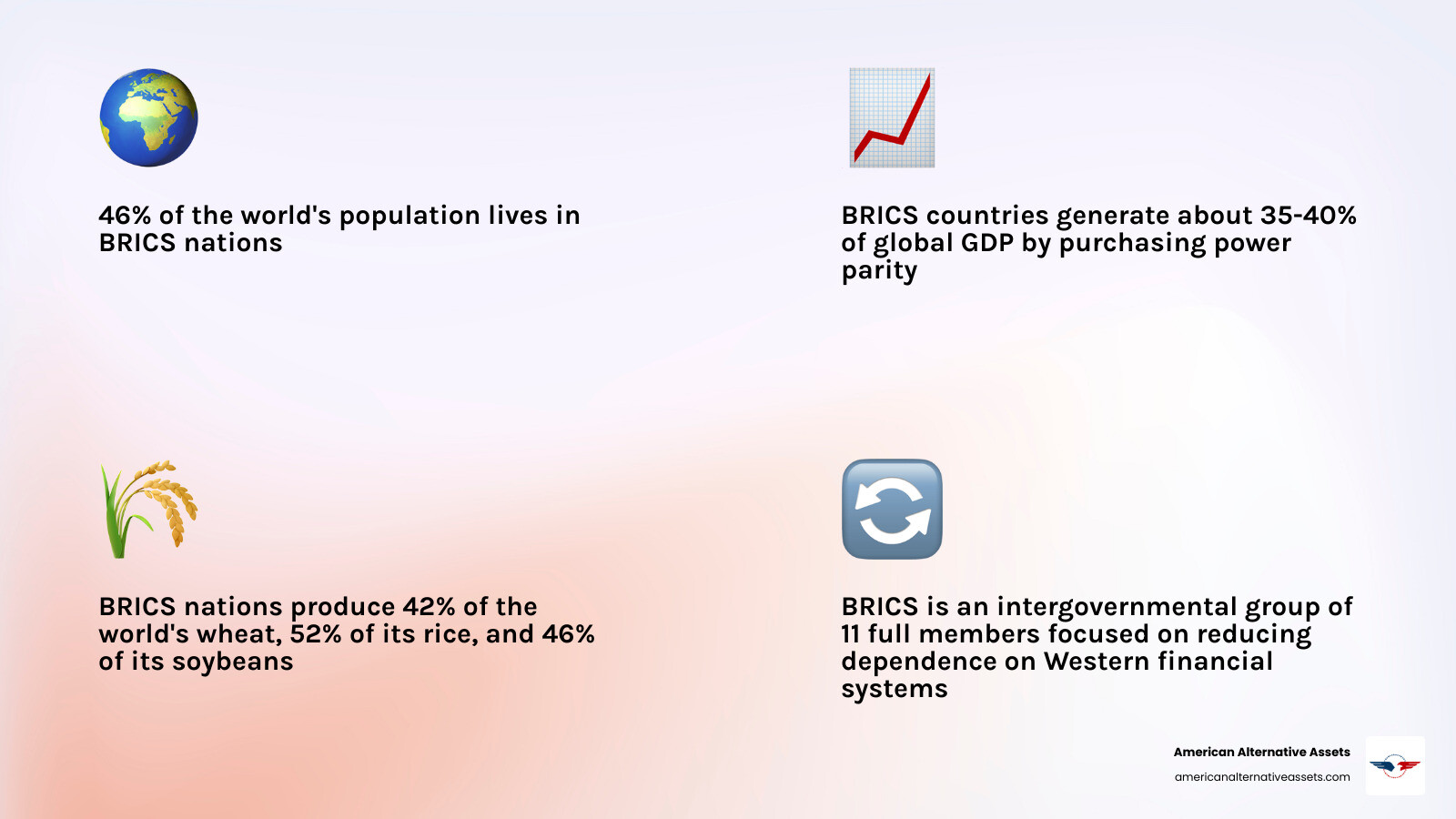
- 46% of the world’s population lives in BRICS nations
- ~35-40% of global GDP (by purchasing power parity) comes from BRICS countries
- 26% of world trade flows through BRICS economies
- BRICS nations produce 42% of the world’s wheat, 52% of its rice, and 46% of its soybeans
The group’s core mission is to give emerging economies a stronger voice in global institutions, reduce dependence on Western financial systems, and build alternative tools for trade and development.
For everyday Americans watching global markets, BRICS matters because its push to move away from the U.S. dollar has real implications for long-term financial stability and wealth preservation.
I’m Shanon Davis, founder of American Alternative Assets, and my background in venture capital taught me how fragile paper-based financial systems can be. That is exactly why I’ve spent years studying how shifts in what is BRICS nations and global monetary power can affect savings, retirement planning, and the case for holding physical precious metals, like gold and silver coins and bars, inside a Precious Metals IRA. In the sections ahead, we’ll break down everything you need to know, clearly and without the jargon.
Quick look at what is brics nations:
What Is BRICS Nations and What Does BRICS Stand For?
BRICS stands for Brazil, Russia, India, China, and South Africa. Today, though, the term usually refers to the larger grouping built around those original names.
At its core, BRICS is a diplomatic and economic forum. It brings together large emerging-market countries that want more influence in how the global system works. That includes trade, development finance, political coordination, and reform of institutions like the IMF and World Bank.
What is BRICS nations in simple terms?
In simple language, BRICS is a club of major non-Western economies that meet regularly and try to coordinate on big global issues.
It is not a single country, not a military alliance, and not a formal union like the European Union. It is better understood as an informal bloc. It has no permanent treaty-based secretariat and no central headquarters running everything day to day. Instead, it works through annual summits, ministerial meetings, working groups, and a rotating presidency. You can see the official overview on the BRICS 2026 information page.
What is BRICS nations meant to do?
BRICS was created to pursue a few broad goals:
- Give emerging economies a stronger voice in global governance
- Push for reforms in institutions dominated by the West
- Expand trade and investment among member countries
- Support development financing through alternative institutions
- Encourage use of local currencies and reduce overreliance on the U.S. dollar
- Promote a more multipolar world, meaning global power is spread across several centers, not concentrated in one
In practice, BRICS often talks about sovereignty, multilateralism, UN-centered diplomacy, and the interests of the Global South.
How BRICS is structured and how decisions are made
BRICS runs on consensus. If members do not agree, the group generally does not move forward. That makes it flexible, but also slow.
Its structure rests on three broad pillars:
- Political and security cooperation
- Economy and finance
- Cultural and people-to-people exchanges
The presidency rotates among members, and the presiding country hosts that year’s summit and sets key priorities. Alongside leaders’ summits, there are meetings for finance ministers, foreign ministers, trade officials, central bank representatives, and other sector-specific groups.
That informal structure is part of BRICS’ personality. Some see that as a strength. Others see it as a polite way of saying, “Everyone’s here, but nobody brought a rulebook.”
BRICS Members Today and How the Group Expanded

BRICS has changed a lot since the early days when it was just a catchy acronym.
What is BRICS nations membership in 2026?
As of 2026, BRICS has 11 full members:
- Brazil
- Russia
- India
- China
- South Africa
- Egypt
- Ethiopia
- Iran
- Indonesia
- Saudi Arabia
- United Arab Emirates
This expansion matters because it adds more population, energy production, trade routes, and political influence across Africa, the Middle East, Asia, and Latin America.
Timeline of BRICS membership changes
Here is the short timeline:
- 2001, the term “BRIC” was coined by economist Jim O’Neill
- 2006, foreign ministers from the BRIC countries began meeting
- 2009, the first BRIC summit took place in Yekaterinburg, Russia
- 2010, South Africa was invited, creating BRICS
- 2024, Egypt, Ethiopia, Iran, Saudi Arabia, and the UAE joined as full members
- 2025, Indonesia became the first Southeast Asian full member
- 2026, the group appears more cautious about further rapid expansion, even as many countries remain interested
One important footnote, Argentina was invited during the expansion wave but declined to join. That is a reminder that BRICS growth is not automatic.
Full members vs partner countries
BRICS now includes both full members and partner countries. Partner status gives countries a way to engage without becoming full members right away. This lets BRICS widen its network while avoiding an instant jump to a much larger and more complicated club.
According to official BRICS materials, 10 countries joined as partners in 2025. More than 30 countries reportedly expressed interest in some form of BRICS participation in 2024. Admission is flexible and consensus-based, which means there is no simple checklist, but support from existing members is essential.
For a policy-focused overview, see the House of Commons Library briefing on BRICS expansion. For a market-focused read, our team also covers expansion in The New BRICS Members You Need to Know About.
Why BRICS Was Founded and What It Wants to Change
To understand BRICS, it helps to know that it started as both an idea and a reaction.
Origins, from BRIC idea to BRICS summit diplomacy
The term “BRIC” was first popularized in 2001 as a way to describe four large emerging economies expected to play a much bigger role in the global economy. But the political grouping did not just spring from a bank report.
Its roots also run through earlier diplomatic forums such as RIC, Russia-India-China, and IBSA, India-Brazil-South Africa. Those groupings showed that major developing countries wanted more direct coordination outside Western-led institutions. The first full summit in 2009 turned the idea into an actual diplomatic format. South Africa joined soon after, giving the group African representation and turning BRIC into BRICS.
For historical background, the BRICS Information Centre at the University of Toronto is useful.
Original goals of BRICS
The founding goals were fairly consistent:
- Increase the voice of emerging economies in global decision-making
- Reform international financial institutions
- Promote development and investment
- Expand South-South cooperation
- Support a more balanced international order
In plain English, BRICS wanted the global system to stop acting like the guest list was finalized in 1945.
Why BRICS talks about a multipolar world order
The phrase “multipolar world order” comes up constantly in BRICS discussions. It means a world where power is distributed among several major states and regions, rather than centered mainly around the United States and its allies.
Many BRICS members argue that existing systems reflect older power balances and underrepresent the Global South. They want more influence in trade rules, development banking, reserve currency arrangements, and diplomatic institutions.
At the same time, BRICS is not perfectly united in what that future should look like. Some members lean more confrontational toward the West, while others want reform without rupture. The Council on Foreign Relations backgrounder does a solid job explaining that tension.
BRICS Institutions, De-Dollarization, and Financial Initiatives
One reason BRICS matters is that it has tried to build institutions, not just issue statements.
The New Development Bank and what it actually does
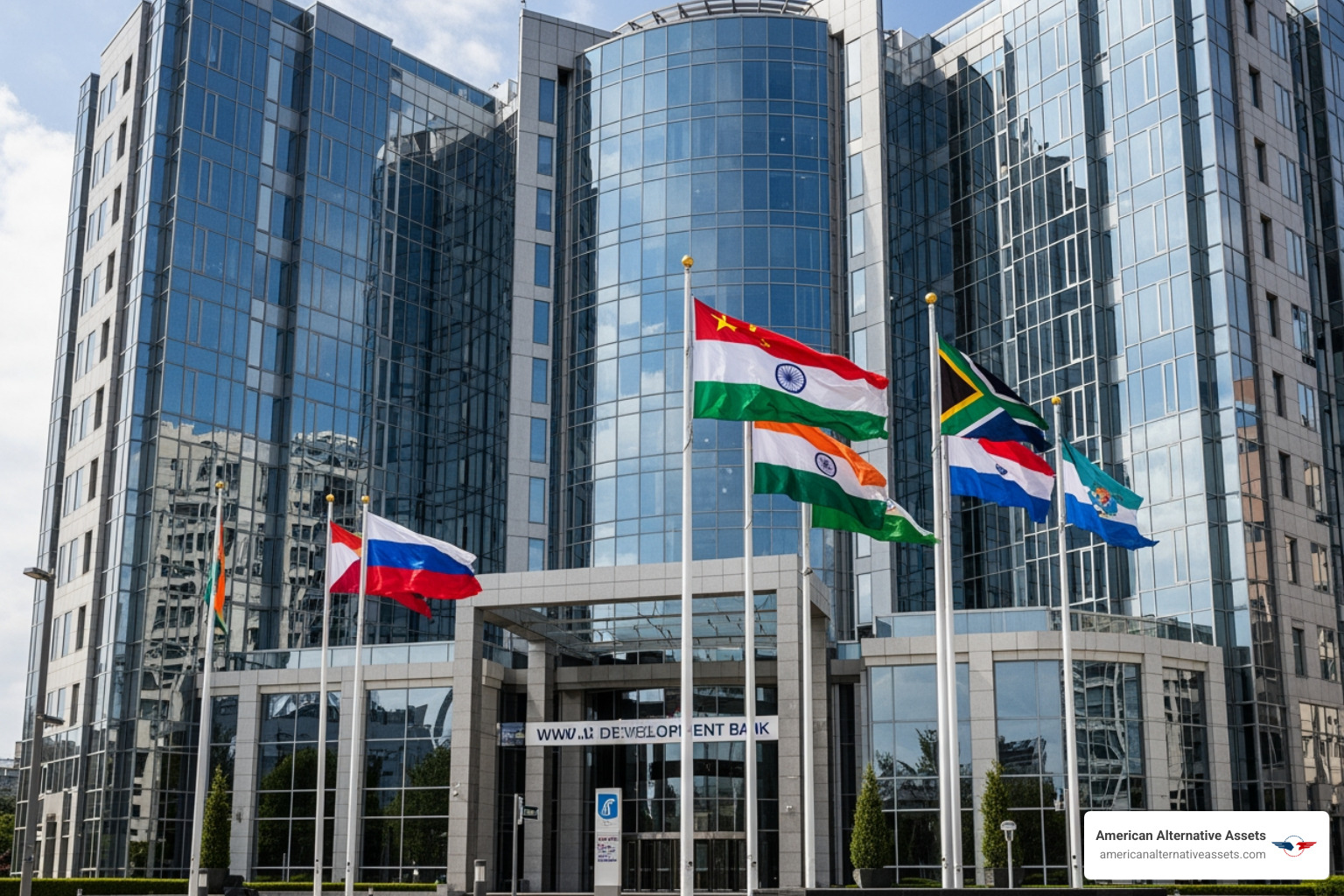
The New Development Bank, or NDB, was established in 2014 and is headquartered in Shanghai. Its purpose is to finance infrastructure and sustainable development projects in BRICS and other emerging economies.
This is often described as a BRICS alternative to the World Bank, though that comparison should be used carefully. The NDB is still much smaller. Research cited above notes that it has approved more than $32 billion for 96 projects since 2016, with a focus on infrastructure, energy, and related development needs.
So the NDB is real and active, but it has not replaced the older global institutions. It has, however, given BRICS something important, a working financial institution of its own.
Other BRICS tools, from the CRA to BRICS Pay
BRICS has also launched or discussed several other tools and initiatives:
- Contingent Reserve Arrangement, or CRA, a $100 billion liquidity support framework created in 2014
- BRICS Pay and related payment ideas, aimed at cross-border settlements outside traditional dollar-heavy channels
- BRICS Bridge, often discussed as a broader payments and settlement concept
- BRICS Cable, a communications infrastructure concept
- Satellite and digital cooperation initiatives, with BRICS+ countries reportedly having over 1,200 satellites in orbit
The CRA is especially important because it was designed to help members facing short-term balance-of-payments pressure. In other words, it is meant to provide a financial backstop if turbulence hits.
How BRICS aims to reduce reliance on the U.S. dollar
This is the part that gets headlines, and for good reason.
BRICS is not close to replacing the dollar outright. The dollar is still used in more than 80 percent of global trade, according to the research above. But BRICS is clearly trying to reduce dependence on it.
Its de-dollarization approach includes:
- Settling more trade in local currencies
- Building payment systems that avoid dollar-based bottlenecks
- Increasing reserve diversification
- Expanding bilateral currency arrangements
- Encouraging non-dollar financing channels
One statistic in the research stands out. The Chinese renminbi accounts for about 47 percent of total intra-BRICS trade transactions. That does not mean a shared BRICS currency has arrived. It does show that the internal currency mix is shifting.
For readers following the monetary angle, see our related guides on Will the BRICS Currency Actually Break the Buck? and The Rise of BRICS and the Fall of the US Dollar.
From our perspective at American Alternative Assets, this trend matters because when countries search for alternatives to dollar dependence, investors often start asking a parallel question: what assets sit outside the paper promises of the financial system? For many, physical gold and silver coins and bars held in a Gold IRA, Silver IRA, or broader Precious Metals IRA become part of that conversation. Unlike paper-based assets such as gold ETFs, mining stocks, or similar financial products, which carry counterparty exposure and depend on fund structures, market intermediaries, or third-party promises, physical precious metals offer direct ownership of a tangible asset. That distinction is widely seen as meaningful during periods of monetary uncertainty, because with physical metals, your wealth is not tied to a fund manager, a stock exchange, or another institution’s paper claim.
Why BRICS Matters, Economic Weight, G7 Comparison, and Key Criticisms
BRICS gets attention because the numbers are hard to ignore.
The economic and demographic significance of BRICS
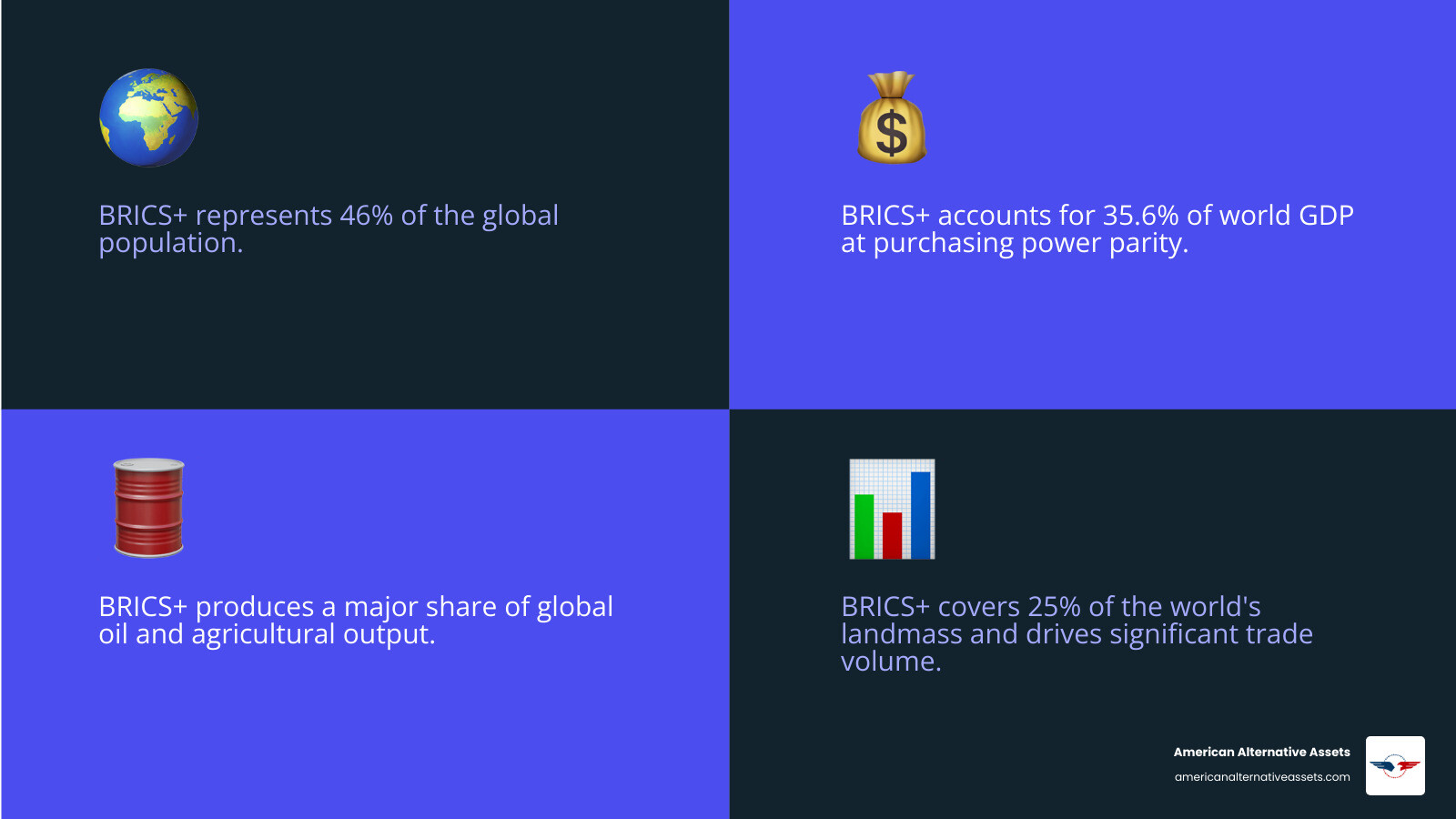
Collectively, BRICS+ accounts for:
- About 46 percent of the world’s population
- About 25 percent of the world’s landmass
- Around 35.6 percent of world GDP at purchasing power parity in 2022
- More than a quarter of global trade, with some official materials putting the figure near 26 percent
- Intra-BRICS trade of $614.8 billion in 2022
The resource and production story is just as striking:
- Nearly 30 percent of global oil output
- About 45 percent of global agricultural products
- 42 percent of the world’s wheat
- 52 percent of the world’s rice
- 46 percent of the world’s soybeans
- About 40 percent of global internet users
This is why BRICS is not just a diplomatic slogan. It sits on major energy, food, manufacturing, and consumer-market power.
BRICS vs G7 vs G20
A quick comparison helps:
| Group | Main strength | Key limitation |
|---|---|---|
| BRICS | Population, resources, PPP output, Global South influence | Internal divisions, informal structure |
| G7 | Wealth, institutions, military power, financial market depth | Smaller population share, slower growth |
| G20 | Broadest major-economy forum | Too large and diverse for tight coordination |
BRICS+ now has a larger GDP than both the G7 and the EU on a PPP basis, according to the research. That is an important qualifier, PPP is different from nominal GDP. In nominal terms, the G7 remains stronger. In institutional depth, capital markets, and military spending, the G7 also still holds major advantages.
The G20 is different again. It is broader and includes both Western powers and major emerging economies, including several BRICS members. So BRICS is not a replacement for the G20. It is more like a tighter political identity inside the wider global forum.
Main criticisms and challenges facing BRICS
BRICS has real strengths, but also real problems.
The biggest criticisms include:
- Internal rivalries, especially between China and India
- Divisions over Russia’s war in Ukraine
- Wide differences in political systems and economic models
- No founding treaty, permanent secretariat, or strong enforcement mechanism
- Questions about whether expansion makes unity harder
- Doubts about a common BRICS currency ever becoming practical
Some analysts see BRICS as the future of a more balanced world. Others call it a loose coalition held together mainly by dissatisfaction with Western dominance.
Both views contain some truth. BRICS is influential, but it is not seamless. It is big, ambitious, and often internally awkward, like trying to coordinate a dinner reservation for 11 countries with different strategic priorities.
For broader reading, see BRICS on Wikipedia and our own article on Why Trump is Targeting BRICS and What it Means for the Dollar and Your Wealth.
Frequently Asked Questions About What Is BRICS Nations
Is BRICS anti-West or just pro-Global South?
The answer is, it depends on the member and the issue.
BRICS officially frames itself as pro-multilateral, pro-reform, and supportive of stronger Global South representation. Some members are more openly critical of Western dominance than others. So while critics often call BRICS anti-West, the group is better described as a reformist and sometimes counterbalancing bloc, not a unified anti-West alliance.
Can BRICS create a currency that replaces the dollar?
In theory, BRICS can keep developing payment systems and increase local-currency trade. In practice, replacing the dollar with a single BRICS currency would be extremely difficult.
A shared currency would require major political trust, monetary coordination, and institutional integration that BRICS does not currently have. So the more realistic path is not “new currency beats dollar next Tuesday.” It is a gradual rise in non-dollar settlement channels.
Why are more countries trying to join BRICS?
Countries are interested in BRICS for several reasons:
- Access to a growing trade network
- Political visibility and diplomatic leverage
- Development finance alternatives
- Less dependence on Western institutions
- Strategic autonomy in a more multipolar world
Some governments also see BRICS as a hedge, not necessarily against the West entirely, but against overdependence on any single power center. We explore some of that dynamic in Cuba’s Bold Move to Join BRICS: What it Means for the U.S. Dollar and Global Power Shifts.
Conclusion
So, what is BRICS nations really about?
It is a fast-evolving coalition of major emerging economies that wants more influence over global rules, more financial independence, and a bigger role for the Global South in world affairs. It began with Brazil, Russia, India, China, and South Africa, and by 2026 it has grown into an 11-member bloc with partner countries waiting in the wings.
BRICS matters because of its scale, nearly half the world’s population, a huge share of global production, and rising influence over trade, energy, food, and finance. It also matters because its push for de-dollarization reflects a broader shift in how countries think about sovereignty, payments, and reserves.
For investors, that does not mean panic. It means pay attention.
At American Alternative Assets, we believe periods of monetary change are a reminder to think carefully about diversification, preparedness, and long-term wealth preservation. That is one reason many Americans explore physical precious metals, especially gold and silver coins and bars held directly in a Gold IRA, Silver IRA, or Precious Metals IRA. Unlike paper-based alternatives such as gold ETFs, mining stocks, or similar market products, physical metals involve no counterparty risk and do not depend on the performance of a fund or financial institution. Direct ownership of tangible assets is widely seen as a meaningful layer of protection during times of economic uncertainty.
If you want to learn more about how physical metals may fit into a broader preparedness strategy, visit our page for more information about our Gold IRA services.
This article is for informational purposes only and does not constitute financial advice. Please consult your financial advisor before making investment decisions.
Investing in precious metals involves risk. Past performance does not guarantee future results.