







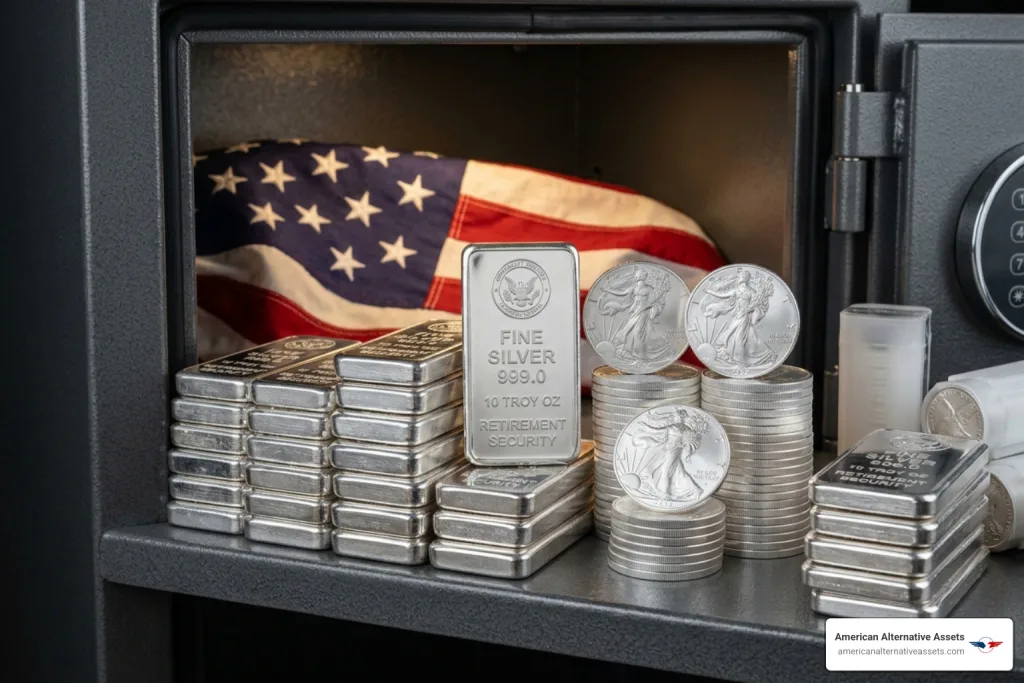
Why Starting a Silver IRA Makes Sense Right Now
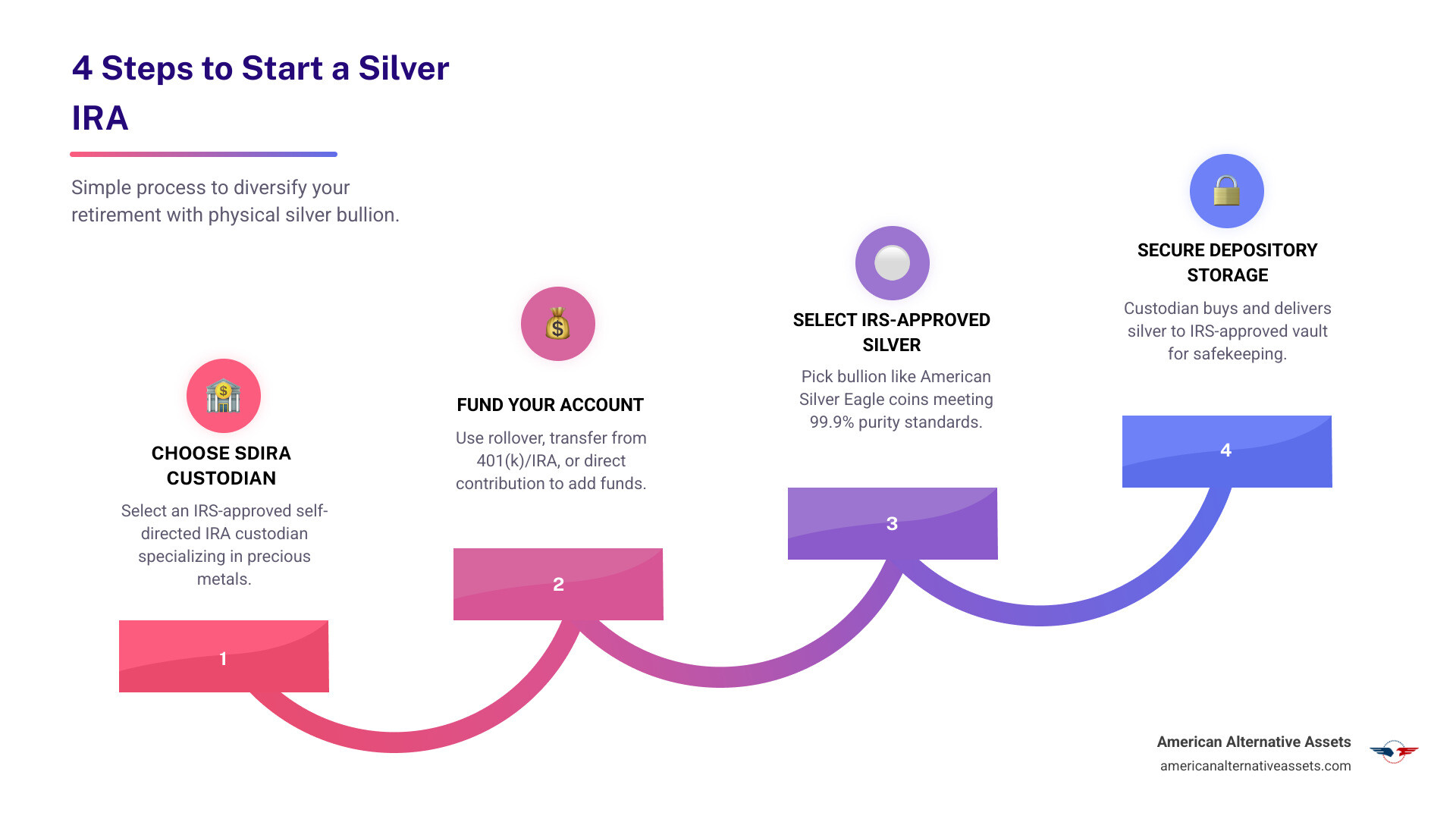
To start a silver IRA, follow these four steps:
- Choose a self-directed IRA (SDIRA) custodian that specializes in physical precious metals
- Fund your account through a rollover, transfer, or direct contribution
- Select IRS-approved silver that meets the 99.9% purity requirement
- Direct your custodian to purchase and deliver your silver to an IRS-approved depository
That’s the core process. The rest of this guide walks you through each step in detail, including IRS rules, storage requirements, and what to watch out for.
Economic uncertainty has a way of sharpening focus. When markets swing wildly and inflation chips away at purchasing power, many retirement savers start asking a simple question: Is my money in the right place?
For a growing number of Americans, the answer involves physical silver. A silver IRA is a self-directed Individual Retirement Account that holds physical silver bullion instead of paper assets like stocks or bonds. It follows the same tax rules as a traditional or Roth IRA, but gives you ownership of something real and tangible, stored in a secure, IRS-approved depository.
Silver’s appeal goes beyond its history as a store of value. Industrial demand for silver reached 680.5 million ounces in 2024, representing nearly 59% of global silver consumption, marking the fourth consecutive year of record industrial demand. That kind of structural demand, driven by solar panels, electronics, and emerging technologies, sets silver apart from purely financial assets.
I’m Shanon Davis, and my interest in physical precious metals goes back to a silver Morgan coin my grandfather placed in my hand when I was nine years old. After years in venture capital and living through the 2008 financial crisis firsthand, I built American Alternative Assets specifically to help ordinary people learn how to start a silver IRA and step outside a financial system that can feel fragile and unpredictable.
Start a silver IRA glossary:
Why Investors Choose to Start a Silver IRA in 2026
As we navigate through April 2026, the financial landscape continues to present unique challenges. Traditional portfolios, often heavily weighted in stocks and bonds, are increasingly viewed as vulnerable by those who remember the lessons of the past. We believe that to truly diversify, one must look toward assets that do not rely on the promises of a third party to hold their value.
Investors choose to start a silver IRA because it offers a triple threat of benefits: it acts as a hedge against inflation, provides essential portfolio diversification, and allows for the ownership of a tangible asset with massive industrial utility. Unlike paper assets that can be diluted or erased by corporate mismanagement, physical silver is a finite resource. It cannot be printed into existence.
Many of our clients in Woodland Hills and across California are looking for Is Silver a Good Investment? and finding that silver often moves inversely to the stock market. When confidence in the dollar or traditional equities falters, silver has historically stood its ground. This “safe haven” status is a primary reason why people are shifting their focus toward Silver IRA Rollovers and Investments. For a general overview of how precious metals IRAs work, the Internal Revenue Service IRA FAQs are also a useful reference.
The Industrial Advantage of Silver
Silver is often called the “indispensable metal.” While gold is primarily a financial asset, silver is a workhorse of the modern economy. In 2024, industrial demand hit record highs, and as we look at the data for 2025 and 2026, that trend shows no signs of slowing down.

The push for renewable energy is a massive driver. Solar panels require significant amounts of silver for their conductive paste. Additionally, the explosion in electronics, semiconductors, and electric vehicles (EVs) means that silver is being consumed at an unprecedented rate. When you start a silver IRA, you aren’t just betting on a currency hedge, you are investing in the literal building blocks of the future. This dual role as both an investment and an industrial commodity provides a unique floor for silver’s value that most other assets simply don’t have.
Physical Silver vs. Paper Assets
One of the most important distinctions we make for our clients is the difference between physical silver and “paper silver,” such as ETFs or mining stocks. When you own a silver ETF, you own a piece of paper that tracks the price of silver, but you do not own the metal itself. This introduces “counterparty risk,” which is the risk that the institution managing the fund might fail or that the paper claims exceed the actual silver in the vault.
By choosing to Discover the Power of a Self-Directed Precious Metals IRA, you eliminate that middleman. You own the physical coins and bars. They are held in your name, within your IRA, and stored in a high-security vault. In a world of digital digits and high-frequency trading, there is a profound sense of security in knowing your retirement is backed by something you can actually hold in your hand.
How to Start a Silver IRA: A Step-by-Step Guide
The process to start a silver IRA is more straightforward than many people realize, but it does require working with specialized partners. A standard brokerage like Fidelity or Schwab generally cannot hold physical bullion for you. Instead, you need a Self-Directed IRA (SDIRA).
This type of account gives you the freedom to invest in alternative assets, including precious metals, real estate, and more. Our role at American Alternative Assets is to provide white-glove service through this entire transition, ensuring that every IRS rule is followed to the letter so your wealth remains protected and private. For a broader look at the process, you can check out our Precious Metals IRA Complete Guide.
Choosing an IRS-Approved Custodian to Start a Silver IRA
The first major step is selecting a custodian. The custodian is an IRS-approved trust company that handles the administrative side of your IRA. They don’t choose your investments, that is your job, but they do handle the record-keeping, reporting to the IRS, and the movement of funds to the dealer and depository.
When you start a silver IRA, your custodian ensures that your account stays in “good standing” with the government. We work with some of the most reputable custodians in the industry to make sure our clients have a seamless experience. You can learn more about how these entities function in our Precious Metals IRA Custodians Guide.
Funding Your Account to Start a Silver IRA
Once your account is open, you need to put money in it. There are three primary ways to do this:
- Direct Transfer: If you have an existing Traditional or Roth IRA, you can transfer all or part of the funds to your new silver IRA. This is usually a “trustee-to-trustee” move, meaning the money never touches your personal bank account, which avoids any tax triggers.
- Rollover: If you have a 401(k), 403(b), or TSP from a former employer, you can “roll” those funds into your silver IRA. This is a very common way to start a silver IRA without incurring penalties.
- Annual Contribution: You can also fund the account with new cash contributions, subject to IRS limits.
For the 2026 tax year, the IRA contribution limits are $7,500 for those under age 50 and $8,600 for those age 50 or older (which includes the $1,100 catch-up contribution). If you are looking to move a larger sum from an old work plan, our Guide to Precious Metals Rollovers provides a detailed roadmap.
IRS Rules and Purity Requirements for Silver Bullion
The IRS is quite particular about what kind of silver can go into an IRA. You can’t just buy some old silver coins from a garage sale and put them in your retirement account. Under Section 408(m) of the Internal Revenue Code, only specific bullion coins and bars meet the standards for a tax-advantaged account.
The most important rule is the purity standard. For silver to be eligible, it must have a minimum fineness of .999 (99.9% pure). It must also be produced by a national government mint or an accredited refiner (such as those approved by COMEX or NYMEX).

Approved Silver Coins and Bars
Most investors who start a silver IRA stick with well-known, highly liquid products. These are easy to buy, easy to value, and easy to sell when the time comes for distributions. Common choices include:
- American Silver Eagle: The official silver bullion coin of the United States.
- Canadian Silver Maple Leaf: Known for its extreme purity and advanced security features.
- Australian Kookaburra or Kangaroo: Popular coins from the Perth Mint.
- Austrian Philharmonic: A beautiful European choice.
- Silver Bars: PAMP Suisse, Sunshine Minting, or Royal Canadian Mint bars are also excellent options, provided they carry the proper hallmarks and weight stamps.
For a full breakdown of what you can and cannot buy, see The Definitive List of IRA Approved Silver.
Prohibited Items and Collectibles
It is just as important to know what is not allowed. The IRS generally prohibits “collectibles” in an IRA. This includes:
- Numismatic Coins: Rare or antique coins where the value is based on scarcity rather than metal content.
- Junk Silver: Pre-1965 U.S. coins that are only 90% silver.
- Personal Jewelry or Silverware: Even if it is pure silver, it cannot be held in an IRA.
- Personally Owned Silver: You cannot sell silver you already own to your own IRA. That is considered a “prohibited transaction.”
To keep your account compliant, it is vital to follow the Precious Metals IRA Rules Guide closely.
Secure Storage and Depository Requirements
One of the biggest misconceptions about a silver IRA is that you can keep the silver at your house. While we understand the desire to have your wealth close at hand, the IRS is very clear: IRA-owned precious metals must be held by a qualified third party in an IRS-approved depository.
These depositories are like Fort Knox for private citizens. They offer multi-layered security, 24/7 monitoring, and full insurance coverage. Major names in the industry include the Delaware Depository and Brink’s Global Services. When you work with reputable dealers, they will help coordinate the shipping of your metals directly to one of these secure facilities.
Segregated vs. Commingled Storage
When you set up your storage, you will usually have two choices:
- Commingled Storage: Your silver is stored in a large vault with silver belonging to other investors. You still own the exact weight and type of silver you bought, but you might not get the exact same physical bar back when you take a distribution. This is often the more cost-effective option.
- Segregated Storage: Your silver is kept in a separate, individual locker or “pallet” away from everyone else’s metal. You are guaranteed to get back the exact same physical items you put in.
We often discuss these options during our Precious Metals Retirement Account Complete Guide consultations to help you decide which fits your needs for privacy and security.
Why Home Storage is Prohibited
We have seen many “schemes” online suggesting that you can set up a “Home Storage IRA” using an LLC. We strongly advise our clients to be extremely cautious here. The IRS has successfully challenged these arrangements in court (notably in the McNulty v. Commissioner case).
If the IRS determines that you have “unfettered access” to your IRA silver at home, they may treat the entire account as a taxable distribution. This means you would owe income tax on the total value of the silver, plus a 10% early withdrawal penalty if you are under age 59.5. To avoid this nightmare, always use an approved depository, as explained in our Precious Metals IRA Complete Guide.
Frequently Asked Questions about Silver IRAs
Deciding to start a silver IRA often brings up a few specific questions. Here is a quick breakdown of the most common topics we discuss with our clients.
| Feature | Traditional Silver IRA | Roth Silver IRA |
|---|---|---|
| Funding | Pre-tax or tax-deductible dollars | Post-tax dollars |
| Growth | Tax-deferred | Tax-free |
| Distributions | Taxed as ordinary income | Tax-free (if qualified) |
| RMDs | Required starting at age 73 | No RMDs during owner’s life |
How long does it take to start a silver IRA?
The timeline can vary depending on how quickly your current custodian moves, but generally, the process takes 10 to 15 business days.
- Days 1-3: Open your new SDIRA account and receive your account number.
- Days 3-10: Funds are transferred or rolled over from your old account.
- Days 10-15: You select your silver, the purchase is executed, and the metal is shipped to the depository.
What are the RMD rules for silver?
If you have a Traditional Silver IRA, you must begin taking Required Minimum Distributions (RMDs) starting at age 73. One of the unique benefits of a silver IRA is that you can take these distributions “in-kind.” This means instead of selling your silver for cash and taking the cash, you can have the actual physical silver coins shipped directly to your home. You still pay the taxes on the value, but you get to keep the metal.
Can I move silver I already own into an IRA?
No. As mentioned earlier, this is a prohibited transaction. The IRS requires that all assets in an IRA be purchased using the funds within that IRA. If you have a collection of silver at home that you want to “move” into an IRA, the only legal way is to sell that silver personally and then use the cash to make a new annual contribution to your IRA (within the yearly limits).
Conclusion
Starting a silver IRA is a proactive step toward taking control of your financial future. In a world of digital uncertainty, the weight of physical silver provides a level of peace of mind that paper assets simply cannot match. Whether you are driven by the record-breaking industrial demand for silver or the need for a proven inflation hedge, adding “the white metal” to your retirement strategy is a time-tested way to diversify.
At American Alternative Assets, we pride ourselves on our white-glove, relationship-first service. We aren’t just here to facilitate a transaction; we are here to build a foundation of trust and transparency. We believe every American deserves real privacy and protection for their hard-earned wealth.
If you are ready to move from zero to silver, we invite you to Start your journey with a Precious Metals IRA today. Our team is ready to help you navigate the rules, choose the right products, and secure your legacy with physical silver.
This article is for informational purposes only and does not constitute financial advice. Please consult your financial advisor before making investment decisions.
Investing in precious metals involves risk. Past performance does not guarantee future results.