







Why the BRICS Nations Economy Is Reshaping Global Finance
The BRICS nations economy is one of the most significant economic shifts of the 21st century, and it’s happening right now, whether most Americans are paying attention or not.
Here’s a quick snapshot of where things stand:
| Metric | BRICS | G7 |
|---|---|---|
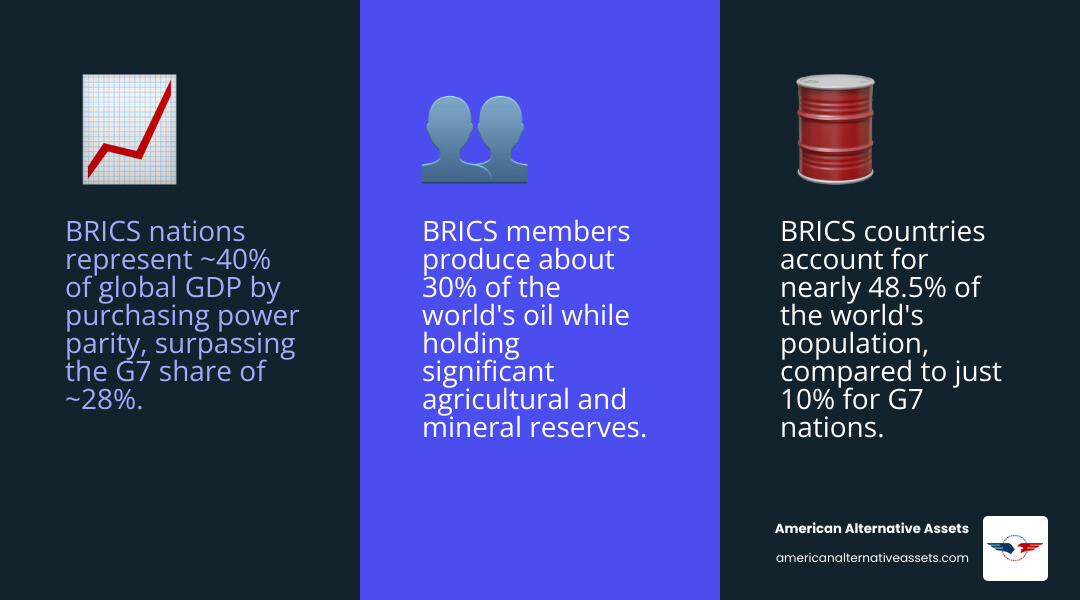
| GDP (Purchasing Power Parity) | ~$78 trillion (40%+ of global GDP) | ~$48 trillion (~28%) |
| GDP (Nominal) | ~$32 trillion | ~$54.5 trillion |
| Share of World Population | ~48.5% | ~10% |
| Oil Production Share | ~30% of global output | Significantly less |
| Agricultural Output | ~45% of global products | Minority share |
| Projected GDP Growth (2025) | ~3.4% | ~1.2% |
What does this mean for you? As BRICS nations grow in economic weight, they are actively working to reduce dependence on the US dollar. That has real implications for inflation, purchasing power, and the long-term stability of dollar-denominated savings.
This isn’t distant geopolitics. It connects directly to how much your retirement savings may be worth in 10 or 20 years.
The bloc now includes 11 full members, from Brazil and China to the UAE and Ethiopia. Together, they account for nearly half the world’s population and a growing share of global trade, energy, and food production. And more countries are lining up to join.
The dollar still dominates global trade, but its share of global foreign exchange reserves has slipped from over 70% in the early 2000s to around 59% today. That’s a slow trend, but a consistent one.
I’m Shanon Davis, founder of American Alternative Assets, and my background in venture capital and wealth preservation has given me a front-row seat to how shifts in the global BRICS nations economy create ripple effects for everyday American investors. Understanding these forces is the first step toward protecting what you’ve built.
Quick BRICS nations economy definitions:
What is the BRICS Bloc and Why is it Expanding?
To truly understand the BRICS nations economy, we have to look back at how this alliance came together. The concept started as “BRIC,” an analytical term coined by Goldman Sachs economist Jim O’Neill in 2001 to describe the fast-growing emerging markets of Brazil, Russia, India, and China.
What began as an investment concept quickly turned into a formal political alliance. The founding nations held their first official summit in 2009. By 2011, South Africa formally joined, expanding the acronym to BRICS. For more details on the origins, check out our guide on All About BRICS Nations.
For over a decade, this core group focused on increasing its voice in global financial institutions like the World Bank and the International Monetary Fund (IMF). However, the real turning point came with the historic expansion.
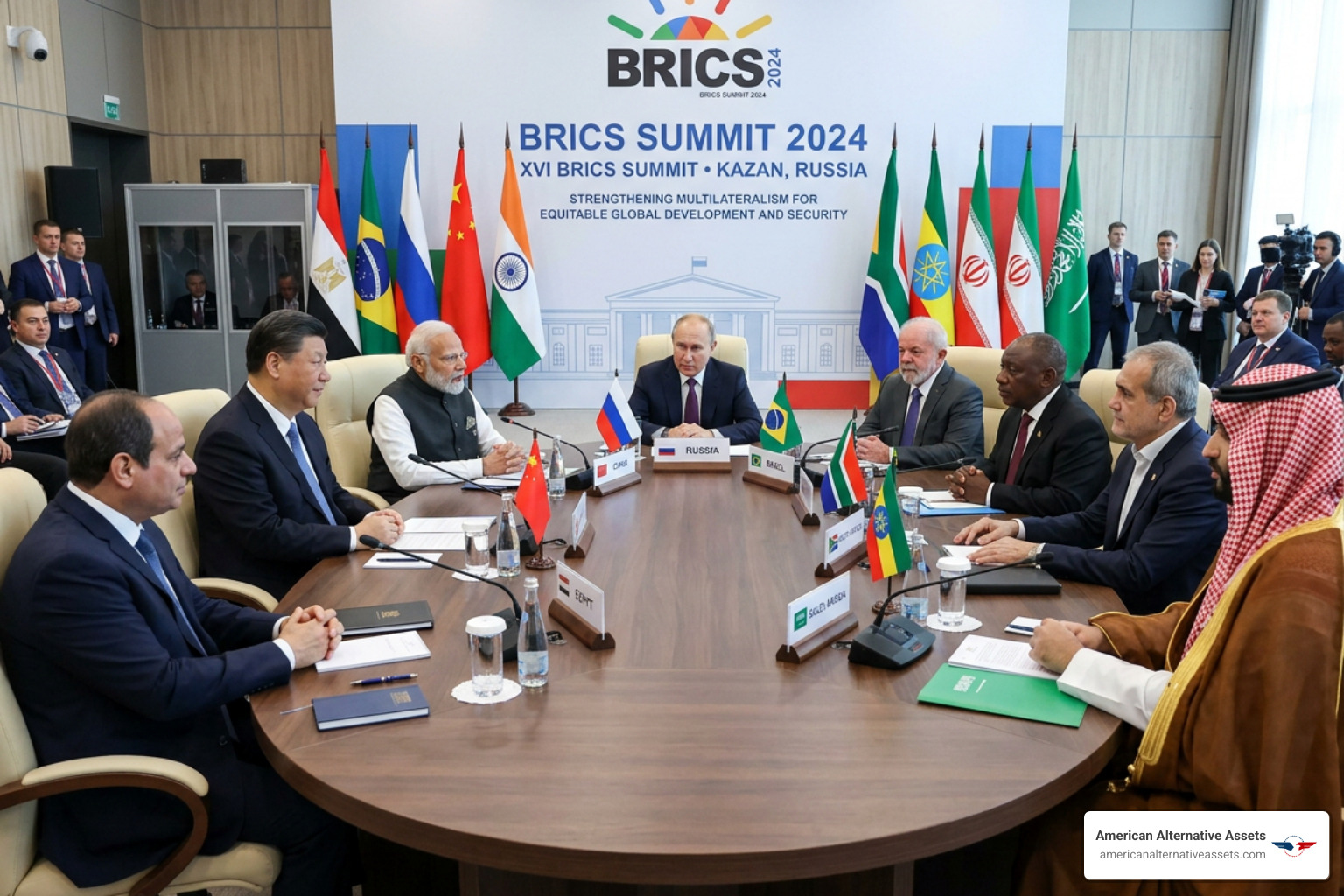
In early 2024, the bloc welcomed Egypt, Ethiopia, Iran, and the United Arab Emirates (UAE) as full members. Saudi Arabia was invited and has participated in activities, though it has proceeded with caution. To understand the geopolitical weight of these additions, read about The New BRICS Members You Need to Know About.
To handle the massive surge of interest from other nations, the bloc introduced a “partner countries” category in late 2024. This allows countries like Cuba, Bolivia, and others to align with the bloc’s initiatives without taking on full membership. For example, you can see how this plays out in Cuba’s Bold Move to Join BRICS What it Means for the U.S. Dollar and Global Power Shifts.
This expansion is driven by a shared desire among emerging economies to build parallel systems of finance and trade. By expanding, the BRICS alliance is positioning itself as the premier voice for the Global South, creating an alternative network that functions independently of Western financial control.
Evaluating the BRICS Nations Economy: Growth, Scale, and G7 Comparisons
The sheer scale of the expanded BRICS nations economy is reshaping global finance. In 2026, the contrast between the G7 (the United States, Canada, the UK, France, Germany, Italy, and Japan) and the BRICS bloc is starker than ever.
While the G7 historically dictated global economic policy, BRICS has quietly overtaken it in several key metrics. According to BRICS 2026 Statistics | BRICS Nations & Key Facts – The World Data, the expanded bloc now accounts for roughly 46% of the world’s population and 25% of its landmass.
When measuring economic output, the method matters. In nominal terms, the G7 still holds the lead, with a combined GDP of around $54.52 trillion compared to the BRICS total of over $32 trillion. However, when using Purchasing Power Parity (PPP), which adjusts for the actual cost of goods in each country, the picture flips.
By PPP standards, the BRICS+ economy has reached approximately $78 trillion, representing over 40% of global economic output, while the G7 sits at roughly 28%. This divergence has caught the attention of world leaders. In fact, as highlighted in BRICS Has Overtaken G7 Economies and Will Grow Further: Russian Finance Minister – 12.05.2026, Sputnik India, the gap between these two blocs is projected to widen as emerging markets continue to outpace Western growth rates.
The Role of China and India in the BRICS Nations Economy
Within the bloc, China and India serve as the twin engines of growth, though they play very different roles.
China remains the industrial and technological heavyweight. It accounts for more than half of the total BRICS economic output under PPP terms. China’s massive manufacturing capacity, heavy investments in artificial intelligence, and green energy supply chains provide the bloc with unmatched industrial power.
India, on the other hand, is the fastest-growing major economy in the world. With growth forecasts for 2026 hovering around 6.6%, India is rapidly expanding its digital infrastructure, consumer markets, and technology corridors.
For a deeper look at these dynamics, the BRICS GDP Growth 2026: A Strategic Guide for US Investors – Johnymillionaire outlines how capital is rotating toward these high-growth corridors.
Resource Wealth and Commodity Dominance
Beyond manufacturing and technology, the true leverage of the BRICS bloc lies in its control over vital global resources. With the inclusion of major energy producers like Iran and the UAE, the bloc now controls:
- Over 43% of global crude oil production.
- More than 50% of the world’s natural gas reserves.
- Over 78% of global mineral coal production.
This resource dominance extends directly into agriculture and food security. The expanded bloc contributes to roughly 45% of global agricultural products. According to the SnapshotBRICSJointStatisticalPublication_2025.pdf, BRICS nations produce approximately 42% of the world’s wheat, 52% of its rice, and 46% of its soybeans.
Additionally, the bloc controls roughly 72% of the world’s rare earth mineral reserves, which are critical for manufacturing electronics, defense systems, and green energy technologies. This gives the BRICS alliance unprecedented leverage in global supply chains.
Financial Architecture: The New Development Bank and De-Dollarization
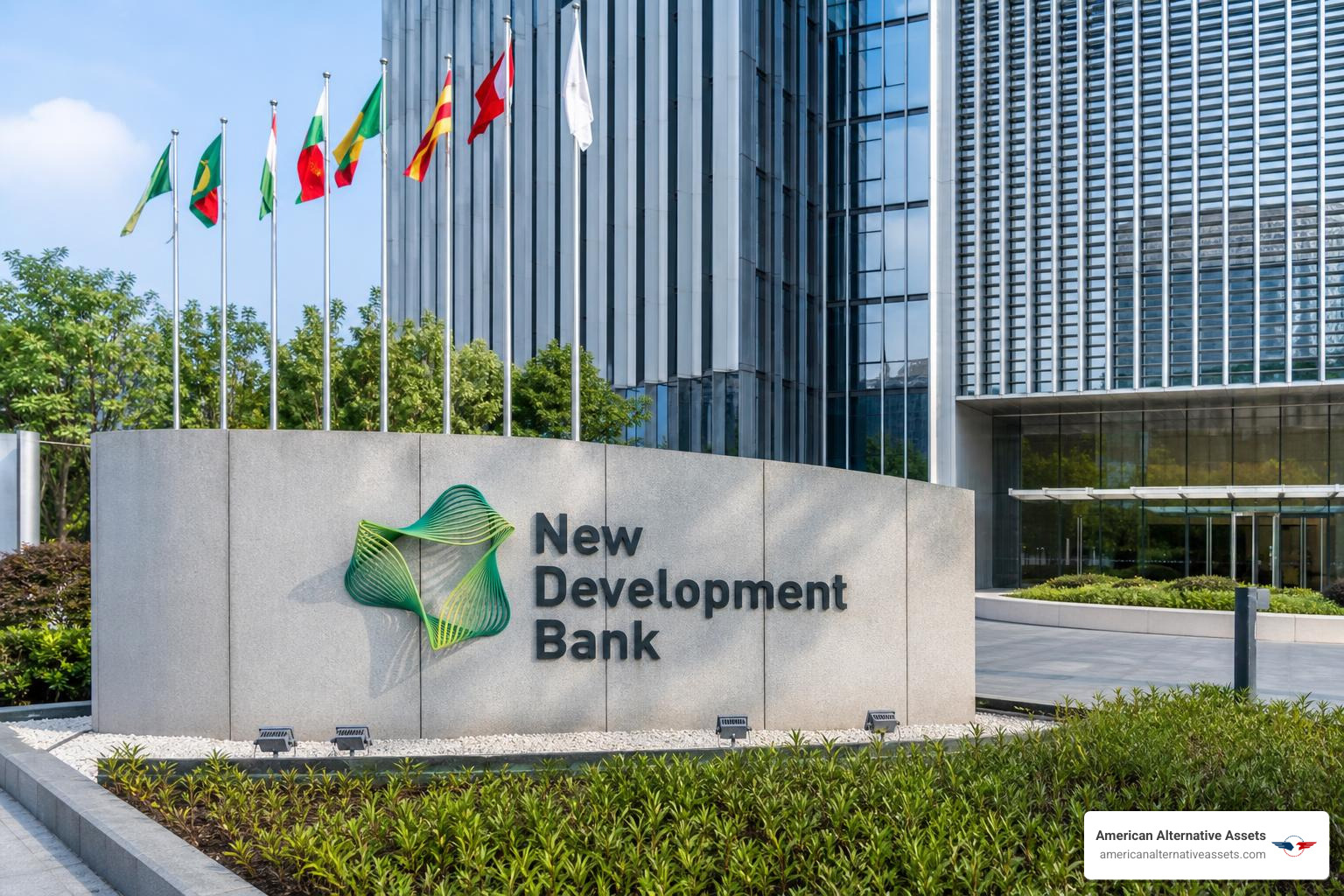
To build a truly independent economic system, the BRICS nations recognized they needed their own financial institutions. In 2015, they launched the New Development Bank (NDB), headquartered in Shanghai, alongside the Contingent Reserve Arrangement (CRA).
The NDB was designed as an alternative to the World Bank, focusing on funding infrastructure and sustainable development projects in emerging markets. Since its operations began, the NDB has approved more than $32 billion for nearly one hundred projects. Unlike Western institutions, which often attach strict structural adjustment demands to their loans, the NDB aims to provide financing with fewer political strings attached.
The CRA serves as a financial safety net, providing member nations with liquidity during balance-of-payments crises. This allows members to access emergency funding without relying solely on the IMF. Together, these institutions form the core of the bloc’s parallel financial architecture, as discussed in The Rise of BRICS and the Fall of the US Dollar.
The Push for Local Currency Settlement
A major focus of the BRICS nations economy is reducing the risk of relying on a single currency, specifically the US dollar. When Western nations froze approximately $300 billion in Russian foreign exchange reserves following the conflict in Ukraine, it sent a clear signal to developing nations. Many realized that relying on the dollar-dominated SWIFT payment system left them vulnerable to unilateral sanctions.
In response, the bloc has accelerated local currency settlement for bilateral trade. The results are already visible:
- Russia-China Trade: Approximately 95% of bilateral trade between Russia and China is now settled in rubles and yuan.
- The Renminbi’s Rise: The Chinese renminbi now accounts for roughly 47% of all intra-BRICS trade transactions.
- Alternative Payment Systems: The development of “BRICS Pay,” a decentralized, blockchain-based system, aims to bypass SWIFT entirely, allowing members to settle trade directly in their national currencies.
As explored in The Real Promise of BRICS Lies in Building Alternatives | Countercurrents, the goal is not necessarily to destroy the dollar overnight, but to build functional, parallel systems that make Western financial pressure far less effective.
Prospects for a Common BRICS Currency
There has been significant discussion about the creation of a unified BRICS currency, sometimes referred to as “the Unit,” which could potentially be backed by a basket of national currencies and hard assets like gold.
However, launching a shared currency faces massive structural hurdles. Unlike the European Union, the BRICS nations do not share a unified monetary policy, a central bank, or integrated political systems. Member countries are highly protective of their monetary sovereignty, and nations like India are hesitant to support any system that might inadvertently increase China’s financial dominance.
For a realistic assessment of these challenges, read our analysis on Will the BRICS Currency Actually Break the Buck? or explore How Would a New BRICS Currency Affect the US Dollar? | INN for an external perspective. While a single, physical BRICS currency may be far in the future, the rapid shift toward using local currencies for trade is already quietly reducing global demand for the dollar.
Geopolitical Tensions and Internal Divisions
While the economic scale of the BRICS bloc is undeniable, it is far from a monolithic alliance. The group is held together by a shared desire for a multipolar world, but it is also divided by deep geopolitical rivalries, diverse political systems, and economic imbalances.
The most significant internal division is the relationship between China and India. The two nuclear-armed neighbors share a disputed border and have engaged in military standoffs.
Economically, India faces a massive trade deficit with China, which reached $116 billion in 2025. India also plays a delicate balancing act, maintaining active participation in BRICS while simultaneously strengthening its security ties with the United States through the Quadrilateral Security Dialogue (the Quad).
Furthermore, the members hold very different foreign policy goals:
- Anti-Western Stance: Countries like Russia and Iran view the bloc as a direct tool to confront Western hegemony and bypass sanctions.
- Non-Aligned Stance: Members like Brazil, India, and the UAE view BRICS as a way to diversify their diplomatic relationships, not as an anti-Western alliance. They value their trade relationships with both the United States and Europe.
These differing priorities are highlighted in America has natural partners for economic statecraft among many … , which notes that many BRICS nations remain natural economic partners for the West despite their participation in the bloc.
Structural Vulnerabilities Within the BRICS Nations Economy
The BRICS nations economy also faces deep internal structural vulnerabilities.
First, there is a fundamental imbalance in trade patterns. Seven of the ten full members rely on primary commodities, such as oil, minerals, and agricultural products, for over 60% of their exports to other bloc members. Meanwhile, China dominates the export of high-value manufactured goods. This creates a classic primary-versus-manufactured goods imbalance, where some members worry they are simply trading reliance on the West for reliance on China.
Second, the economic performance of individual members varies wildly. While China and India continue to expand, other members face severe domestic challenges. For example, South Africa struggles with high unemployment, which hovered around 32.3% in 2024, alongside persistent infrastructure bottlenecks.
These economic differences, combined with currency volatility and exposure to commodity price shocks, make deep policy integration difficult to achieve.
How the Rise of BRICS Impacts US Investors and the Dollar
For decades, the US dollar has enjoyed “exorbitant privilege” as the world’s primary reserve currency. This status allows the United States to run large budget deficits and borrow at lower interest rates, as central banks around the world must hold dollars to facilitate global trade.
However, the rapid growth of the BRICS nations economy and their deliberate push toward de-dollarization represent a gradual shift in this dynamic. If global demand for the dollar declines, even by a modest percentage, the economic consequences for American savers could be significant:
- Increased Inflation: A weaker dollar means imported goods become more expensive for American consumers.
- Higher Borrowing Costs: To attract buyers for its debt, the US government may have to offer higher interest rates, which can drive up mortgage and credit card rates.
- Purchasing Power Decline: Over time, savings tied solely to the dollar may lose real purchasing power.
This changing landscape is why global trade tensions are rising. To understand the political responses to these shifts, read about Why Trump is Targeting BRICS and What it Means for the Dollar and Your Wealth.
Central Bank Gold Accumulation
As the global monetary system becomes more fragmented, central banks around the world are taking proactive steps to protect their reserves. Instead of holding only paper currencies, they are buying physical gold at historic rates.
According to data from the World Gold Council, gold now accounts for roughly 15% of global foreign exchange reserves, up from 11% just five years ago. China and Russia together hold more than 4,400 tons of gold in their official reserves.
This trend is not a coincidence. Gold is a tangible asset that cannot be devalued by central bank printing presses or frozen by foreign governments. By increasing their gold exposure, central banks are returning to sound money principles to hedge against currency and geopolitical risks. You can track this ongoing shift through our updates on Central Banks.
Protecting Wealth with Physical Precious Metals
For individual retirement savers, the lesson from global central banks is clear: diversification is essential during times of monetary transition.
When wealth is concentrated only in dollar-based accounts, it may be more exposed to currency depreciation, market stress, and systemic uncertainty. Physical precious metals offer direct ownership of a tangible asset with no counterparty risk.
This is a critical distinction. Many investors mistakenly turn to paper assets, such as gold ETFs, mutual funds, or gold mining stocks, believing they offer the same protection. In reality, these paper instruments carry significant disadvantages. They expose you to counterparty risks, fund management decisions, and stock market volatility, all without giving you actual ownership of a single ounce of metal. If the financial system faces a severe crisis, a paper contract may prove worthless.
In contrast, physical precious metals in a Gold, Silver, and Precious Metals IRA provide true security. Many American investors are choosing to diversify their retirement savings by establishing a Precious Metals IRA. This specialized self-directed IRA allows you to hold physical, IRS-approved gold and silver coins and bars within a tax-advantaged account, ensuring you own real, tangible wealth that you can fully control.
At American Alternative Assets, we specialize in helping clients navigate this process with white-glove, relationship-first service. Based in Woodland Hills, California, we focus on transparency, trust, and ethical practices to help you secure real protection for your hard-earned wealth.
For more insights on how these global currency shifts interact with physical assets, explore Will the BRICS Currency Actually Break the Buck?.
Frequently Asked Questions About the BRICS Bloc
What is the combined GDP of the BRICS nations?
In nominal terms, the combined GDP of the 11 BRICS nations exceeds $32 trillion, representing about 28% to 30% of the global economy. However, when measured by Purchasing Power Parity (PPP), their combined GDP is approximately $78 trillion, which accounts for over 40% of global economic output. This is significantly larger than the G7’s PPP share of roughly 28%.
Can a BRICS currency replace the US dollar?
A sudden replacement is highly unlikely. The US dollar is still used in over 80% of global trade transactions and makes up about 59% of global foreign exchange reserves. The deep liquidity of US financial markets and the trust in its legal systems are difficult to replicate.
However, we are seeing a gradual diversification. Rather than a single currency replacing the dollar, the global financial system is moving toward a multipolar setup where local currencies, digital payment systems, and physical assets play a much larger role in international trade.
How can US investors hedge against de-dollarization?
Many investors choose to hedge against currency risk by diversifying a portion of their portfolio into physical precious metals. It is important to avoid paper assets like gold ETFs or mining stocks, which do not grant you ownership of physical metal and are subject to stock market volatility and counterparty failures. Instead, setting up a physical Gold, Silver, and Precious Metals IRA allows you to hold physical gold and silver coins and bars. These tangible assets historically serve as a reliable store of value when fiat currencies lose purchasing power, providing a level of safety that paper investments simply cannot match.
This article is for informational purposes only and does not constitute financial advice. Please consult your financial advisor before making investment decisions.
Conclusion
The BRICS nations economy is no longer just an emerging market trend, it is a major force in global finance. From controlling vital energy reserves to building parallel payment systems, the expanded bloc is actively creating alternatives to the traditional, dollar-centric financial order.
While these shifts happen gradually, their long-term impact on the purchasing power of the US dollar is a trend that proactive investors should monitor closely. Protecting your retirement savings requires understanding currency risk and considering tangible, time-tested forms of diversification.
At American Alternative Assets, we are here to help you navigate these global changes. By diversifying with physical gold and silver, you can build a more resilient foundation for your wealth.
If you are ready to take control of your financial preparedness, learn how to Protect your wealth with a Gold IRA today.
Disclaimers
This article is for informational purposes only and does not constitute financial advice. Please consult your financial advisor before making investment decisions.
Investing in precious metals involves risk. Past performance does not guarantee future results.