








Why Gold IRA Retirement Planning Belongs in Your Wealth Strategy
Gold IRA retirement planning is one of the most discussed strategies for protecting long-term wealth, especially as inflation, market swings, and economic uncertainty make traditional paper assets feel less reliable.
Here is a quick snapshot of what you need to know:
| Topic | Key Point |
|---|---|
| What is a Gold IRA? | A self-directed IRA that holds physical gold and other approved precious metals |
| Who can open one? | Any investor eligible for a traditional or Roth IRA |
| IRS purity requirement | Gold must be at least 99.5% pure (with one exception: American Gold Eagles) |
| Storage rule | Physical metals must be stored at an IRS-approved depository, never at home |
| Contribution limits (2026) | $7,000 per year ($8,000 if age 50 or older) |
| Tax structure | Same as traditional or Roth IRAs, depending on account type |
| Physical metals allocation discussion | Many precious metals advocates discuss 5-10% of retirement savings as a starting point for physical Gold, Silver, and Precious Metals IRAs |
| RMDs | Begin at age 73 for Traditional Gold IRAs |
Unlike a standard paper-based retirement account, a Gold IRA gives you direct ownership of a physical, tangible asset inside a tax-advantaged structure. A Silver IRA or broader Precious Metals IRA can do the same with other approved physical metals. That is a meaningful distinction when you are thinking about what your retirement savings are actually backed by.
Gold and silver have served as stores of value for centuries. During periods of high inflation, currency weakness, and market stress, physical precious metals have historically held purchasing power in ways that paper assets often have not. That does not mean gold, silver, or other precious metals are risk-free or right for every investor. But for those who want genuine diversification away from paper claims, physical metals in a retirement account offer something paper-based portfolios simply do not have.
This guide walks you through everything: IRS rules, eligible products, setup steps, tax implications, storage requirements, and how to decide how physical gold, silver, and other approved precious metals may belong in your IRA.
I’m Shanon Davis, founder of American Alternative Assets, and my background spans venture capital and years of hands-on experience helping everyday investors navigate gold IRA retirement planning and broader Precious Metals IRAs as tools for long-term wealth preservation. After watching the fragility of paper-based systems up close during the 2008 financial crisis, I built this company on one principle: helping people hold value that does not depend on anyone else’s promises.
This article is for informational purposes only and does not constitute financial advice. Please consult your financial advisor before making investment decisions.
Investing in precious metals involves risk. Past performance does not guarantee future results.
Learn more about gold IRA retirement planning:
The Role of Gold IRA Retirement Planning in Wealth Preservation
Retirement planning is not just about chasing growth through paper markets. It is about preserving purchasing power, reducing overdependence on paper assets, and preparing for economic cycles that no one can perfectly predict.
That is where physical gold, silver, and other approved precious metals can play a meaningful role through Gold, Silver, and Precious Metals IRAs.
Physical precious metals have historically been viewed as:
- A hedge during periods of inflation
- A store of value when currencies weaken
- A diversifier during stock market volatility
- Tangible assets that are not issued by a corporation or government
- Long-term wealth preservation tools
Gold prices have gone through major cycles. Gold spiked in the early 1980s, traded in a broad range for many years, then rose sharply after the 2008 financial crisis. It reached levels above $2,000 per ounce in summer 2020 and remained above that level as of January 2024. These movements remind us of two important truths: gold can rise during uncertainty, and gold can also be volatile.
That is why we do not talk about physical precious metals as a casual speculation. We talk about owning real coins and bars through a compliant IRA structure. A Gold IRA, Silver IRA, or broader Precious Metals IRA can help add a layer of resilience to retirement savings that would otherwise remain exposed to paper-based promises.
At American Alternative Assets, we believe gold IRA retirement planning works best when it is thoughtful, compliant, and aligned with the investor’s long-term physical precious metals goals.
Why Direct Physical Gold Ownership Matters
There is a major difference between owning physical gold in a self-directed IRA and owning paper exposure that merely tracks gold prices.
With a physical Gold IRA, your retirement account owns real, IRS-approved bullion coins or bars. A Silver IRA or broader Precious Metals IRA can also hold approved physical metals when IRS rules are followed. The metals are stored in an approved depository under IRA rules. With nonphysical gold exposure, you generally own a paper-based claim connected to gold pricing, not specific coins or bars held for your IRA.
That distinction matters because physical precious metals are not someone else’s promise to perform.
Here is a simple comparison:
| Feature | Physical Gold in a Gold IRA | Nonphysical Gold Exposure |
|---|---|---|
| What you own | IRS-approved gold coins or bars | Paper-based claims linked to gold prices |
| Direct metal ownership | Yes, through the IRA | No direct ownership of specific metals |
| Counterparty exposure | Reduced because the IRA owns tangible metal | Depends on third-party structures, market operations, or management decisions |
| Storage | Held at an IRS-approved depository | No physical storage for the investor because no specific metal is owned |
| Retirement purpose | Long-term wealth preservation and diversification away from paper claims | Paper exposure that remains tied to broader paper-market systems |
| Tangibility | Physical asset | Paper or digital claim |
| Systemic risk | Not eliminated, but less dependent on paper-market mechanics | More dependent on market operations and third-party structures |
Paper assets may appear convenient, but convenience is not the same as control. Paper-based gold exposure can be affected by management decisions, operational risks, debt, production costs, local regulations, and market structure. These layers can separate you from the metal itself.
For investors who want true retirement diversification through tangible assets, physical ownership is the point.
For a deeper look at how metals can fit into a broader physical precious metals plan, read The Complete Guide to Making Your Portfolio More Precious.
IRS Rules and Requirements for Physical Gold IRAs
A Gold IRA is not a loophole or a special side account. It is a self-directed IRA that follows IRS rules for retirement accounts. The main difference is that it allows certain physical precious metals, including gold, silver, platinum, and palladium, when they meet strict requirements.
The IRS does not simply allow you to buy any gold coin you like and call it retirement planning. There are rules around:
- Account structure
- Custodian involvement
- Metal purity
- Approved product types
- Storage
- Distributions
- Prohibited transactions
A Gold IRA, Silver IRA, or broader Precious Metals IRA usually involves three key parties:
- The account owner, meaning you
- A qualified self-directed IRA custodian
- An IRS-approved depository that stores the metals
The custodian administers the IRA, handles reporting, and helps keep the account compliant. The depository stores the metals securely. The metals dealer helps source eligible coins or bars, but the IRA custodian must be part of the process.
You can review general federal IRA information through the IRS overview of Individual Retirement Arrangements. Because Gold, Silver, and Precious Metals IRAs involve additional physical metals rules, always confirm details with your custodian and tax professional before acting.

Eligible Gold Products for Your Retirement Account
Not all gold qualifies for a Gold IRA.
In general, IRA-eligible gold must meet a minimum fineness of 99.5%. One major exception is the American Gold Eagle, which is specifically permitted even though it is 91.67% pure. This exception exists because American Gold Eagles are explicitly recognized under the applicable IRA rules.
Common eligible gold products may include:
- Certain American Gold Eagle coins
- Certain American Gold Buffalo coins
- Certain Canadian Gold Maple Leaf coins
- Certain Australian Kangaroo/Nugget coins
- Certain gold bars produced by approved refiners or government mints
- Certain gold rounds or bullion products that meet IRS standards
Products that generally do not qualify include:
- Jewelry
- Rare collectibles
- Most numismatic coins
- Privately held gold you already own personally
- Gold products that do not meet required purity or production standards
This last point surprises many people. You generally cannot take coins from your personal safe and move them into a Gold IRA. The IRA must purchase approved metals through the proper process using IRA funds.

If you want help understanding eligible physical products for a Gold, Silver, or Precious Metals IRA, see our guide on how to buy gold for an IRA account.
IRS-Approved Storage and the Home Storage Myth
This is one of the most important rules in the entire Gold IRA and Precious Metals IRA world:
You cannot store IRA-owned gold at home.
That means no bedroom safe, no backyard vault, no “secret shelf behind the canned beans” strategy. We appreciate creativity, but the IRS does not.
Physical metals owned by an IRA must be held by an approved trustee or depository. If the account owner takes personal possession before a proper distribution, the IRS may treat it as a taxable distribution. If the investor is under age 59 1/2, additional penalties may apply.
The Tax Court case McNulty v. Commissioner reinforced the risks of attempting personal control over IRA-owned metals. The practical takeaway is simple: keep IRA metals in approved storage.
Approved depositories are used because they provide:
- Secure storage
- Insurance arrangements
- Inventory controls
- Independent handling
- Compliance-focused custody
- Separation between personal assets and IRA assets
Some investors may have the option of segregated or commingled storage, depending on custodian and depository arrangements. Segregated storage generally means your metals are stored separately from other account holders’ metals. Commingled storage means metals of the same type may be stored together while ownership is tracked by records.
For a deeper explanation, read our guide to IRA gold storage.
How to Set Up and Fund Your Gold IRA
Opening a Gold IRA is not difficult, but it should be done carefully. The goal is to create a compliant retirement account that can legally purchase and hold approved physical metals. The same compliance-focused approach applies to Silver IRAs and broader Precious Metals IRAs.
At American Alternative Assets, we help clients through this process with a white-glove, relationship-first approach. That means we focus on clarity, privacy, transparency, and ethical guidance from start to finish.
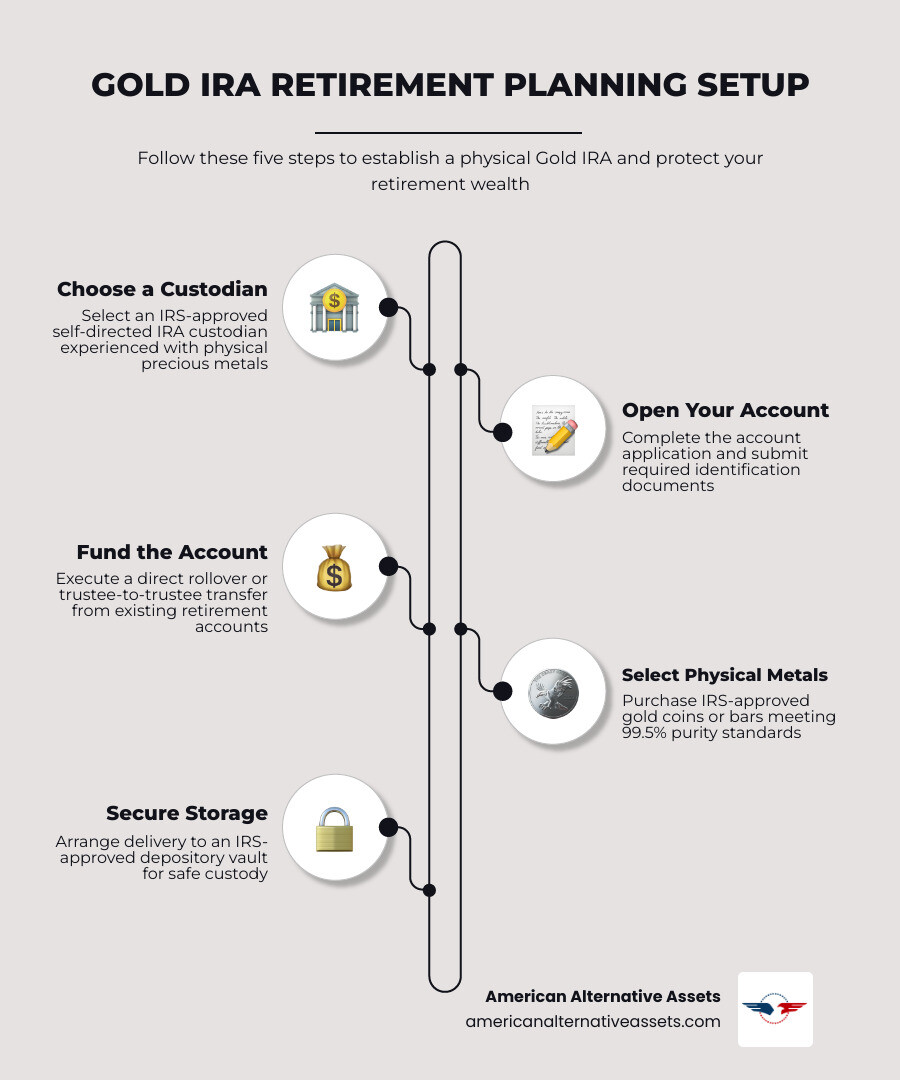
A Gold IRA setup generally includes:
- Choosing a self-directed IRA custodian
- Opening the account
- Funding the account
- Selecting approved physical metals
- Coordinating storage with an approved depository
- Maintaining records and account awareness
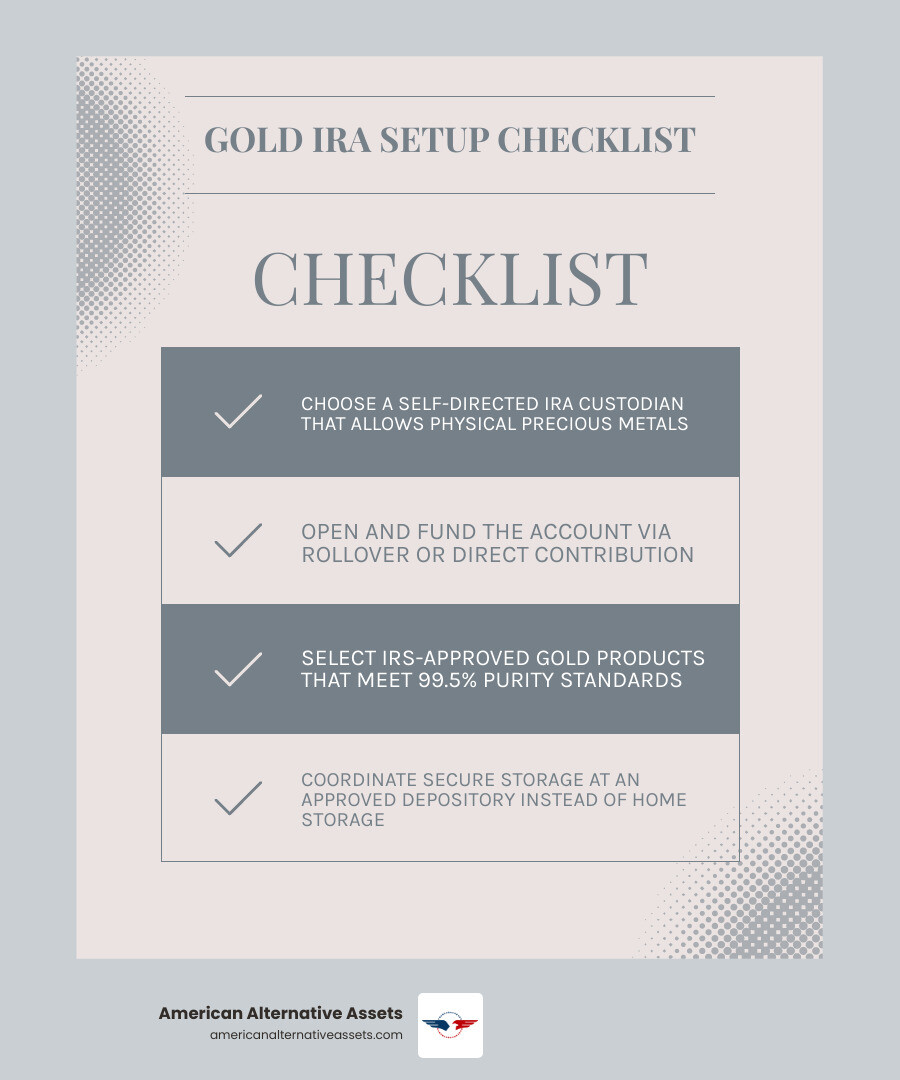
Step-by-Step Gold IRA Retirement Planning Setup
Here is the process in plain English:
Choose your Gold IRA support team
You will need a self-directed IRA custodian and a precious metals provider that understands IRS rules. We help clients navigate the process so they are not left guessing.Open the self-directed IRA
The custodian provides the application and account documents. You choose whether the account is Traditional, Roth, or another eligible structure.Fund the account
Funding may come from a new contribution, an IRA transfer, or a rollover from an eligible retirement plan.Select IRS-approved metals
You choose physical gold, silver, platinum, or palladium that meets IRA rules.Direct the custodian to purchase the metals
The IRA, not you personally, buys the metals. This matters for compliance.Store metals at an approved depository
The metals are shipped to and held by the approved storage facility.Review your account over time
Retirement planning is not “set it and forget it forever.” It is wise to review your Gold, Silver, or Precious Metals IRA allocation, tax rules, and distribution needs regularly.
For more on custodians, see our Precious Metals IRA custodian guide.
Direct Rollovers and Trustee-to-Trustee Transfers
Many investors fund a Gold IRA by moving money from an existing retirement account into a self-directed IRA that can hold approved physical precious metals. Common source accounts may include:
- Traditional IRA
- Roth IRA
- SEP IRA
- SIMPLE IRA, subject to special timing rules
- Former employer 401(k)
- 403(b)
- Governmental 457(b)
- Thrift Savings Plan, when eligible
There are two common ways to move funds.
A trustee-to-trustee transfer usually moves money directly from one IRA custodian to another. You do not personally receive the funds. This is often the simplest path for IRA-to-IRA movement.
A direct rollover usually moves funds from an employer-sponsored retirement plan, such as a former employer 401(k), directly into an IRA. Again, the funds do not pass through your personal bank account.
An indirect rollover is different. The money is sent to you first, and you generally have 60 days to deposit it into another eligible retirement account. Missing that deadline can create taxes and penalties. Employer plan distributions may also involve mandatory withholding, which can make indirect rollovers more complicated.
For most investors, direct movement of funds reduces administrative risk when establishing a Gold, Silver, or Precious Metals IRA. Always speak with your tax professional and plan administrator before starting.
For additional background, read our Precious Metals IRA complete guide. Confirm all funding details with your own custodian, plan administrator, and tax professional before initiating a transfer or rollover.
Tax Implications and Portfolio Allocation Considerations
Gold IRAs follow the same basic tax framework as other IRAs. The tax treatment depends on the account type, not on the fact that the asset is gold. The same general framework applies when a self-directed IRA holds approved physical silver, platinum, or palladium.
That means you should consider:
- Whether the account is Traditional or Roth
- Whether contributions are deductible
- Whether income limits apply
- How withdrawals are taxed
- When required minimum distributions begin
- How metals may be sold or distributed
- How physical precious metals fit within your retirement plan
Traditional vs. Roth Gold IRA Retirement Planning
A Traditional Gold IRA may allow tax-deductible contributions, depending on your income, filing status, and workplace retirement plan coverage. Growth is generally tax-deferred. Withdrawals in retirement are usually taxed as ordinary income.
A Roth Gold IRA is funded with after-tax dollars. Qualified withdrawals may be tax-free if IRS requirements are met, including the five-year rule and age requirements. Roth IRAs also do not have required minimum distributions during the original owner’s lifetime under current rules.
As of 2026, IRA contribution limits are:
| Age | Annual IRA Contribution Limit |
|---|---|
| Under 50 | $7,000 |
| 50 or older | $8,000 |
These limits apply across your IRAs combined, not separately to every IRA you own. For example, if you contribute to both a Roth IRA and a Gold IRA, your combined contributions must stay within the annual limit.
Traditional Gold IRAs are subject to required minimum distributions beginning at age 73 under current law. RMDs may be handled by selling enough metal to generate cash or by taking an in-kind distribution of physical metals. Either way, planning ahead matters.
For a balanced view of benefits and considerations, read Gold IRA Pros and Cons.
Determining Your Physical Precious Metals Allocation
How much physical gold, silver, and other approved precious metals should you hold in a retirement account?
Many precious metals advocates discuss a 5-10% allocation to physical gold or precious metals as a starting point for diversification away from paper claims. Some investors may choose more or less depending on age, risk tolerance, retirement timeline, income needs, and views on inflation.
We do not believe in cookie-cutter allocation discussions. A person nearing retirement may think differently than someone with 25 years to go. A conservative investor may value tangible ownership differently than an investor who is still heavily exposed to paper-market volatility.
Consider these questions:
- How much of your retirement is tied to paper-based market assets?
- Are you concerned about inflation or currency weakness?
- Do you want direct ownership of physical assets?
- How soon will you need income from the account?
- Are you comfortable with gold and silver price fluctuations?
- Have you discussed physical metals allocation with a qualified advisor?
Gold, silver, platinum, and palladium do not pay dividends or interest. Their value depends on market pricing. Physical metals can help diversify away from paper claims, but purchases should be made through a compliant Gold, Silver, or Precious Metals IRA plan, not impulsively.
For a deeper overview, visit The Ultimate Guide to Precious Metals IRAs: What You Need to Know.
Frequently Asked Questions About Gold IRAs
Gold IRAs are simple in concept, but the rules matter. The same is true for Silver IRAs and broader Precious Metals IRAs that hold approved physical coins and bars. Here are the questions we hear most often from investors exploring physical precious metals for retirement.
Can I store my Gold IRA coins at home?
No. IRA-owned metals must be stored at an IRS-approved depository or qualified facility through the IRA structure.
If you store Gold IRA coins at home, in a personal safe, or in a personal safe deposit box under your control, the IRS may treat that as a distribution. That can trigger ordinary income taxes and, if you are under age 59½, a possible early withdrawal penalty.
Personal ownership of gold outside an IRA is different. You may buy personal precious metals and store them as you choose. But if the metals are owned by your IRA, they must follow IRA custody rules.
What are the contribution limits for a Gold IRA?
For 2026, the annual IRA contribution limit is $7,000 if you are under age 50 and $8,000 if you are age 50 or older.
These limits apply to total IRA contributions across Traditional and Roth IRAs. Rollovers and transfers generally do not count against annual contribution limits.
Contribution rules can change, and eligibility may depend on income, account type, and tax filing status. Always check current IRS guidance or speak with a tax professional before contributing.
How do RMDs work with physical gold?
Traditional Gold IRAs are subject to required minimum distributions beginning at age 73 under current law.
Because a Gold IRA holds physical metals, there are generally two ways to satisfy an RMD:
- Sell a portion of the metals through the IRA and take cash
- Take an in-kind distribution of metals, meaning the metals are distributed to you personally
Once metals are distributed from the IRA, they are no longer IRA assets. The value of the distribution is generally taxable as ordinary income for Traditional IRAs.
This is why planning ahead matters. Gold and silver prices can change, and physical metals are not divided as easily as cash in a bank account. Your custodian can help coordinate the mechanics, and your tax professional can help you understand the tax result.
Conclusion
Gold IRA retirement planning is about more than owning shiny coins, although we admit, shiny coins are not exactly a downside.
At its core, a physical Gold IRA is about preparedness. A Silver IRA or broader Precious Metals IRA can serve the same purpose with other approved physical metals. These accounts give retirement savers a way to hold tangible precious metals inside a tax-advantaged account while adding diversification away from traditional paper assets.
The key is doing it correctly:
- Use a qualified self-directed IRA custodian
- Buy only IRS-approved metals
- Store metals at an approved depository
- Understand Traditional vs. Roth tax treatment
- Plan for RMDs if applicable
- Keep your physical metals allocation aligned with your Precious Metals IRA strategy
- Consult your financial and tax professionals before making decisions
At American Alternative Assets, we help clients pursue physical precious metals with a relationship-first approach built on trust, transparency, privacy, and ethical practices. Whether you are in Woodland Hills, elsewhere in California, or simply researching your next step, we are here to help you understand the process clearly.
If you are ready to explore physical gold inside a retirement account, visit our American Alternative Assets Gold IRA page.
Additional resources for continued research:
- The Ultimate Guide to Precious Metals IRAs
- Discover the Power of a Self-Directed Precious Metals IRA Today
- Understanding Your Gold Storage Options with American Alternative Assets
- Gold IRA Investing Guide
Disclaimers:
This article is for informational purposes only and does not constitute financial advice. Please consult your financial advisor before making investment decisions.
Investing in precious metals involves risk. Past performance does not guarantee future results.