








Why Protecting Retirement Assets Should Be Your Top Priority Right Now
Protecting retirement assets is one of the most important financial challenges Americans face today. Between market swings, rising costs, creditor threats, and inflation quietly eating away at purchasing power, the savings you’ve spent decades building can be more exposed than you realize.
Here is a quick overview of the most effective ways to protect your retirement assets:
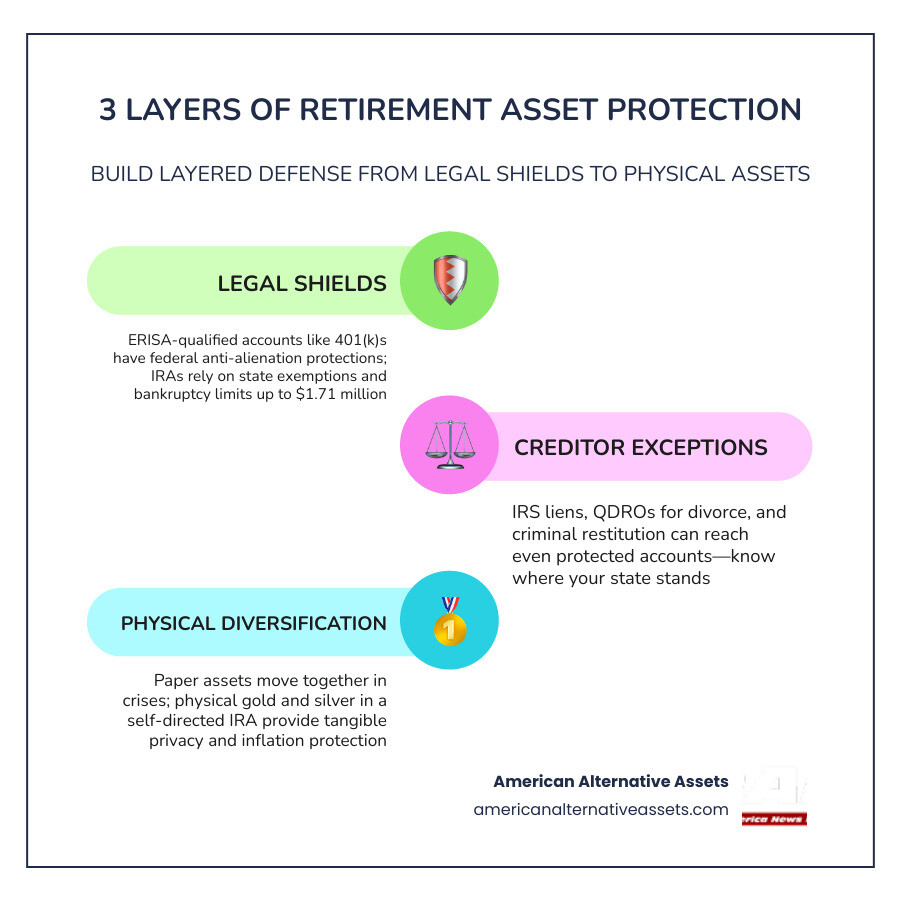
- Understand legal protections , ERISA-qualified plans like 401(k)s have strong federal creditor shields. IRAs rely more on state law and bankruptcy exemptions.
- Know the exceptions , The IRS, divorce orders (QDROs), and criminal restitution judgments can reach even well-protected accounts.
- Check your state’s rules , State exemptions for IRAs vary widely. Where you live matters.
- Diversify across asset types , Paper-based assets can lose value together during economic stress. Physical assets like gold and silver have historically behaved differently.
- Plan for beneficiaries , Retirement account protections often do not pass to heirs automatically. Proper trust structures can help.
- Manage withdrawals strategically , The order and timing of distributions affects your tax burden and how long your savings last.
- Act before a threat exists , Asset protection strategies only work when put in place early. Last-minute moves can be reversed by courts.
U.S. retirement accounts held nearly $30 trillion as recently as 2018, roughly one-third of all household financial assets. That makes retirement savings one of the largest targets for creditors, volatile markets, and inflation alike.
The challenge is that most people assume their accounts are fully protected. In reality, the level of protection depends heavily on the account type, the state you live in, and whether you’ve taken deliberate steps to build a layered defense.
This guide walks through every layer of that defense, from federal law to physical asset diversification, so you can make informed decisions about your retirement security.
I’m Shanon Davis, founder of American Alternative Assets, and my background spans venture capital and over a decade of studying how ordinary Americans can step outside fragile financial systems by protecting retirement assets with tangible, time-tested alternatives. That experience shapes everything in this guide.
This article is for informational purposes only and does not constitute financial advice. Please consult your financial advisor before making investment decisions. Investing in precious metals involves risk. Past performance does not guarantee future results.
Terms related to protecting retirement assets:
Understanding the Legal Shields: ERISA vs. Non-Qualified Accounts
When it comes to shielding your retirement savings from lawsuits and creditors, not all accounts are created equal. The primary dividing line in federal law is whether your account is qualified under the Employee Retirement Income Security Act, commonly known as ERISA.
ERISA-qualified plans include employer-sponsored accounts such as traditional 401(k) plans, 403(b) plans, and defined benefit pension plans. These accounts are protected by a powerful federal mechanism known as the anti-alienation clause. This clause acts as an ironclad barrier, preventing creditors from attaching, garnishing, or seizing the funds within the plan. Under federal law, these protections are generally unlimited in dollar amount, meaning whether you have $10,000 or $10 million in a corporate 401(k), private creditors cannot touch it.
Non-qualified accounts, on the other hand, do not enjoy these automatic, unlimited federal shields outside of bankruptcy. This category includes traditional IRAs, Roth IRAs, Simplified Employee Pension (SEP) IRAs, and Savings Incentive Match Plan for Employees (SIMPLE) IRAs. Because these plans are set up by individuals rather than corporate employers, they do not fall under ERISA Title I protections.
Instead, the safety of your IRA from everyday lawsuits depends heavily on state law and specific federal bankruptcy limits. This distinction is vital for anyone considering rolling over an old employer plan. If you move funds from a highly protected corporate 401(k) into a traditional IRA, you may unwittingly reduce your level of creditor protection depending on where you reside.
For a deeper look into how these legal boundaries affect your personal savings, you can read more about Asset Protection for Retirement Accounts.
Bankruptcy Protections and Creditor Exceptions for Retirement Savings
If you are forced to file for bankruptcy, federal law provides a different set of rules that levels the playing field somewhat between ERISA plans and individual accounts. Under the Bankruptcy Abuse Prevention and Consumer Protection Act, or BAPCPA, both qualified and non-qualified accounts receive substantial shields, though limits still apply to individual IRAs.
While ERISA plans remain fully protected in bankruptcy with no dollar cap, traditional and Roth IRAs are subject to a statutory exemption limit. This limit is adjusted every three years to account for inflation. For the period of April 1, 2025, through March 31, 2028, the federal bankruptcy exemption for contributed IRA assets is capped at $1,711,975 per person.
It is important to note that this cap only applies to direct contributions made to traditional or Roth IRAs. Rollover dollars, which are funds moved from an ERISA-qualified plan like a 401(k) into a rollover IRA, are generally exempt without any dollar limit, provided you keep clean documentation proving the source of those funds.
Despite these robust bankruptcy shields, there are critical exceptions where creditors can bypass both ERISA and BAPCPA protections to access your retirement funds:
- Qualified Domestic Relations Orders (QDROs): During a divorce, a court can issue a QDRO directing that a portion of your ERISA-qualified retirement plan be paid to an ex-spouse or child for support.
- Federal Tax Liens: The IRS possesses sweeping collection powers that supersede standard asset protection laws. If you owe back taxes, the federal government can place a lien on and seize your retirement accounts.
- Criminal Restitution Judgments: Federal courts can order the seizure of retirement funds to satisfy criminal fines or victim restitution orders.
Understanding these boundaries is essential when designing a defense strategy. For practical steps on keeping your savings secure from general debt claims, explore these Protect Retirement Accounts from Creditors strategies.
State-Level Variations in protecting retirement assets
Outside of formal bankruptcy court, the level of protection your IRA receives from a standard civil lawsuit, such as a car accident judgment or a business dispute, is entirely determined by state law. Because we are based in Woodland Hills, California, we pay close attention to how California handles these exemptions, and the rules here are vastly different from other parts of the country.
In some states, IRAs receive complete exemption from judgment creditors, meaning your savings are fully protected up to any amount. However, California takes a much more conservative approach. Under California Civil Procedure Code Section 704.115, private retirement plans are generally exempt from execution, but individual retirement accounts (IRAs) are only exempt “to the extent necessary for the support of the judgment debtor when the debtor retires and for the support of the spouse and dependents of the judgment debtor.”
This “necessary for support” clause introduces significant uncertainty. If you are sued in California, a judge will decide how much of your IRA you actually need to survive based on your age, health, other income sources, and standard of living. If you have a large IRA, the court may decide that a substantial portion of it is not necessary for your basic support and allow a creditor to seize those excess funds.
Furthermore, certain types of accounts are highly vulnerable across almost all jurisdictions. According to a landmark 2014 Supreme Court ruling in Clark v. Rameker, inherited IRAs do not qualify as “retirement funds” under federal bankruptcy law. Because the beneficiary did not save those funds for their own retirement, cannot make new contributions to the account, and must withdraw the money within a set timeframe, the courts ruled that inherited IRAs are fully fair game for creditors.
To understand which of your assets might be in jeopardy during a legal dispute, you can review this breakdown of Which retirement assets are most vulnerable in a debt lawsuit? – CBS News. For those living in the Golden State, navigating these complex rules requires careful planning, which is why In California, Strategies Abound For Protecting Retirement … serves as a valuable resource for local residents looking to maximize their state-level exemptions.
Shielding Your Wealth from Market Volatility and Inflation
While legal threats from creditors and lawsuits require structured legal defenses, the everyday erosion of your purchasing power through inflation and market volatility represents an equally dangerous threat to your hard-earned savings. For many retirees, the fear of a sudden market downturn just as they begin taking distributions, known as sequence of returns risk, is a constant source of anxiety.

Relying solely on paper-based assets like stocks, bonds, mutual funds, and traditional exchange-traded funds (ETFs) exposes your portfolio to systemic financial risks. When the broader financial markets experience a downturn, paper assets often decline in tandem.
Even conservative bond portfolios, which were historically viewed as safe havens, have faced severe losses during periods of rapid interest rate hikes and persistent inflation. This vulnerability highlights the limitations of traditional paper-based diversification. If all your assets exist within the digital ledger of the traditional banking and Wall Street systems, they remain vulnerable to policy shifts, currency devaluation, and market corrections. Paper assets are highly fragile and fail to provide the security of tangible wealth.
To counter these systemic risks, physical gold and silver have served as historical stores of value for thousands of years. Unlike paper currencies, corporate stocks, or paper-based gold investments, physical precious metals cannot be printed out of thin air, cannot go bankrupt, and do not rely on a counterparty to honor a contract. They represent tangible, finite wealth that exists completely independent of the traditional banking system, making them a powerful tool for preserving purchasing power over long horizons.
To understand how global monetary shifts are currently threatening traditional paper assets, you can read about The Great Monetary Pivot of 2024: A Looming Catastrophe for Your Retirement and Investments. For a practical look at how tangible assets perform when fiat currencies lose value, refer to A Complete Guide to Buying Gold to Protect Against Inflation.
Strategic Diversification: The Role of Physical Precious Metals in protecting retirement assets
True portfolio resilience is not about trying to predict the next market crash, it is about building a structure that can withstand any economic climate. This is where a self-directed Precious Metals IRA plays a vital role. By establishing a self-directed account, you gain the ability to diversify a portion of your retirement wealth directly into physical gold and silver coins and bars.
It is important to distinguish between direct physical ownership and paper-based gold investments like gold ETFs or mining stocks. Paper gold products do not grant you ownership of actual, physical metal. Instead, they represent shares in a trust or a corporate entity, meaning you still carry the risks of the financial markets, management decisions, and custodian solvency. These paper alternatives are inferior and expose you to the very market volatility you are trying to avoid.
Furthermore, the paper markets are heavily influenced by institutional forces. Today, the market for corporate proxy advice is dominated by just two firms, Glass Lewis and Institutional Shareholder Services (ISS), which jointly hold a 97 percent market share. Because roughly 70 percent of outstanding shares in publicly traded U.S. companies are held by institutional investors, these proxy advisors hold immense sway over corporate decisions and shareholder votes.
When you invest in paper stocks and mutual funds, your capital is often used to support agendas that may not align with your personal values or economic interests.
By contrast, physical gold and silver coins held securely within a Precious Metals IRA offer true privacy and asset protection. They are tangible assets with zero counterparty risk, providing a clean break from the institutional voting blocks and paper-shuffling of Wall Street. To learn more about how these specialized accounts operate under IRS rules, check out The Ultimate Guide to Precious Metals IRAs: What You Need to Know.
Managing Tax-Efficient Withdrawals and RMDs while protecting retirement assets
As you transition from the accumulation phase of retirement to the distribution phase, managing how and when you withdraw your money becomes a critical part of protecting retirement assets. Once you reach age 73, or age 75 for those born after 1959, the IRS requires you to begin taking Required Minimum Distributions (RMDs) from traditional IRAs and 401(k) plans. These distributions are taxed as ordinary income, which can easily push you into a higher tax bracket if not managed carefully.
To protect your savings from excessive taxation, many retirees implement an income-smoothing strategy. This involves taking strategic, early distributions from tax-advantaged accounts after age 59 and a half but before RMDs officially kick in. By doing so, you can gradually reduce the overall balance of your traditional accounts, lowering your future mandatory distribution amounts and keeping your lifetime tax burden as low as possible.
Physical precious metals fit seamlessly into a long-term distribution and tax-planning strategy. When you hold physical gold or silver within a self-directed IRA, you are not forced to sell your metals on the open market to satisfy your RMDs. The IRS allows for “in-kind” distributions, meaning you can have the actual physical gold or silver shipped directly from your secure depository to your home.
You will pay the ordinary income tax based on the fair market value of the metals at the time of distribution, but you get to keep the physical asset in your personal possession as a continuing store of private wealth.
If you are currently holding your savings in a traditional employer plan and want to explore your options, you can read Unlock Your Retirement: The Simple Steps to Transferring Your 401k to an IRA for a step-by-step transition guide.
Safeguarding Assets for Yourself and Your Beneficiaries
When planning for the future, we must look beyond our own lifetimes to ensure that our hard-earned savings are safely passed down to our loved ones. Unfortunately, recent legislative changes have made transferring retirement assets far more complex and tax-heavy for beneficiaries.
Under the SECURE Act, the traditional “stretch IRA” has been largely eliminated for non-spouse beneficiaries. Previously, if you left an IRA to a child or grandchild, they could stretch out the required distributions over their own life expectancy, allowing the funds to grow tax-deferred for decades.
Today, most designated beneficiaries must fully distribute the entire balance of an inherited IRA within ten years of the original owner’s death. This rapid distribution schedule can create massive tax liabilities for your heirs, often hitting them during their peak earning years when they are already in high tax brackets.
Furthermore, as established by the Supreme Court in Clark v. Rameker, inherited IRAs carry zero federal bankruptcy protection. If your child inherits your IRA directly and later faces a lawsuit, divorce, or bankruptcy, those funds can be seized by their creditors.
To protect your heirs, you can utilize a specialized retirement trust as your IRA beneficiary. By naming a properly structured “see-through” trust as the beneficiary of your retirement account, you can dictate how the funds are distributed while wrapping the inherited assets in a protective legal shield.
For a comprehensive guide on integrating trusts into your retirement transfer strategy, you can review these expert Tips for Protecting and Transferring IRAs | Mercer Advisors.
Direct vs. Trust-Based Beneficiary Designations
| Feature | Direct Beneficiary Designation | Trust-Based Beneficiary Designation |
|---|---|---|
| Creditor Protection | None (funds are fully vulnerable to heirs’ creditors) | High (spendthrift clauses protect assets from lawsuits) |
| Divorce Protection | Vulnerable if commingled with marital assets | Protected (assets remain separate within the trust) |
| Distribution Control | Heir receives full control of funds immediately | Grantor controls timing and conditions of payouts |
| SECURE Act Tax Impact | Subject to the strict 10-year distribution rule | Can be managed tax-efficiently through trust terms |
| Complexity & Cost | Low (simple form update with custodian) | Moderate to High (requires legal drafting and trust setup) |
Frequently Asked Questions about Protecting Retirement Savings
Are inherited IRAs protected from creditors?
At the federal level, inherited IRAs are not protected from creditors in bankruptcy court due to the Supreme Court’s ruling in Clark v. Rameker. Because the courts do not view inherited accounts as active retirement funds, they are treated as general assets.
However, some states have passed specific laws to protect inherited IRAs for their residents. If you live in a state without these protections, or if you want to ensure your heirs are secure regardless of where they live, naming an irrevocable, see-through retirement trust as the beneficiary of your IRA is often the most effective solution.
Can the IRS seize my retirement accounts?
Yes. The IRS possesses statutory collection authority that overrides almost all federal and state asset protection laws, including ERISA and state homestead exemptions. If you have delinquent federal tax debt, the IRS can place a levy on your traditional IRAs, Roth IRAs, and corporate 401(k) plans.
While the IRS generally views retirement seizures as a last resort, they will execute them if a taxpayer refuses to enter into a tax resolution agreement or installment plan.
How does a Gold IRA help protect my retirement from inflation?
A Gold IRA protects your retirement by substituting paper-based assets with tangible, physical precious metals that hold intrinsic value. Throughout history, paper currencies have consistently lost purchasing power due to expansionary monetary policies and inflation.
Physical gold and silver act as natural hedges because their value is tied to their finite supply and universal demand. By holding physical metals within a self-directed IRA, you build a resilient foundation for your portfolio that behaves independently of stock market volatility and currency devaluation.
Conclusion
Protecting retirement assets requires a proactive, multi-layered strategy that addresses legal, tax, and economic risks before they manifest. From understanding the differences between ERISA-qualified plans and individual IRAs to navigating state-level exemptions, safeguarding your wealth is a continuous process of education and action.
At American Alternative Assets, we specialize in helping clients step outside the vulnerabilities of traditional paper-based financial systems. Operating from our office in Woodland Hills, California, we are committed to providing a white-glove, relationship-first service built on absolute transparency, trust, and ethical practices. We believe that true financial security comes from owning tangible, private wealth that you can see and hold.
If you are ready to take control of your financial future and build real protection for your hard-earned savings, we invite you to take the next step. Secure your wealth with a Gold IRA today and speak with our dedicated team about designing a resilient diversification plan.
Investing in precious metals involves risk. Past performance does not guarantee future results.