







Why Millions of Americans Are Asking How Does Gold Hedge Against Inflation
How does gold hedge against inflation is one of the most important questions any saver or investor can ask right now. Here is the short answer:
Gold hedges against inflation by maintaining purchasing power as paper currency loses value. When inflation rises, each dollar buys less. Gold, priced in dollars, tends to rise in price to compensate. This means the same ounce of gold buys roughly the same amount of real goods over time, even as prices climb.
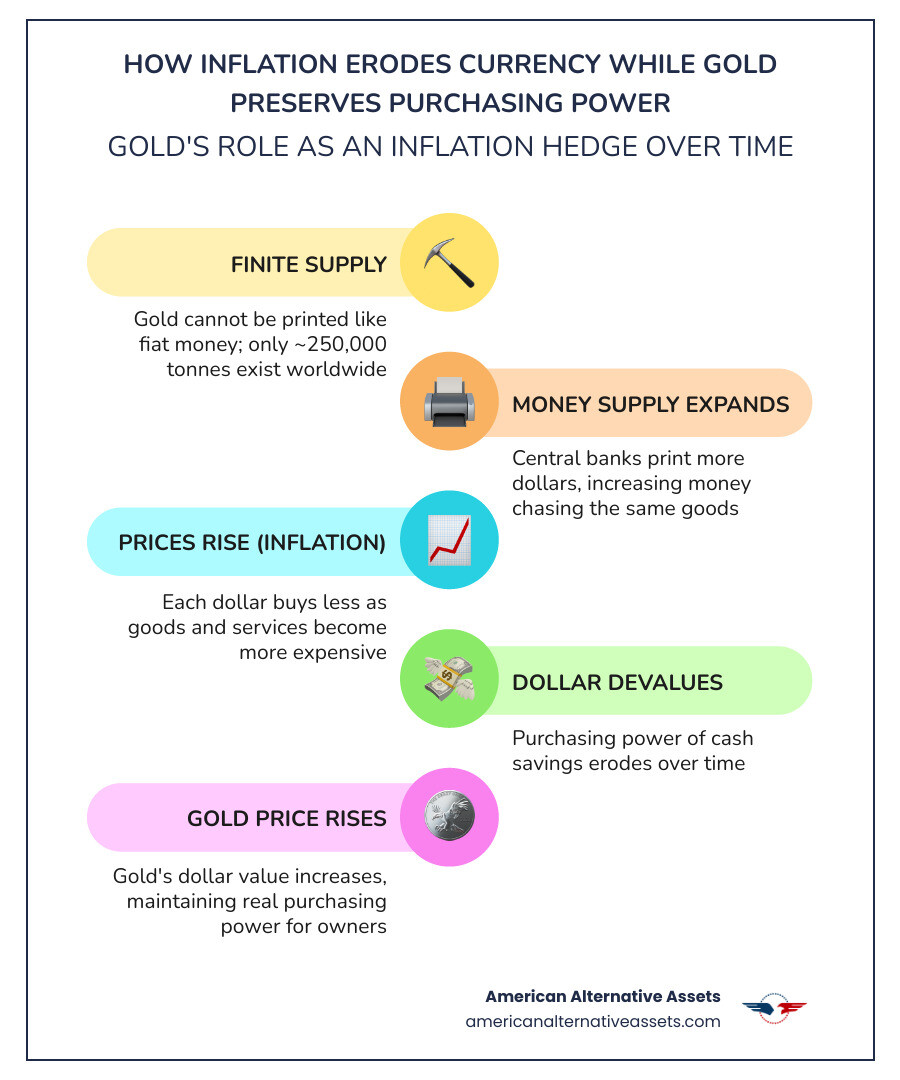
How it works, step by step:
- Central banks print more money, expanding the money supply
- More dollars chase the same goods, pushing prices higher
- The dollar loses purchasing power (inflation)
- Gold, which cannot be printed or created at will, becomes more valuable in dollar terms
- Gold owners are effectively compensated with more dollars per ounce, preserving their real wealth
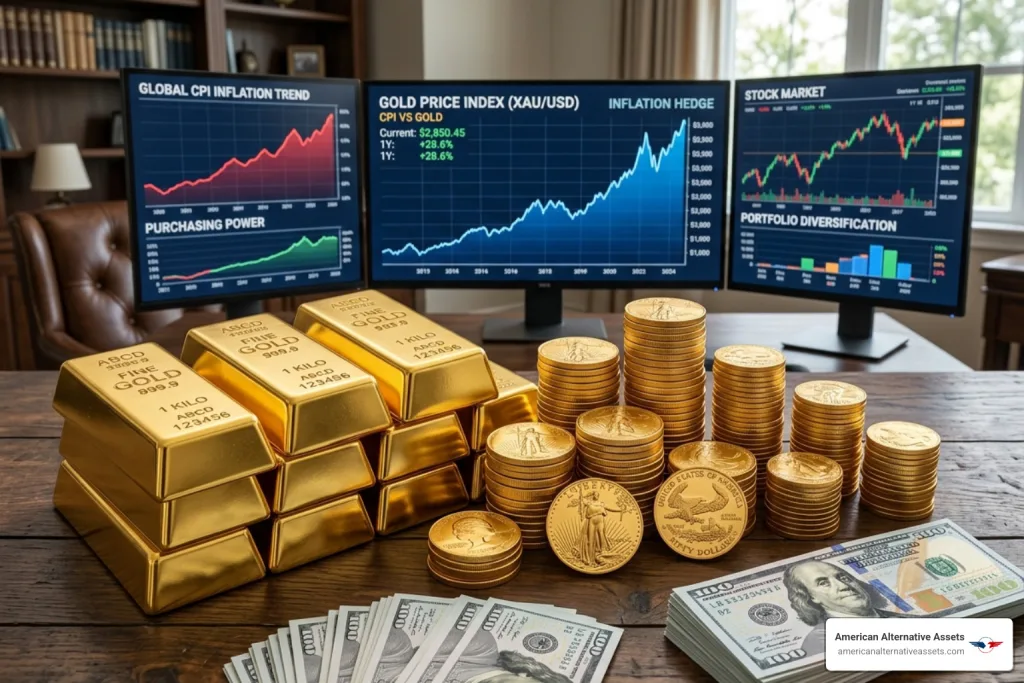
A simple example: In 1929, roughly 10 kg of gold was worth about $7,300, enough to buy the average American home at the time. By 2024, that same 10 kg was worth around $830,000, enough to buy nearly two average homes. Cash held since 1929 would have lost the vast majority of its purchasing power.
This is not a perfect, day-to-day relationship. Gold’s hedging ability is strongest over multi-year periods, during sustained inflation, and under specific economic conditions. But the core principle is consistent: gold preserves purchasing power when paper money does not.
I’m Shanon Davis, founder of American Alternative Assets, and understanding how does gold hedge against inflation is something I’ve studied closely, first through years in venture capital watching paper-based wealth evaporate in 2008, and then by building a company dedicated to helping ordinary Americans protect their savings with physical precious metals. In the sections below, I’ll walk you through the mechanics, the historical evidence, and the practical steps you need to know.
This article is for informational purposes only and does not constitute financial advice. Please consult your financial advisor before making investment decisions.
Understanding the Mechanism: How Does Gold Hedge Against Inflation?
At its heart, gold is a form of “honest money.” Unlike the paper currency in your wallet, which can be printed by the billions at the push of a button, gold has a finite supply. It is estimated that there are fewer than 250,000 tonnes of gold in the entire world. This scarcity is exactly what gives it intrinsic value.
When we talk about how does gold hedge against inflation, we are really talking about a tug-of-war between gold and the U.S. dollar. Because gold is priced in dollars, it often acts as a mirror to the dollar’s health. When the dollar loses value because of inflation, it takes more of those “weaker” dollars to buy the same ounce of gold. This price adjustment is what protects the owner. You aren’t necessarily getting “richer” in terms of what you can buy, but you are successfully preventing yourself from getting poorer.
Think of it like a life jacket. A life jacket doesn’t make you fly, but it keeps your head above water when the tide of rising prices starts to swell. This is the primary reason why gold is widely seen as a hedge during times of economic uncertainty.
The physical stability of gold also plays a role. It does not corrode, it is virtually indestructible, and it cannot be “devalued” by a government’s policy change. In fact, the theoretical cost to artificially produce gold in a laboratory is about one trillion times its current market value. This makes it the ultimate store of value. You can read more about this in this Scientific research on gold’s inflation threshold.
Identifying the threshold: When does gold hedge against inflation effectively?
One of the most fascinating insights from recent economic studies is that gold does not react to every tiny wiggle in the inflation rate. Research indicates there is a specific “activation point.” According to data analyzed between 1969 and 2021, gold’s hedging properties primarily kick in when monthly inflation in the U.S. exceeds 0.55 percent.
When inflation is low or moderate, gold might stay quiet. However, in “high-inflation regimes,” gold becomes highly responsive. This is often triggered by economic overheating or massive increases in the money supply. When the public starts to sense that the Federal Reserve is losing its grip on price stability, demand for gold typically surges. For a deeper look at these specific triggers, check out our guide on Gold Inflation Impact.
The role of real interest rates and opportunity cost
While inflation is the main driver, we also have to look at “real” interest rates. This is simply the interest rate you get from a bank or a bond minus the rate of inflation.
Gold is a non-yielding asset, meaning it doesn’t pay you a monthly dividend or interest check. Because of this, when interest rates are high and inflation is low, people often prefer to hold bonds. But when inflation outpaces interest rates, creating “negative real rates,” the “opportunity cost” of holding gold disappears. If your bank account is paying you 3 percent but inflation is at 7 percent, you are effectively losing 4 percent of your wealth every year by keeping it in cash. In that environment, the safety and potential growth of physical gold become incredibly attractive to those in Woodland Hills and across the country.

Historical Evidence: Gold’s Performance During Inflationary Cycles
History is a great teacher when it comes to how does gold hedge against inflation. If we look back at the most painful inflationary periods in American history, gold has a habit of showing up exactly when it is needed most.
The 1970s provide the clearest example. During that decade, the U.S. faced a “perfect storm” of oil crises, high government spending, and the end of the gold standard in 1971. Inflation peaked at a staggering 13 percent in 1979. During this time, gold didn’t just keep up, it leaped. It went from roughly $35 an ounce at the start of the decade to a peak of about $850 per ounce by 1980.
More recently, we saw this play out during the COVID-19 era. Between 2021 and 2022, supply chain shocks and massive stimulus programs led to an inflation surge. Gold futures more than doubled in the two years leading into the end of 2025, easily outpacing the S&P 500 during that specific window of shock.
Gold vs. the Consumer Price Index (CPI)
The relationship between gold and the Consumer Price Index (CPI) is strong, but it is not always a straight line. Since 1971, there has been an 86 percent correlation between the CPI and the price of gold. Since the year 2000, that correlation has actually tightened to 92 percent.
However, statistics show that only about 16 percent of the variation in gold prices can be explained by CPI changes alone. This tells us that while gold follows the general trend of rising prices, it is also influenced by other factors like fear, geopolitical tension, and currency strength.
One of the most powerful ways to visualize this is the “House Test.” In 1929, the average U.S. home cost about $6,500. At the time, 10kg of gold was worth about $7,300. Fast forward to 2024, and that same amount of gold is worth over $830,000. Even though the average house price has climbed to roughly $420,000, that same pile of gold can now buy two houses. This demonstrates that gold often grows faster than the basic cost of living. You can find more details on these price movements in our report on the Gold Price Spike On Inflation Report.
Lessons from the “Lost Decades” and recovery
It is important to be honest: gold doesn’t go up every single year. Between 1980 and 2000, gold entered a long cooling-off period. This happened because the Federal Reserve, under Paul Volcker, raised interest rates aggressively to kill inflation. With real interest rates high and the stock market entering a massive bull run, gold lost about 60 percent of its value.
However, the 21st century has been a different story. From 2001 to 2011, gold went on a massive run from $250 to nearly $1,900. The lesson here is that gold is a long-term play. It is meant to be a foundational part of your wealth, not something you trade back and forth like a tech stock. When the “Great Moderation” of the 80s and 90s ended, gold resumed its role as the ultimate protector.
Beyond the CPI: Hedging Against Currency Debasement and M2 Growth
Many investors make the mistake of only looking at the CPI. But the CPI only measures the price of a specific “basket” of goods like milk, eggs, and rent. It doesn’t always capture the true erosion of your wealth.
This is where the “M2 Money Supply” comes in. M2 is a broad measure of all the money in the economy, including cash and checking deposits. When the government prints money, the M2 supply expands. Research from the World Gold Council shows that gold has a much stronger long-term relationship with the money supply than it does with the CPI.
Why M2 money supply is a superior metric for gold
Gold shows “strong evidence of cointegration” with the U.S. M2 money supply. This is a fancy way of saying that as more money is printed, gold prices eventually catch up. Between 1971 and 2020, this relationship remained stable.
When central banks engage in “quantitative easing” or massive stimulus, they are effectively debasing the currency. They are making every dollar in your pocket worth a little bit less by creating more of them out of thin air. Because you cannot “print” gold, it serves as a natural ceiling against this debasement. If you are worried about the long-term stability of the dollar, gold is your primary defense. Learn more about the dangers of a ballooning money supply in our article on Hyperinflation A Growing Threat To Your Savings.
Gold as a “Crisis Currency” during geopolitical tension
Gold is also unique because it is a “stateless” asset. It is not the liability of any government. This makes it a “crisis currency” that people flock to during wars, pandemics, or trade disputes.
For example, gold gained 20 percent in the hours following the Brexit vote and surged 30 percent during the early months of the COVID-19 pandemic. Central banks themselves understand this. In recent years, central banks around the world have been buying gold at record rates to diversify their reserves away from the U.S. dollar. They know that when the geopolitical weather gets stormy, gold is the only asset that everyone still trusts.
Physical Gold vs. Paper Assets: The Case for Direct Ownership
At American Alternative Assets, we believe there is a massive difference between “owning gold” and “owning a piece of paper that says it represents gold.” While the financial industry loves to push “paper gold” like ETFs and mining stocks, these come with risks that physical gold simply does not have.
The hidden risks of “Paper Gold” and derivatives
When you buy a Gold ETF (Exchange Traded Fund), you are buying a share of a trust. You do not own the metal. You cannot drive to the vault and ask for your bars. This introduces “counterparty risk.” You are relying on the fund manager, the auditors, and the financial system to remain solvent and honest.
Furthermore, ETFs often charge management fees that eat away at your returns over time. Gold mining stocks are even riskier. A mining company’s stock price can crash because of bad management, environmental lawsuits, or labor strikes, even if the price of gold is going up. If your goal is to protect against a systemic collapse or a currency crisis, paper assets may leave you vulnerable. We discuss these risks further in our post on Why Precious Metals Matter Now More Than Ever.
Drawbacks of Paper Assets:
- No physical possession or delivery
- Management and storage fees that compound over time
- Counterparty risk (the risk that the institution fails)
- High correlation with the general stock market
- Operational risks for mining companies (strikes, spills, political instability)
The benefits of tangible wealth and privacy
Physical gold, held in a secure vault or a Precious Metals IRA, is a tangible asset. It is “private property” in the truest sense. It provides a level of privacy and protection that digital assets cannot match.
Direct ownership means you have no third-party liability. If the banking system takes a “holiday,” your physical gold remains yours. It is portable wealth that has been recognized in every corner of the globe for 5,000 years. This is the “white-glove” level of security we aim to provide. You can explore the full range of Investor Benefits In Owning Gold on our blog.
Strategic Implementation: How to Hedge Against Inflation with a Precious Metals IRA
So, how do you actually put this into practice? For most Americans, the most efficient way to hold physical gold is through a Precious Metals IRA. This allows you to own real, physical bars and coins while enjoying the same tax advantages as a traditional IRA or 401(k).
Practical steps for how gold hedges against inflation in a portfolio
Most experts recommend an allocation of 5 to 15 percent of your total portfolio in precious metals. If you are more concerned about a major economic crisis, some suggest moving toward 20 percent.
The key is “rebalancing discipline.” If gold has a massive year and starts to make up 25 percent of your portfolio, you might sell a little to buy other assets. Conversely, if gold prices dip, it is often a “golden opportunity” to add more to your holdings at a discount. By using dollar-cost averaging, you can build your position over time regardless of short-term price swings. For more on building a resilient retirement, read The Fed Just Admitted Inflation Isnt Going Away Heres What That Means For Your Retirement.
Why physical gold stands out among other inflation hedges
While there are other hedges like TIPS (Treasury Inflation-Protected Securities) or real estate, they each have significant limitations.
TIPS are tied to the government’s own CPI numbers, which many argue underreport true inflation. Furthermore, TIPS are still government debt. If the government faces a debt crisis, the “protection” may be an illusion. Real estate is a great asset, but it is highly illiquid. You cannot sell a bedroom to pay for groceries. It also comes with high taxes, maintenance costs, and is sensitive to interest rate hikes.
Physical gold stands alone. It is liquid, it has no counterparty risk, and it has a proven track record of preserving purchasing power for millennia. It is the only asset that is truly independent of the financial system. Discover more about why gold outshines other options in our article Golden Opportunities Why Gold Shines Brighter Than Stocks.
Frequently Asked Questions
Does gold always go up when inflation rises?
Not always in the short term. Sometimes gold prices can dip even when inflation is high because of “liquidity events.” During a market crash, investors might sell their gold simply because it is the only thing they have that still has value, using the cash to cover losses elsewhere. However, over the long term, gold has consistently corrected upward to match the loss of currency value.
How much gold should I hold for inflation protection?
A common recommendation for a conservative portfolio is 5 to 7 percent. For those who are more aggressive or concerned about a “stagflation” scenario (high inflation and low growth), 10 to 15 percent is often cited as the “sweet spot” for meaningful protection.
Is silver also an effective inflation hedge?
Yes, silver often follows gold’s lead, but with more “horsepower.” Silver is more volatile, meaning it can rise much faster than gold during a bull market, but it can also fall harder. Silver also has massive industrial demand, which gives it a different set of price drivers. Many of our clients choose to hold both as complementary assets.
Conclusion
At American Alternative Assets, we don’t just see gold as a commodity. We see it as a cornerstone of financial freedom and personal responsibility. Our mission is to provide a white-glove, relationship-first service to help you navigate the complexities of wealth protection.
In an era of endless money printing and global uncertainty, the question is no longer “should I own gold,” but rather “how much gold is enough to protect what I’ve worked for?” We are here to help you answer that question with transparency, ethics, and a commitment to your privacy. If you are ready to take the next step, you can learn more about starting a Gold IRA with our team today.
Investing in precious metals involves risk. Past performance does not guarantee future results.