







What Is a Precious Metal IRA? A Clear Answer Before We Dive In
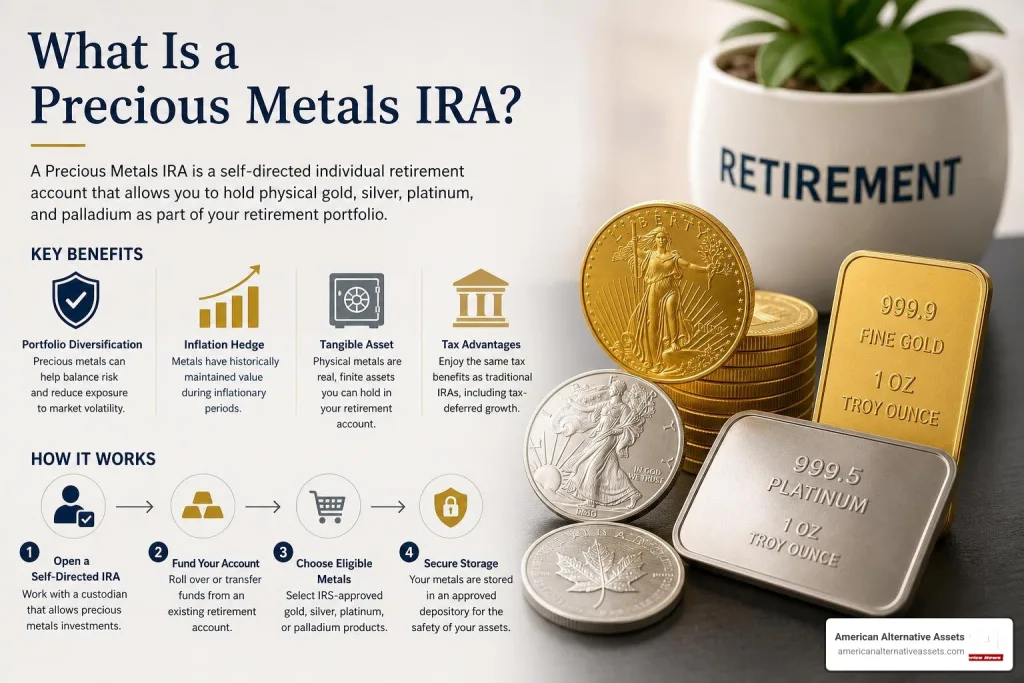
A precious metal IRA is a type of self-directed individual retirement account (IRA) that lets you hold physical gold, silver, platinum, or palladium, rather than stocks, bonds, or mutual funds, as your retirement asset.
Here is what you need to know at a glance:
| Feature | Precious Metal IRA |
|---|---|
| Account type | Self-Directed IRA (SDIRA) |
| Eligible metals | Gold, silver, platinum, palladium |
| Purity requirements | Gold 99.5%, Silver 99.9%, Platinum/Palladium 99.95% |
| Storage | IRS-approved depository only |
| Tax treatment | Same as Traditional or Roth IRA |
| Annual contribution limit (2026) | $7,000 under 50, $8,000 age 50+ |
| Home storage | Not permitted |
The core idea is simple. You get the same tax advantages as a regular IRA, but instead of paper assets, you own physical metal stored in a secure, IRS-approved facility.
Most retirement accounts hold assets that exist only on a screen. A precious metal IRA holds something real.
For people worried about market volatility, inflation, or the fragility of paper-based financial systems, that distinction matters. As one longtime metals advocate put it, physical gold represents value that doesn’t depend on anyone else’s promises.
That perspective resonates deeply with how we think about wealth preservation at American Alternative Assets.
I’m Shanon Davis. My background in venture capital, combined with a lifelong appreciation for tangible assets that started with a silver coin my grandfather handed me as a child, drives everything I teach about what is a precious metal ira and why physical ownership belongs in a serious retirement strategy. Let’s walk through everything you need to know.
This article is for informational purposes only and does not constitute financial advice. Please consult your financial advisor before making investment decisions.
Must-know what is a precious metal ira terms:
- how to invest in precious metals with a self-directed ira
- ira precious metals custodians
- investing in a gold ira
Understanding the Basics: What Is a Precious Metal IRA?
To fully understand what is a precious metal ira, we must first look at the vehicle that makes it possible, the Self-Directed IRA (SDIRA).
In a traditional retirement account, your investment options are usually restricted to paper assets like stocks, bonds, and mutual funds. Standard brokerages simply do not have the framework to hold tangible physical property. A Self-Directed IRA removes these limitations, giving you the freedom to invest in alternative assets while keeping the exact same tax advantages as conventional retirement plans.
This opportunity was officially established by the Taxpayer Relief Act of 1997. This landmark legislation expanded the list of acceptable retirement investments, allowing physical gold, silver, platinum, and palladium to be held inside an IRA. It marked a massive shift for retirement savers, transforming how we think about long-term wealth protection.
By choosing a physical precious metals IRA, you are choosing to hold tangible wealth. Rather than owning shares in a mining company or a piece of a paper fund, you own actual physical bars and coins. This structure provides direct, physical control over your financial future, ensuring your hard-earned savings are anchored by real, physical assets.
For a deeper look into how this structure works, we recommend reading our detailed guide on What is a Gold IRA? and exploring the academic foundation of these accounts in What a Precious Metals IRA Is and How it Works – Clute Journals .
IRS-Approved Metals and Purity Standards
While a self-directed IRA offers incredible freedom, you cannot simply buy any gold or silver coin and put it in your retirement account. The IRS has strict guidelines regarding the types of metals allowed, their purity, and their overall condition.
These regulations protect the integrity of your retirement account, ensuring that only high-quality, highly liquid assets are held. To navigate these guidelines successfully, it is essential to understand the exact specifications set by the government. For a complete breakdown of the legal framework, you can refer to our Precious Metals IRA Rules Guide.
Defining the Assets: What Is a Precious Metal IRA Approved Product?
To qualify for a self-directed IRA, physical metals must meet strict fineness requirements. These standards are set by recognized global exchanges and must be verified before any purchase is finalized:
- Gold: Must meet a minimum purity of 99.5% (.995 fineness).
- Silver: Must meet a minimum purity of 99.9% (.999 fineness).
- Platinum: Must meet a minimum purity of 99.95% (.9995 fineness).
- Palladium: Must meet a minimum purity of 99.95% (.9995 fineness).
There is one notable exception to the gold purity rule: the American Eagle coin. Although the American Gold Eagle is minted at 91.67% purity (22-karat gold alloyed with silver and copper for durability), the IRS explicitly approves it for IRA inclusion because of its status as official U.S. legal tender.
Eligible Coins and Bars for Your Portfolio
When selecting physical products for your portfolio, you must focus on products minted by sovereign government mints or accredited refiners. These products are highly liquid and universally recognized.
Common eligible gold products include:
- American Eagle bullion coins
- American Buffalo bullion coins
- Canadian Maple Leaf coins
- Austrian Philharmonic coins
- Bars and rounds produced by accredited manufacturers (such as PAMP Suisse or Credit Suisse) meeting the 99.5% purity standard
Common eligible silver products include:
- American Eagle silver coins
- Canadian Maple Leaf silver coins
- Austrian Philharmonic silver coins
- Silver bars and rounds produced by certified refiners meeting the 99.9% purity standard
It is equally important to understand what you cannot include. The IRS strictly prohibits rare, collectible, or numismatic coins. This includes pre-1933 gold coins, gold Krugerrands, and 90% silver US coins. Collectible coins carry subjective value and high dealer markups, making them unsuitable for retirement accounts under IRS guidelines.
To ensure you only select compliant products, you can explore our comprehensive Precious Metals IRA Complete Guide.
The Benefits and Considerations of Physical Metal IRAs
Every investment vehicle has its unique characteristics, and a physical precious metals IRA is no exception. Weighing the benefits and practical considerations is an essential step in determining if this path fits your long-term goals.
The Benefits of Physical Ownership
- True Diversification: Physical precious metals often move independently of traditional stock and bond markets. This independence makes them an excellent tool for balancing paper-heavy portfolios.
- Historical Inflation Hedge: Physical gold and silver have historically maintained their purchasing power over long periods, acting as a natural shield against currency devaluation.
- Zero Counterparty Risk: Unlike paper stocks or fund shares, physical metal does not rely on a company’s performance, a bank’s solvency, or a fund manager’s decisions to hold its value.
- Peace of Mind: There is a unique confidence that comes with knowing a portion of your wealth exists in a physical, tangible form that you can hold in your hands upon distribution.
Practical Considerations
- No Passive Income: Physical metals do not pay dividends, interest, or yields. Their primary purpose is wealth preservation and long-term capital appreciation.
- Storage and Security Mandates: You cannot keep your IRA metals at home. The IRS requires them to be stored in an approved depository, which involves ongoing secure storage and administrative costs.
- Liquidity Timelines: Selling physical metal from an IRA is a straightforward process, but it requires coordinating with your custodian and depository, which typically takes a few business days to finalize.
For a balanced, third-party look at how these factors interact, you can read Pros And Cons Of Precious Metals IRAs: What To Know Before You … .
Portfolio Protection: What Is a Precious Metal IRA Role in Diversification?
True diversification is about more than just owning different mutual funds, it is about owning entirely different classes of assets. In times of severe economic uncertainty, stock markets can experience sudden downturns. Physical precious metals serve as a historical safe haven during these periods.
When central banks around the world increase their gold reserves, they do so to stabilize their national wealth. In 2024 and 2025, central banks purchased roughly 800 tonnes of gold per year, with 43% of surveyed banks planning to increase their holdings even further. This institutional demand highlight’s gold’s role as a cornerstone of monetary stability.
By allocating a portion of your retirement portfolio to physical gold and silver, you build a resilient foundation. If paper assets face headwinds, your physical holdings are there to provide balance and stability.
To learn more about the strategic role of gold in a retirement portfolio, visit Why Invest in a Gold IRA?
How to Set Up and Fund Your Account
Setting up a physical precious metals IRA is a simple, structured process when you work with the right partners. We believe in providing a smooth, transparent experience to help you transition your wealth securely.

Here are the simple steps to establish your account:
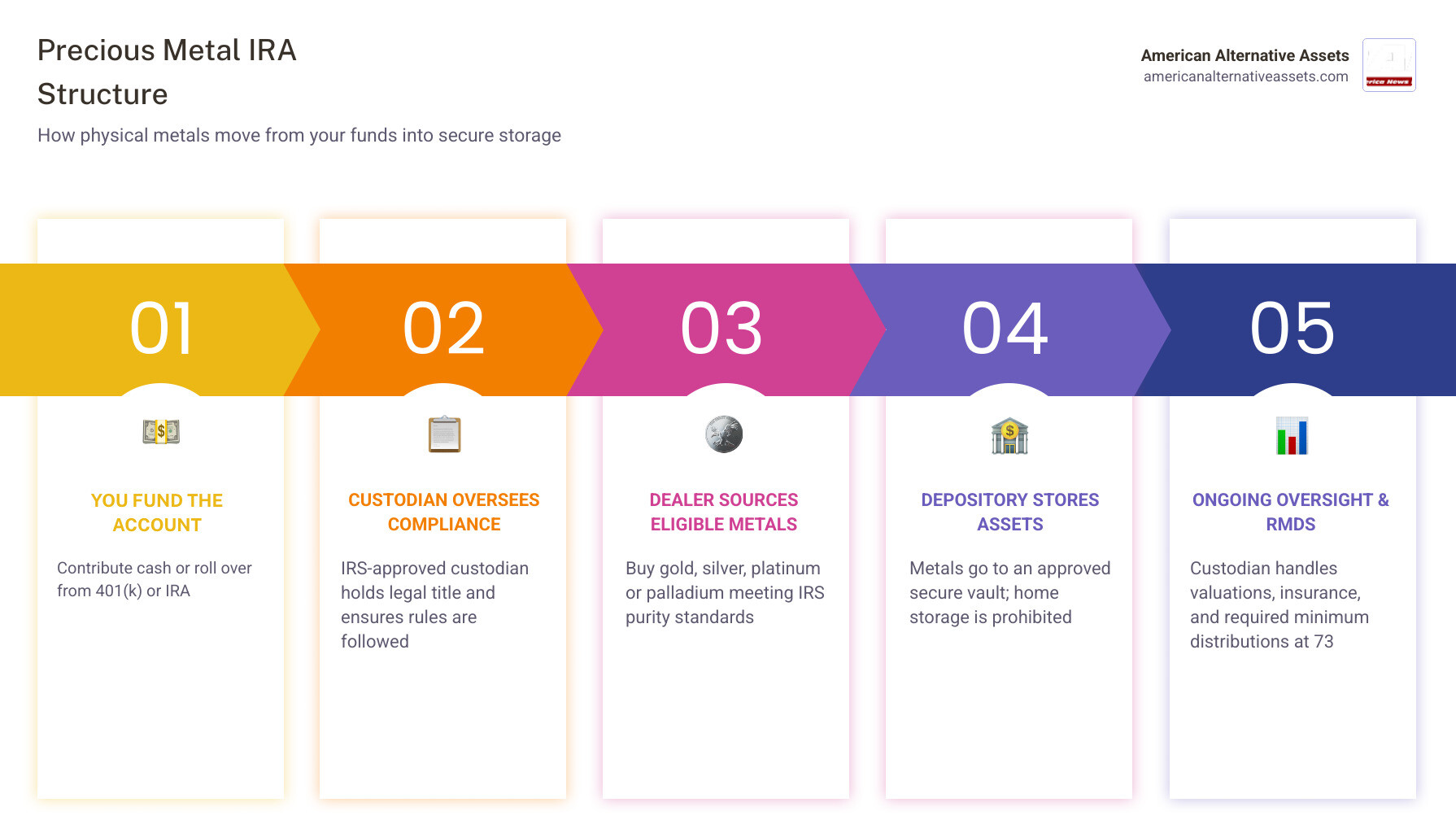
- Select a Self-Directed Custodian: You must work with an IRS-approved custodian that specializes in self-directed accounts capable of holding physical assets.
- Partner with a Precious Metals Dealer: Choose a trusted partner, like American Alternative Assets, to help you select eligible coins and bars.
- Fund Your Account: Transfer funds from an existing retirement account, such as a traditional IRA, Roth IRA, or 401(k).
- Select and Purchase Your Metals: Direct your custodian to purchase the specific physical gold, silver, platinum, or palladium products you have chosen.
- Secure Storage: Your physical metals are shipped directly from the dealer to an IRS-approved depository, where they are securely stored under your custodian’s oversight.
For a detailed walkthrough of this setup, read our guide on How to Invest in Precious Metals with a Self-Directed IRA.
Choosing an IRS-Approved Custodian
Your custodian handles the administrative duties of your account. They track your purchases, report necessary tax information to the IRS, and ensure your account remains compliant with all federal regulations.
Because standard financial institutions do not offer physical metal storage, you must work with a specialized self-directed custodian. When selecting a custodian, look for transparency, established experience, and excellent customer service.
To help you make an informed choice, we have put together a Precious Metals IRA Custodians Guide.
Funding Your Account via Rollover or Transfer
There are two primary ways to fund a new precious metals SDIRA:
- Direct Transfer: This is a direct, custodian-to-custodian transfer of funds from an existing traditional or Roth IRA. The funds move directly between the institutions, meaning there is zero tax reporting and no risk of penalties.
- Rollover: If you are funding your account from an employer-sponsored plan, like a 401(k) or 403(b), you will perform a rollover. A direct rollover moves the funds straight to your SDIRA custodian. If you perform an indirect rollover, you have exactly 60 days to deposit the funds into your new SDIRA to avoid taxes and early withdrawal penalties.
Once your account is funded, your annual contributions must align with IRS limits. For 2026, the annual IRA contribution limit is $7,500 if you are under age 50, or $8,600 if you are age 50 or older.
To understand the mechanics of moving your existing retirement savings, check out How Does a Gold IRA Work?
The Risks of Paper Gold vs. the Security of Physical Assets
Many investors ask why they should choose a physical precious metals IRA instead of simply buying a gold exchange-traded fund (ETF) or gold stocks. The answer lies in the fundamental difference between owning a piece of paper and owning a physical asset.
Paper precious metals, such as ETFs, are financial instruments designed to track the spot price of metal. However, when you buy a gold ETF, you do not own any actual gold. You own shares in a trust that is managed by third parties. This introduces significant counterparty risk. If the fund manager, the broker, or the financial institution backing the fund faces operational or systemic failure, your investment is at risk.
Furthermore, paper ETFs carry ongoing management fees, known as expense ratios, which slowly reduce your holdings over time. They also expose you to the systemic risks of the broader stock market. If the financial system experiences a crisis, paper assets can be subject to rapid liquidation and volatility.
A physical precious metals SDIRA eliminates these risks. You have direct, physical ownership of real gold and silver bars and coins. There are no fund managers between you and your wealth.
| Feature | Physical Precious Metals SDIRA | Paper Gold ETFs |
|---|---|---|
| Ownership | Direct ownership of physical, allocated bars and coins | Ownership of paper shares tracking a trust |
| Counterparty Risk | None. The physical metal is yours and exists independently | High. Reliant on fund managers, brokers, and banks |
| Systemic Risk | Protected from banking and stock market failures | Exposed to market volatility and financial system stress |
| Ongoing Costs | Flat annual storage and custodial maintenance fees | Ongoing percentage-based expense ratios |
| Physical Possession | Eligible for physical distribution upon retirement | No physical delivery available to retail investors |
For a deeper analysis of the structural differences and risks, read Understanding Gold IRAs: Benefits, Setup, and Risks Explained .
Storage, Custodial Maintenance, and Tax Rules
To maintain the tax-advantaged status of your retirement account, your physical metals must be stored in an IRS-approved depository. These depositories are highly secure, specialized facilities equipped with state-of-the-art security systems, 24/7 monitoring, and comprehensive insurance coverage.
You can choose between two main storage options:
- Segregated Storage: Your physical metals are stored in a separate, individual lockbox or vault space, completely isolated from other investors’ holdings. When you take a distribution, you receive the exact same bars or coins you purchased.
- Commingled (or Non-Segregated) Storage: Your metals are stored alongside identical products of the same weight and purity in a shared vault space.
Your custodian and depository will charge flat annual fees for storage and account maintenance. Unlike paper ETFs, which charge fees based on a percentage of your total asset value, these flat fees ensure that your costs do not automatically increase as the value of your metals grows.
When it comes to taxes, a precious metals SDIRA follows the same rules as standard IRAs. Traditional SDIRA contributions may be tax-deductible, with taxes deferred until you take distributions in retirement. Roth SDIRA contributions are made with after-tax dollars, allowing you to enjoy completely tax-free growth and qualified withdrawals.
Once you reach age 73, traditional IRAs require you to begin taking Required Minimum Distributions (RMDs). With a physical precious metals IRA, you can choose to satisfy your RMDs by selling a portion of your metals for cash, or by taking “in-kind” distributions, meaning the actual physical gold or silver is shipped directly to your home.
To learn more about the rules of storage and compliance, read The Ultimate Guide to Precious Metals IRAs.
Frequently Asked Questions About Precious Metals IRAs
Can I store my IRA precious metals at home?
No. The IRS strictly prohibits home storage for self-directed IRAs. All physical metals must be held under the physical control of an approved third-party custodian and stored in an IRS-approved depository. Attempting to store your IRA metals at home, or keeping them in a personal safe deposit box, is treated as a full taxable distribution. This will trigger immediate income taxes on the entire value of the metals, along with a 10% early withdrawal penalty if you are under age 59.5.
To learn more about these rules and separate fact from fiction, read Precious Metals IRA Myths Debunked.
What portion of my retirement portfolio should be in precious metals?
Most financial professionals suggest allocating between 5% and 10% of a total retirement portfolio to physical precious metals. This percentage can vary depending on your personal risk tolerance, retirement timeline, and financial goals. The goal is to establish a strong, physical foundation of tangible wealth that can balance your paper-based investments without over-concentrating in a single asset class.
How long does a 401(k) to precious metals IRA rollover take?
A direct custodian-to-custodian transfer or rollover typically takes between 5 and 7 business days to complete. The exact timeline depends on how quickly your current retirement plan administrator processes the request and transfers the funds to your new self-directed IRA custodian.
Conclusion
Understanding what is a precious metal ira is the first step toward building a resilient, diversified retirement portfolio. By moving away from a strategy reliant entirely on paper assets, you can secure your retirement savings with physical, tangible wealth.
At American Alternative Assets, we are dedicated to helping you protect your hard-earned wealth. Based in Woodland Hills, California, our team provides a white-glove, relationship-first service built on trust, transparency, and ethical practices. We focus on education, real privacy, and dedicated wealth protection to help you navigate the process with complete confidence.
If you are ready to learn more about how physical gold and silver can secure your future, explore our Precious Metals IRA resources or speak with one of our specialists today.
Investing in precious metals involves risk. Past performance does not guarantee future results.