








Why Understanding the Factors Affecting Gold Price Matters for Your Wealth
The factors affecting gold price are not random. They follow patterns tied to real economic forces, and understanding them can help you make smarter decisions about protecting your wealth.
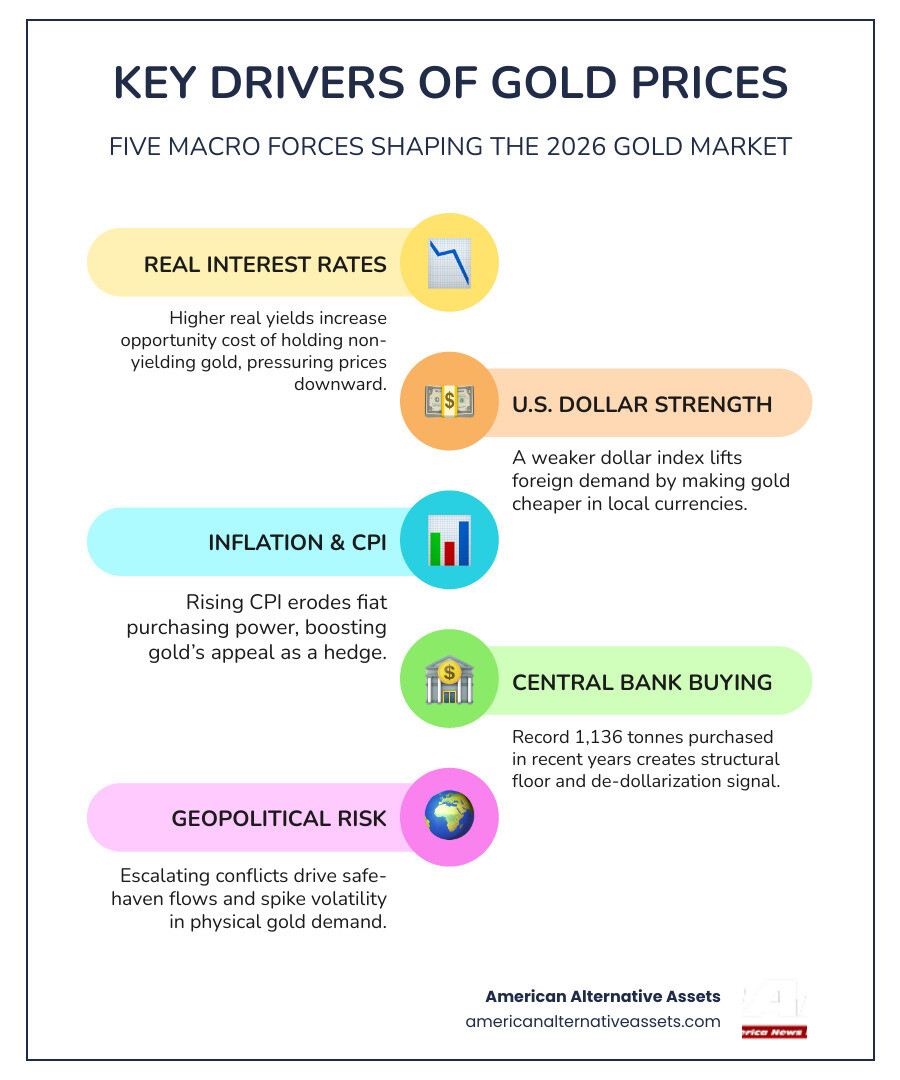
Here is a quick overview of the main drivers:
| Factor | How It Affects Gold |
|---|---|
| Real interest rates | Higher real yields raise the cost of holding gold, pushing prices down |
| U.S. dollar strength | A weaker dollar makes gold cheaper for foreign buyers, lifting demand |
| Inflation | Rising inflation erodes purchasing power, increasing gold’s appeal |
| Central bank buying | Large purchases reduce available supply and signal long-term confidence in gold |
| Geopolitical instability | Crises drive investors toward gold as a safe-haven asset |
| Mine supply | Annual production grows slowly, making gold prices more sensitive to demand shifts |
| Investment demand | ETF inflows and physical buying both move prices, but in different ways |
| Consumer demand | Jewelry and technology sectors account for a significant share of annual consumption |
Gold has served as a store of value for thousands of years. But its price is anything but static. It swings with interest rate decisions, geopolitical shocks, currency moves, and shifts in how institutions and individuals choose to hold wealth.
In fact, gold crossed above $5,500 per ounce intraday in January 2026, a new nominal record, before pulling back sharply by mid-year. That kind of volatility is not noise. It reflects real changes in the forces that drive gold’s value.
Understanding those forces is the first step toward using gold wisely as part of a wealth preservation strategy.
I’m Shanon Davis, founder of American Alternative Assets, and my background in venture capital, combined with my experience through the 2008 financial crisis, gave me a understanding of the factors affecting gold price and why physical ownership matters. That foundation shapes everything we do at American Alternative Assets, and it is what this guide is built on.
Factors affecting gold price terminology:
The Primary Factors Affecting Gold Price
To understand how the gold market functions, we must look at the broad macroeconomic drivers that dictate global capital flows. Unlike corporate stocks or government bonds, gold does not pay a dividend or yield interest. This unique characteristic means that its price is heavily influenced by the opportunity cost of holding it compared to yield-bearing assets.
When traditional financial systems are stable and fiat currencies are strong, the opportunity cost of holding gold increases. Conversely, when confidence in monetary policy wavers, gold becomes highly attractive. According to educational insights from Factors Affecting Gold Price 2026: What Drives the Price of Gold? | Markets.com, the gold price is a continuous reflection of global supply and demand dynamics, heavily weighted by the actions of central banks, interest rate shifts, and currency valuations.
How Interest Rates and Real Yields Act as Factors Affecting Gold Price
For decades, real interest rates, which are nominal interest rates minus the rate of inflation, have served as the single most reliable predictor of gold price movements. This relationship is rooted in the concept of opportunity cost. Because physical gold pays no coupon, holding it becomes less appealing when real yields on government bonds are high. Why hold a non-yielding asset when you can secure a guaranteed, inflation-adjusted return of 2% or 3% on a U.S. Treasury bond?
This dynamic is clearly reflected in the Treasury Inflation-Protected Securities (TIPS) market. Historically, a 100-basis-point increase in 10-year real yields has led to an 18% decline in the inflation-adjusted price of gold. This empirical real duration of approximately 18 years highlights how sensitive the precious metal is to the Federal Reserve’s monetary policy. When the Fed aggressively hikes interest rates to combat inflation, real yields rise, creating a powerful headwind for gold.
However, this historical relationship is not set in stone. In recent years, we have witnessed periods where real yields and gold prices rose in tandem. This occurs when investors lose confidence in the fiscal health of the nation, realizing that rising yields are a symptom of growing sovereign debt risk rather than robust economic growth.
The U.S. Dollar and Inflation as Factors Affecting Gold Price
The relationship between the U.S. dollar and gold is deeply structural. Because gold is priced globally in U.S. dollars, any fluctuation in the value of the greenback has an immediate, mechanical translation effect on the price of gold. When the U.S. Dollar Index (DXY) strengthens, gold becomes more expensive for foreign buyers using weaker local currencies, which naturally dampens global demand and pressures the dollar-denominated price downward.
Inflation is another critical driver. When paper currencies are printed in excess, their purchasing power inevitably declines. Because the physical supply of gold cannot be expanded by government decree, it acts as a natural monetary anchor. When Consumer Price Index (CPI) reports signal that inflation is overshooting central bank targets, investors quickly pivot to hard assets. We saw a prime example of this during the Gold Price Spike on Inflation Report, which demonstrated how quickly market participants react to currency debasement by seeking the safety of tangible precious metals.
Central Bank Reserves and De-Dollarization Trends
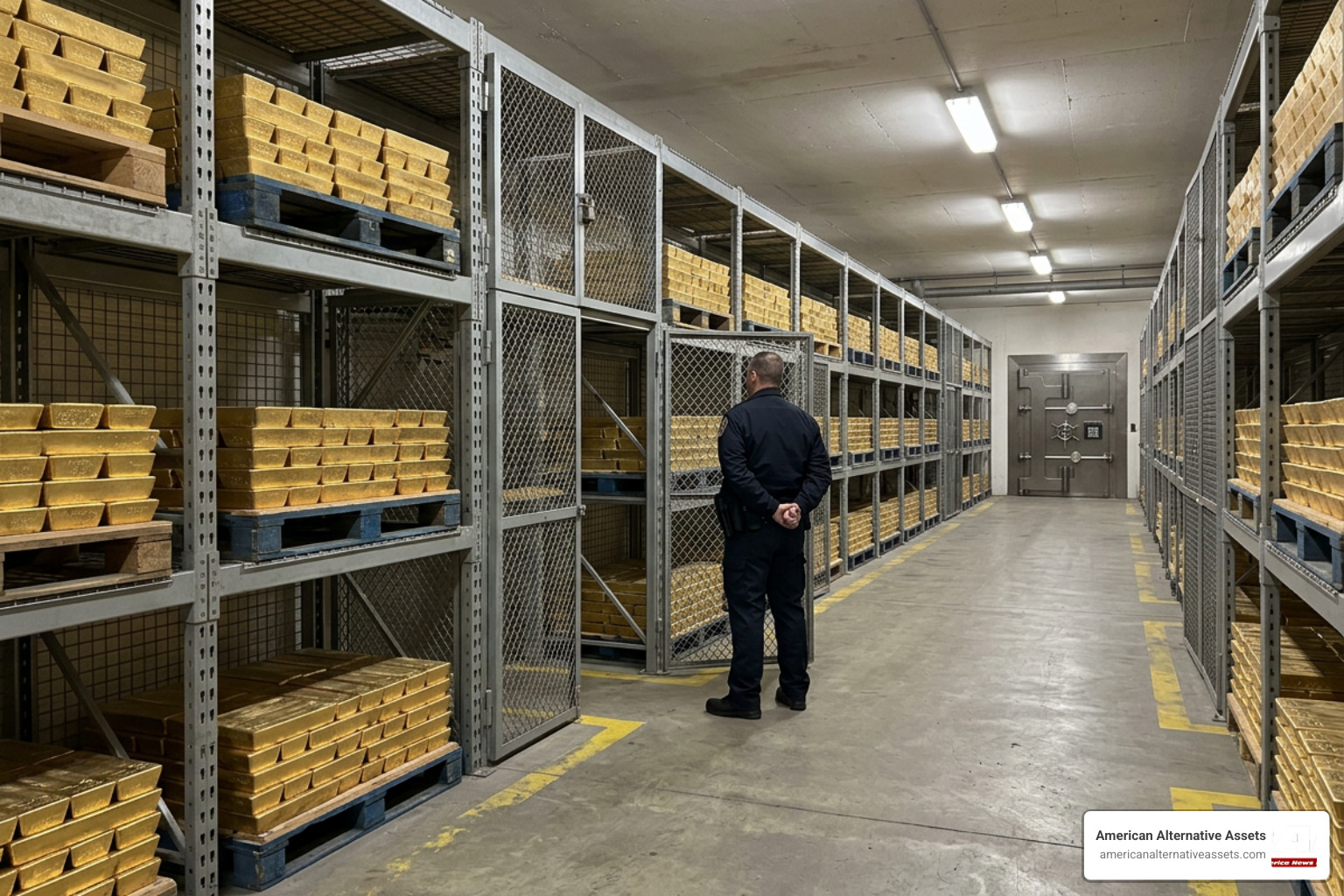
One of the most powerful structural changes in the modern gold market is the aggressive return of central banks as major buyers. Historically, central banks would occasionally sell down their gold reserves during economic booms to chase higher yields in the bond markets. Today, the script has completely flipped. Sovereign nations are accumulating physical gold at a pace not seen in over half a century, driven by a collective desire for de-dollarization and reserve diversification. To understand why these institutions are shifting their holdings, you can read more about Why Gold is Gaining.
Official Sector Buying and Reserve Diversification
Central banks hold approximately one-fifth of all the gold ever mined. This massive concentration of ownership means that official sector buying trends have a profound impact on the structural floor of the gold price. In 2022, central banks purchased a record-breaking 1,136 tonnes of gold, the largest annual total since 1950. This monumental buying spree was followed by 1,051 tonnes in 2023 and 1,045 tonnes in 2024.
This sustained demand is not a temporary trend. It represents a fundamental shift in global reserve management. Following the freezing of Russian foreign reserves in 2022, central banks around the world realized that fiat assets held in foreign custody carry significant geopolitical and sanctions risk. Physical gold, stored within a nation’s own borders, is the only reserve asset with no issuer, no counterparty risk, and no dependency on foreign financial infrastructure.
Unreported Purchases and Geopolitical Shifts
While official reports to the International Monetary Fund (IMF) provide some visibility into central bank activity, a significant portion of official sector buying occurs quietly behind the scenes. Analysts estimate that over half of recent official sector purchases may be unreported, as sovereign entities seek to accumulate physical reserves without alerting the broader market and driving prices higher.
For example, while reported central bank purchases seemed to moderate on paper during certain quarters of 2025 and 2026, alternative trade data and customs tracking painted a completely different picture. Chinese net imports of gold reached 317 tonnes in the first quarter of 2026 alone, nearly three times the volume of the previous quarter. This massive influx of physical gold into Asia, combined with rising global debt levels and ongoing currency crises, suggests that the structural demand for physical wealth protection is far stronger than traditional public reporting indicates.
Geopolitical Instability and Safe-Haven Demand
When geopolitical tensions escalate, the global financial system experiences sudden bouts of extreme volatility. During these periods, investors look for assets that can withstand systemic shocks. Gold has earned its reputation as the ultimate safe-haven asset precisely because it is tangible, globally recognized, and carries no liabilities. When war, trade disputes, or political crises threaten the stability of paper assets, the rush for physical protection intensifies, as discussed in Gold Swings $300 as Middle East War Escalates: What Retirees Need to Watch Right Now.
Escalating Conflicts and Market Volatility
Geopolitical conflicts create immediate, short-term fear premiums in the gold market. Whether it is escalating tensions in the Middle East, trade disputes between major global powers, or the weaponization of financial sanctions, these events highlight the fragility of interconnected global markets.
During these crises, paper investments, such as stocks, bonds, and digital currencies, are highly vulnerable to sudden liquidity freezes and counterparty defaults. Gold, by contrast, thrives in environments of high uncertainty. While these short-term fear premiums can occasionally fade once a specific crisis resolves, the broader structural shift toward safe-haven assets remains a powerful force in an increasingly unstable world.
Why Physical Gold Outperforms Paper Assets in Crises
In times of genuine systemic crisis, the difference between physical gold and paper-based gold proxies becomes stark. Many investors mistakenly believe that owning a gold exchange-traded fund (ETF) or trading gold futures contracts provides the same level of security as holding physical bars and coins.
Paper assets are fundamentally dependent on a complex chain of financial intermediaries, custodian banks, and clearinghouses. If a systemic failure or a major liquidity crisis occurs, these paper structures can face severe operational disruptions, trading halts, or counterparty defaults. Physical gold, held in secure custody or personal possession, has no counterparty risk. It cannot be frozen by a digital bank failure, nor can it be devalued by corporate bankruptcy. For those seeking true wealth preservation, direct physical ownership is the only reliable option.
Supply Dynamics: Global Gold Production and Mining Challenges

While demand is the primary driver of short-term price fluctuations, the structural supply of gold is incredibly rigid. Unlike fiat currencies, which can be created digitally with the stroke of a key, physical gold must be located, permitted, mined, and refined through an incredibly labor-intensive and capital-heavy process. This natural scarcity is what underpins gold’s long-term purchasing power.
Inelastic Mine Supply and Production Limits
The annual global mine production adds only about 2% to 3% to the existing above-ground stock of gold each year. This inelasticity means that even if the price of gold doubles tomorrow, mining companies cannot suddenly flood the market with new supply.
The mining industry faces severe structural constraints:
- Declining Ore Grades: The easily accessible, high-grade gold deposits have largely been exhausted. Miners must now dig deeper and process vast amounts of low-grade ore to extract the same amount of metal.
- Permitting and Regulatory Hurdles: It can take anywhere from 10 to 20 years from the initial discovery of a gold deposit to the day the first ounce of gold is poured. Environmental regulations and local permitting processes have grown increasingly stringent.
- High Capital Expenditure: Setting up a modern mining facility requires billions of dollars in upfront capital, making supply highly unresponsive to short-term price spikes.
Recycling and Above-Ground Stocks
Because gold is virtually indestructible, almost all the gold ever mined in human history still exists in some form today, totaling roughly 200,000 tonnes. This massive above-ground stock acts as a potential source of secondary supply through recycling.
When gold prices experience dramatic spikes, scrap gold recycling volume typically rises as consumers sell old jewelry or industrial components. However, this secondary supply is highly price-sensitive and acts as a temporary buffer rather than a permanent solution to supply constraints. Once the initial wave of high-price recycling subsides, the market must once again rely on the slow, steady drip of primary mine production.
Investment Demand: Physical Ownership vs. Paper Gold
The way investors choose to allocate capital into the gold market plays a massive role in day-to-day price discovery. However, the vehicle an investor chooses, whether physical coins and bars or paper-based financial instruments, has major implications for their actual security and risk exposure.
| Investment Type | Ownership Structure | Counterparty Risk | Systemic Protection | Liquidity during Crises |
|---|---|---|---|---|
| Physical Gold (Bars/Coins) | Direct tangible ownership | None | Absolute protection against financial system collapse | High, globally recognized asset |
| Gold ETFs (Paper Gold) | Shares in a trust, no direct claim to metal | High (dependent on trustees, custodians, and brokers) | Low, vulnerable to market closures and bank freezes | Subject to market trading hours and exchange liquidity |
| Gold Futures/Derivatives | Leveraged paper contracts | Extremely High | None, highly speculative | Subject to margin calls and exchange rules |
The Risks of Gold ETFs and Futures Contracts
Gold ETFs, such as the SPDR Gold Shares (GLD), are often used by short-term institutional traders due to their ease of trading. As of June 2026, major gold ETFs held roughly 40 million ounces of gold, worth approximately $182 billion. However, for long-term wealth preservation, these paper-backed proxies carry significant structural risks and are highly disadvantageous compared to physical ownership.
When you buy a gold ETF, you do not own physical gold. You own shares in a trust that holds gold. You cannot demand delivery of your physical metal unless you are an extremely large institutional participant holding millions of dollars in shares. You are fully exposed to the credit and operational risks of the custodian bank, the trustee, and the brokerage firm handling your account. Furthermore, the futures market is highly leveraged, with hundreds of paper claims existing for every single ounce of physical gold sitting in exchange vaults. In a systemic liquidity crisis, this paper leverage can unravel rapidly, leaving paper gold holders highly vulnerable. Paper assets simply cannot provide the security of tangible wealth.
The Benefits of Physical Gold in a Precious Metals IRA
To achieve true financial preparedness, physical gold held within a self-directed Precious Metals IRA is the only reliable solution. A Precious Metals IRA allows you to enjoy the tax advantages of a traditional retirement account while holding physical gold and silver coins or bars in a secure, IRS-approved depository.
At American Alternative Assets, we specialize in helping clients navigate this process with our signature white-glove, relationship-first service. We believe in complete transparency and ethical practices, ensuring that your wealth is protected by tangible assets, not paper promises. We help you select eligible physical products, coordinate with trusted self-directed custodians, and arrange secure, insured storage, giving you real privacy and peace of mind for your retirement savings.
Consumer Demand: Jewelry and Technology Sectors
While investment and central bank buying dominate financial headlines, the physical consumption of gold in the jewelry and technology sectors provides a massive, consistent baseline of global demand.
Global Jewelry Consumption Patterns
Jewelry accounts for approximately 50% of annual gold consumption. This demand is not evenly distributed across the globe. It is heavily concentrated in emerging markets, particularly in China and India, where jewelry is viewed not merely as a fashion accessory, but as a traditional form of savings and cultural wealth.
In these regions, consumer jewelry demand is highly price-elastic. When gold prices experience rapid spikes, jewelry volume in terms of tonnage often declines, as consumers wait for prices to stabilize. However, during periods of economic stability or local currency depreciation, the physical demand for high-purity jewelry (such as 22-karat and 24-karat gold) acts as a powerful, steady drain on global physical supply, helping to establish a firm price floor.
Industrial and Technological Applications
Though it represents a smaller slice of the pie, roughly 7% to 8% of annual gold demand comes from industrial and technological applications. Gold’s unique physical properties, including its exceptional electrical conductivity, high resistance to corrosion, and extreme malleability, make it irreplaceable in modern manufacturing.
You can find gold in:
- Microchips and Electronics: High-end smartphones, computers, and telecommunications equipment rely on gold bonding wires for reliable data transmission.
- Medical Devices: Gold is used in rapid diagnostic tests, implants, and precision surgical instruments.
- Green Technology: Advanced solar panels and aerospace components utilize gold coatings to maximize efficiency and withstand extreme environmental conditions.
As technology continues to advance, this industrial demand remains a highly stable, non-speculative component of the global gold market.
Historical Price Trends and the 2026 Market Outlook
To gain a clear perspective on where the gold market is heading, we must look at how historical price trends have responded to major economic shifts. The long-term trajectory of gold reflects the ongoing struggle between paper currencies and tangible assets, as outlined in the Gold Mid-Year Outlook 2026: Point break | World Gold Council.
From the Gold Standard to the January 2026 Nominal Record High
Since the termination of the Bretton Woods system in 1971, which completely severed the U.S. dollar’s link to gold, the precious metal has undergone several major bull and bear cycles:
- The 1980 Peak: Driven by rampant inflation, oil shocks, and geopolitical crises, gold reached an inflation-adjusted peak of about $3,300 per ounce in January 1980.
- The 2008 Financial Crisis: The collapse of the subprime mortgage market triggered a massive global flight to quality, driving gold to new highs as central banks initiated unprecedented quantitative easing.
- The January 2026 Record: Driven by massive central bank de-dollarization, persistent global inflation, and escalating geopolitical conflicts, gold soared to an all-time nominal record high above $5,608.35 per ounce in January 2026.
While a $100 investment in gold in 1972 would have grown to about $6,700 by 2025, compared to over $24,000 for the same amount invested in the S&P 500, gold’s primary role has never been to outperform speculative equity markets during periods of peace. Its purpose is to act as a wealth anchor, protecting your purchasing power when paper assets face severe devaluations.
Analyzing the Mid-2026 Price Correction and Future Forecasts
Following the spectacular nominal high in January 2026, the gold market experienced a dramatic mid-year correction, with prices dipping below $4,000 per ounce by June. To the untrained eye, an 18% correction might look alarming. However, experienced precious metals investors view these pullbacks as healthy consolidations within a long-term structural bull market.
As analyzed in Gold’s Dramatic Correction Creates Unexpected Opportunity, these corrections are often driven by short-term speculative futures traders unwinding leveraged positions, and they rarely impact the long-term fundamentals of physical demand. In fact, these lower price levels typically trigger massive bargain-hunting demand from central banks and physical buyers in Asia. Looking forward, the structural drivers, including historic sovereign debt levels, persistent inflation, and systemic geopolitical shifts, remain highly supportive of gold’s long-term upward trajectory, as detailed in Will Gold Keep Rising? The Ultimate Precious Metals Forecast.
Frequently Asked Questions about Gold Price Drivers
What is the single biggest factor affecting gold price movements?
Over short-to-medium-term horizons, real interest rates are generally the most powerful factor. Because physical gold is a non-yielding asset, its opportunity cost is directly tied to the real returns available on low-risk government bonds. When real yields rise, gold faces downward pressure. When real yields fall or turn negative, gold typically experiences strong upward momentum.
Why is physical gold preferred over paper gold during economic crises?
Physical gold is preferred because it completely eliminates counterparty risk. Paper gold instruments, such as ETFs, mutual funds, and futures contracts, are financial claims dependent on brokers, custodians, and complex clearing systems. During a major systemic crisis, these paper structures can face operational halts, liquidity freezes, or institutional defaults. Physical gold in your possession or stored in an independent secure depository remains a tangible, liquid asset that cannot be devalued or frozen by a third party.
How do central bank purchases influence the long-term price of gold?
Central bank purchases create a powerful, price-insensitive structural floor under the gold market. When central banks buy hundreds of tonnes of physical gold to diversify their reserves, they remove that supply from the circulating market, making physical gold scarcer. This continuous official sector demand helps to buffer the market against deep price corrections and signals long-term, institutional confidence in gold as a strategic reserve asset.
Conclusion
Understanding the factors affecting gold price reveals that gold is not just another speculative commodity. It is a highly sophisticated, globally recognized form of money that responds to real macroeconomic and geopolitical forces. From shifting real interest rates and currency debasement to historical central bank de-dollarization and supply constraints, these drivers highlight why physical precious metals remain a vital tool for long-term wealth preservation.
If you are looking to protect your hard-earned savings from the vulnerabilities of the traditional paper-based financial system, we invite you to take action today. At American Alternative Assets, we are committed to helping you navigate the process of establishing a secure, physical Precious Metals IRA with our personalized, relationship-first service.
To take the first step toward securing your financial future, you can buy physical gold and silver directly or contact our team in Woodland Hills, California, to discuss your wealth preservation options.
Disclaimers: This article is for informational purposes only and does not constitute financial advice. Please consult your financial advisor before making investment decisions.
Investing in precious metals involves risk. Past performance does not guarantee future results.