








Why Traditional Advice About Long-Term Wealth Often Fails
Long term wealth isn’t just about having a big number in your retirement account. It’s about building financial security that can’t evaporate when markets crash, currencies weaken, or economic systems shift.
Here’s what real long-term wealth requires:
- Assets you actually own – not just paper promises or digital entries
- Protection against inflation – maintaining purchasing power over decades
- Diversification beyond stocks and bonds – reducing systemic risk
- A disciplined, consistent strategy – time plus tangible assets equals prosperity
- Freedom from counterparty risk – no reliance on banks, brokers, or fund managers
The truth is, most conventional financial advice focuses on accumulating shares in companies you don’t control, funds with fees that compound against you, and retirement accounts vulnerable to the same market forces that wiped out fortunes in 2008, 2000, and 1929.
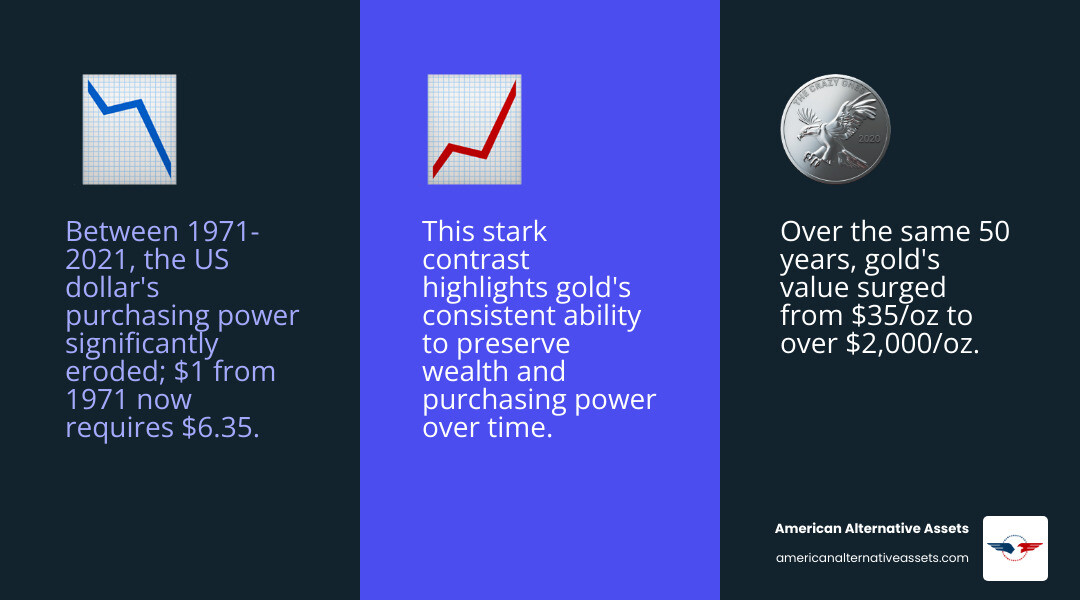
The dollar has lost over 96% of its purchasing power since 1913. Meanwhile, gold has maintained its value for thousands of years. An ounce of gold bought a quality suit in ancient Rome. It still does today. That’s not a coincidence. It’s the difference between real assets and paper promises.
Building long term wealth means understanding this fundamental distinction. It means looking beyond the noise of daily market swings and recognizing that true financial security comes from owning things with intrinsic value.
I’m Shanon Davis, and I’ve spent my career helping Americans step outside the fragile paper-based system and build long term wealth through physical precious metals. After watching the 2008 crash destroy families who thought they were playing it safe, I founded American Alternative Assets to provide a different path. What follows is a practical guide to building prosperity that lasts.
Long term wealth terms simplified:
The Pitfalls of a Paper-Based Portfolio
For many years, the conventional wisdom has been to invest heavily in stocks and bonds for long term wealth accumulation. However, relying solely on a paper-based portfolio can expose your financial future to significant risks. We’ve seen how quickly market sentiment can shift, turning seemingly solid investments into sources of anxiety.

Market volatility is a constant companion in paper assets. One day the market is soaring, the next it’s plummeting, often driven by headlines and speculation. This is where the difference between investing and trading becomes critical. Investing, for us, means building long term wealth through assets that hold intrinsic value. Trading, on the other hand, is about trying to profit from short-term price movements, often driven by chasing “hot tips” or fleeting trends. This speculative approach rarely leads to lasting prosperity. Research generally shows frequent trading is more harmful than helpful to investment returns over the long term, and it may also be subject to higher taxation.
The illusion of consistent stock market returns can be deceiving. While the S&P 500 has an average annual return of about 10% historically, this figure smooths over periods of intense downturns. We’ve witnessed historic market crashes, like those in 2000, 2008, and the ongoing concerns of today. These events highlight the systemic risks inherent in a system built on promises, not tangible assets.
Inflation, the silent thief of purchasing power, further erodes the value of savings held in traditional accounts. As the dollar’s value declines, your hard-earned money buys less and less. Understanding where your money is truly invested and how it performs during these periods is crucial for protecting your long term wealth. For a deeper dive into past market events, consider exploring Where Is Your Money Really Invested? A Look at 3 Historic Market Crashes. We believe understand The Dollar’s Slow Decline and Gold’s Steady Value: What Wall Street Won’t Say Out Loud.
Why “Time in the Market” Isn’t a Silver Bullet
You’ve probably heard the adage, “It’s time in the market, not timing the market.” While patience is a virtue, especially when investing in tangible assets, this advice can be misleading when applied indiscriminately to paper assets. Market downturns, as we’ve discussed, are not just temporary blips. They can be devastating for those whose portfolios lack true diversification.
The risk of paper assets goes beyond mere price fluctuations. There’s also the element of counterparty risk in instruments like ETFs and even stocks. When you own an ETF, you don’t own the underlying assets directly, but rather a share in a fund managed by a third party. This introduces layers of risk that are absent when you physically hold an asset. The S&P 500’s volatility, while offering potential for growth, also carries the inherent danger of significant losses if your portfolio is entirely comprised of such instruments.
The danger of a portfolio without tangible assets is that it leaves you vulnerable to systemic shocks. When confidence in the financial system wavers, paper assets can lose value rapidly, irrespective of the underlying company’s health. We encourage you to consider how this might impact your retirement plans; some experts even warn about the potential fragility of traditional retirement vehicles, as discussed in Is Your 401(k) or IRA a Ticking Time Bomb? Robert Kiyosaki Warns of a Great Depression 2.0. Why a Gold IRA Could Be Your Retirement Lifeline.
The Debt and Credit Trap
Before we even begin to discuss asset acquisition, it’s crucial to address the foundation of your personal finances: debt and credit. Effectively managing debt is a cornerstone of building long term wealth. High-interest debt, such as credit card balances, acts as a significant drag on your financial progress. It’s often more beneficial to pay off high-interest debt before investing, as few investments consistently yield returns higher than credit card interest rates.
Your credit score also plays a vital role in your financial security. A good credit score can open up better interest rates on loans for major purchases, while a poor score can cost you thousands over your lifetime. Building a strong financial base means understanding and improving your credit, paying bills on time, and keeping your credit utilization low.
The psychological burden of debt can also hinder your long term wealth journey. The stress and anxiety associated with mounting debt can make it difficult to focus on future planning and consistent investing. By prioritizing debt management, you free up financial resources and mental energy to focus on building a more secure and prosperous future.
The Bedrock Principles for Building Real, Long-Term Wealth
Building long term wealth isn’t about shortcuts or get-rich-quick schemes. It’s about establishing a solid foundation based on timeless principles. Think of it like constructing a sturdy house, where each principle is a critical part of the blueprint, and tangible assets form the cornerstone.

First, setting clear financial goals is paramount. Do you want to retire early? Buy a home? Fund your children’s education? Having specific, measurable, achievable, relevant, and time-bound (SMART) goals provides a roadmap for your financial journey.
The power of starting early cannot be overstated. Thanks to the magic of compounding, even small, consistent contributions over a long period can grow into substantial sums. For example, investing $300 every month over a 40-year period with a 5% net rate of return could accumulate nearly $450,000, with only $145,000 being initial contributions, the rest being compound growth. The earlier you begin, the more time your assets have to grow.
Creating a financial plan is your personal GPS for long term wealth. This plan should outline your budget, savings goals, investment strategy, and debt management approach. Consistency and discipline are the fuel that keeps this plan moving forward. We know that 84% of consistent budgeters maintained their financial commitments at nearly twice the rate of non-budgeters (45%), and 92% of Canadian retirees feel more positive about their financial situation due to having a written financial plan. These statistics underscore the power of planning and consistency.
Living within your means is a fundamental practice. This means understanding your monthly income and expenses, and making conscious decisions about your spending. Building an emergency fund, typically 3 to 6 months of living expenses, is another critical step, providing a financial safety net for unexpected life events like job loss or medical emergencies.
Finally, increasing your earning potential is a powerful accelerant for long term wealth. Investing in your education, developing new skills, and exploring career paths that align with your interests and offer growth opportunities can significantly boost your income. Tools like the Occupational Outlook Handbook from the U.S. Bureau of Labor Statistics can help you assess potential salaries and career growth.
The Power of a Tangible Asset Strategy
In a world increasingly dominated by digital transactions and paper promises, focusing on what you can truly control becomes a superpower for long term wealth builders. This means owning real, physical assets. Unlike stocks or bonds, which represent claims on something else, physical assets like precious metals are intrinsically valuable. They are not subject to counterparty risk, meaning their value doesn’t depend on the solvency or integrity of a third party.
Owning physical precious metals is about protecting your purchasing power against inflation and economic uncertainty. As the dollar fluctuates, gold and silver have historically served as reliable stores of value, maintaining their worth over millennia. This tangible nature provides a sense of security and permanence that is hard to replicate with other investment vehicles.
The mindset of a true long term wealth builder is one of patience, discipline, and a focus on intrinsic value. It’s about looking beyond short-term market fluctuations and understanding the enduring value of what you own. While we can draw inspiration from the principles of legendary investors like Warren Buffett, who emphasizes strong businesses at fair prices and holding for the long term, we recognize that true wealth preservation often comes from assets outside the traditional stock market. You can explore Unlock Long-Term Wealth with Warren Buffett’s Top Investing Strategies for more insights. We believe Why Precious Metals Matter Now More Than Ever is a crucial read for anyone serious about lasting prosperity.
Automating Your Path to Prosperity
One of the simplest yet most effective strategies for building long term wealth is to automate your contributions. This removes emotion from financial decisions and ensures consistent saving and investing, turning it into a habit rather than an occasional task.
Setting up automatic transfers to your savings and investment accounts means that a portion of your income goes directly towards your financial goals before you even have a chance to spend it. Whether it’s a fixed amount each payday or a percentage of your earnings, automation ensures that your long term wealth plan is always active. This consistent investment, regardless of market conditions, is known as dollar-cost averaging, and it helps mitigate the risk of market volatility over time.
Fortifying Your Future with Physical Precious Metals
To truly build long term wealth that endures, we must consider assets that stand apart from the traditional financial system. This is where physical precious metals, particularly gold and silver, play a pivotal role.
The role of diversification is to protect your portfolio from being overly reliant on any single asset class. While stocks and bonds have their place, their correlation to each other, and to the broader economic climate, means that a downturn in one can often impact the other. Precious metals, however, tend to perform inversely or independently of traditional assets, offering a crucial hedge against inflation and economic uncertainty. Gold, for instance, has historically been a strong performer during inflationary periods. You can learn more about this in Gold Inflation Impact.
Protecting your assets from financial risks is not just about growth, but about preservation. The historical stability of gold and silver spans millennia. They have been recognized as stores of value across diverse cultures and economies, outlasting currencies and empires. In times of geopolitical instability, precious metals often shine as safe-haven assets. As global tensions rise, many investors look to Protect Your Retirement With Gold.
Owning physical gold and silver provides a foundational layer of security for your long term wealth. It’s a tangible asset that you control, offering peace of mind in an unpredictable world. For further insights into the advantages of holding gold, we recommend Investor Benefits in Owning Gold.
The Superiority of Physical Gold for Long-Term Wealth
When we talk about investing in gold for long term wealth, it’s crucial to distinguish between physical gold and “paper gold” investments. While gold stocks, ETFs, and certificates might seem like convenient ways to gain exposure to gold, they come with inherent risks that physical gold does not.
| Feature | Physical Gold | Gold Stocks/ETFs |
|---|---|---|
| Ownership | Direct, tangible ownership | Indirect, paper claims, managed by third parties |
| Counterparty Risk | None | High (rely on fund managers, brokers, mining companies) |
| Tangibility | Real, physical asset | Digital entry, share in a fund, or certificate |
| Fees | Storage/transactional | Management fees, expense ratios, trading commissions |
| Market Correlation | Often inverse to stocks | Can correlate to broader stock market performance |
| Purpose | Wealth preservation, hedge | Capital appreciation (often speculative) |
The risks of paper gold are significant. Gold ETFs, for example, typically do not hold 100% of the gold they represent, and they carry management fees that can erode your returns over time. Gold mining stocks are tied to the performance of a company, not directly to the price of gold, and are subject to operational risks, corporate governance issues, and market sentiment. These are not true physical ownership.
The security of holding a real asset, like physical gold or silver, means you possess the asset directly. This eliminates counterparty risk and provides a fundamental layer of protection for your long term wealth. This is why we advocate for Why Invest in a Gold IRA?. The question of What Percentage of My Portfolio Should Be Allocated to Gold? is a common one, and it depends on your individual financial situation and goals, but it’s a conversation worth having with your financial advisor.
Using Tax-Advantaged Accounts to Your Advantage
Building long term wealth also involves smart tax planning. Utilizing tax-advantaged accounts like 401(k)s and IRAs can significantly boost your retirement savings by allowing your investments to grow tax-deferred or even tax-free.
However, traditional 401(k)s and IRAs are typically limited to paper assets like stocks, bonds, and mutual funds. This is where a Self-Directed IRA comes into play. A What Is a Self-Directed IRA? allows you to hold a broader range of alternative assets, including physical precious metals. This means you can diversify your retirement portfolio with tangible assets while still enjoying the tax benefits of a retirement account.
Understanding How Does a Gold IRA Work? is crucial for those looking to fortify their retirement with physical gold and silver. It involves rolling over funds from an existing retirement account into a new, self-directed IRA, which then allows you to purchase IRS-approved precious metals. Adhering to the Precious Metals IRA Rules Guide ensures your investments remain compliant and your long term wealth is protected within the framework of tax law.
Frequently Asked Questions about Long-Term Wealth and Precious Metals
Is investing in the stock market enough to build long-term wealth?
While the stock market has historically offered growth potential, relying solely on it is not enough to build truly secure long term wealth. The stock market, by its very nature, is susceptible to significant volatility and systemic risks. As we’ve seen, economic downturns and market crashes can dramatically impact paper portfolios.
For true long term wealth, a comprehensive approach requires diversification beyond stocks and bonds. This means incorporating tangible assets that move independently of the stock market, providing stability during turbulent times. An all-paper portfolio leaves your financial future vulnerable to forces outside your control. We believe it’s important to be prepared, especially given that a Financial Apocalypse Looms: Stock Market Bleeds as Recession Fears Surge – Protect Yourself With Diversification.
How does starting early impact my ability to build wealth?
Starting early is one of the most powerful advantages you have in building long term wealth. The principle of compounding means that your investments earn returns, and then those returns earn returns, creating exponential growth over time. The longer your money is invested, the more significant this compounding effect becomes.
Starting early also allows you to acquire assets over a longer time horizon, smoothing out the impact of market fluctuations. With a core holding of physical precious metals, starting early means you have more time to ride out market cycles, knowing your foundational assets are secure and preserving their purchasing power. This reduced pressure of time, coupled with a secure foundation of tangible assets, empowers you to build long term wealth with greater confidence.
What is the difference between investing and trading?
The fundamental difference between investing and trading lies in their time horizons and objectives. Investing, especially for long term wealth, focuses on a long-term perspective. It’s about acquiring assets with intrinsic value and holding them for years, even decades, to benefit from compounding and fundamental growth. Our focus is on building foundational wealth.
Trading, conversely, is about short-term speculation. Traders aim to profit from quick price movements, often buying and selling assets within days, hours, or even minutes. This approach is akin to chasing quick profits and is highly susceptible to market noise and emotional decision-making.
For us, a “buy and hold” strategy is most effective when applied to assets that have intrinsic value, like physical gold and silver. These assets are not speculative bets but foundational elements of long term wealth preservation. This disciplined approach, as highlighted in 10 Tips for Successful Long-Term Investing, prioritizes steady growth and protection over fleeting gains.
Conclusion: Securing Your Financial Legacy
Building long term wealth is a journey that demands foresight, discipline, and a clear understanding of what truly constitutes financial security. We’ve explored the pitfalls of relying solely on paper-based portfolios, emphasizing the importance of a strong financial foundation built on debt management and smart planning.
Crucially, we’ve highlighted the indispensable role of tangible assets, particularly physical precious metals, in a modern portfolio. These assets provide a hedge against inflation, protect against economic uncertainty, and offer true diversification, unlike their paper counterparts. By embracing direct ownership and leveraging tax-advantaged accounts like Precious Metals IRAs, you can take proactive steps to secure your financial future.
At American Alternative Assets, we are dedicated to helping our clients steer this path. We believe in white-glove, relationship-first service, built on trust, transparency, and ethical practices. Our goal is to ensure real privacy and protection for your long term wealth. Take control of your financial future and build a legacy of true, lasting wealth.
Secure your assets with a trusted gold depository
This article is for informational purposes only and does not constitute financial advice. Please consult your financial advisor before making investment decisions.
Investing in precious metals involves risk. Past performance does not guarantee future results.