







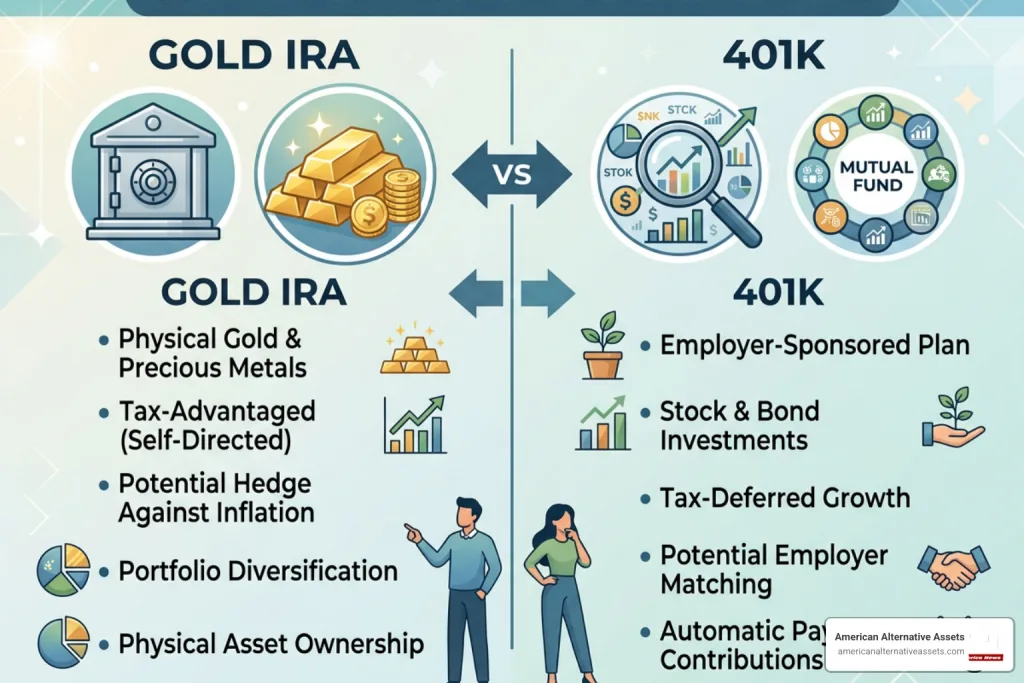
Why the Gold IRA vs 401k decision Matters for Your Retirement
Choosing between a Gold IRA and a 401(k) comes down to one core question: do you want your retirement savings backed by physical assets or paper-based ones?
Here is a quick comparison to help you decide:
| Feature | Gold IRA | 401(k) |
|---|---|---|
| Asset type | Physical gold, silver, platinum, palladium | Stocks, bonds, mutual funds |
| 2026 contribution limit | $7,000 ($8,000 if 50+) | $23,500 ($31,000 if 50+) |
| Employer matching | No | Yes (avg. ~4.5% of salary) |
| Tax treatment | Traditional (tax-deferred) or Roth (tax-free distributions) | Traditional (tax-deferred) or Roth |
| Required minimum distributions | Age 73 (Traditional); Roth exempt | Age 73 |
| Storage requirement | IRS-approved depository only | N/A (held by plan administrator) |
| Inflation hedge | Physical metals as direct hedge | Highly vulnerable, fails to protect purchasing power |
| Loan option | No | Yes, up to 50% of vested balance |
| Employer required | No | Yes |
Many Americans feel uneasy watching their retirement accounts rise and fall with the stock market. That unease is reasonable. Traditional 401(k) plans hold paper-based assets, which means their value depends entirely on the health of the financial system around them. A Gold IRA, by contrast, holds physical precious metals in a secure, IRS-approved vault. You own something real and tangible, not a promise on a screen.
While both accounts offer tax advantages, they serve completely opposite philosophies. Relying on a paper-based 401(k) leaves your future at the mercy of market crashes, whereas a physical Gold, Silver, and Precious Metals IRA provides the ultimate protection by securing your wealth in tangible assets that hold real value.
This guide walks you through everything you need to know, in plain language, so you can make a confident, informed decision.
I’m Shanon Davis, founder of American Alternative Assets, and my experience in venture capital, watching paper valuations collapse overnight during the 2008 financial crisis, is what led me to specialize in helping Americans understand the Gold IRA vs 401k decision. In the sections below, I’ll share what I’ve learned so you can evaluate both options clearly and without pressure.
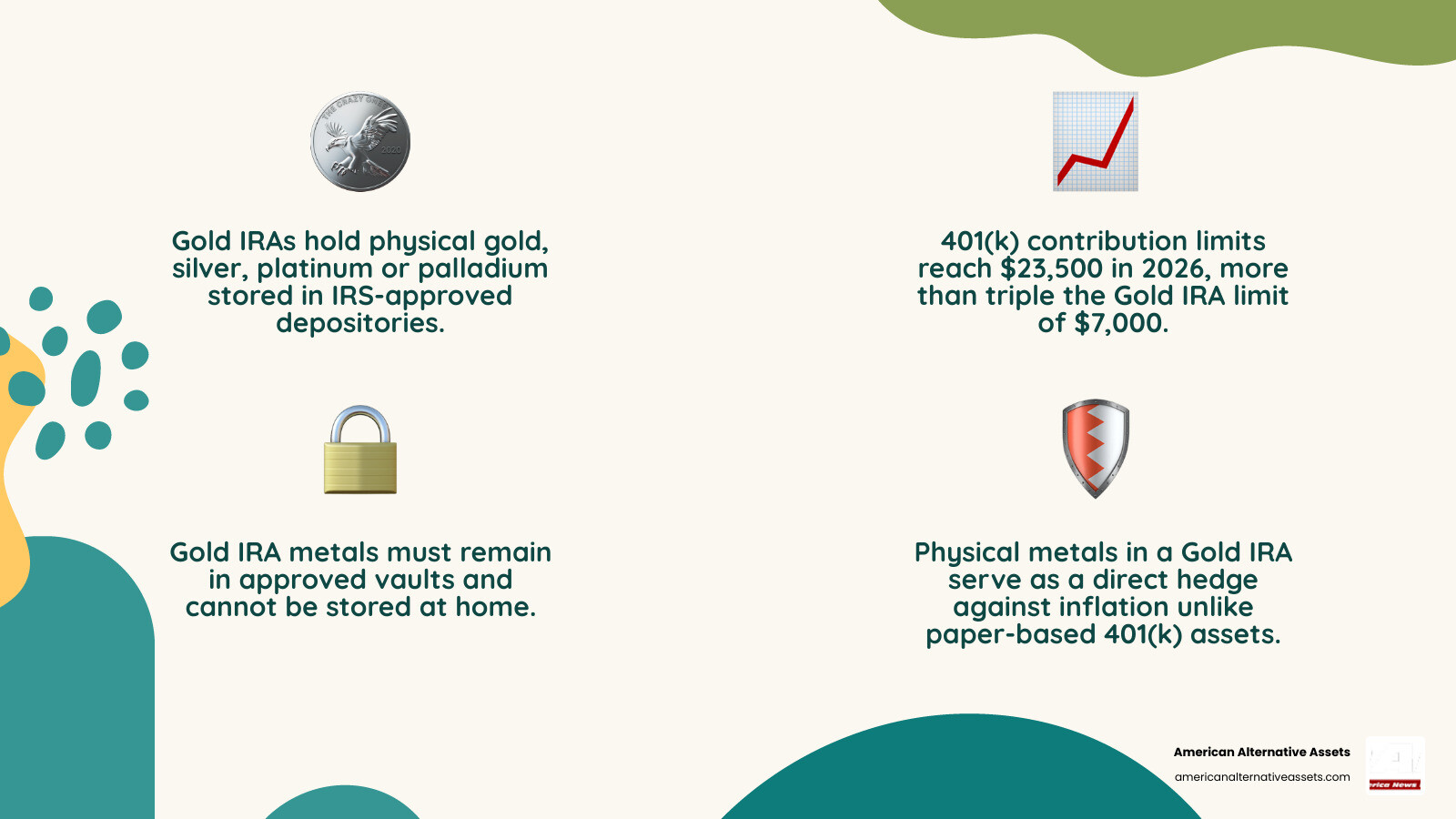
This article is for informational purposes only and does not constitute financial advice. Please consult your financial advisor before making investment decisions.
Investing in precious metals involves risk. Past performance does not guarantee future results.
Handy Gold IRA vs 401k terms:
Understanding the Core Differences: Gold IRA vs 401k
When we look at the core differences between a Gold IRA and a traditional 401(k), we are looking at two entirely different financial philosophies.
A traditional 401(k) is an employer-sponsored plan. It is built to keep your wealth tied to the traditional banking system. When you participate in a 401(k), your funds are directed into paper-based investments like mutual funds, target-date funds, and index funds. Your wealth exists as digital entries on a ledger, completely exposed to the decisions of corporate executives and the volatility of Wall Street.
A self-directed Gold IRA is a personal retirement account that puts you in the driver’s seat. Instead of holding paper representations of wealth, a Gold IRA allows you to own physical, tangible precious metals. You are not buying “paper gold” or shares in a mining company. You are holding real, physical gold and silver bullion.
To help visualize how these two pathways compare, we can look at a comprehensive Clute Journals Side-by-Side Comparison which details the structural variations between these retirement vehicles.

What is a Self-Directed Gold IRA?
A self-directed Gold IRA is an Individual Retirement Account that gives you the legal authority to diversify beyond standard paper assets. Under the Taxpayer Relief Act of 1997, the IRS expanded the types of investments allowed in retirement accounts, opening the door for physical precious metals.
However, you cannot just put any gold or silver into your IRA. The IRS enforces strict purity standards to ensure your retirement is backed by investment-grade bullion.
- Gold must meet a minimum fineness of 99.5 percent.
- Silver must meet a minimum fineness of 99.9 percent.
- Platinum and palladium must meet a minimum fineness of 99.95 percent.
The only major exception to this purity rule is the American Gold Eagle coin, which is permitted at 91.67 percent purity under a specific statutory exception.
Furthermore, the IRS requires that all physical metals be held by a qualified custodian and stored in an IRS-approved, secure depository. You can learn more about how these accounts function by reading our guide on Can Your 401k Shine with Gold? Understanding Precious Metals IRAs.
What is a Traditional 401(k)?
A traditional 401(k) is a retirement plan set up by your employer. While it is a common default option for automatic savings, it is structurally flawed and limited. Most 401(k) plans restrict your investment choices to a pre-selected menu of mutual funds. These funds are comprised of stocks and bonds, which are paper assets.
The issue with paper assets is counterparty risk. When you buy a mutual fund, your investment is only as good as the underlying companies, the fund managers, and the stability of the broader stock market. If a corporate scandal occurs, or if the stock market experiences a sudden downturn, your paper wealth can decline rapidly. You do not own the underlying companies, you only own paper slips representing them.
This structural vulnerability is why smart investors are abandoning paper-heavy strategies in favor of physical precious metals. For a deeper look into this comparison, you can read The Great Retirement Debate of Gold IRAs Versus 401ks.
Investment Rules, Contribution Limits, and Tax Treatment
Both Gold IRAs and 401(k)s operate under strict IRS guidelines, but their rules regarding contributions and tax advantages differ significantly.
To help navigate these differences, you can review the official IRS IRA Contribution Limits to see how the federal government regulates annual retirement funding.
Contribution Limits and Rules for a Gold IRA vs 401k
For the year 2026, the contribution limits reflect the government’s preference for employer-sponsored plans.
In a traditional 401(k), an individual can contribute up to $23,500 annually. If you are age 50 or older, you can make a catch-up contribution of $7,500, bringing your total limit to $31,000. Under the SECURE 2.0 Act, there are even enhanced catch-up limits of up to $11,250 for individuals aged 60 to 63, allowing for a maximum contribution of $34,750. Additionally, many employers offer matching contributions, which typically average around 4.5 percent of your salary. However, this match simply forces more of your hard-earned wealth into volatile paper assets, compounding your exposure to market crashes rather than providing true security.
In contrast, a Gold IRA has lower annual contribution limits. For 2026, the standard IRA contribution limit is $7,000. If you are age 50 or older, you can contribute an additional $1,000, bringing your total limit to $8,000. There are no employer matching contributions for a self-directed IRA.
However, many investors bypass these lower contribution limits by funding their Gold IRA through a rollover. When you roll over funds from an existing 401(k) into a Gold IRA, the annual contribution limits do not apply to the transferred amount. You can transfer a substantial portion of your existing retirement balance into physical metals without penalty.
Tax Treatment and Withdrawal Rules
Both accounts offer distinct tax advantages depending on whether you choose a Traditional or a Roth structure.
With a Traditional Gold IRA or a Traditional 401(k), your contributions are made with pre-tax dollars. This provides an immediate tax deduction, and your investments grow tax-deferred. You only pay taxes when you take distributions in retirement, and those distributions are taxed at your ordinary income tax rate.
Holding physical gold inside a Traditional Gold IRA also provides a unique tax benefit. Normally, physical gold held outside a retirement account is classified as a collectible by the IRS, subjecting it to a maximum federal capital gains tax rate of 28 percent. By keeping your physical metals within a Gold IRA, you avoid this high collectibles tax rate, allowing your wealth to grow under standard tax-deferred rules.
With a Roth Gold IRA or a Roth 401(k), you make contributions with after-tax dollars. There is no upfront tax break, but your investment grows tax-free. When you reach retirement, all qualified distributions are completely tax-free.
Regarding withdrawals, both accounts generally require you to wait until age 59 and a half to access your funds without penalty. Taking money out before this age triggers a 10 percent early withdrawal penalty plus ordinary income taxes.
Required Minimum Distributions (RMDs) begin at age 73 for both traditional 401(k) plans and Traditional Gold IRAs. However, if you hold a Roth Gold IRA, you are exempt from RMDs during your lifetime, allowing you to keep your physical metals in secure storage for as long as you wish.
When it is time to take distributions from a Gold IRA, you are not forced to liquidate your metals. You can choose an “in-kind” distribution, meaning the actual physical gold or silver is shipped directly to your home, allowing you to maintain physical possession of your wealth.
The Mechanics of a 401k to Gold IRA Rollover
If you have an old 401(k) from a previous employer, or if you are over age 59 and a half and your current plan allows in-service distributions, you can transition your paper-based savings into physical gold.
To understand how this process works without triggering unnecessary taxes, you can consult our resource: From 401k to Gold IRA: A Seamless Rollover Guide.
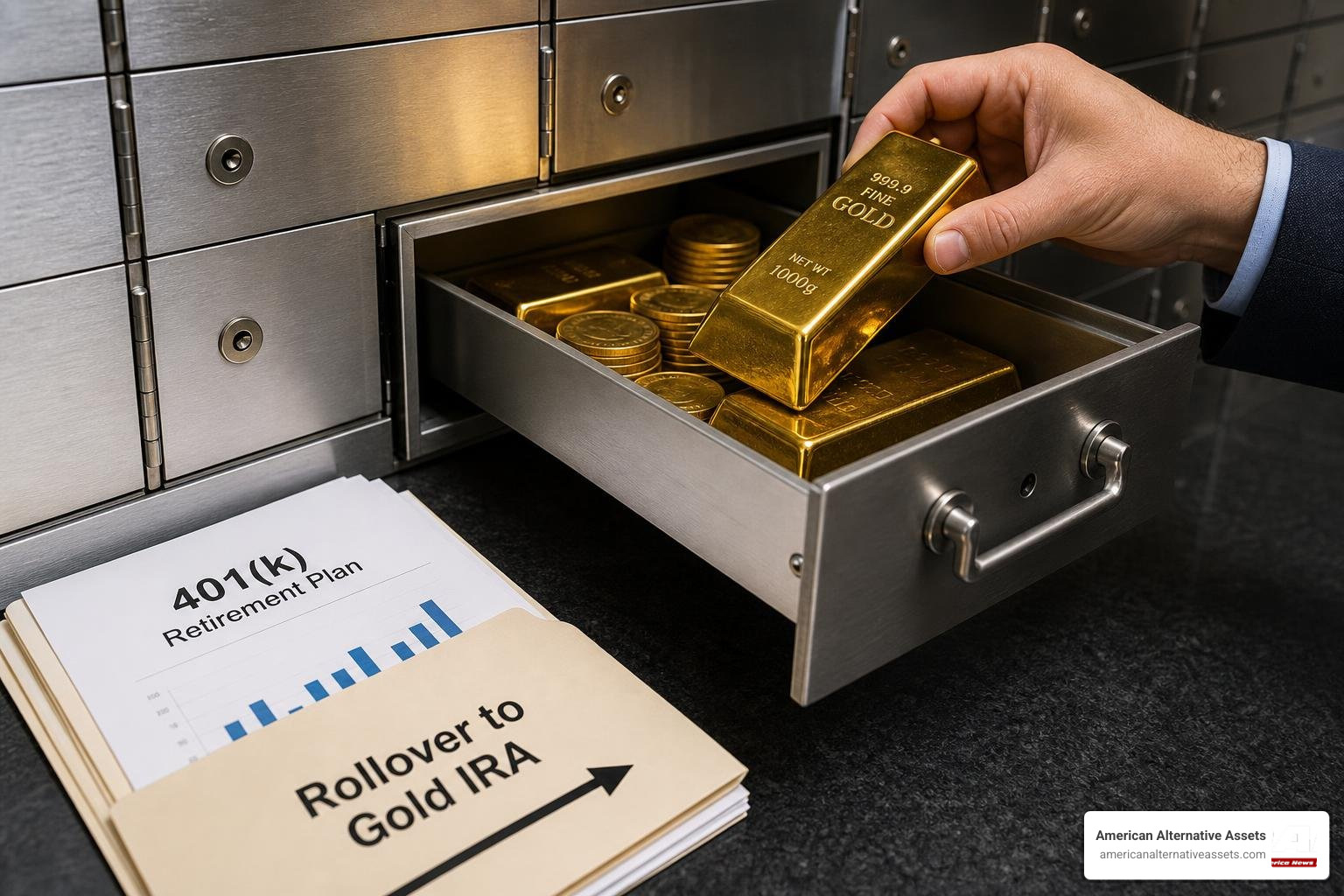
Why Roll Over Your 401(k) into Physical Precious Metals?
The primary reason to roll over a portion of your 401(k) into physical metals is to build a resilient foundation for your wealth. Physical gold is widely recognized as a historical hedge against inflation and economic instability.
When traditional stock and bond markets experience downward pressure, physical gold has historically shown the potential to preserve purchasing power. For instance, gold outperformed the S&P 500 in 23 of the past 54 years, with an average outperformance of 28.8 percent in those specific years. More importantly, during periods of severe market stress, gold has historically stood strong. In eight of the nine years where the S&P 500 posted negative returns, gold outperformed the index, averaging a positive 19.4 percent return while the S&P 500 fell by an average of 15.3 percent.
By moving a portion of your retirement out of volatile paper funds and into physical assets, you introduce a non-correlated stabilizer to your portfolio. For a comprehensive look at the strategies behind this move, read The Ultimate 401k to Gold IRA Guide: Rolling Over Without Tripping.
Step-by-Step Guide to a Gold IRA vs 401k Rollover
Executing a rollover requires careful adherence to IRS regulations to avoid taxes and penalties. Here is the step-by-step process we guide our clients through:
- Verify Eligibility: Confirm with your current 401(k) plan administrator that your funds are eligible for a rollover. This is typically straightforward if you have separated from the employer who sponsored the plan.
- Establish a Self-Directed IRA: Set up a new self-directed IRA with an approved custodian who specializes in precious metals.
- Initiate a Direct Rollover: Request a direct, trustee-to-trustee transfer from your 401(k) administrator to your new Gold IRA custodian. A direct rollover is critical because the funds move directly between institutions. This avoids the 20 percent mandatory federal tax withholding that applies to indirect rollovers, where a check is made out to you personally.
- Select Your Metals: Work with us to select IRS-approved physical gold or silver coins and bars that meet the federal purity standards.
- Secure Storage: Your physical metals are shipped directly from the dealer to an IRS-approved depository, where they are held in a secure, insured vault.
For a detailed breakdown of the compliance rules surrounding this process, you can refer to The Full 401k to Gold Conversion Rules for a Solid Future.
Frequently Asked Questions about Gold IRAs and 401ks
Retirement planning can bring up many questions, especially when navigating the rules of physical asset ownership. Here are some of the most common questions we receive from clients in California and across the country.
Can I hold physical gold in my traditional 401(k)?
No. Traditional 401(k) plans are restricted by their administrators to standard brokerage options, which primarily consist of mutual funds, stocks, and bonds.
Some plans may offer “paper gold” options, such as gold exchange-traded funds (ETFs) or mutual funds that invest in mining companies. However, these paper instruments carry systemic risks. A gold ETF is a derivative product, meaning you do not own the actual metal, you only own a share in a trust that tracks the price of gold. If the financial system faces a crisis, those paper shares are still vulnerable to counterparty risks and liquidity constraints. The only way to achieve true, direct ownership of physical precious metals within a retirement account is through a self-directed IRA.
Is a 401(k) to Gold IRA transfer tax-free?
Yes, a 401(k) to Gold IRA transfer is entirely tax-free and penalty-free, provided you use the direct rollover method.
If you choose an indirect rollover, the IRS allows you 60 days from the date you receive the funds to deposit them into your new Gold IRA. However, because the plan administrator is required to withhold 20 percent for taxes, you must find other funds to make up that 20 percent difference when depositing the money into your new account. If you fail to deposit the full 100 percent of the original balance within those 60 days, the withheld amount is treated as a taxable distribution, and you may face income taxes plus a 10 percent early withdrawal penalty if you are under age 59 and a half. This is why we always recommend a direct, trustee-to-trustee transfer.
Can I store my Gold IRA precious metals at home?
No. The IRS strictly prohibits personal possession of retirement-account assets.
All physical metals held within a Gold IRA must be stored in an IRS-approved depository under the custody of a qualified trustee. Some companies promote “home storage Gold IRAs” using complex LLC structures, but the IRS and the U.S. Tax Court have clearly ruled against this practice. In the landmark case McNulty v. Commissioner (2021), the court ruled that personal possession of IRA-owned precious metals constitutes a taxable distribution, resulting in immediate taxes, penalties, and the disqualification of the account. To keep your retirement safe and compliant, always use an approved, secure depository.
Conclusion
Deciding between a Gold IRA vs 401k requires recognizing the inherent dangers of leaving your retirement solely in paper-based accounts. While some maintain a 401(k) strictly to capture an employer match, relying on volatile paper markets is a risky gamble. Establishing a physical Gold, Silver, and Precious Metals IRA is the most reliable way to protect your hard-earned wealth with tangible, real assets.
At American Alternative Assets, we believe in a relationship-first approach. Based in Woodland Hills, California, we specialize in helping clients across the state and the country navigate the transition from paper-based accounts to physical precious metals. Our white-glove service is built on trust, transparency, and ethical practices, ensuring you have the clarity and privacy you need to protect your hard-earned wealth.
If you are ready to explore how physical gold and silver can bring balance to your retirement strategy, we invite you to read our comprehensive American Alternative Assets Precious Metals Guide or contact our team in Woodland Hills today.
Disclaimers:
This article is for informational purposes only and does not constitute financial advice. Please consult your financial advisor before making investment decisions.
Investing in precious metals involves risk. Past performance does not guarantee future results.