







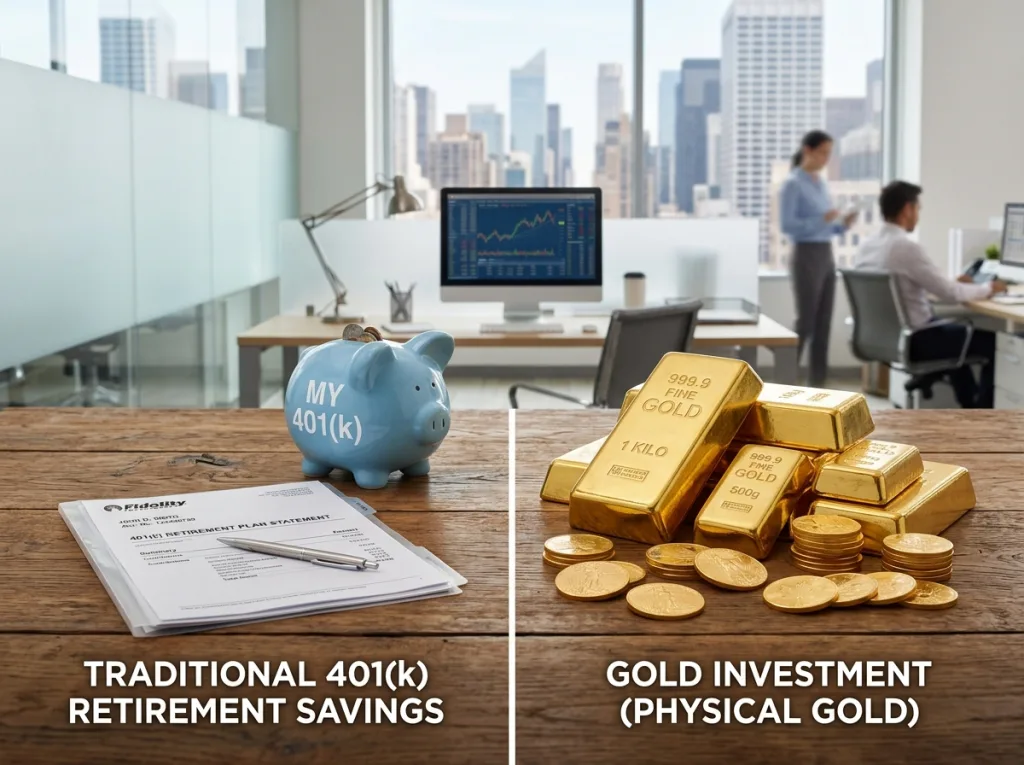
The Great Retirement Debate: How to Compare 401k to Gold IRA
When you compare 401k to gold ira options side by side, the core difference comes down to one thing: what your retirement savings are actually made of.
Here is a quick snapshot of the key differences:
| Feature | 401(k) | Gold IRA |
|---|---|---|
| Account type | Employer-sponsored | Self-directed IRA |
| What you hold | Stocks, bonds, mutual funds | Physical gold and precious metals |
| Contribution limit (2025) | $23,500 ($31,000 if 50+) | $7,000 ($8,000 if 50+) |
| Employer matching | Yes, often up to 6% of salary | No |
| Tax treatment | Tax-deferred (traditional) | Tax-deferred or tax-free (Roth) |
| Required minimum distributions | Yes, starting at age 73 | Traditional yes; Roth Gold IRA no |
| Investment control | Limited to plan options | Full self-directed control |
| Inflation hedge | Limited | Strong, via physical metals |
| Storage requirement | None (paper assets) | IRS-approved depository required |
| Creditor protection | Federal (ERISA) | Depends on state law |
Americans currently hold over $6.6 trillion in 401(k) accounts and nearly $11.5 trillion across all IRA accounts, according to data from the Investment Company Institute. Both are powerful retirement tools. But they are built for different purposes, and which one serves you better depends entirely on your goals.
A 401(k) is designed for growth through traditional markets. A Gold IRA is designed to hold physical precious metals, offering a layer of protection that paper-based assets simply cannot replicate.
If you are concerned about market volatility, dollar devaluation, or the long-term stability of your retirement savings, understanding how these two accounts differ is not just useful. It is essential.
I’m Shanon Davis, and my journey from venture capital to founding American Alternative Assets gave me a front-row seat to exactly why understanding how to compare 401k to gold ira matters so much for ordinary Americans. Having watched the 2008 financial crisis expose the fragility of paper-based wealth, I built this company to help people hold value that does not depend on anyone else’s promises.
Understanding the Fundamentals of 401ks and Gold IRAs
To truly compare 401k to gold ira plans, we have to start with the basics. Most of us are familiar with the 401(k). It is a defined contribution plan sponsored by an employer. You contribute a portion of your paycheck, and often, your employer “matches” a percentage of that contribution. It is automated, convenient, and built entirely on paper-based investments like mutual funds and target-date funds.
However, a 401(k) is essentially a “locked box” of digital entries. You do not own the underlying companies or the physical assets; you own a share of a fund that tracks them. If the stock market experiences a significant correction, your digital balance reflects that loss immediately.
A Gold IRA, on the other hand, is a type of self-directed Individual Retirement Account (SDIRA). While a traditional IRA limits you to stocks and bonds, a self-directed version allows you to hold alternative assets. In our case, we focus on physical precious metals. When you invest in a Gold IRA, you are shifting from “paper wealth” to “tangible wealth.”
Physical gold is not just another line item on a spreadsheet. It is a physical asset with thousands of years of history as a store of value. Unlike a company that can go bankrupt or a currency that can be printed into oblivion, physical gold has no counterparty risk. Its value is intrinsic.

Key Differences When You Compare 401k to Gold IRA
When we sit down with clients at American Alternative Assets, we often discuss the structural differences between these two vehicles. While both are tax-advantaged accounts recognized by the IRS, the way they behave during economic shifts is night and day.
One of the biggest hurdles with a 401(k) is the lack of control. Your employer and the plan administrator choose the menu of investments. Usually, this is a handful of mutual funds. You cannot decide to buy physical gold bars within a standard 401(k). You are essentially a passenger on a ship steered by someone else.
A Gold IRA offers full self-directed control. You choose the specific coins or bars, provided they meet IRS purity standards. You decide when to buy and, eventually, how you want to take your distributions. This level of autonomy is vital for those who want to be the primary architect of their financial future.
Contribution Limits to Compare 401k to Gold IRA in 2025
The IRS updates contribution limits regularly to account for inflation. For 2025, the 401(k) remains the heavyweight in terms of how much cash you can squirrel away annually.
- 401(k) Limits: In 2025, employees can contribute up to $23,500. If you are age 50 or older, you can add a “catch-up” contribution of $7,500, bringing your total to $31,000.
- Gold IRA Limits: The limit for all your IRAs (including Gold IRAs) combined is $7,000 in 2025. For those 50 and older, the limit is $8,000.
While the 401(k) allows for higher annual contributions, many of our clients find that the real power of a Gold IRA comes from the rollover. You aren’t limited to just the $7,000 annual contribution if you are moving funds from an existing 401(k) or traditional IRA. You can transfer much larger sums into a Gold IRA to protect the wealth you have already built over decades.
Tax Benefits and Withdrawal Rules
Both accounts offer significant tax advantages, but the timing of those benefits differs.
In a traditional 401(k) or traditional Gold IRA, your contributions are often made with pre-tax dollars. This lowers your taxable income today, and the investments grow tax-deferred. You only pay taxes when you take the money out in retirement.
If you choose a Roth Gold IRA, you contribute after-tax dollars. The trade-off is that your qualified withdrawals in retirement are generally tax-free. This is a popular choice for those who believe tax rates will be higher in the future than they are today.
One important rule to remember is the Required Minimum Distribution (RMD). Currently, the IRS requires you to start taking money out of your traditional 401(k) or traditional IRA at age 73. However, as of 2025, Roth Gold IRAs are exempt from lifetime RMDs for the original owner, allowing your physical gold to stay protected and growing for as long as you wish.
The Power of Physical Assets in Economic Uncertainty
Why do people compare 401k to gold ira options so right now? It often comes down to the “purchasing power” of the US dollar. Since 1971, the dollar has lost a staggering amount of its purchasing power, while gold has historically gained value over the long term.
In a traditional 401(k), your success is tied to the strength of the financial system. If the dollar weakens or inflation spikes, the “real” value of your paper assets can erode, even if the number on your statement stays the same.
Physical gold acts as a hedge. When the stock market is volatile or the economy feels unstable, gold has historically served as a “safe haven.” In 8 out of the last 9 years where the S&P 500 was negative, gold actually outperformed, providing a necessary cushion for portfolios that were otherwise bleeding value.
How to Compare 401k to Gold IRA Rollover Processes
If you have an “orphaned” 401(k) from a previous employer, it might be sitting in low-yield funds or exposed to unnecessary market risk. Moving those funds into a Gold IRA is a common strategy for diversification.
The process is generally straightforward if you follow the “direct rollover” path. In a direct rollover, the funds move from your 401(k) administrator directly to your new Gold IRA custodian. This is a tax-free event and avoids the 20% mandatory withholding that occurs with “indirect” rollovers.
At American Alternative Assets, we pride ourselves on a relationship-first approach to this process. We help you navigate the paperwork to ensure your movement of wealth is compliant and efficient. You can find more details on our gold ira services page to see how we handle the heavy lifting for you.
IRS Rules for Physical Metal Storage and Purity
The IRS is very specific about what can go into a Gold IRA. You cannot simply buy any gold coin and put it in your retirement account.
- Purity Standards: Gold must be at least 99.5% pure. Silver must be 99.9% pure. Platinum and palladium must be 99.95% pure.
- Approved Metals: Common choices include American Gold Eagles, Canadian Maple Leafs, and bars from accredited refiners like PAMP Suisse.
- No Home Storage: This is a critical rule. Per the McNulty v. Commissioner court case, you cannot store your IRA-owned gold in a safe at home. Doing so is considered a “distribution” by the IRS, which could trigger immediate taxes and penalties on the entire account value.
Your metals must be held in an IRS-approved depository. These are high-security facilities (like Delaware Depository or Brinks) that provide insured, third-party storage. For those interested in silver, you can learn more about the specific requirements for silver ira services on our dedicated page.
Determining the Best Strategy for Your Retirement Goals
So, when you compare 401k to gold ira, which one wins? The truth is, they don’t have to compete. Many of the most successful investors we work with use both.
If your employer offers a 401(k) match, that is essentially “free money” that is hard to pass up. However, relying only on a 401(k) leaves you 100% exposed to the risks of the stock market and the banking system.
A balanced approach often involves maximizing your employer match in your 401(k) and then using a Gold IRA to diversify a portion of your wealth (often 10% to 30%) into physical precious metals. This creates a “barbell” strategy: growth potential on one side and wealth preservation on the other.
Frequently Asked Questions about Retirement Options
Can I roll over an active 401k into a Gold IRA?
This depends on your plan’s specific rules. Most 401(k) plans do not allow you to move funds while you are still actively employed there, unless you have reached age 59.5. This is called an “in-service distribution.” If you have a 401(k) from a former employer, however, you can usually roll that over into a Gold IRA at any time, regardless of your current age.
What are the risks of a Gold IRA compared to a 401k?
Every investment has risks. In a 401(k), your primary risk is market volatility and the potential for a systemic financial collapse. In a Gold IRA, the price of gold can be volatile in the short term. Additionally, because gold is a physical asset, it does not pay dividends or interest like a stock or bond might. It is a growth and preservation play, not an income-generation play.
Is physical gold better than a gold ETF in a 401k?
Some 401(k) plans allow you to buy “Gold ETFs” (Exchange Traded Funds). While this gives you exposure to the price of gold, you do not own the metal. You own a share of a trust that owns the metal. If the fund manager fails or the financial system freezes, you may find that your “paper gold” is difficult to liquidate. Physical gold in a Gold IRA gives you direct ownership of the tangible asset. For those looking to add to their holdings outside of an IRA, you can explore our options for buying gold and silver directly.
Conclusion
The debate between 401(k)s and Gold IRAs isn’t about which one is “better” in a vacuum. It is about which one provides the security you need for the future you envision.
At American Alternative Assets, we believe that true financial freedom comes from diversification that includes tangible, physical assets. Our Woodland Hills, CA-based team is dedicated to providing white-glove, relationship-first service. We don’t just set up accounts; we build partnerships based on transparency and ethical practices.
Whether you are looking to protect a lifetime of savings from a looming recession or simply want to ensure your “paper wealth” is backed by something real, we are here to help. Our goal is to ensure you have real privacy and protection for the wealth you have worked so hard to build.
If you are ready to take the next step in securing your legacy, we invite you to learn more info about American Alternative Assets and how we can assist you in navigating the great retirement debate.
This article is for informational purposes only and does not constitute financial advice. Please consult your financial advisor before making investment decisions.
Investing in precious metals involves risk. Past performance does not guarantee future results.