








Why Smart Investors Are Rethinking What It Means to Diversify
Diversify investment portfolio strategies have become more critical than ever as traditional investment models face unprecedented challenges. Here’s what you need to know:
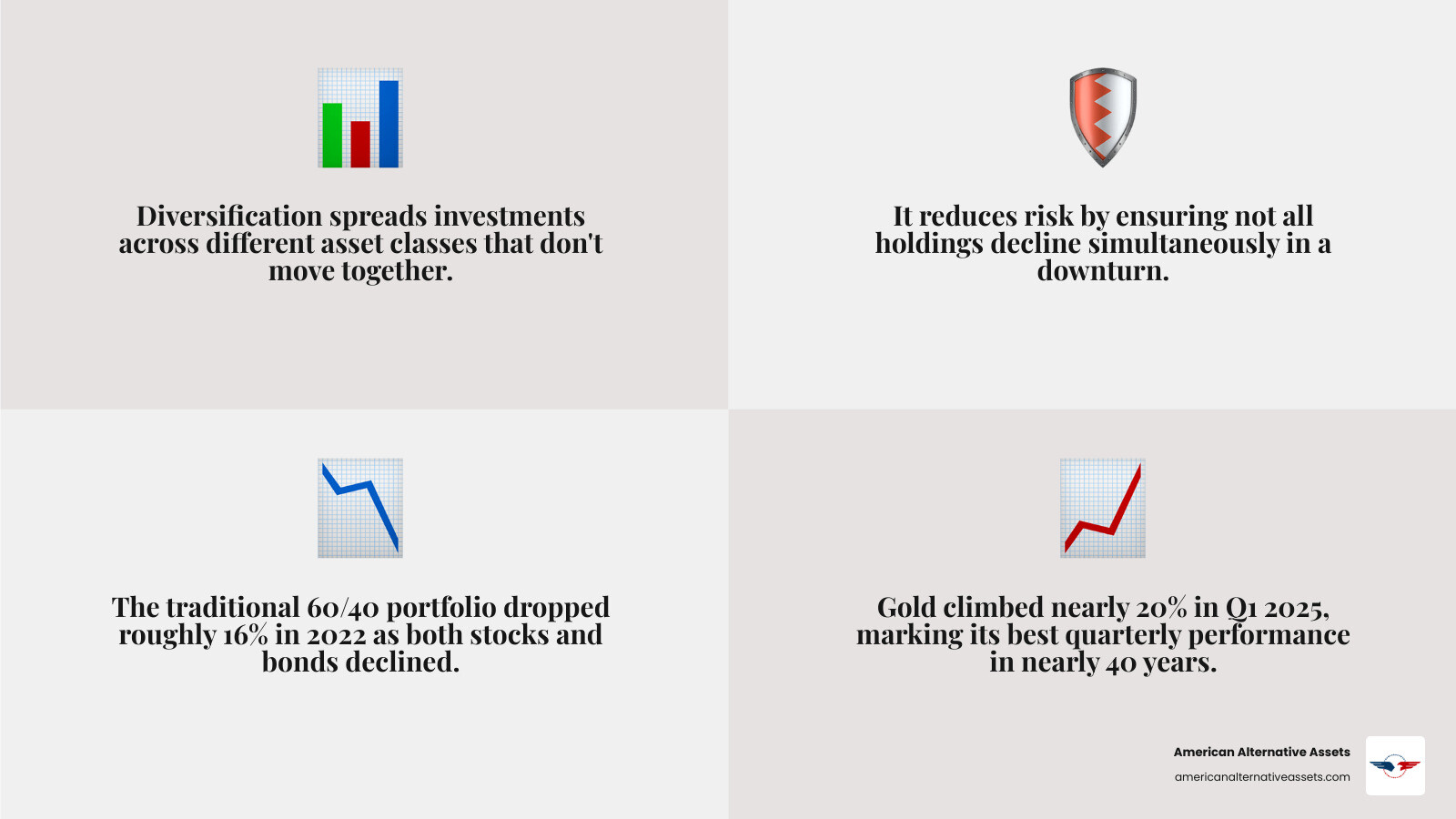
- What it is: Spreading investments across different asset classes that don’t move together
- Why it matters: Reduces risk by ensuring not all holdings decline simultaneously
- The key shift: Traditional stock and bond portfolios may no longer provide adequate protection
- The solution: Including uncorrelated assets like physical precious metals (gold and silver)
- Recommended allocation: Many experts suggest 5-20% of your portfolio in alternative assets
You’ve probably heard the saying, “Don’t put all your eggs in one basket.” My grandfather handed me a silver Morgan coin when I was nine and told me, “This is real money.” That moment stuck with me through decades of working in venture capital, watching markets swing wildly on emotion rather than fundamentals.
Then came 2008.
I watched families lose everything, not because they made bad decisions, but because their entire retirement sat in assets that all collapsed together. Their portfolios were “diversified” on paper, with different stocks and bonds. But when the crisis hit, everything fell at once.
That’s when the traditional definition of diversification revealed itself as dangerously incomplete.
The classic 60/40 portfolio (60% stocks, 40% bonds) worked well from 1981 to 2021, largely because interest rates kept falling. But in 2022, that same portfolio dropped roughly 16% as both stocks and bonds declined together. The S&P 500 fell 5% and the Nasdaq sank 11% in Q1 2025 alone, while gold climbed nearly 20%, marking its best quarterly performance in nearly 40 years.
Today’s economic environment demands a different approach. Rising interest rates, mounting federal debt, geopolitical tensions, and inflation concerns have exposed the limitations of relying solely on paper assets that all respond similarly to market stress.
True diversification means including assets that behave independently from each other. When stocks fall, you need holdings that might rise or at least hold steady. That’s where physical precious metals like gold and silver have historically played a crucial role.
I’m Shanon Davis, and after working in venture capital and witnessing the 2008 crisis firsthand, I founded American Alternative Assets to help ordinary Americans diversify investment portfolio strategies beyond fragile paper systems using tangible assets they can actually control. This guide will show you how to build a more resilient portfolio for long-term wealth preservation.
Why Traditional Diversification May No Longer Be Enough
For decades, the conventional wisdom for how to diversify investment portfolio strategies revolved around a mix of stocks and bonds. This approach, often epitomized by the 60/40 portfolio, aimed to balance growth potential with stability. The idea was that when stocks struggled, bonds would provide a cushion, and vice-versa. However, recent economic shifts have severely tested this long-held belief, revealing a dangerous illusion of stability for many investors.
We’ve seen that when a crisis hits, assets that were once thought to be uncorrelated can suddenly move in lockstep. This is known as concentration risk, where too many assets are tied to similar market forces. The result can be significant losses, as witnessed during the 2008 financial crisis when portfolios composed entirely of housing-adjacent stocks suffered immense declines, even if they held different companies. For a deeper look at how such events can impact portfolios, explore our insights on The Dangerous Illusion of Stability and Where Is Your Money Really Invested? A Look at 3 Historic Market Crashes.
The goal of diversification is to choose a mix of investments that tend to perform well at different times. If your assets are “uncorrelated,” meaning they react to economic events in different ways, you can reduce the risk of major losses that can result from over-emphasizing a single security or asset class. This fundamental concept is explored further in guides like Asset Allocation, Diversification, and Rebalancing 101.
The Limits of Stocks and Bonds
While stocks offer the highest growth potential, they also come with the potential for higher losses. Historically, large company stocks, as a group, have lost money on average about one out of every three years. Market volatility can be intense, and as we’ve seen, recessions and economic downturns can cause significant stock market bleeding. Our article, Financial Apocalypse Looms: Stock Market Bleeds as Recession Fears Surge. Protect Yourself with Diversification, highlights these concerns.
Bonds, on the other hand, are generally less volatile than stocks and typically offer higher returns than cash investments. However, they are not without risk. Fixed income investments are subject to interest rate, credit, market, and issuer risks. The performance of the 60/40 portfolio from 1981 to 2021 was largely buoyed by a long period of declining interest rates. When interest rates began to rise, the diversification benefits of bonds diminished, and both stocks and bonds struggled simultaneously. This phenomenon challenges the idea of bonds as a constant safe haven. The potential collapse of the safe U.S. bond market is a topic we’ve addressed in, The Day No One Showed Up: Why the Collapse of the Safe U.S. Bond Market Should Terrify You and Why Gold Could Soar to $25,000.
The core problem with relying solely on stocks and bonds for diversification is that they are both “paper assets.” Their value is tied to the performance of corporations and governments, and they can be highly correlated during times of economic stress or systemic risk. When the system itself is under pressure, their individual differences may become less pronounced, leading to simultaneous declines.
The Pitfall of ‘Diworsification’
While the goal is to diversify investment portfolio holdings, it’s possible to take it too far without a clear strategy. This leads to what some experts call “diworsification,” a term coined to describe the act of adding too many assets to a portfolio, increasing complexity without actually reducing risk or enhancing returns. It’s like collecting different kinds of candy at a store, some classic, some novelty. You might have a lot of candy, but if they all melt in the sun the same way, your “diversification” didn’t help.
The danger lies in not understanding the underlying correlations of the assets you’re adding. If you simply add more stocks from different sectors, but those sectors are all highly sensitive to the same economic indicators, you haven’t truly diversified your risk. You’ve merely spread your capital across a wider range of correlated assets. This can lead to increased management fees, more paperwork, and potentially diluted returns, all without providing the intended protection. As the CalCPA notes, “Diworsification” can happen when investors increase the number of holdings without a strategic reduction in overall portfolio risk.
The key insight is that diversification isn’t just about owning many different things, but about owning assets that behave differently under varying market conditions. True diversification seeks out assets that are genuinely uncorrelated, so that when one part of your portfolio faces headwinds, another part might be thriving or holding its value. Without this strategic approach, increased complexity can mask underlying vulnerabilities.
The Strategic Role of Physical Precious Metals in Your Portfolio
In an increasingly unpredictable global economic environment, the need for truly uncorrelated assets to diversify investment portfolio strategies has become paramount. This is where physical precious metals, particularly gold and silver, step into a strategic role. These tangible assets have a long history of maintaining value and acting as a safe haven during times of market volatility, inflation, and geopolitical uncertainty.

Unlike paper assets, which are promises to pay or claims on future earnings, physical gold and silver represent real, intrinsic value. They are not subject to the same counterparty risks as stocks and bonds, nor are they directly tied to the performance of a single company or government. This makes them exceptional tools for wealth preservation, especially when traditional financial markets are under stress. For more on their enduring value, consider Why Precious Metals Matter Now More Than Ever.
Historically, gold has demonstrated a near-perfect lack of correlation to equities over a 10-year period (-0.01). This means its price movements are largely independent of the stock market, providing a crucial buffer when other assets decline. Gold is also widely recognized as a hedge against inflation. When the purchasing power of fiat currencies erodes, gold tends to hold or increase its value, protecting your wealth from inflationary pressures. We explore this further in Gold Inflation Impact.
Furthermore, precious metals shine as a safe-haven asset during periods of geopolitical tension and economic uncertainty. As global tensions rise, investors often flock to gold, driving up its price. For example, gold climbed nearly 20% in Q1 2025, marking its best quarterly performance in nearly 40 years, and has soared more than 1,000% since the beginning of the millennium. This is why many consider it a critical component for protecting retirement savings, as discussed in Global Tensions Rising: Protect Your Retirement with Gold. By adding physical precious metals to your portfolio, you’re not just adding another asset, you’re adding a foundational element of stability and independence from the broader financial system.
Physical Ownership vs. Paper ‘Gold’
When we talk about diversifying with precious metals, it’s crucial to distinguish between physical ownership and paper “gold” assets. Not all gold investments are created equal, and the distinction has significant implications for true diversification and wealth protection.
| Feature | Physical Gold IRA | Gold Stocks/ETFs |
|---|---|---|
| True Ownership | Direct ownership of tangible gold or silver bars/coins | Indirect ownership, shares in a fund or company, not physical metal |
| Counterparty Risk | Minimal, held by a third-party depository | Significant, subject to the solvency of the ETF provider, bank, or mining company |
| Liquidity | Can be sold, but may take a few days to process | Highly liquid, can be bought/sold quickly on exchanges |
| Crisis Performance | Tends to perform well, acts as a safe haven | May decline with broader market, subject to operational risks of companies or fund structures |
Paper assets like gold Exchange Traded Funds (ETFs) or gold mining stocks, while seemingly offering exposure to gold, carry inherent counterparty risks. An ETF is a financial product, not the physical metal itself. If the ETF provider faces financial difficulties, your investment could be at risk, regardless of gold’s market price. Similarly, gold mining stocks are tied to the performance of a company, not just the commodity. Their value is influenced by management decisions, production costs, labor issues, and geopolitical factors, which may not correlate with the price of gold itself.
The benefit of holding what you own, in physical form, cannot be overstated. It removes layers of financial intermediaries and their associated risks. With physical precious metals, you possess a tangible asset that has preserved wealth for millennia. This direct ownership is a cornerstone of true diversification and offers a unique sense of security. As we detail in Investor Benefits in Owning Gold, the advantages of physical gold extend beyond mere price appreciation.
How to Diversify Your Investment Portfolio with Gold and Silver
Incorporating physical gold and silver into your strategy to diversify investment portfolio holdings is a straightforward process, especially with the right guidance. The most common and tax-advantaged ways for individuals to own precious metals in the U.S. include:
- Gold IRAs and Silver IRAs: These are self-directed Individual Retirement Accounts that allow you to hold physical gold and silver bullion, approved by the IRS, within a tax-deferred or tax-free retirement account. This is a powerful way to protect your retirement savings with tangible assets. Our Gold IRA Investing Guide provides comprehensive details on how these accounts work.
- Physical Bullion (Coins and Bars): You can also purchase physical gold and silver coins and bars for direct ownership outside of a retirement account. This provides immediate access and control over your assets.
Determining the right allocation for precious metals in your portfolio is a personal decision based on your financial goals, risk tolerance, and current market conditions. However, many financial advisors suggest a modest allocation, typically ranging from 5% to 20% of your total portfolio, to achieve meaningful diversification benefits without over-concentrating. Gold’s near-perfect lack of correlation with equities makes even a small allocation highly effective in reducing overall portfolio volatility. We dig into this in more detail in What Percentage of My Portfolio Should Be Allocated to Gold?.
Our approach at American Alternative Assets is to help you integrate these tangible assets as part of a long-term strategy for wealth preservation. We believe in building a resilient portfolio that can withstand economic shocks and provide peace of mind, offering real privacy and protection for your wealth, based on trust, transparency, and ethical practices.
Building Your Diversified Portfolio: A Step-by-Step Approach
Building a truly diversified portfolio requires a thoughtful and proactive approach. It’s about taking control of your financial future and not leaving your retirement to chance. As Robert Kiyosaki warns about potential economic turbulence, securing your retirement with a Gold IRA could be a crucial lifeline. Our article, Is Your 401(k) or IRA a Ticking Time Bomb? Robert Kiyosaki Warns of a Great Depression 2.0. Why a Gold IRA Could Be Your Retirement Lifeline, emphasizes this urgency.

This process begins with understanding your personal financial landscape. You need to assess your risk tolerance, define clear financial goals, and consider your time horizon for investing. Are you saving for retirement decades away, or a major purchase in a few years? These factors will influence your asset allocation decisions.
At American Alternative Assets, we empower our clients in California and Woodland Hills, CA, to take a self-directed approach to their investments, offering white-glove, relationship-first service. This means guiding you through the process of truly diversifying your portfolio with tangible assets, ensuring you have the knowledge and support to make informed decisions for your long-term growth and wealth preservation.
Step 1: Evaluate Your Current Portfolio’s Vulnerabilities
Before you can build a more resilient portfolio, you need to understand the strengths and weaknesses of your existing one. This involves a thorough review of your current assets. Ask yourself:
- What percentage of my portfolio is in traditional stocks and bonds?
- How exposed am I to market downturns if these assets all decline simultaneously?
- Are my current investments highly correlated, meaning they tend to move in the same direction?
Identifying concentration risk is key. For example, if a significant portion of your portfolio is tied to a single sector or a few large companies, you might be more vulnerable than you realize. The concept of “The Everything Bubble” suggests that many traditional assets could be inflated, making their simultaneous correction a real threat. Understanding these vulnerabilities, as discussed in The Everything Bubble, is the first step toward true diversification. We help you assess these correlations and identify areas where your portfolio might be overexposed to systemic risk.
Step 2: Explore a Precious Metals IRA
Once you’ve identified your portfolio’s vulnerabilities, exploring a Precious Metals IRA becomes a logical next step to diversify investment portfolio holdings. This specialized retirement account allows you to hold physical gold, silver, platinum, or palladium bullion.
Here’s how a Gold IRA works:
- Tax Advantages: Like traditional IRAs, contributions may be tax-deductible, and earnings grow tax-deferred until retirement. With a Roth Gold IRA, qualified distributions in retirement are tax-free.
- Rollover Process: You can easily transfer funds from an existing 401(k), 403(b), TSP, or traditional IRA into a Precious Metals IRA without incurring taxes or penalties. This rollover process is a popular way to move paper assets into tangible ones.
- Choosing a Custodian: A qualified custodian, approved by the IRS, is required to administer your Precious Metals IRA. They handle the paperwork and ensure compliance with IRS regulations. Our Precious Metals IRA Custodians Guide offers valuable insights into selecting the right partner.
- Storage Options: Your physical precious metals are stored in an IRS-approved, secure depository, typically located in a non-bank facility, ensuring their safety and integrity.
Our team at American Alternative Assets specializes in guiding clients through every step of setting up and managing a Precious Metals IRA, ensuring a smooth and transparent experience. For a complete understanding, refer to our Precious Metals IRA: Complete Guide.
Step 3: Implement and Rebalance Strategically
After establishing your Precious Metals IRA, the next phase involves making your initial purchase and integrating these new assets into your overall financial plan. Our experts help you select the appropriate type of gold and silver products, ensuring they meet IRS purity standards for IRAs.
The importance of periodic review and strategic rebalancing cannot be overstated. Market values fluctuate, and over time, your asset allocation may drift from your desired target. Rebalancing involves adjusting your portfolio back to its original allocation. This disciplined approach helps maintain your desired risk level and ensures your portfolio remains aligned with your long-term goals for wealth preservation.
It’s crucial to avoid emotional decisions during market swings. Staying focused on long-term wealth preservation means sticking to your strategic asset allocation, even when instinct might tell you to chase trends. As we’ve learned from Two Retirement Lessons, discipline and a long-term perspective are vital for navigating market cycles. We are here to support you in maintaining that focus, ensuring your diversified portfolio continues to serve your long-term financial goals.
Frequently Asked Questions about Portfolio Diversification
We often encounter common questions from individuals looking to diversify investment portfolio strategies. Here are some of the most frequent inquiries and our expert insights.
Can diversification guarantee I won’t lose money?
No, diversification cannot guarantee against investment losses. It’s a common misconception that diversification eliminates risk entirely. As regulators like The OCC state, All investments involve risk and may lose value. The value of an investment can go down depending on market conditions.
Instead, diversification is a risk mitigation strategy. It aims to reduce the impact of market volatility on your overall portfolio. By spreading your investments across different asset classes, you increase the odds that when one asset performs poorly, another might be performing well or holding its value, smoothing out your returns and minimizing potential losses. It’s about reducing the severity of downturns, not preventing them entirely. A well-diversified portfolio aims to make your investment journey more stable and less prone to extreme swings.
How much of my portfolio should be in precious metals?
There is no one-size-fits-all answer, as the ideal allocation depends on your individual financial goals, risk tolerance, and time horizon. However, many financial experts and studies suggest that a modest allocation to precious metals, particularly physical gold and silver, can significantly improve portfolio stability and reduce overall risk.
General guidelines often suggest allocating between 5% to 20% of your total portfolio to precious metals. This range is typically sufficient to provide meaningful diversification benefits, given gold’s low correlation with traditional assets, without making your portfolio overly concentrated in a single alternative asset. For a more detailed discussion on this topic, we recommend reading What Percentage of My Portfolio Should Be Allocated to Gold?. We work closely with our clients to help them determine an allocation that aligns with their specific circumstances and objectives.
Is it difficult to set up a Gold IRA?
Many people assume that setting up a Gold IRA is a complicated or arduous process, but with the right partner, it can be quite streamlined. At American Alternative Assets, we pride ourselves on making the process simple and secure for our clients in California and Woodland Hills, CA.
The most common way to fund a Gold IRA is through a rollover from an existing retirement account, such as a 401(k), 403(b), TSP, or traditional IRA. Our team guides you through the necessary paperwork, ensuring a seamless transfer of funds without any tax implications or penalties. We also assist in choosing an IRS-approved custodian and arranging secure storage for your physical precious metals. Our white-glove service is designed to explain the process, making it accessible even if you’re new to alternative investments. As we explain in Demystifying Gold: How We Make Buying and Selling Gold Simple and Secure for You, our goal is to provide trust, transparency, and ethical practices every step of the way.
Conclusion: Take Control of Your Financial Future Through True Diversification
In a financial landscape marked by increasing volatility and uncertainty, the importance of truly diversifying your investment portfolio cannot be overstated. While traditional stock and bond allocations have served investors for decades, recent market behavior has highlighted their limitations, especially when assets move in correlated fashion during times of stress.
At American Alternative Assets, we believe that true diversification extends beyond paper assets to include tangible, uncorrelated holdings like physical precious metals. Gold and silver offer a proven path to wealth preservation, acting as a hedge against inflation and a safe haven during economic and geopolitical instability. By incorporating these foundational assets, you can build a more resilient portfolio, providing a crucial layer of protection for your retirement and long-term financial security.
We are committed to empowering our clients with the knowledge and resources to take proactive steps in safeguarding their wealth. Our white-glove, relationship-first service ensures that you receive personalized guidance, built on trust and transparency, as you explore the unique benefits of physical precious metals IRAs.
Don’t let the illusion of stability leave your financial future vulnerable. Take control and explore how adding physical precious metals can transform your approach to diversification.
Ready to take the next step towards a truly diversified and resilient portfolio? Find how American Alternative Assets can help you secure your financial future: https://americanalternativeassets.com/delaware-depository/
This article is for informational purposes only and does not constitute financial advice.
Investing in precious metals involves risk. Past performance does not guarantee future results.