








Why Precious Metals Tax Benefits Matter Before You Buy
Understanding precious metals tax benefits is one of the most important steps you can take before investing in gold or silver. Done right, the tax rules can work in your favor. Ignored, they can quietly eat into your returns.
Here is a quick overview of the key tax benefits available to precious metals investors:
| Benefit | How It Works |
|---|---|
| 28% collectibles cap | Long-term gains on physical gold and silver are taxed at a maximum 28%, lower than your ordinary income rate if you are in the 32%, 35%, or 37% bracket |
| Tax-deferred growth | Inside a Traditional Gold IRA, your metals grow without annual tax, and you pay ordinary income tax only on distributions |
| Tax-free growth | Inside a Roth Gold IRA, qualifying withdrawals are completely tax-free |
| Sales tax exemptions | Many states, including Texas and Colorado, exempt qualifying bullion purchases from sales tax entirely |
| Loss offsets | Losses on precious metals can offset other capital gains, and up to $3,000 per year can offset ordinary income |
| Stepped-up basis | Inherited metals receive a new cost basis at fair market value on the date of death, potentially eliminating years of built-up gains |
These benefits do not apply automatically. They depend on how you hold your metals, how long you hold them, and whether you follow IRS rules carefully.
Physical gold and silver are classified by the IRS as collectibles, not standard capital assets. That single classification changes nearly everything about how your gains, losses, and retirement account distributions are calculated. Whether you are buying bullion for the first time or rolling over a 401(k) into a Gold IRA, knowing these rules upfront protects your wealth and keeps you compliant.
I am Shanon Davis, founder of American Alternative Assets, and my background in venture capital, combined with my long-standing personal interest in tangible assets, has given me a practical understanding of precious metals tax benefits that goes beyond theory. In the sections below, I will walk you through the complete picture, from federal tax rates and state exemptions to IRA rules and record-keeping, so you can invest with confidence.
What Precious Metals Tax Benefits Really Mean for Beginners
For beginners, precious metals tax benefits usually come down to five big ideas:
- how the IRS taxes physical gold and silver when you sell
- whether you hold metals long enough to qualify for better treatment
- whether you buy in a state with a sales tax exemption
- whether you track cost basis correctly
- whether you hold metals inside a properly structured Gold IRA, Silver IRA, or Precious Metals IRA
Tax benefits are not magic. They are mostly the result of good structure, clean records, and patience. Not glamorous, but very effective.
Federal tax basics for physical gold and silver
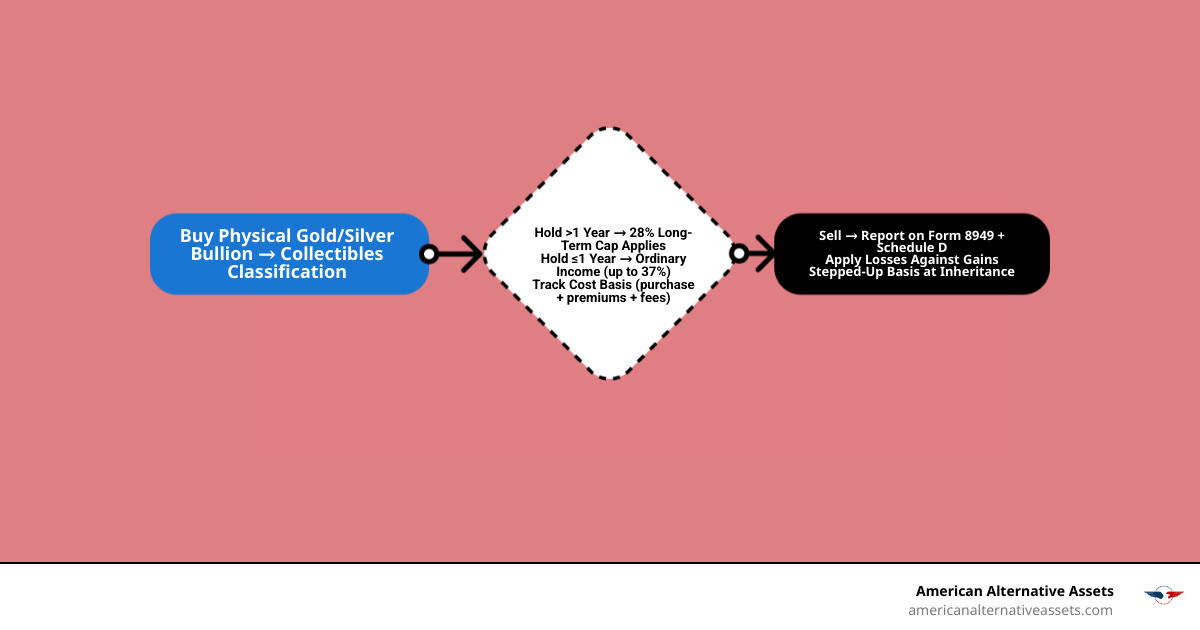
At the federal level, physical gold and silver are generally taxed as collectibles. If you hold them for more than one year, long-term gains are subject to a maximum 28% collectibles rate. If you hold them for one year or less, gains are taxed at ordinary income rates, which can be higher.
That means timing matters. Selling after 11 months and 29 days can produce a very different tax result than selling after one year and one day.
Where precious metals tax benefits can actually show up
For most investors, tax benefits appear in these places:
- long-term holding periods that avoid short-term ordinary income treatment
- a Traditional Gold IRA, Silver IRA, or Precious Metals IRA, where gains grow tax-deferred
- a Roth Gold IRA, Silver IRA, or Precious Metals IRA, where qualified withdrawals can be tax-free
- properly documented losses that offset gains
- inherited metals that receive a stepped-up basis
Why physical metals are taxed differently than paper exposure
The tax code treats direct ownership of bullion differently because you own a tangible collectible asset. That is very different from owning a paper claim tied to metal prices.
We believe physical ownership matters. Bullion coins and bars give you direct exposure to the metal itself. Paper products can introduce layers of counterparty risk, structural complexity, and tax confusion without delivering actual possession of precious metals. If your goal is physical precious metals in a Gold IRA, Silver IRA, or Precious Metals IRA, then owning actual IRS-approved bullion is the cleanest path.
Federal Income Tax Rules That Drive Precious Metals Tax Benefits
The federal rules are the engine behind most precious metals tax benefits and most unpleasant surprises. For broader background, see this Financial Planning overview and this Accounting Today article.
How the 28% collectibles cap works for long-term gains
If you sell physical gold or silver after holding it for more than one year, your gain is taxed under the collectibles rules. The maximum federal rate is 28%.
This is higher than the standard long-term capital gains ceiling that applies to many stocks, but it can still be beneficial for investors in higher ordinary income brackets. For example, someone in the 32%, 35%, or 37% bracket may pay only 28% on a long-term bullion gain instead of their higher ordinary rate.
Also remember, the 28% rate is a cap, not always the exact rate. If your ordinary rate is lower, your effective tax on the collectible gain may be lower.
High-income investors may also owe the 3.8% Net Investment Income Tax in some cases, which can increase the total federal bite.
How short-term gains on precious metals are taxed
If you hold physical metals for one year or less, gains are taxed as ordinary income. In 2026, that can mean rates up to 37% federally.
So yes, the tax code rewards patience. Sometimes the difference between short-term and long-term treatment is large enough to make your calendar feel like part of your portfolio.
Keep the acquisition date for every lot you buy. Without it, proving long-term treatment becomes harder than it should be.
How to calculate taxable gain using cost basis
Your taxable gain is generally:
Sale proceeds – adjusted cost basis = taxable gain
Your cost basis usually starts with:
- purchase price
- dealer premium
- commissions or transaction costs
- shipping related to the acquisition
Good basis tracking can reduce taxable gain legally and accurately. If you only remember the spot price and forget premiums and related purchase costs, you may overstate gain and overpay tax.
Special basis rules for gifted and inherited metals
Gifted metals and inherited metals follow different rules.
For gifts, basis is generally the donor’s carryover basis. In some loss situations, a dual-basis rule can apply, which makes gift property more complicated than many people expect.
For inherited metals, basis is usually the fair market value on the date of death. This stepped-up basis can significantly reduce taxable gain if the metal appreciated during the original owner’s lifetime.
That is one reason inherited bullion often has a very different tax profile from gifted bullion.
Can losses reduce taxes on precious metals sales?
Yes. Capital losses on precious metals can offset capital gains from metals or other investments. If total capital losses exceed total capital gains, up to $3,000 of excess net capital loss can offset ordinary income each year. Remaining unused losses generally carry forward.
Another useful point, physical precious metals are generally not subject to the wash sale rule. That means investors may be able to realize a loss and repurchase metal without the same wash sale restrictions that apply to many securities. This is one of the more practical planning tools for taxable accounts.
State Sales Tax Exemptions on Bullion Purchases
State sales tax is separate from federal income tax, and this is where geography matters. Since American Alternative Assets is based in California, this section focuses on California rules.
For official California guidance, see CDTFA Regulation 1599. For a broader state-by-state overview, this reference can help: Precious Metals Sales Tax By State (Updated 2025).

California, Texas, and Colorado rules investors should know
California provides a sales tax exemption for certain investment-grade precious metals transactions that exceed $2,000 per transaction. That threshold increased from $1,500 to $2,000 effective January 1, 2023.
In general, qualifying products must derive value primarily from metal content rather than rarity or collectible appeal. Many numismatic and rare coins do not qualify.
Because our location is in California, the practical takeaway is simple:
- under the threshold, sales tax may apply
- over the threshold, qualifying bullion may be exempt
- collectibles and non-qualifying items may still be taxable
Texas and Colorado also have favorable bullion sales tax rules, but investors should confirm how delivery and dealer rules apply before assuming an exemption.
New York and Washington changes that affect buyers
Some states use different thresholds or changed their rules recently. Those examples are useful for comparison, but California buyers should focus first on California law and the state where delivery occurs.
If you are purchasing bullion for delivery in California, California rules generally matter most.
How to confirm a purchase qualifies for a state exemption
Before buying, confirm:
- the total invoice amount
- that the items are investment-grade bullion
- that the products are valued mainly for metal content
- whether the delivery location affects tax treatment
- whether the dealer invoice clearly identifies the qualifying items
That paperwork matters. A clean invoice today can save a messy explanation later.
Reporting, Record-Keeping, and 1099-B Triggers
The IRS may not ask for your receipts on day one, but if you ever need them and do not have them, that is when the fun stops.
For added reading, see US Capital Gains Tax Guide for Gold and Silver Investors and our own guide, Everything You Need to Know About Gold Taxes.

How to report bullion sales on your tax return
Bullion sales are generally reported on Form 8949, with totals flowing to Schedule D of Form 1040.
Typical details include:
- description of the metal sold
- date acquired
- date sold
- proceeds
- cost basis
- resulting gain or loss
If you sold multiple lots, each lot may need separate treatment unless properly aggregated under the reporting rules.
When dealers may file Form 1099-B
Certain bullion transactions can trigger dealer Form 1099-B reporting based on product type and quantity. Examples often cited include:
- 25 or more one-ounce Gold Maple Leaf coins
- certain large silver bar transactions, such as 1,000-ounce bars
Reporting thresholds depend on the exact product and quantity, not simply the dollar value. Also, a dealer filing Form 1099-B does not create the tax, it just creates an information trail. You still must report taxable gains whether or not a form is issued.
Best record-keeping practices to protect your cost basis
We encourage clients to keep:
- purchase invoices
- trade confirmations
- proof of payment
- shipping records
- storage statements
- appraisals or date-of-death valuations for inherited metals
- gift documentation showing original owner basis, if available
If you buy over time, track each lot separately. Ten one-ounce coins bought in 2021 are not necessarily the same tax lot as ten bought in 2025.
Using specific identification to strengthen precious metals tax benefits
Specific identification lets you choose which lot you sold, if your records support it. This can matter a great deal when different lots have different costs.
If one batch of gold was purchased at a higher price than another, selling the higher-basis lot first may reduce current taxable gain. Without clear records, you may end up relying on a less favorable method.
Specific identification is one of the most practical ways to improve after-tax outcomes legally.
Precious Metals Tax Benefits Inside a Gold IRA
For many long-term savers, the most powerful precious metals tax benefits show up inside a self-directed Gold IRA holding physical bullion.
If you are new to the structure, start with our Precious Metals IRA Rules Guide and The Ultimate 401k to Gold IRA Guide: Rolling Over Without Tripping.
Precious metals tax benefits in a Traditional Gold IRA
A Traditional Gold IRA can offer:
- potential tax deductibility for eligible contributions
- tax-deferred growth
- no annual tax on gains while assets remain inside the IRA
When distributions begin, amounts withdrawn are generally taxed as ordinary income. The collectibles rate does not apply to Traditional IRA distributions. That is an important distinction.
Traditional IRAs are also generally subject to required minimum distributions starting at age 73. For more on that, see Required Minimum Distributions (RMDs) Rules and Penalties.
Precious metals tax benefits in a Roth Gold IRA
A Roth Gold IRA flips the tax timing:
- contributions are generally made with after-tax dollars
- growth can be tax-free
- qualified withdrawals can be tax-free
Roth IRAs also do not have lifetime RMDs for the original owner. That can provide more flexibility if you want to avoid being forced to distribute assets on a schedule.
The five-year rule and age requirements still matter for qualified tax-free treatment.
IRS purity and storage rules for physical metals in IRAs
To qualify for IRA treatment, metals must satisfy IRS rules. Common standards include:
- gold, generally 99.5% pure
- silver, generally 99.9% pure
There are exceptions written into the law, most notably the American Gold Eagle, which is IRA-eligible despite being 91.67% pure.
Metals also must be held by an approved custodian or trustee and stored in an approved depository. Personal possession is generally not allowed.
Why home storage can break IRA tax treatment
This is one of the most important compliance rules.
If IRA-owned gold or silver is stored at home, in a personal safe, or otherwise held under your personal control, the IRS may treat that as a distribution. That can trigger taxes and possibly penalties.
In plain English, a “home storage Gold IRA” is not the shortcut many people hope it is. It can break the very tax treatment you were trying to achieve.
Physical bullion in an IRA vs paper metals in retirement accounts
We focus on physical bullion because it aligns with the purpose of a Precious Metals IRA, owning actual approved metal in a compliant structure.
Paper products may track price, but they do not provide direct ownership of bullion. They can also come with different tax treatment and structural issues that many beginners do not fully understand. If your goal is tangible precious metals exposure in retirement, physical coins and bars held through the proper IRA framework keep that focus where it belongs, on the metal itself.
Common Tax Pitfalls and Smart Planning Moves
Tax planning for precious metals is often less about exotic tricks and more about avoiding own goals.
For more retirement distribution guidance, visit IRA Withdrawal Rules.
Mistakes that can increase your tax bill
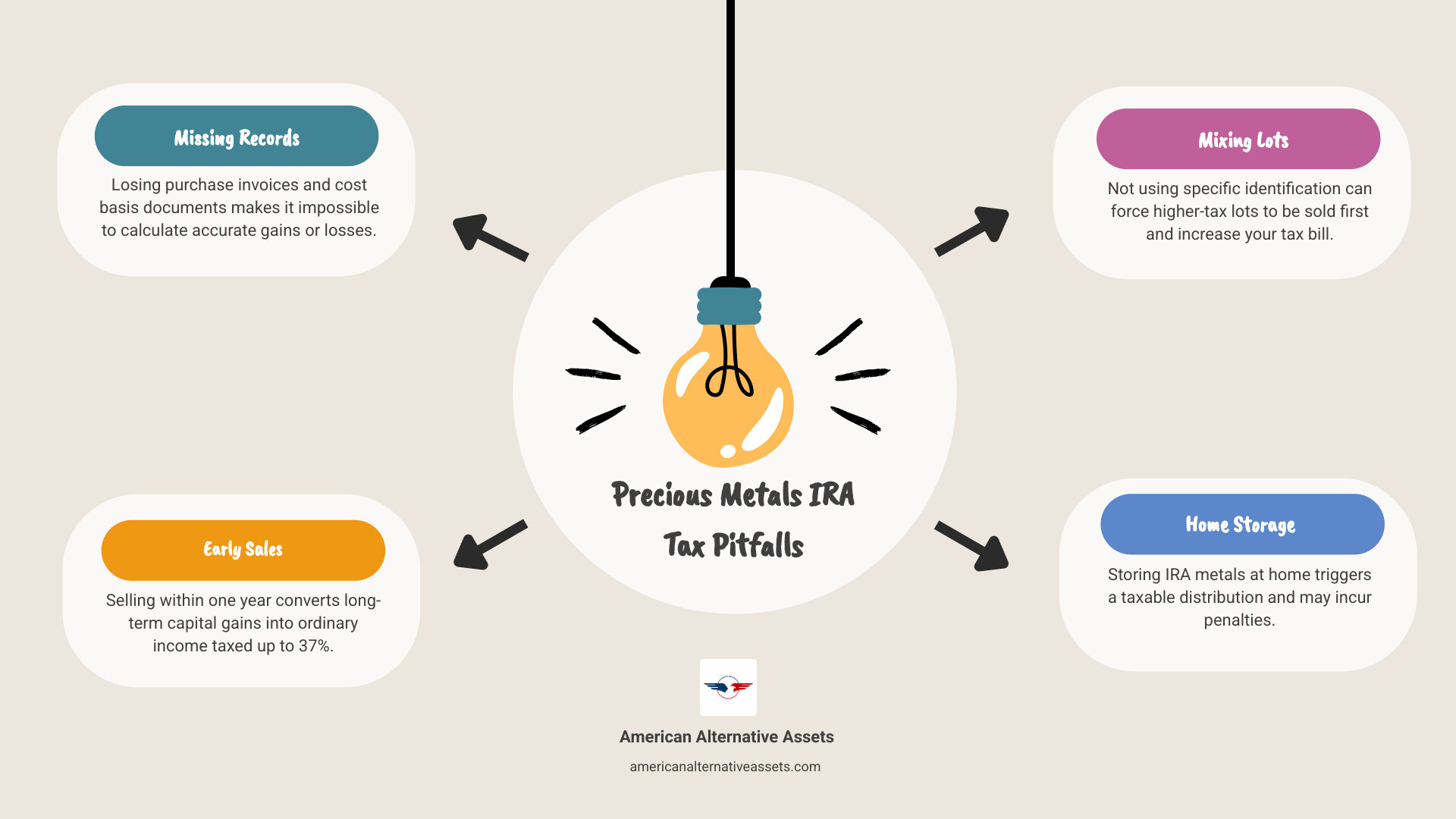
Common errors include:
- losing purchase records and basis support
- selling before the one-year holding period ends
- mixing lots and not knowing which metal was sold
- overlooking California sales tax rules on purchases
- buying metals that are not IRA-eligible
- taking personal possession of IRA metals
Each one can increase taxes or create compliance headaches.
Legal ways investors may defer or reduce taxes
Depending on the situation, lawful planning moves may include:
- holding more than one year before selling taxable-account bullion
- harvesting losses to offset gains
- using specific identification for partial sales
- understanding gift and inheritance basis rules
- using direct rollovers when moving retirement funds into a Precious Metals IRA
Direct rollovers are especially important because they help avoid accidental taxable distributions. If you are considering a rollover, our guide on The Full 401k to Gold Conversion Rules for a Solid Future can help.
Planning for distributions without unnecessary liquidation
Not every retirement distribution must mean selling everything at once.
In some cases, investors may plan for:
- in-kind distributions of metals
- cash distributions from other IRA assets
- liquidity planning for RMDs in Traditional accounts
This matters because selling bullion only to satisfy a required distribution may not always be the most efficient move. Good planning can provide more flexibility.
Frequently Asked Questions about Precious Metals Tax Benefits
Are gold and silver always taxed at 28%?
No. The 28% figure is the maximum long-term federal rate for collectibles. If you held the metals for one year or less, gains are taxed at ordinary income rates instead. If your taxable income is lower, your effective long-term rate may also be lower than 28%.
Do precious metals losses offset other capital gains?
Yes. Capital losses from precious metals can offset other capital gains. If losses exceed gains, up to $3,000 per year may offset ordinary income, with unused losses carried forward.
Can I keep Gold IRA metals at home?
Generally, no. IRA-owned metals must be held by an approved custodian and stored in an approved depository. Home storage can cause the IRS to treat the metals as distributed, which may create taxes and penalties.
Conclusion
The biggest precious metals tax benefits come from understanding the rules before you buy, not after you sell. Physical gold and silver can offer meaningful tax advantages through long-term holding, loss offsets, stepped-up basis treatment, and, most importantly for many retirement investors, the tax-deferred or tax-free structure of a properly built Precious Metals IRA.
At American Alternative Assets, we believe physical ownership still matters. Tangible bullion held in a compliant retirement account can play a valuable role in a broader diversification strategy, especially for investors who want direct exposure to precious metals rather than paper substitutes.
If you want to continue your research, start with The Full 401k to Gold Conversion Rules for a Solid Future and Learn More About Gold and Silver IRAs.
Article Disclaimer
This article is for informational purposes only and does not constitute financial advice. Please consult your financial advisor before making investment decisions.
Investing in precious metals involves risk. Past performance does not guarantee future results.