








Gold and Taxes: What Every Investor Needs to Know Before Selling
Do you have to pay tax on gold? Yes, in most cases you do. When you sell gold for a profit, the IRS expects a cut. How much depends on what type of gold you own, how long you’ve held it, and where it’s stored.
Here’s a quick breakdown:
| Situation | Tax Treatment |
|---|---|
| Physical gold sold after 1+ year | Long-term capital gains, max 28% (collectibles rate) |
| Physical gold sold within 1 year | Short-term gains, taxed as ordinary income (up to 37%) |
| Gold in a Traditional IRA | Tax-deferred, taxed as ordinary income on withdrawal |
| Gold in a Roth IRA | Tax-free growth, no tax on qualified distributions |
| Inherited gold | Cost basis resets to fair market value at date of death |
| Gifted gold | Recipient keeps the original owner’s cost basis |
The key thing to understand upfront: the IRS classifies physical gold as a “collectible,” not a standard investment like a stock or bond. That single classification changes everything about how your gains are taxed.
Most investors don’t realize this until they’ve already sold. And by then, the tax bill can be much larger than expected.
I’m Shanon Davis, and my background in venture capital, combined with years of experience helping Americans navigate the complexities of physical precious metals ownership, gives me a front-row seat to the confusion around do you have to pay tax on gold. In the sections below, I’ll walk you through everything clearly, from IRS rules to strategies that can help you keep more of what you’ve earned.
This article is for informational purposes only and does not constitute financial advice. Please consult your financial advisor before making investment decisions. Investing in precious metals involves risk. Past performance does not guarantee future results.
Do You Have to Pay Tax on Gold? (The Basics)

When gold prices climb, it’s natural to think about cashing in. However, the question of do you have to pay tax on gold is one that requires a bit of homework. The short answer is yes, if you sell your gold for more than you paid for it, you have realized a capital gain. The IRS views gold as property, and like any property, it is subject to taxation when it changes hands for a profit.
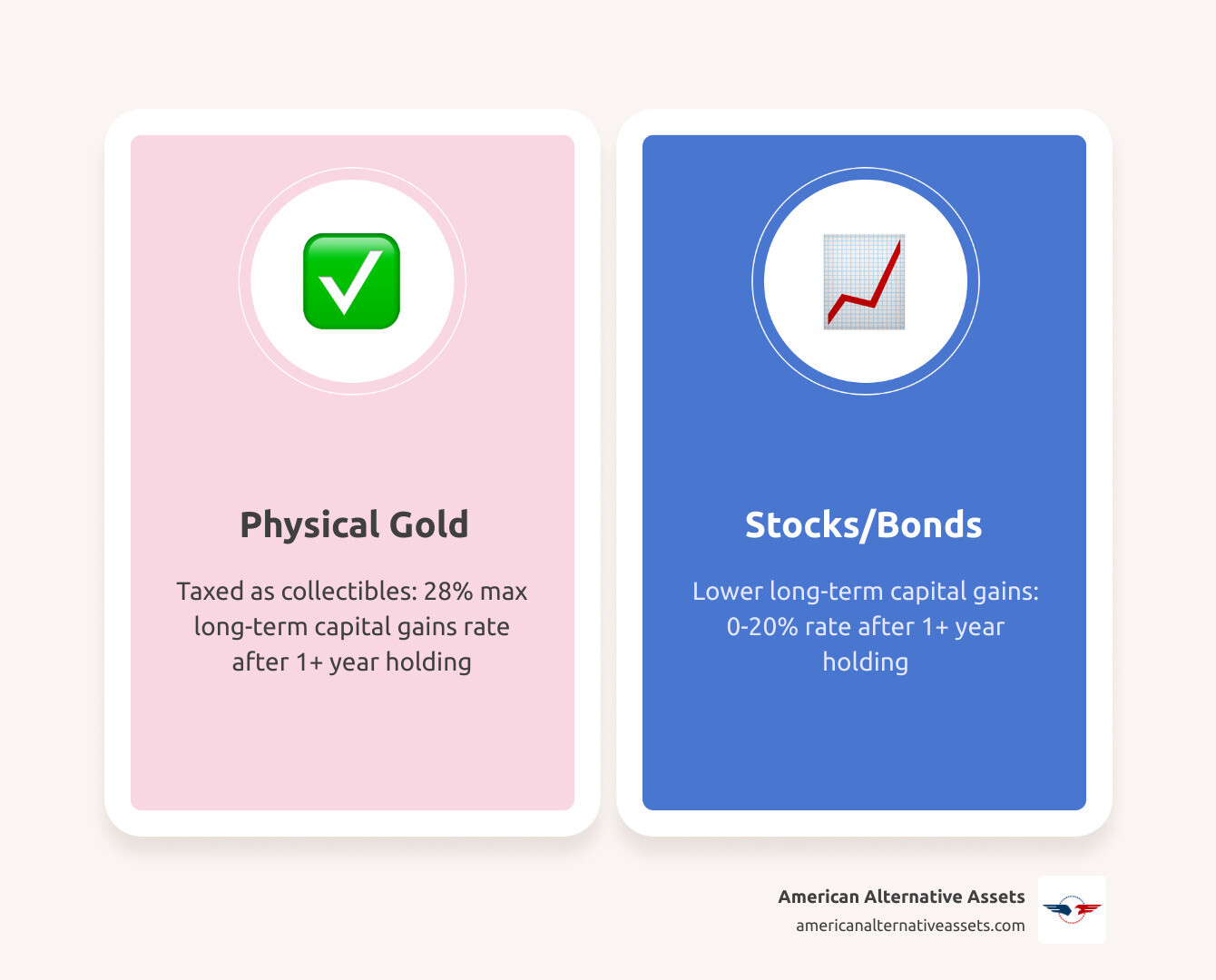
The IRS specifically places physical gold, including coins, bars, and bullion, into the “collectibles” category. This is a crucial distinction. While most people are used to the 15 percent or 20 percent long-term capital gains rates for stocks, collectibles are taxed at a maximum rate of 28 percent. This higher rate can take a significant bite out of your returns if you aren’t prepared for it.
It is also important to remember that you only owe taxes when you sell. Simply holding gold in a safe or a vault does not trigger a tax bill. The “taxable event” happens the moment you convert that physical metal back into cash. To get a deeper grasp of how these rules apply to different metals, you can explore Understanding Taxes on Gold and Silver Investments.
Do you have to pay tax on gold held in an IRA?
One of the most effective ways to manage your tax liability is by holding your metals within a retirement account. When you choose a Precious Metals IRA, you are essentially creating a tax-sheltered environment for your wealth. In a Traditional Gold IRA, your investments grow tax-deferred. This means you do not pay a penny in capital gains taxes while the gold is sitting in the account. You only pay taxes when you take a distribution in retirement, and at that point, it is taxed as ordinary income.
For those who prefer to pay their taxes upfront, a Roth Gold IRA offers the potential for completely tax-free growth. As long as you follow the IRS rules for distributions, you won’t owe the government anything on the appreciation of your gold. At American Alternative Assets, we specialize in helping clients set up these accounts with a white-glove, relationship-first approach. We believe that physical ownership within a retirement account provides a level of protection that “paper” assets simply cannot match. You can learn more in our Gold IRA Investing Guide and weigh the Gold IRA Pros and Cons to see if it fits your strategy.
Cost Basis and Calculating Taxable Gains
To figure out how much you owe, you first need to determine your “cost basis.” This isn’t just the price you paid for the gold. It also includes dealer premiums, shipping fees, and any commissions paid at the time of purchase. If you’ve been paying for professional storage or insurance, those costs can sometimes be factored into your basis as well, effectively lowering your taxable gain.
The formula is simple: Sale Price minus Cost Basis equals Taxable Gain. For example, if you bought a gold bar for $2,000 (including fees) and sold it for $2,500, your taxable gain is $500. Keeping meticulous records is the only way to ensure you don’t overpay. If you are wondering if it’s the right time to sell, check out our insights on Precious Metals Returns: Is It Time to Cash In?.
How Physical Gold is Taxed: The Collectibles Rule
The IRS Section 408(m) is the rulebook that defines what counts as a collectible. For most investors, this is the most frustrating part of the tax code. Because the IRS treats your gold bars and coins like rare stamps or fine art, you don’t get the same tax breaks that stock market investors enjoy.
The 28 percent maximum long-term capital gains rate is a ceiling, not a floor. If your ordinary income tax rate is lower than 28 percent, you will pay your lower rate. However, if you are a high earner in a 32 percent, 35 percent, or 37 percent bracket, your gold gains are capped at 28 percent. This can actually be a slight advantage for those in the highest tax brackets. For a detailed look at these rules, All That Glitters Is Usually Taxable: Gold and Silver Tax Rules | Kiplinger provides excellent context.
Short-Term vs. Long-Term Holding Periods
The “one-year rule” is the dividing line for gold taxes. If you hold your gold for 365 days or less before selling, it is considered a short-term capital gain. These gains are taxed at your ordinary income rate, which can be as high as 37 percent in 2026.
If you hold your gold for at least one year and one day, it moves into the long-term category. This is where the 28 percent collectibles cap applies. For most people, holding gold as a long-term hedge is not just a sound financial strategy, it is also a smarter tax move.
Taxation of Gifted and Inherited Gold
The rules change significantly when gold is passed down or given away. If you receive gold as a gift, you generally “step into the shoes” of the person who gave it to you. This means you inherit their original cost basis and their holding period. If they bought gold at $400 an ounce decades ago, and you sell it at $2,500, you are responsible for the tax on that massive gain.
Inherited gold is much more tax-friendly. When you inherit gold, you usually receive a “step-up in basis.” Your new cost basis is the fair market value of the gold on the day the original owner passed away. If the gold was worth $2,400 on that day and you sell it for $2,500 later, you only owe taxes on the $100 difference.
| Acquisition Type | Cost Basis | Holding Period |
|---|---|---|
| Purchase | Price paid + fees | Starts on purchase date |
| Gift | Original owner’s basis | Starts on original owner’s purchase date |
| Inheritance | Fair market value at date of death | Treated as long-term regardless of time held |
In 2026, the annual gift tax exclusion is $19,000. You can give up to this amount in gold to as many people as you like without having to file a gift tax return.
Tax Advantages of Physical Gold IRAs
Setting up a self-directed IRA (SDIRA) is a game-changer for those asking do you have to pay tax on gold. These accounts allow you to hold actual, physical gold coins and bars rather than just “paper” representations of wealth. The primary advantage is the ability to defer taxes, allowing your wealth to compound without the government taking a cut every year.
With a Traditional Gold IRA, your contributions may even be tax-deductible, depending on your income level. This provides immediate tax relief today while you build a secure foundation for tomorrow. When it comes time to retire, you’ll need to be aware of the Required Minimum Distributions (RMDs) Rules and Penalties and the specific Retirement Plan RMD Rules to avoid unnecessary fees.
Purity Standards and IRS Compliance
Not just any gold can go into an IRA. The IRS is very picky. To qualify, gold must meet a minimum fineness of .995 (99.5 percent purity). This generally means 24-karat gold bars and specific coins. There is one notable exception: the American Gold Eagle. Despite being 22-karat gold, it is explicitly allowed in IRAs by the IRS.
Your gold must also be held by an authorized trustee or custodian and stored in an IRS-approved depository. You cannot keep IRA gold in a shoebox under your bed. This ensures the integrity of the tax-deferred status and provides a high level of security for your assets. For more on these technical requirements, see Retirement Plan RMD Rules 2.
Avoiding Penalties on Distributions
The IRS wants you to keep your retirement money in your retirement account. If you take money out before you reach age 59.5, you will likely face a 10 percent early withdrawal penalty on top of the ordinary income taxes you’ll owe.
There are ways to move your money without triggering taxes, such as a direct rollover from a 401(k) or another IRA. This is a delicate process, and at American Alternative Assets, we help our clients navigate these transfers to ensure they don’t lose a portion of their wealth to avoidable penalties. Understanding the IRA Withdrawal Rules is essential for anyone looking to protect their retirement nest egg.
Comparing Physical Gold to Paper Assets

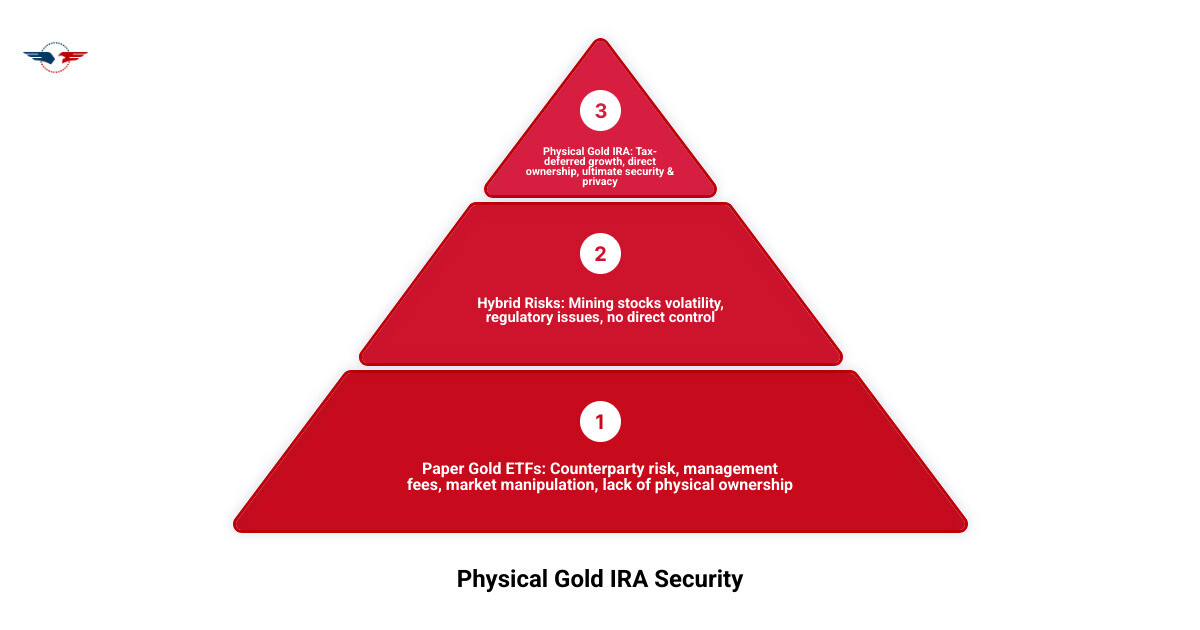
Many investors are tempted by the convenience of gold ETFs (Exchange-Traded Funds) or mining stocks. While these might seem easier than buying physical bars, they come with a host of hidden risks and tax headaches. When you buy an ETF, you don’t actually own gold. You own a share in a trust that owns gold. This introduces “counterparty risk.” If the fund manager fails or the trust is mismanaged, your “paper gold” could become worthless.
Mining stocks are even more volatile. They aren’t just tied to the price of gold, they are tied to the company’s management, labor disputes, and environmental regulations. These are traditional equities, and while they follow standard capital gains rules, they don’t offer the same “chaos insurance” that physical gold provides.
Why Paper Gold Assets Carry Higher Risks
Paper gold is often subject to market manipulation and the whims of high-frequency traders. Furthermore, these funds charge management fees that eat into your returns over time. Perhaps most importantly, paper assets lack privacy. Every transaction is tracked and reported instantly. Physical gold held in a private vault or a secure IRA offers a level of control and discretion that the digital world simply cannot replicate.
Tax Inefficiencies of Paper Gold
You might think that a gold ETF would be taxed like a stock, but that’s a common misconception. Many physically-backed gold ETFs are still taxed as collectibles at the 28 percent rate. Additionally, these funds often sell gold internally to cover their expenses, which can create “capital gains distributions” for you. This means you could end up owing taxes at the end of the year even if you didn’t sell a single share. Physical gold in an IRA is a much more streamlined and efficient way to grow your wealth.
Reporting and Record-Keeping for Gold Sales
The IRS expects you to be honest. When you sell gold for a profit, you are required to report it on Schedule D of your Form 1040. Even if you don’t receive a tax form from the dealer, the responsibility to report the gain lies with you. Failing to do so can lead to audits, penalties, and interest that far outweigh the original tax bill.
Good record-keeping is your best defense. You should keep a folder with every receipt, shipping manifest, and storage invoice. If you ever need to prove your cost basis to the IRS, you’ll be glad you have that paper trail. For more tips on selling your metal responsibly, see our Beginner’s Guide to Not Getting Ripped Off.
Do you have to pay tax on gold when selling at a loss?
If you sell your gold for less than you paid, you have a capital loss. This isn’t all bad news. You can use that loss to offset other capital gains. For example, if you made $5,000 on a stock sale but lost $2,000 on a gold sale, you only pay taxes on the $3,000 net gain.
If your total losses exceed your total gains, you can use up to $3,000 of the “excess loss” to reduce your ordinary taxable income. Any remaining loss can be “carried forward” to future years. This is known as tax-loss harvesting. To understand how the selling side of the equation works, you can read about How the Buyback Process Works.
IRS Form 1099-B Requirements
In certain situations, a precious metals dealer is required to report your sale to the IRS using Form 1099-B. This usually happens when you sell large quantities of specific types of gold. For example, selling more than 25 ounces of Gold Maple Leafs or Krugerrands in a single transaction will trigger a report. However, selling American Gold Eagles, regardless of the quantity, typically does not require the dealer to file a 1099-B. This nuance is one reason why Gold Eagles remain a favorite among privacy-conscious investors.
State-Level Taxes and Sales Tax Exemptions
The question of do you have to pay tax on gold also depends on where you live. While federal capital gains taxes apply to everyone, state-level sales taxes vary wildly. Currently, 45 states offer some form of exemption for precious metals. Some states are very friendly to gold investors, while others see it as just another opportunity to collect revenue.
Florida’s 2025 Tax Law Expansion
Florida has recently become a haven for precious metals investors. Effective August 1, 2025, the state expanded its exemptions. Now, sales of gold, silver, and platinum bullion are exempt from sales and use tax regardless of the sales price. This is a massive win for Florida residents, as it removes a major barrier to entry for small and large investors alike.
Navigating California Precious Metals Taxes
California is a bit more complicated. Under Regulation 1599, the state exempts “monetized bullion” and “non-monetized gold or silver bullion” from sales tax, but only if the total sale is $2,000 or more. If you buy $1,500 worth of gold in Woodland Hills, you’ll likely pay sales tax. If you buy $2,500, the tax disappears. This creates a strong incentive for California investors to “buy in bulk.” For a deeper dive into these local rules, check out How Sales Tax Works on Bullion and Coins in California and Gold and Silver Taxes in California (CA).
Frequently Asked Questions about Gold Taxes
Do I have to report gold sales if I don’t receive a 1099-B?
Yes. The 1099-B is a tool for the IRS to double-check your reporting, but the absence of the form does not mean the gain is tax-free. You are legally required to report all capital gains on your tax return.
Are gold coins legal tender exempt from capital gains tax?
No. Even though coins like the American Gold Eagle have a face value (e.g., $50), the IRS treats them as property/collectibles based on their market value. You cannot claim they are just “currency” to avoid capital gains tax.
How does the IRS track physical gold purchases?
For the most part, the IRS does not track your purchases unless they involve large amounts of cash. Dealers are required to file Form 8300 if you pay $10,000 or more in physical cash (stack of bills). If you pay by check or wire transfer, there is no immediate report to the IRS, though your bank may keep records of the transaction.
Conclusion
Navigating gold taxes doesn’t have to be a headache. By understanding the collectibles rule, utilizing the power of a Precious Metals IRA, and keeping excellent records, you can protect your wealth from unnecessary erosion.
At American Alternative Assets, we are committed to providing white-glove service that puts your needs first. We believe in trust, transparency, and ethical practices. Whether you are looking to diversify your retirement account or simply want to hold physical gold for long-term security, we are here to help you every step of the way. Our focus on physical gold and silver IRAs ensures that you have real privacy and protection for your hard-earned wealth. For more information, explore our resources on physical gold IRAs.
This article is for informational purposes only and does not constitute financial advice. Please consult your financial advisor before making investment decisions.
Investing in precious metals involves risk. Past performance does not guarantee future results.