








Why Understanding Your Self-Directed IRA Fee Matters Before You Invest
Self-directed IRA fees are a critical factor that can significantly affect your long-term retirement wealth, yet many investors don’t fully understand what they’re paying, or why.
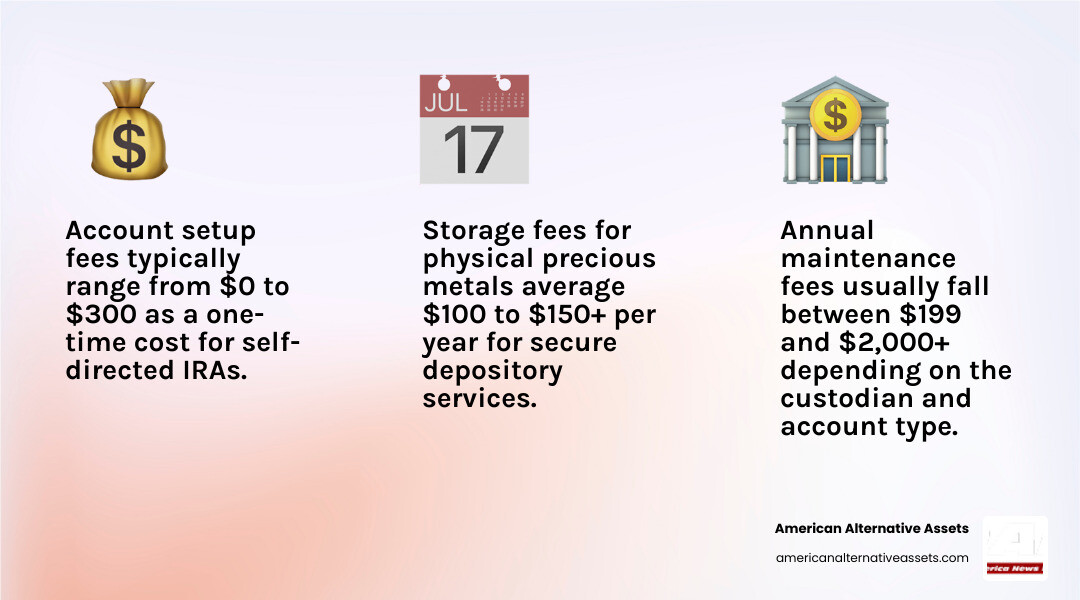
Here’s a quick overview of what you can typically expect to pay:
| Fee Type | Typical Range |
|---|---|
| Account setup fee | $0 to $300 (one-time) |
| Annual maintenance fee | $199 to $2,000+ per year |
| Transaction fees | $25 to $175 per transaction |
| Storage fees (precious metals) | $100 to $150+ per year |
| Wire transfer fees | $25 to $30 per transfer |
| Account termination fee | $175 to $250 |
Unlike a traditional brokerage IRA, a self-directed IRA (SDIRA) utilizes a specialized custodian to handle IRS compliance, recordkeeping, and the administration of physical assets. These standard administrative costs ensure your physical holdings are fully protected and compliant.
The good news: once you understand the fee structure, you can make smarter choices, select the right custodian, and keep more of your retirement savings working for you.
This article breaks down every layer of SDIRA fees, compares pricing models, and explains what to watch out for, especially if you’re holding physical precious metals like gold or silver.
I’m Shanon Davis, and my background spans venture capital and, more importantly, a lifelong focus on tangible, real-world assets as a hedge against fragile financial systems, which is exactly why understanding self-directed IRA fees is central to everything I teach. Getting this right from the start means your physical gold and silver holdings can compound in a tax-advantaged account without unnecessary costs quietly eroding your wealth.
What is a Self-Directed IRA and How Do Fees Work?

To understand how a self-directed ira fee works, it is first necessary to understand what makes this account unique. A self-directed individual retirement account is a specialized retirement vehicle that allows you to hold alternative assets that traditional brokerages simply do not support. While a standard retirement account limits you to stocks, mutual funds, and bonds, a self-directed plan opens the door to tangible wealth. To learn more about the fundamentals, you can read our guide on What is a Self-Directed IRA?
When you open a self-directed retirement account to hold physical precious metals, you must work with an IRS-approved custodian. These institutions do not provide investment advice or assess the quality of your purchases. Instead, custodian responsibilities for precious metals IRAs focus strictly on administrative duties. They process your transactions, complete essential tax forms, and maintain IRS compliance for physical gold and silver.
Because the custodian must perform specialized administrative tasks, execute complex transfers, and ensure that your physical assets are safely held in an approved depository, they charge specialized administrative fees. These administrative costs keep your account in good standing with the IRS, ensuring that your physical holdings remain protected and your tax-advantaged status is fully preserved.
Traditional Brokerage IRAs vs. Self-Directed IRAs
Traditional brokerage platforms make their money in ways that are often invisible to the average investor, frequently dealing in paper assets and their limitations, collecting fees through hidden expense ratios, mutual fund management charges, or payment for order flow. Because paper assets exist only as digital entries on a ledger, traditional brokerages can automate their processes, but they pass on hidden costs to the investor.
In contrast, physical precious metals IRAs offer clear, transparent pricing. When you purchase physical gold or silver, your custodian coordinates with precious metals dealers, processes wire transfers, verifies shipping manifests, and coordinates secure physical storage with an IRS-approved depository.
This process provides active oversight, specialized recordkeeping, and rigorous compliance tracking. The transparent fees associated with a physical precious metals IRA reflect this high level of operational security and direct ownership. For investors seeking tangible wealth preservation, these straightforward costs are a highly efficient way of maintaining direct ownership of physical assets, which are widely seen as a hedge during times of economic uncertainty. You can explore the differences further in our article on What is a Self-Directed IRA?
Understanding the Self-Directed IRA Fee Structure

When establishing a self-directed account, you will encounter several different types of administrative charges. A transparent custodian will outline these costs clearly in their fee schedule. Understanding how these charges are structured is the first step to ensuring you do not pay more than necessary. For a deeper look into comparing custodian costs, you can read our article on the Self-Directed IRA Custodian Fee Comparison: Don’t Get Fleeced.
The primary custodial costs you can expect to encounter include:
- Setup Fees: A one-time establishment fee charged by the custodian to open your account, verify your identity, and set up your file in their secure database.
- Annual Maintenance: An ongoing fee charged to cover the cost of annual IRS reporting, account statement generation, and general recordkeeping.
- Transaction Fees: Charges associated with buying or selling assets within your IRA, such as processing a purchase of physical gold coins or silver bars.
- Secure Storage Fees: Fees charged by the depository to store, secure, and insure your physical precious metals.
Flat-Fee vs. Asset-Based Fee Models
One of the most important decisions you will make when comparing custodians is choosing between flat-rate fee structures and asset-based fee models.
Under an asset-based pricing model, often referred to as assets under management or AUM pricing, the custodian charges a fee based on a percentage of your total portfolio value. While this model may seem affordable when your account balance is small, it can become incredibly costly as your portfolio grows. As the value of your physical gold and silver increases, your annual custodial costs rise proportionally, penalizing you for successful long-term wealth preservation.
A flat-rate fee structure, on the other hand, charges a fixed annual fee regardless of your account balance. Whether your retirement portfolio is valued at a modest starting amount or has grown to a substantial nest egg, your annual maintenance fee remains exactly the same. This model provides exceptional cost predictability, making it highly advantageous for long-term investors who plan to accumulate significant physical holdings. To help you evaluate which model is right for you, check out our Precious Metals IRA Custodians Guide.
Additional Custodial Costs to Watch For
Beyond the standard maintenance and setup fees, there are several ancillary charges that can impact your overall costs. It is vital to read the fine print of any custodial agreement to identify these potential fees before they occur.
First, look at wire fees. Most self-directed transactions require wire transfers to move funds quickly and securely between your IRA and your precious metals dealer. Custodians typically charge a fee for both incoming and outgoing wires.
Second, pay attention to paper statement options. Many custodians charge an extra fee if you prefer to receive paper statements in the mail. Opting into electronic delivery is an easy way to eliminate this ongoing cost.
Finally, you should be aware of account termination fees and in-kind distribution charges. If you decide to transfer your account to another custodian or take a physical distribution of your gold and silver, the custodian will charge a fee to process the paperwork and coordinate the secure release of your metals from the depository.
Comparing Precious Metals IRA Custodians and Provider Costs
Choosing the right custodian requires a careful comparison of both fee structures and service quality. Different custodians tailor their services to different types of alternative investments, so it is important to choose a provider that specializes in physical precious metals. For a comprehensive overview, you can refer to our Precious Metals IRA Custodians Guide.
Below is a qualitative comparison of how several popular custodians structure their services and fee models:
| Custodian | Primary Fee Model | Best Suited For | Key Operational Characteristics |
|---|---|---|---|
| Equity Trust | Flat-Rate | Long-Term Precious Metals Portfolios | Highly established, robust online portal, integrated with major depositories |
| STRATA Trust | Flat-Rate (Tiered by Account Size) | Physical Gold & Silver Investors | Streamlined processing for precious metals, simple fee structure |
| GoldStar Trust | Flat-Rate | Diversified Alternative Assets | Excellent customer service, specialized in physical asset holding |
At American Alternative Assets, we maintain preferred custodian partnerships with established industry leaders to ensure our clients receive secure, reliable, and cost-effective administration for their physical gold and silver.
Flat-Fee Providers and Subscription Models for Precious Metals
For investors holding physical gold and silver, flat-fee custodians are often the most stable choice. Providers like Equity Trust utilize flat-fee structures that keep your annual costs completely predictable. Under this model, your fees do not scale with the market value of your precious metals.
This predictability is incredibly valuable during periods of economic volatility. If inflation rises and the spot price of physical gold increases, a flat-fee custodian will not charge you more just because your assets have gained value. This ensures that the growth of your retirement wealth stays in your account rather than going toward custodial overhead. To learn more about flat-fee custodians, read our Precious Metals IRA Custodian Complete Guide.
Asset-Based and Tiered Pricing Providers
Some custodians utilize tiered pricing structures where the annual fee is determined by brackets of asset value. While this is slightly different from a strict percentage-based fee, it still means that your costs will increase as your physical portfolio grows.
If you choose a custodian with tiered pricing, you must monitor your account value closely. Crossing into a higher tier can result in a sudden jump in your annual maintenance fee. For investors starting with smaller accounts, these models can sometimes be competitive, but they generally offer less long-term cost efficiency compared to flat-fee models as you continue to purchase physical gold and silver. For more details on how tiered structures compare, review our IRA Precious Metals Custodians Complete Guide.
Fees Specific to Physical Precious Metals IRAs
Physical precious metals IRAs have unique operational requirements that differ from other self-directed accounts. Because you are investing in physical gold and silver coins or bars, you must account for the costs associated with transporting, securing, and insuring tangible wealth.
These fees do not apply to paper gold risks, such as gold ETFs or mutual funds, because paper assets do not involve physical custody. However, paper assets carry counterparty risks and do not provide the same security as direct ownership of physical metals. To understand these specific requirements, you can read our IRA Precious Metals Custodians Complete Guide.
Custodian and Depository Storage Fees
When you invest in physical metals through a self-directed IRA, the IRS mandates that the assets must be stored in a secure, approved depository. You cannot store your IRA gold or silver at home. Your custodian will coordinate storage with world-class facilities such as Brink’s or the Delaware Depository.
Depository storage fees are charged annually to cover secure vaulting, 24/7 security, and full insurance coverage for your physical holdings. These fees generally fall into two categories:
- Commingled Storage: Your physical metals are stored in a secure vault alongside the metals of other investors. While the inventory is tracked with absolute precision down to the exact ounce, the specific coins or bars you receive upon distribution may not be the exact physical pieces that were originally shipped. This is typically the most cost-effective storage option.
- Segregated Storage: Your physical gold and silver are stored in a separate, individually locked space within the depository. This ensures that the exact physical coins or bars you purchase are kept completely isolated and will be the exact physical assets returned to you during a distribution.
Many depositories offer flat storage fees for these services, which helps keep your ongoing costs highly manageable. For a full breakdown of storage options, refer to our Precious Metals IRA Custodian Complete Guide.
Why Physical Metals Outperform Paper Assets and the Value of Secure Storage
Many traditional financial advisors push paper assets like gold stocks, ETFs, or mutual funds, pointing to their lack of physical storage fees. However, these paper assets carry significant counterparty risk. When you buy a gold ETF, you do not own physical gold. You own a share in a trust that tracks the price of gold, leaving you vulnerable to the financial health of the fund manager, the broker, and the systemic inflation of the broader financial system.
Physical gold and silver, stored securely in an approved depository, represent tangible wealth preservation with zero counterparty risk. Physical metals have served as a reliable store of value for thousands of years, protecting purchasing power through wars, market crashes, and currency devaluations.
The modest cost of secure depository storage is a small price to pay for genuine financial privacy, protection, and peace of mind. For a comprehensive look at why physical ownership is the superior path, read our guide on How to Invest in Precious Metals with a Self-Directed IRA.
Strategies to Manage and Optimize Your Custodial Costs
While custodial and storage fees are a necessary part of holding physical assets in a retirement account, there are several practical strategies you can use to manage and optimize these expenses. By being proactive, you can keep your administrative costs to a minimum. To explore these strategies in detail, check out our Precious Metals IRA Complete Guide.
First, always opt for electronic delivery of your statements and disclosures. Most custodians charge an annual fee for printing and mailing paper documents. Switching to online access is a simple, zero-cost way to reduce your annual overhead.
Second, practice transaction consolidation. Because custodians often charge transaction fees for processing new purchases or sales, making fewer, larger purchases is far more cost-effective than making frequent, small transactions. Consolidating your physical gold and silver acquisitions into a single annual purchase can significantly reduce your transaction-related expenses.
How to Minimize Your Precious Metals IRA Expenses
Another excellent strategy for maximizing the growth of your retirement wealth is choosing how you pay your custodial fees. Most custodians allow you to pay your annual fees either directly from the cash balance inside your IRA or personally using an outside credit card or bank account.
When you pay your fees using personal funds, you allow your entire tax-advantaged IRA balance to remain fully invested in physical gold and silver. This keeps more of your retirement dollars working for you, allowing your physical holdings to compound over time without being chipped away by annual administrative bills.
Furthermore, paying custodial fees with personal funds may offer tax advantages depending on your overall financial situation. We highly recommend consulting with a qualified tax professional to discuss how these payment methods apply to your specific tax circumstances. For more tips on managing your precious metals retirement account, read The Ultimate Guide to Precious Metals IRAs: What You Need to Know.
Selecting the Right Custodian for Your Physical Gold and Silver
The most effective way to minimize your long-term costs is to select a high-quality custodian from the very beginning. Moving your assets between custodians later can result in costly transfer and termination fees, so getting it right the first time is essential.
When evaluating custodians, look beyond the basic fee schedule. Consider the custodian’s reputation, processing speed, and customer service standards. A low-cost provider that takes weeks to process a transaction or fails to answer your phone calls can cost you far more in missed opportunities and frustration than a slightly higher-priced custodian who offers prompt, professional service.
At American Alternative Assets, we have spent years vetting custodians to establish preferred relationships with the most reliable, secure, and transparent administrators in the industry. We handle the heavy lifting of coordinating with these custodians, ensuring that your transition into physical precious metals is completely seamless.
Frequently Asked Questions About SDIRA Fees
Can SDIRA fees be paid directly from the retirement account?
Yes, most custodians will allow you to pay your administrative and storage fees directly from the cash balance of your self-directed IRA. If you choose this option, you must ensure that your account maintains a sufficient cash cushion to cover these costs, as the custodian cannot liquidate physical gold or silver to pay fees without executing a formal distribution.
However, many investors prefer the credit card option, paying their fees with personal funds to keep their tax-advantaged retirement dollars fully invested in physical metals.
Are precious metals IRA fees tax-deductible?
Historically, custodial fees paid with personal funds were sometimes deductible as miscellaneous itemized deductions. However, tax laws are subject to change, and individual financial situations vary greatly.
We always recommend consulting with a certified public accountant or a qualified tax professional to determine the current tax status of your custodial fees and how to best structure your payments for maximum tax efficiency.
What are the benefits of choosing an established custodian over an ultra-low-cost provider?
Choosing an established custodian with a proven track record provides several critical advantages over smaller, ultra-low-cost providers. Established custodians offer dedicated customer support, highly efficient transaction processing times, and deep regulatory compliance expertise.
They also maintain robust, secure depository partnerships with world-class facilities like Brink’s, ensuring that your physical gold and silver are held under the highest levels of security and insurance. An ultra-low-cost provider may cut corners on staffing, technology, or security, leaving you with slow processing times and frustrating customer service when you need it most.
Conclusion
Understanding self-directed ira fee structures is a vital step toward taking control of your retirement and protecting your hard-earned wealth. Physical precious metals IRAs offer highly competitive and transparent administrative costs, representing an exceptionally efficient investment to secure physical gold and silver. Physical assets are widely seen as a hedge during times of economic uncertainty, offering true diversification away from the risks of paper-based financial systems.
At American Alternative Assets, we specialize in helping our clients navigate the process of establishing Precious Metals IRAs. Our unique value proposition is our white-glove, relationship-first service. We build our relationships on trust, transparency, and ethical practices, ensuring that you receive real privacy and protection for your wealth.
Our team is here to guide you through every step of the process, from selecting the ideal flat-fee custodian to coordinating secure vault storage for your physical gold and silver. To take the first step toward securing your retirement with tangible wealth, explore our guide on What is a Self-Directed IRA? or contact our team in Woodland Hills, California today.
Disclaimer: This article is for informational purposes only and does not constitute financial advice. Please consult your financial advisor before making investment decisions. Investing in precious metals involves risk. Past performance does not guarantee future results.