








Understanding the Self-Directed IRA Custodian Fee Comparison
Self-directed IRA custodian fee comparison is something every serious retirement investor needs to do before opening an account. The wrong choice can quietly cost you hundreds, or even thousands, of dollars every year.
Here is a quick summary of how major SDIRA custodians compare on fees:
| Custodian | Fee Structure | Est. Annual Fee | Customer Rating |
|---|---|---|---|
| IRAR Trust | Flat (per asset) | Low end of market | High |
| IRA Financial | Flat (all-inclusive) | ~$495 | High |
| Madison Trust | Flat | ~$440-$556 | 4.8 |
| Equity Trust | Tiered | $350-$2,500+ | 4.3 |
| Strata | Flat/tiered | ~$500 | 4.8 |
| Rocket Dollar | Setup + monthly | $360 setup + $30/mo | Varies |
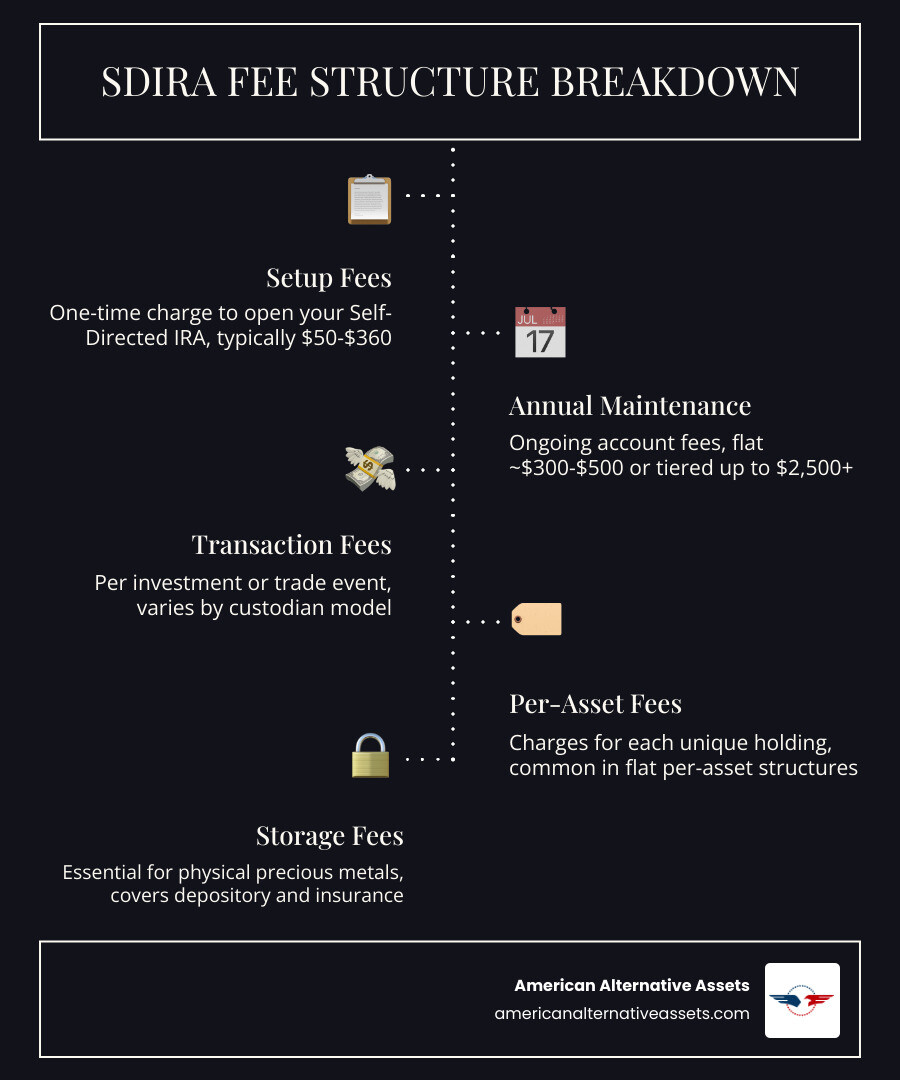
Key fee types to compare:
- One-time setup fees
- Annual maintenance fees, flat vs. tiered vs. asset-based
- Transaction fees per investment event
- Per-asset holding fees
- Storage fees, critical for physical precious metals
- Wire transfer and termination fees
There is no such thing as a fee-free SDIRA. Every custodian charges something. The difference is in how they charge, and how much those costs compound over time.
For investors holding physical precious metals like gold and silver, the fee picture gets even more important. You are not just paying for account administration. You are also paying for secure depository storage, insurance, and IRS-compliant custody of tangible assets. Those costs are real, and they vary significantly across providers.
The good news? Once you understand the fee structure, comparison becomes straightforward.
My name is Shanon Davis. After watching paper-based assets collapse in 2008 and spending years in venture capital, I built American Alternative Assets specifically to help everyday investors make sense of the true cost of protecting their wealth through physical precious metals. Doing a real self-directed IRA custodian fee comparison is one of the first steps I walk every investor through, because the fee structure you choose today shapes your returns for decades.
This article is for informational purposes only and does not constitute financial advice. Please consult your financial advisor before making investment decisions. Investing in precious metals involves risk. Past performance does not guarantee future results.

When we look at the landscape of retirement accounts, most people are used to the “hidden” fees of mutual funds or the zero-commission trades of big-box brokerages. However, a Self-Directed IRA (SDIRA) is a different animal entirely. Because you are moving away from paper assets like stocks and bonds and into physical precious metals, the custodian has a much higher administrative burden.
Internal Revenue Code Section 408 requires that all IRAs be held by a qualified custodian. You cannot legally hold your own IRA assets under your mattress or in a home safe. This is why a custodian is mandatory. They handle the recordkeeping, IRS reporting, like Forms 5498 and 1099-R, and help ensure your account remains compliant with complex tax laws. For a general overview of how the IRS defines IRAs and custodial requirements, see the IRS retirement topics page.
Standard fee schedules highlight that costs generally fall into three buckets: setup, annual maintenance, and transaction-based costs. For those of us focused on physical gold and silver, we also have to account for the specialized costs of secure, third-party storage.
Comparing the Self-Directed IRA Custodian Fee Comparison for 2026
As we move through 2026, the market for alternative assets has matured. We are seeing a push toward more transparent, flat-fee models. Investors are becoming savvier, realizing that a percentage-based fee on a growing gold portfolio can become a massive drag on wealth.
The 2026 contribution limits are now $7,000 for those under 50 and $8,000 for those 50 and older. While these contributions are a great start, many of our clients at American Alternative Assets are performing rollovers of much larger sums from old 401(k)s or Traditional IRAs. When you are moving six figures into physical metals, the fee structure you choose becomes the most significant variable in your long-term cost of ownership.
To get a better grasp of the foundation, you might want to review What is a Self-Directed IRA? to understand how these accounts differ from the standard options offered by commercial banks.
How to Use a Self-Directed IRA Custodian Fee Comparison to Save
The secret to saving money on custodial fees is matching the fee structure to your investment behavior. If you are a “buy and hold” investor who wants to secure a large amount of physical gold and let it sit for a decade, a flat-fee model is almost always your best friend.
Conversely, if you were making dozens of small transactions a year, you would need to look closely at per-transaction costs. For the physical precious metals investor, the strategy is usually passive. We help our clients select their metals, fund the account, and then the assets are stored securely. Since you aren’t trading every day, you want to minimize the recurring annual “tax” the custodian takes just for keeping the lights on.
For a deeper dive into how to pick the right partner, see our Precious Metals IRA Custodian Complete Guide.
Core Components of SDIRA Pricing Models
When we perform a self-directed IRA custodian fee comparison, we have to look past the marketing “hook” and into the fine print. Most custodians charge a one-time setup fee to open the account and perform the initial compliance checks. This usually ranges from $50 to $300 across the industry.
Once the account is open, the ongoing costs begin. These are the fees that pay for the custodian’s “white-glove” service, their technology platforms, and their staff who ensure your account doesn’t trigger an accidental IRS penalty.
Flat-Fee vs. Asset-Based Models
This is the most critical fork in the road for any investor.
- Flat-Fee Models: You pay a fixed dollar amount every year (e.g., $495), regardless of whether your account is worth $50,000 or $500,000. This is the model we generally prefer for our clients because it rewards you for being a successful investor. As the value of your physical gold rises, your fee stays the same, meaning your effective “expense ratio” actually drops over time.
- Asset-Based (Tiered) Models: Your fee is based on a percentage of your account value or moves up into higher “tiers” as your balance grows. For example, Equity Trust uses a tiered system that can scale from $350 to over $2,500 per year. While this might be cheaper for a very small account, it can become quite expensive as you build significant wealth.
You can use a Retirement Advisor Fees Calculator to see how these different models might impact your specific balance.
Specialized Costs for Physical Precious Metals
Unlike a “paper” IRA that holds digital entries of stocks, a Gold IRA holds tangible, heavy, and highly valuable bars and coins. This introduces two unique costs:
- Storage Fees: Your metals must be kept in an IRS-approved depository. You can choose “segregated” storage (your metals are kept in a separate box) or “non-segregated” storage (your metals are kept with other investors’ metals of the same type). Segregated is typically more expensive but offers the ultimate peace of mind.
- Insurance: The custodian or depository must maintain insurance against theft, loss, or damage. This is usually bundled into your storage fee, but it is a vital component of protecting your wealth.
Hidden Costs and Transactional Expenses to Watch
The “sticker price” of an annual fee is rarely the whole story. When we conduct a self-directed IRA custodian fee comparison, we look for the “death by a thousand cuts” fees.
- Wire Transfer Fees: Every time you move cash in or out, you might be charged $25 to $30.
- Paper Statement Fees: Many custodians now charge $5 to $10 per month just to mail you a physical statement. Opting for e-delivery is an easy win.
- Termination/Transfer-Out Fees: If you decide to move your account elsewhere, some custodians charge a “break-up” fee that can be $150 or more.
- Processing Speed: While not a direct fee, slow processing can cost you money. If a custodian takes three weeks to fund a transaction, you might miss out on a favorable price for silver or gold.
The Role of Checkbook Control in Fee Reduction
Some investors choose to use an “IRA LLC” structure, often called checkbook control. In this setup, your IRA owns 100% of a newly formed LLC, and you act as the manager. This allows you to write checks directly from a dedicated business bank account to purchase assets.
The benefit is that you can often bypass the custodian’s per-transaction fees because the custodian isn’t “processing” every single buy and sell; they are simply holding the LLC as a single asset. However, this structure has its own setup costs and requires strict adherence to IRS rules to avoid prohibited transactions. You can explore the math behind these structures using a Hidden Cost Calculator.
Evaluating Value Beyond the Base Fee
At American Alternative Assets, we believe that the cheapest option isn’t always the best. In physical precious metals, you are looking for a partner, not just a spreadsheet entry.
A low-cost, “budget” custodian might have a call center with long wait times and staff who don’t understand the nuances of precious metals purity standards. When you are dealing with your life’s savings, “white-glove” service matters. You want a custodian who offers transparency, ethical practices, and a relationship-first approach. This ensures that when you have a question about a distribution or a storage concern, you get a real person who knows your name.
Our IRA Precious Metals Custodians Complete Guide provides more insight into how to weigh these qualitative factors against the raw numbers.
Frequently Asked Questions about Self-Directed IRA Custodian Fee Comparison
Are self-directed IRA custodian fees tax-deductible?
This is a common question with a nuanced answer. Generally, if you pay your custodial fees with personal funds (using a check or credit card outside of the IRA), they may be tax-deductible as an itemized deduction, subject to certain IRS limits. However, if the fees are deducted directly from your IRA balance, they are paid with “pre-tax” dollars, so you don’t get an additional deduction on your tax return. Most of our clients find that paying from personal funds is a great way to keep as much “working capital” inside the IRA as possible to maximize growth. For more on how money moves in and out of these accounts, check out the IRA Withdrawal Rules.
What is the typical Year 1 cost for a basic SDIRA?
For a standard account holding one type of physical precious metal, you should expect a Year 1 total between $300 and $600. This typically includes a one-time setup fee ($50-$150), the first year’s maintenance fee ($200-$300), and the initial storage/insurance fee ($100-$150). These costs reflect the specialized requirements for the security of physical assets and rigorous compliance standards necessary for alternative investments. You can compare this to other Types of Retirement Accounts to see the value proposition.
Why do precious metals IRAs have different fee structures?
Physical gold and silver require more than just a line on a ledger. They require physical space in a high-security vault, specialized insurance policies, and regular audits to ensure the metal exists and meets purity standards (99.5% for gold, 99.9% for silver). These operational realities are why the fee structures differ from a standard IRA. To understand the mechanics of how the metal is actually purchased and moved, see How Does a Gold IRA Work?.
Conclusion
Choosing a custodian is a foundational decision for your retirement. By performing a diligent self-directed IRA custodian fee comparison, you ensure that your hard-earned savings are going toward your future, not into the pockets of a financial institution through hidden “junk” fees.
At American Alternative Assets, we specialize in helping our clients navigate this transition. We don’t believe in paper-based promises; we believe in the enduring value of physical gold and silver bars and coins. Our relationship-first service is built on the pillars of trust and transparency. We want you to understand every penny that goes into your account setup and maintenance so there are never any surprises.
Protecting your wealth is about more than just picking the right asset. It is about picking the right partners, the right structures, and the right fee models to ensure your legacy remains intact.
If you are ready to take the next step and move away from the volatility of paper markets, we invite you to learn more about our custodian services and how we can help you secure your financial future with physical precious metals.
This article is for informational purposes only and does not constitute financial advice. Please consult your financial advisor before making investment decisions.
Investing in precious metals involves risk. Past performance does not guarantee future results.