







Why Precious Metal News Matters for Investors Right Now
Precious metal news in May 2026 is moving fast, and the key drivers every investor should know are:
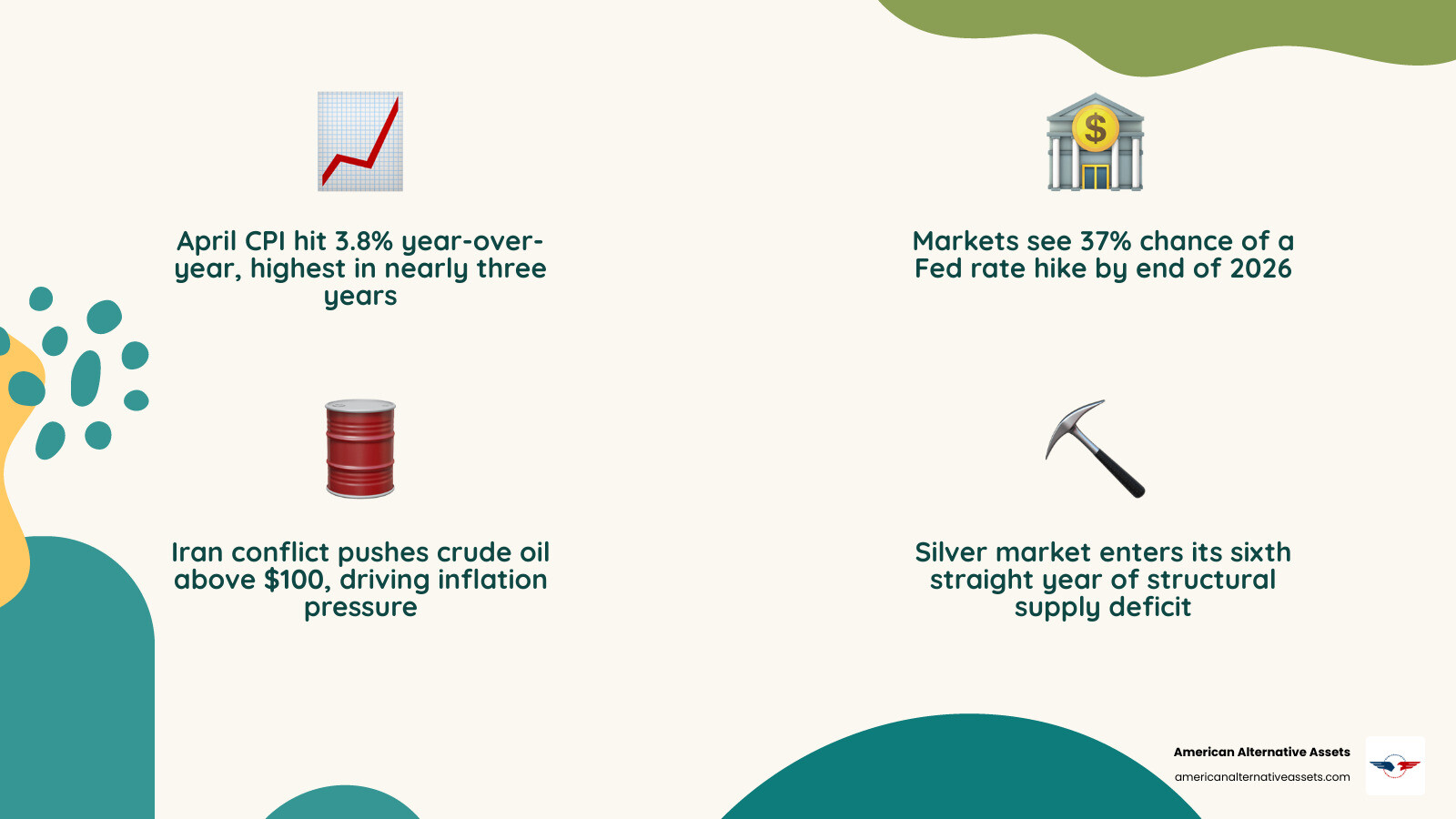
- Inflation: April CPI came in at 3.8% year-over-year, the highest in nearly three years
- Fed policy: Markets now assign a 37% probability of a rate hike before year-end, with a new Fed chair confirmed
- Geopolitical risk: The Iran conflict has pushed crude oil above $100 per barrel, rippling through all asset classes
- Silver deficits: The silver market is heading into its sixth straight year of supply shortfalls
- Central bank demand: Global central banks continue to accumulate gold, supporting a long-term structural bull market
- India tariffs: India doubled gold and silver import duties to 18.4%, reshaping global physical demand flows
Markets are sending mixed signals right now. Gold has pulled back from recent highs as a stronger U.S. dollar and rising Treasury yields weigh on prices. At the same time, silver is outperforming, driven by industrial demand and a deepening supply crunch. For investors who hold physical precious metals, understanding these forces is not just interesting. It is essential.
The case for physical gold and silver has rarely been more clearly supported by real-world data. Central banks are buying. Supply deficits are widening. And inflation is proving stubborn despite tighter monetary policy. Paper-based assets like ETFs and futures contracts add a layer of counterparty risk that physical ownership simply does not carry. When markets get volatile, that difference matters.
I’m Shanon Davis, and my experience spans venture capital and years of studying how precious metal news shapes long-term wealth preservation strategies, including the hard lessons I learned watching paper-heavy portfolios crumble in 2008. In the sections below, I’ll break down exactly what’s moving gold and silver markets right now and what it means for investors focused on protecting real, tangible wealth.
Precious metal news terminology:
Macroeconomic Drivers and Precious Metal News

The biggest market story in Precious Metal News right now is the tug-of-war between long-term support and short-term pressure.
On one side, gold and silver still benefit from sticky inflation, policy uncertainty, central bank buying, and geopolitical stress. On the other, a firmer U.S. dollar and higher Treasury yields have recently pressured spot prices. That is why daily headlines can look confusing. One morning gold is acting like a classic safe haven, the next it is slipping after economic data surprises to the upside.
This is not unusual. Precious metals often react to several forces at once:
- Inflation data
- Federal Reserve expectations
- Real interest rates
- Treasury yields
- U.S. dollar direction
- Manufacturing and growth data
- Global risk events
Recent market coverage from Kitco’s producer-price report highlighted how sensitive both metals have become to inflation surprises. Even when the long-term case stays intact, hotter data can quickly change expectations for rates, and that usually hits metals first through the dollar and bond market.
Impact of CPI and PPI on Physical Gold and Silver
April’s inflation readings mattered because they reinforced the idea that inflation is not gone, it is just changing outfits.
Headline CPI rose 3.8% year over year in April 2026, with a 0.6% monthly gain. Energy was a major driver, accounting for more than 40% of the monthly increase, largely because the Iran conflict pushed oil sharply higher. Then came a hotter producer price reading, which suggested pipeline inflation may still be feeding through the economy.
For metals, this created a split reaction:
- Gold faced near-term pressure because hotter inflation can delay Fed easing
- Silver held up better because it also benefits from industrial demand
- Platinum and palladium were mixed, reflecting broader commodity volatility
In plain English, markets heard, “Inflation is still sticky, so rates may stay higher for longer.” That tends to lift yields and the dollar, both of which can weigh on gold in the short run.
But for physical holders, the broader takeaway is still constructive. Persistent inflation erodes purchasing power over time, and that is exactly why tangible assets remain relevant. We discussed that theme in The Fed Is Frozen Gold Is Screaming Here’s What the Smart Money Is Watching.
Gold demand rose 2% year over year in the first quarter, and reached a record in value terms. That is a strong reminder that even during periods of price volatility, underlying demand has not disappeared.
Short-Term Pressure from Treasury Yields and the Dollar
The short-term headwind is straightforward. Stronger economic data has reduced immediate hopes for rate cuts, and in some sessions it has even revived talk of further tightening.
Recent reports showed:
- Stronger factory orders
- Manufacturing PMI above expansion territory
- A firmer 10-year Treasury yield
- A stronger U.S. dollar index
Those factors tend to create pressure on metals because non-yielding assets like gold and silver look less attractive when cash and bonds pay more. That dynamic was visible in market coverage such as Gold, silver slide as stronger U.S. data, firmer yields pressure metals.
Still, we think investors should separate short-term trading pressure from long-term ownership logic. A stronger dollar can slow a rally. It does not erase the reasons people own physical precious metals in the first place:
- Diversification
- Currency debasement concerns
- Inflation hedging potential
- Geopolitical uncertainty
- Reduced counterparty exposure
That is part of the bigger picture we covered in Gold Hits 5150 as Trumps Tariff War and a Stubborn Fed Squeeze the Dollar from Both Sides.
Geopolitical Tensions and Global Supply Shifts

If macro data explains the daily chop, geopolitics explains why investors keep coming back to physical metals.
The Middle East remains the clearest example. The Iran conflict has driven crude above $100 per barrel, lifted inflation concerns, and injected another layer of uncertainty into markets that were already digesting a complicated Fed backdrop. Gold and silver often act as shock absorbers in this kind of environment, though not always in a straight line.
At the same time, policy shifts in major consuming nations are affecting the physical market directly, especially on the demand side.
India’s Import Duty Hike and Physical Demand Risks
One of the most important supply-chain stories in recent precious metal news is India’s sudden import-duty increase.
According to The Hindu’s report on the tariff move, the government doubled import duty on gold and silver, taking the effective rate to 18.4%.
That matters because India is one of the world’s largest physical bullion markets. The numbers are striking:
- Gold imports reached $71.9 billion in 2025-26, up 24% from the prior year
- Gold import volume fell 5% to 721 tonnes
- Silver imports jumped 150% in value terms to $12 billion
- Jewelry imports rose 146% to $6.5 billion
The likely effects are not hard to see:
- Official imports may decline by an estimated 15% to 20%
- Domestic jewelry businesses could face tighter margins
- Smuggling incentives may rise as legal import costs increase
- Global demand flows may shift rather than disappear
That last point matters most. Higher tariffs can suppress official channels, but they do not necessarily erase investor demand for physical metal. In many cases, they distort the market, create shortages, and widen premiums. That is one reason we continue to focus on real, allocated ownership rather than paper substitutes that may track headlines but do not give direct possession of metal.
For broader context on why global faith in fiat systems remains a key driver, see Gold Hits 5000 as the World Loses Faith in the Dollar.
The Iran Conflict and Energy-Driven Inflation
The Iran conflict is affecting precious metals through two channels at once:
- Safe-haven demand
- Energy-driven inflation
Oil surged above $100 per barrel, with West Texas Intermediate briefly near $102 and other benchmarks pushing higher as well. When energy spikes, the effects spread quickly through transportation, manufacturing, food, and inflation expectations. Markets then start repricing central bank policy.
That creates a weird but common setup for gold:
- Geopolitical fear supports haven demand
- Rising oil supports inflation concerns
- Inflation concerns lift yields
- Higher yields can pressure gold in the short term
So yes, gold can be a haven and still have a rough day. Markets are dramatic like that.
Silver’s reaction has been more resilient because it carries both monetary and industrial characteristics. When manufacturing expectations stay firm and copper rises, silver can outperform even when gold hesitates.
This broader debt-and-inflation backdrop is also why many investors remain focused on long-term wealth preservation. We explored that in The IMF Just Confirmed What Retirees Already Know Americas Debt Is Out of Control.
Silver’s Structural Deficit and Industrial Demand
Silver may be the most interesting story in the market right now. Gold gets the headlines, but silver keeps showing up with stronger fundamentals than many investors expect.
The core issue is simple. Demand has been exceeding supply for years.
- Silver demand outstripped supply by about 95 million ounces last year
- The Silver Institute projects another deficit of around 67 million ounces in 2026
- That would mark the sixth straight annual deficit
- Over five years, the cumulative shortfall is expected to climb above 800 million ounces, roughly a full year’s mining output
Silver’s demand base is also broad:
- Solar panels
- Electronics
- Electrical systems
- AI and data-center hardware
- Bars and coins
- Jewelry and silverware
Unlike gold, silver is not just held. It is used, and often used up.
Why Physical Silver Stands Apart in Precious Metal News
When we look at precious metal news, silver stands apart because its bullish case is built on both scarcity and utility.
Industrial demand remains strong even with some thrift efforts in solar manufacturing. Meanwhile, bar and coin demand is expected to rise sharply in 2026 as investors seek tangible hedges against inflation and policy uncertainty.
Physical silver ownership also avoids the core weakness of paper products. A paper claim may give price exposure, but it does not remove counterparty dependence. Physical silver in a properly structured account is a tangible asset, not a promise layered on top of another promise. In uncertain markets, that distinction matters.
A quick comparison helps:
| Physical silver ownership | Silver-backed paper products |
|---|---|
| Direct ownership of real metal | Claim tied to a financial structure |
| No fund manager or issuer between you and the asset | Includes counterparty exposure |
| Useful for long-term wealth preservation | Often used for short-term trading |
| Tied to real-world supply tightness | Can disconnect from physical market stress |
For a broader look at how real assets are quietly gaining importance, read Gold Quiet Takeover.
China’s Strategic Move into Silver Markets
China’s role in silver has become impossible to ignore.
Research shows China’s silver imports jumped 78% in March 2026. At the same time, export controls and dual-use classifications have tightened the market narrative around silver as a strategic material, not just a commodity.
That matters for several reasons:
- It increases competition for available supply
- It can reduce liquidity in key trading hubs
- It raises the odds of higher physical premiums
- It reinforces silver’s role in industrial policy and national supply security
There have also been reports of tightness in London, one of the main global centers for physical silver liquidity. When demand accelerates and available metal gets tighter, spot prices do not always tell the full story. Physical markets can show stress through delivery delays, higher premiums, or both.
Copper’s strength adds another clue. Bloomberg reported copper above $14,000, reflecting resilient industrial demand and supply concerns. Since silver often tracks broader industrial momentum better than gold does, that supports the case for silver’s continued relevance.
Central Bank Trends and Long-Term Bull Market Forecasts
Short-term volatility gets attention, but central bank behavior may be the strongest long-term signal in the entire market.
Central banks continued buying gold in March, although large sales by a few countries pushed the monthly net figure negative. The bigger point is that official-sector interest remains strong, and that has been one of the most durable supports for the long-term gold bull market.
Other supportive trends include:
- Reserve diversification remains a priority
- Concerns about debt, currency stability, and geopolitics are not fading
- De-dollarization discussions continue in many parts of the world
We think this matters because central banks do not buy gold for entertainment. They buy it as a reserve asset, a hedge, and a form of monetary insurance. Retail investors can learn from that behavior, especially when thinking in terms of preparedness rather than speculation, especially through physical gold and silver held in a Precious Metals IRA.
Analyzing Institutional Forecasts in Precious Metal News
Forecasts for 2026 remain wide, and some are extremely aggressive.
More mainstream institutional views cited in the research include:
- JPMorgan projecting gold could reach 2026 levels around 6,300
- J.P. Morgan forecasting an average silver level around 81, with upside toward 85 later in the year
- Bank of America outlining a silver bull-case range as high as 135 to 309 under tight-supply conditions
Some analysts and market commentators have gone further, discussing scenarios such as $10,000 gold or $300 silver. We view those as tail-end monetary revaluation cases, not base-case forecasts. They are useful because they highlight how large the upside conversation has become, but they should not be treated as certainty.
Key 2026 targets discussed in the market:
- Gold: 6,300 in a bullish institutional case
- Gold: 10,000 in an extreme revaluation scenario
- Silver: 81 average in a more measured bank outlook
- Silver: 135 to 309 in an aggressive supply-shock scenario
- Silver: 300 in a high-end revaluation narrative
The takeaway is not that investors should anchor to the wildest number on the board. It is that the long-term case for physical precious metals in a Gold IRA or Precious Metals IRA is being taken seriously across both conservative and bullish camps.
Paper Claims vs. Physical Ownership
This is where our view is clearest. If the long-term thesis is built on scarcity, reserve demand, currency concerns, and systemic uncertainty, then physical ownership fits that thesis better than paper claims do.
Paper-based exposure may appear convenient, but it introduces risks that physical metal avoids:
- Counterparty dependence
- Potential liquidity stress during market shocks
- Disconnection between paper pricing and physical availability
- No direct possession of the underlying metal
Physical gold and silver coins and bars held through a Gold IRA or Precious Metals IRA align better with a long-term preparedness mindset. They are tangible, allocable, and designed for investors who care about owning the asset itself, not just renting price exposure.
If you want to continue this research, our related reads include The Fed Is Frozen Gold Is Screaming Here’s What the Smart Money Is Watching, Gold Quiet Takeover, and Gold Hits 5000 as the World Loses Faith in the Dollar.
Frequently Asked Questions about Precious Metals
What is driving gold prices in May 2026?
Gold is being driven by a mix of inflation data, Fed expectations, geopolitical risk, central bank demand, ETF flows, Treasury yields, and the U.S. dollar. The biggest near-term pressures have been stronger inflation prints, higher yields, and a firmer dollar. The biggest long-term supports remain central bank buying, stubborn inflation, debt concerns, and safe-haven demand.
Why is the silver supply deficit reaching record levels?
Because annual demand keeps exceeding mine supply plus recycling. Industrial demand from solar, electronics, and AI infrastructure remains strong, while investment demand for bars and coins is also rising. The result is a sixth straight projected market deficit in 2026, with a five-year cumulative shortfall above 800 million ounces.
How do rising interest rates affect physical gold ownership?
Rising rates can pressure gold prices in the short term because they tend to strengthen yields and the dollar. But physical gold ownership is usually considered in a broader context, as a diversification tool and a long-term store of value during inflation, policy uncertainty, and geopolitical stress. In other words, rates can shape short-term pricing, but they do not erase the reasons many investors hold physical gold.
Conclusion
The best Precious Metal News for investors in May 2026 is not just about daily price moves. It is about understanding the bigger pattern.
Gold is navigating a difficult short-term mix of hotter inflation data, rising yields, and a stronger dollar. Silver is being supported by a persistent structural deficit and strong industrial demand. Central banks continue to treat gold as a serious reserve asset. Geopolitical tensions, especially around Iran and energy markets, are keeping safe-haven demand alive. And policy shifts such as India’s import-duty hike are reshaping physical demand flows across the globe.
For investors focused on tangible wealth preservation through physical gold and silver coins and bars, especially inside a Gold IRA or Precious Metals IRA, these are not random headlines. They are signals.
At American Alternative Assets, we help clients explore physical gold and silver ownership through Gold IRAs and Precious Metals IRAs with a relationship-first, transparent approach built around long-term preparedness. If you want to learn more, see our More info about Gold IRA services.
This article is for informational purposes only and does not constitute financial advice. Please consult your financial advisor before making investment decisions. Investing in precious metals involves risk. Past performance does not guarantee future results.