







Why the Future of the Dollar Matters to Your Financial Security
The future of dollar dominance is one of the most important financial questions of our time. Here is a quick summary of where things stand:
Key facts about the dollar’s outlook:
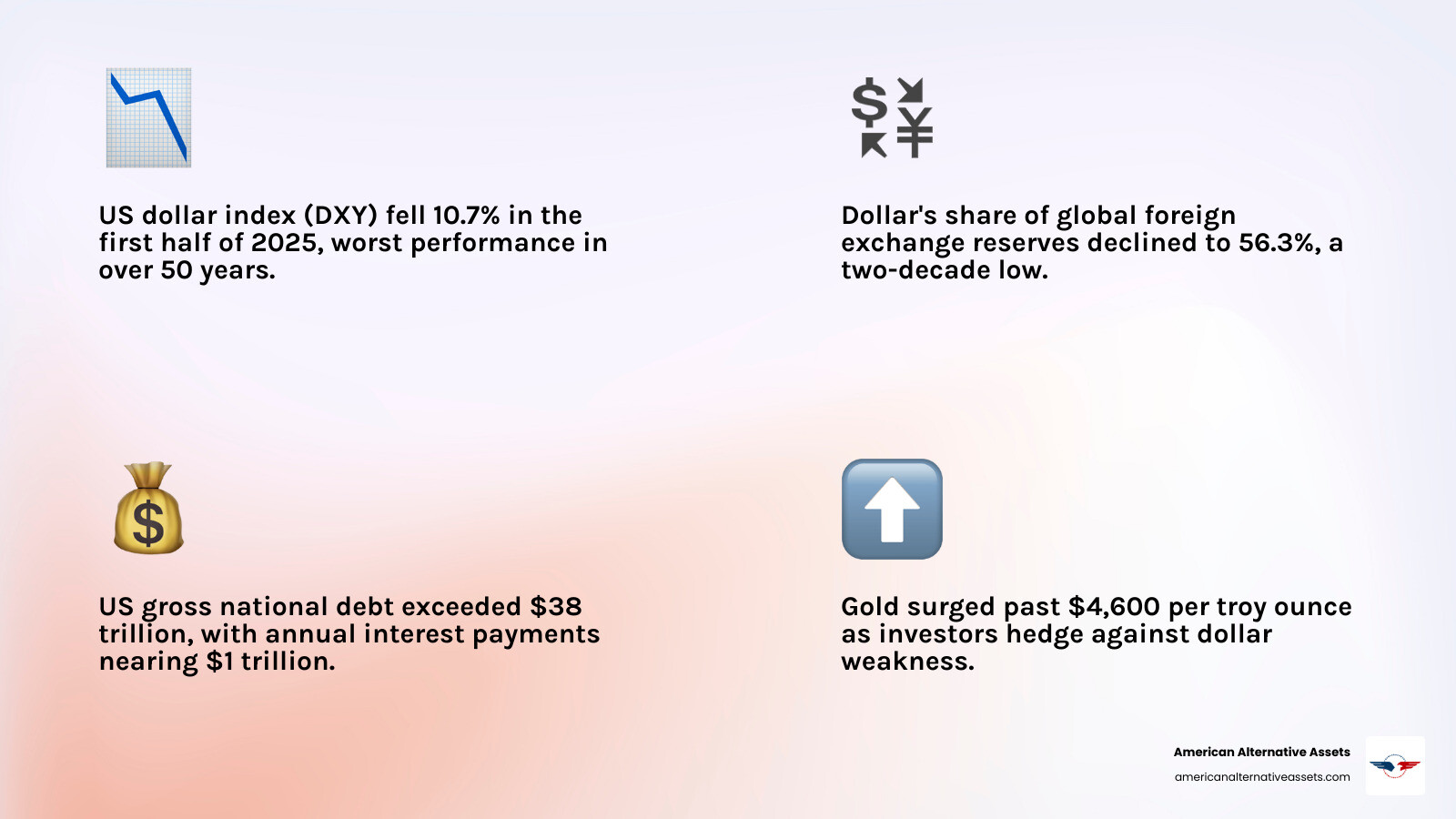
- The US dollar index (DXY) fell 10.7% in the first half of 2025, its worst performance for that period in over 50 years
- The dollar’s share of global foreign exchange reserves has declined to around 56.3%, a two-decade low
- Morgan Stanley forecasts the DXY could fall to 94 by Q2 2026, before potentially recovering to 100 by year-end
- US gross national debt has topped $38 trillion, with annual interest payments approaching $1 trillion
- Gold has surged past $4,600 per troy ounce as investors seek protection from dollar weakness
- Alternative payment systems like China’s CIPS and BRICS-backed platforms are gaining traction globally
These are not distant warnings. They are changes happening right now, reshaping how wealth is stored and transferred across the world.
The dollar is not collapsing overnight. But it is under more pressure than it has been in decades, from rising debt, shifting geopolitics, and growing distrust of US policy institutions. For anyone holding savings or approaching retirement, that pressure matters.
I’m Shanon Davis, founder of American Alternative Assets. My background in finance, combined with lessons learned from the 2008 financial crisis, shaped my view on the future of dollar purchasing power and why tangible assets deserve a place in any serious wealth preservation strategy. In the sections below, we’ll break down exactly what is driving these changes and what you can do about it.
This article is for informational purposes only and does not constitute financial advice. Please consult your financial advisor before making investment decisions. Investing in precious metals involves risk. Past performance does not guarantee future results.
The Current State and Future of Dollar Dominance
The US dollar has long been the undisputed king of the global financial system. However, the crown is looking a bit heavier these days. When we look at the DXY index, which tracks the dollar against a basket of other major currencies, we see a path filled with bumps and sharp turns.
In early 2025, the dollar experienced its worst performance in over half a century, dropping nearly 10 percent. This was not just a random dip. It was a reaction to a “haphazard” policy environment, including massive tariff announcements and rising fiscal uncertainty.

Major financial institutions like Morgan Stanley have been closely watching this “choppy path.” Their current analysis suggests the dollar index could slide from its current level of around 100 down to 94 by the second quarter of 2026. While they do anticipate a potential rebound to 100 by the end of that year, the road there is expected to be defined by slowing US growth and labor market uncertainty.
Some observers still lean on the “TINA” logic, which stands for “There Is No Alternative.” They argue that because US markets are so deep and liquid, the dollar is here to stay. While it is true that the dollar still facilitates nearly 90 percent of global foreign exchange trades, the sheer weight of US debt and policy unpredictability is making the “TINA” argument feel a little less certain than it used to be.
Reserve Currency Erosion and the Future of Dollar Hegemony
One of the clearest signs of a shift is found in the vaults of central banks. For decades, the dollar made up the lion’s share of global reserves. In 1999, that share was 71 percent. By the end of 2025, it had fallen to 56.3 percent, which is a two-decade low.
This decline is not just a statistical quirk. It represents a deliberate choice by world leaders to diversify their holdings. We are also seeing a shift in who owns US debt. Foreign ownership of US Treasuries has fallen from roughly 50 percent in the early 2010s to around 30 percent today. Large European pension funds in places like Amsterdam and Denmark have even begun cutting back their holdings of US government debt, citing concerns over Washington’s fiscal management.
When the world’s biggest investors start looking for the exit, it suggests a massive shift in global wealth that is impossible to ignore. This erosion of hegemony means the US may no longer enjoy the “exorbitant privilege” of borrowing cheaply forever.
Short-Term Volatility and the 2026 Outlook
As we look toward the 2026 horizon, volatility seems to be the only constant. The forecast for the first half of 2026 is particularly bearish, with the dollar expected to hit that 94 level on the DXY. Why? Because the Federal Reserve is expected to continue cutting interest rates to support a cooling economy, which typically makes the dollar less attractive to international investors.
Political events will likely add fuel to the fire. The 2026 midterm elections and potential shifts in Fed leadership create an environment where policy can change with a single tweet or announcement. If you feel like the ground is shifting beneath your feet, you aren’t alone. It is becoming increasingly clear that you cannot let the mainstream media fool you into thinking your cash is perfectly safe from these global forces.
Geopolitical Shifts: BRICS and the Rise of Alternative Systems
Geopolitics is perhaps the biggest driver of the changing future of dollar status. The BRICS nations, originally Brazil, Russia, India, China, and South Africa, have expanded to include major oil producers like Saudi Arabia and the UAE. This bloc now represents nearly a third of the world’s GDP.
A major catalyst for this shift was President Trump’s “Liberation Day” tariff announcements. These tariffs and the resulting trade tensions sent a clear message to the world: the US is willing to use its currency and trade power as a tool for negotiation. In response, many countries are looking for ways to circumvent the dollar entirely to avoid potential sanctions or trade wars. This is why it is vital to understand why Trump is targeting BRICS and what that means for your own wealth preservation.
Digital Pipelines and the Future of Dollar Alternatives
The “plumbing” of global finance is being rebuilt. China has developed its own Cross-Border Interbank Payment System (CIPS), which has processed roughly 45 trillion yuan in transactions since the start of 2025. While this is still a fraction of the US-led CHIPS system, the growth is staggering.
New digital projects like “mBridge” are also taking off. This project involves central banks in China, Hong Kong, Thailand, and the UAE working together to create a system where they can pay each other instantly using their own digital currencies. This bypasses the traditional SWIFT network, which has been the backbone of dollar dominance for decades. As these digital pipelines grow, we are witnessing the rise of BRICS and the potential fall of the US dollar from its position as the world’s only “must-use” currency.
Transactional Diplomacy and Local Currency Trade
We are also seeing a rise in “transactional diplomacy.” India and Russia are now settling trade in rupees and rubles. China settles about one-third of its foreign trade in yuan, a significant jump from just a few years ago.
The most significant shift, however, may be in the oil markets. For decades, the “petrodollar” system ensured that oil was priced and sold in US dollars, creating constant global demand for the greenback. Now, with Saudi Arabia joining BRICS and exploring oil sales in other currencies, that foundation is cracking. When the world’s largest oil exporters stop demanding dollars, the very definition of a reserve currency begins to change.
Fiscal Fragility: Debt, Deficits, and the Future of Dollar Stability
While geopolitical threats are external, the internal threats to the dollar are just as concerning. The US gross national debt has topped a staggering $38 trillion. To put that in perspective, the government is now adding $1 trillion to the debt roughly every 10 weeks.
The fiscal deficit for 2025 is projected at $1.9 trillion, and the current-account gap, which measures the flow of goods and services between the US and the rest of the world, is at 6 percent of GDP. This has led to a narrative in the financial world about “Selling America,” as investors question the long-term sustainability of this debt load. We have to ask ourselves: is America ready for the coming fiscal apocalypse?
Political Triggers and Institutional Pressure
The independence of the Federal Reserve is also under fire. There have been public challenges to Fed leadership, including a criminal investigation into Chairman Jerome Powell over a renovation project. Such events undermine the “predictability and prudence” that once made the dollar the world’s safest asset.
With the nomination of figures like Kevin Warsh to lead the Fed, markets are bracing for a more politicized central bank. This uncertainty, combined with the 2026 midterms, could trigger further dollar volatility. Experts like Shannon Davis have discussed whether we are looking at a dollar collapse on platforms like Daily Clout, highlighting the growing anxiety among those who watch these institutional pressures closely.
Fiscal Dominance and Inflationary Risks
When a government has too much debt, it often faces “fiscal dominance.” This is a situation where the central bank is forced to keep interest rates low or print more money just to help the government pay its bills. This “money printing” is a form of fiat debasement that destroys the purchasing power of every dollar in your pocket.
As the dollar weakens, the cost of everything we import, from electronics to energy, goes up. This “imported inflation” hits consumers directly. The twin deficits (budget and trade) create a vicious cycle that puts the dollar at risk of collapse. It also affects Treasury market liquidity, making it harder for the government to find buyers for its debt without the Fed stepping in to create more money out of thin air.
Gold as the Ultimate Hedge Against Fiat Debasement
In this environment of weakening paper currency, gold has entered a structural bull market. In early 2026, gold prices broke $4,600 per troy ounce. This isn’t just a temporary price spike. It is a fundamental “price discovery” phase where the world is revaluing gold against a devalued dollar.
Central banks are leading the charge. They are swapping their dollar holdings for gold at a historic pace. Gold now accounts for 15 percent of global foreign exchange reserves, up from 11 percent just five years ago. When gold hits levels like $5,000, it serves as a loud and clear signal that the world is losing faith in paper assets.
Repatriation and the Search for Tangible Security
Nations are also becoming wary of leaving their gold in foreign vaults. Germany and Italy have faced growing pressure to repatriate billions of dollars worth of gold currently held in the US. This movement toward physical, local ownership is a response to the “weaponization” of the financial system through sanctions.
If countries are scrambling to pull their gold out of the US, it says a lot about the perceived counterparty risk of the dollar-based system. Physical ownership of tangible assets is the ultimate form of wealth preservation. This is the slow death of the dollar and the relentless rise of gold that many on Wall Street are hesitant to discuss openly.
Strategic Wealth Preservation in a Volatile Economy
So, how do you navigate this landscape? The answer for many is a shift from paper-based assets to physical precious metals. While paper-based proxies might seem convenient, they carry significant risks. They are essentially IOUs that depend on the stability of the very financial system that is currently under stress.
Physical gold and silver, held within a Precious Metals IRA, offer a different level of security. They have no counterparty risk, meaning their value doesn’t depend on a third-party institution staying in business. They provide real privacy and protection for your wealth.
Recent policy shifts, such as those discussed in the context of the Mar-a-Lago Accord, suggest that the era of a stable, strong dollar may be ending. Preparing for this shift means moving toward assets that have maintained their value for thousands of years.
Protecting Retirement from Currency Depreciation
For retirees, the future of dollar purchasing power is a life-and-death issue for their savings. If the dollar loses 10 percent of its value, your retirement fund effectively buys 10 percent less food, healthcare, and energy.
A self-directed Precious Metals IRA allows you to hold physical bullion as a hedge against this depreciation. It is a way to take personal responsibility for your financial future. As Shannon Davis noted in her follow-up on Daily Clout, being proactive about your diversification is the only way to stay prepared in these uncertain times. Physical gold is often called “private money” because it is an asset that no government can simply print more of to devalue your hard work.
Frequently Asked Questions about the Future of the Dollar
What is the 12-month forecast for the US dollar index?
The consensus from many major financial institutions is that the dollar will face a “choppy path.” Morgan Stanley specifically forecasts a decline to the 94 level on the DXY by the second quarter of 2026. While a rebound to 100 is possible by the end of 2026, the short-term outlook remains bearish due to slowing economic growth and anticipated interest rate cuts by the Federal Reserve.
Is the US dollar losing its status as the world’s reserve currency?
The dollar is experiencing a gradual erosion of its dominance rather than a sudden collapse. Its share of global foreign exchange reserves has fallen to 56.3 percent, a twenty-year low. While it remains the most used currency for trade and finance, the rise of alternative payment systems like China’s CIPS and the expansion of the BRICS bloc suggest the world is moving toward a more multipolar financial system.
Why is gold considered a hedge against a weakening dollar?
Gold has a limited supply and cannot be “printed” like fiat currency. Historically, when the dollar weakens or inflation rises, gold tends to increase in value. It acts as a barometer of concern for the global economy. Because gold is priced in dollars, a cheaper dollar often leads to a higher gold price, helping to preserve the purchasing power of your savings.
Conclusion
Predicting the future of dollar dominance requires looking past the daily headlines and focusing on the structural shifts in debt, geopolitics, and monetary policy. At American Alternative Assets, we believe in a relationship-first approach to wealth protection. We provide white-glove service to help our clients navigate these complex changes with transparency and ethical practices.
The challenges facing the dollar are real, but they are also a reason to be proactive. By diversifying into physical precious metals, you are taking a step toward real privacy and protection for your wealth. We are here to help you understand your options and ensure that your retirement is built on a foundation of tangible security. For more information, you can explore our Gold IRA services and see how we can help you prepare for the road ahead.
This article is for informational purposes only and does not constitute financial advice. Please consult your financial advisor before making investment decisions. Investing in precious metals involves risk. Past performance does not guarantee future results.