








Why Understanding Precious Metals IRA Rules Matters
Precious metals IRA rules are the IRS regulations that govern what you can hold in a retirement account, where it must be stored, and how to avoid costly penalties. Diversifying with tangible assets like gold is compelling, but without knowing the rules, you risk fines or even disqualification of your account.
Key Precious Metals IRA Rules at a Glance:
- Approved Metals Only: Gold must be 99.5% pure, silver 99.9%, and platinum/palladium 99.95%.
- No Home Storage: Metals must be held by an IRS-approved custodian in a qualified depository.
- Specific Coins and Bullion: Only certain coins (like American Eagles) and bullion qualify.
- Contribution Limits: $7,000 per year (under 50) or $8,000 (50+) for 2024/2025.
- Early Withdrawal Penalty: A 10% penalty plus income tax applies to withdrawals before age 59½.
- Required Distributions (RMDs): You must begin taking RMDs at age 73.
Over the past decade, the Commodity Futures Trading Commission has charged companies with over $500 million in fraudulent precious metals sales. Many investors lost savings to excessive fees or unknowingly violated IRS rules, leading to unexpected tax bills. Fortunately, these problems are avoidable when you understand the regulations.
This guide covers every essential rule for precious metals IRAs, from qualifying metals and storage to fees and common scams. I’m Shanon Davis, founder of American Alternative Assets. After the 2008 crash exposed the fragility of paper-based retirement systems, I’ve dedicated my career to helping Americans steer precious metals IRA rules with clarity and confidence.
The Foundation: IRS Rules on Collectibles and Precious Metals
Before investing in precious metals for retirement, you must understand a critical rule: the IRS generally prohibits IRAs from holding collectibles. This rule, found in Internal Revenue Code (IRC) Section 408(m), prevents using tax-advantaged accounts for personal luxury items or hobby collections.
If you buy a collectible with your IRA, the IRS treats it as an immediate distribution. You would owe income taxes on the purchase amount, plus a 10% early withdrawal penalty if you’re under 59½.
However, the Taxpayer Relief Act of 1997 created an exception for certain precious metals. Congress recognized that gold, silver, platinum, and palladium meeting strict purity standards are legitimate investments, not collectibles. This exception makes precious metals IRAs possible, typically through a Self-Directed IRA that allows investments beyond stocks and bonds. For official details, you can review the IRS guidance on collectibles in retirement accounts.
Approved vs. Unapproved Metals
The exception under IRC Section 408(m)(3) is very specific, allowing only certain coins and bullion that meet exact fineness standards. This precision is the line between a compliant investment and a costly mistake.
Purchasing non-approved metals for your IRA triggers immediate consequences. The IRS treats the purchase as a taxable distribution, meaning you’ll owe income tax on the amount and a potential 10% penalty. For example, a rare gold coin that doesn’t meet purity standards is considered a collectible, making its full purchase price taxable income for that year.
In severe cases, buying non-approved metals can trigger a prohibited transaction, which can disqualify your entire IRA. If this happens, every dollar in the account becomes immediately taxable, potentially pushing you into a higher tax bracket and creating a massive tax bill. Understanding the specific precious metals IRA rules is the foundation of protecting your retirement savings.
What’s Allowed? Approved Metals and Purity Standards
The IRS is highly specific about which precious metals qualify for an IRA. This ensures you are investing in bullion valued for its metal content, not collectible coins prized for rarity.

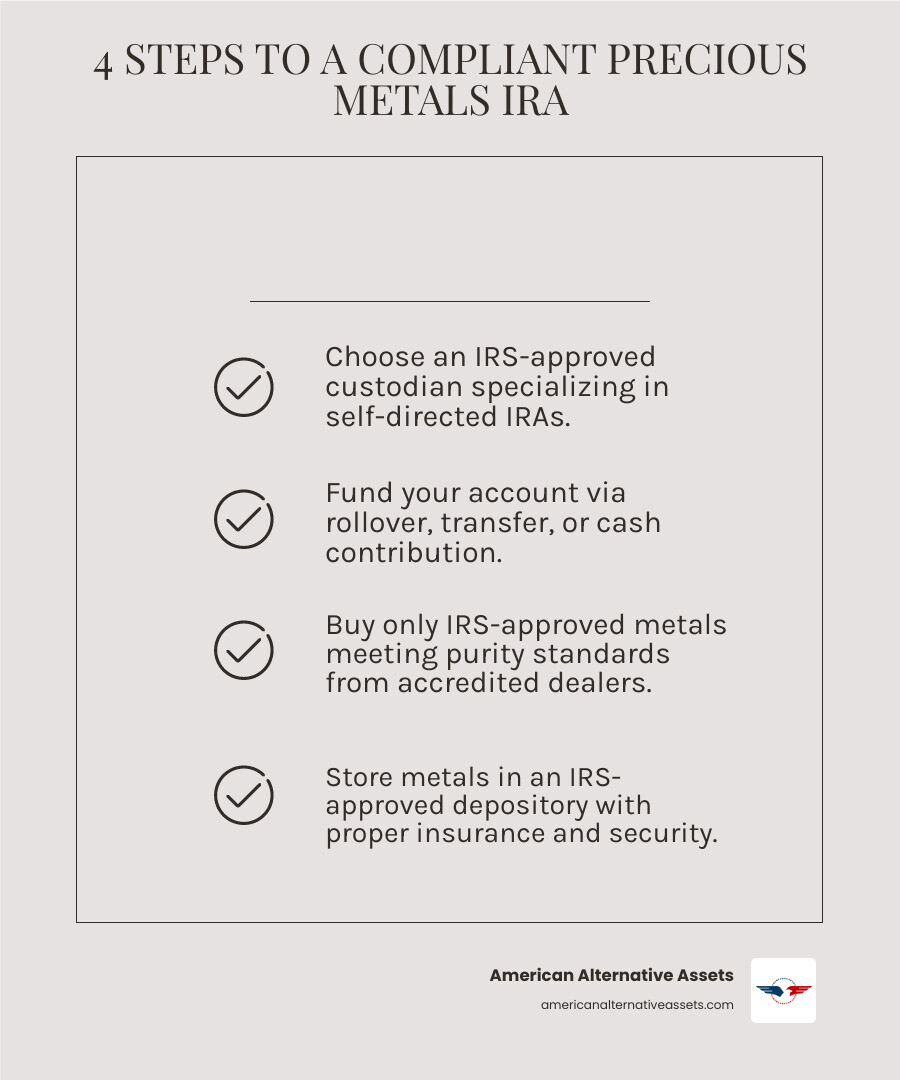
The fineness requirements are strict: gold must be 99.5% pure, silver 99.9% pure, and both platinum and palladium must be 99.95% pure. These are hard requirements, not suggestions. Additionally, metals must come from accredited refiners or national government mints recognized by bodies like NYMEX, COMEX, or LBMA. This ensures the metals are verifiable and meet international quality standards. If you’re considering a gold-focused strategy, our guide on What is a Gold IRA? offers more context.
Gold and Silver IRA Requirements
Gold in an IRA must meet the 99.5% purity standard, with one major exception: American Gold Eagle coins. Despite being 91.67% gold, they are specifically approved by law due to their status as official U.S. bullion.
- Approved Gold: American Gold Eagle (bullion/proof), Canadian Gold Maple Leaf, American Buffalo (uncirculated), Australian Kangaroo/Nugget, and Austrian Philharmonic coins. Gold bars and rounds from approved refiners also qualify.
Silver requires an even higher purity of 99.9% to ensure it is investment-grade bullion.
- Approved Silver: American Silver Eagle (bullion/proof), Canadian Silver Maple Leaf, Mexican Silver Libertad, America the Beautiful, Australian Kookaburra, and Austrian Vienna Philharmonic coins. British Britannia coins minted in 2013 or later also qualify. For more on silver, see our Silver IRA page.
Platinum and Palladium IRA Requirements
Platinum and palladium have the highest purity standard at 99.95% fineness. They offer additional diversification for investors.
- Approved Platinum: American Platinum Eagle (bullion/proof), Canadian Maple Leaf (bullion), and Australian Koala (bullion) coins.
- Approved Palladium: The Canadian Palladium Maple Leaf is the primary approved coin.
What doesn’t qualify is just as important. South African Krugerrands and British Britannia coins minted before 2013 do not meet purity standards. All rare or numismatic coins are prohibited. Adhering to these precious metals IRA rules is essential to avoid taxes and penalties.
The “How-To”: Custodians, Storage, and Key Precious Metals IRA Rules
Many people don’t realize you can’t just buy gold bars and store them at home for your IRA. The IRS has strict requirements for how these assets must be held to protect your retirement savings from penalties.
The precious metals IRA rules mandate that you work with a Self-Directed IRA custodian specializing in alternative assets like physical gold. Traditional IRA providers don’t handle physical metals. Furthermore, all metals must be stored in an IRS-approved depository. This is a legal requirement, not a suggestion. The landmark case McNulty v. Commissioner confirmed this, where an investor faced significant tax consequences for holding his IRA metals personally. Our Precious Metals IRA Custodians Guide can help you choose the right partner.
The Role of the Custodian and Depository
The IRS requires a third-party custodian to hold your IRA assets, creating a separation between you and your physical metals. This prevents them from being classified as personal collectibles. Your custodian acts as the account administrator, handling transactions, ensuring compliance, and coordinating with the depository.
When choosing a custodian, look for an established track record and transparent fees. They should partner with IRS-approved depositories that offer high security and insurance. For storage, you have two options:
- Segregated storage: Your specific coins and bars are held separately.
- Commingled storage: Your metals are stored alongside identical items from other investors.
Both options are fully compliant. You can learn more about them in our guide on Depository Accounts for Gold Storage. Metals in these depositories are typically insured for up to $1 million, with additional coverage available.
Understanding the Associated Fees
Precious metals IRAs have more costs than traditional IRAs due to the handling of physical assets. Expect a one-time setup fee, an annual administrative fee from your custodian, and an annual storage fee from the depository. There is also a dealer markup or “spread”, which is the difference between the dealer’s selling price and the market “spot price.” For bullion, this is often 5% to 10%, but some unscrupulous dealers charge much more. Always demand a clear, itemized breakdown of all fees in writing before you commit.
A Closer Look at the Precious Metals IRA Rules for Possession
You cannot store your IRA-owned precious metals at home or in a personal safe. Taking physical possession before an official distribution is a severe violation. The IRS treats this as a deemed distribution, making the entire value of the metals taxable income. If you’re under 59½, you’ll also face a 10% early withdrawal penalty.
The McNulty case is a real-world example of these consequences. The investor tried to find a loophole and paid a heavy price. While the appeal of tangible assets is strong, the metals must remain with an IRS-approved depository until you take a proper distribution. For more on this, visit our IRA Withdrawal Rules page. Working with a trusted custodian makes compliance straightforward.
Financial & Age-Related Rules: Taxes, Contributions, and RMDs
Like all retirement accounts, precious metals IRAs have financial and age-related rules designed to encourage long-term savings. The primary benefit is tax-advantaged growth, which allows your investments to grow without being diminished by annual taxes. These rules apply just as strictly to physical gold as they do to stocks. For a broad overview, see our resource on Types of Retirement Accounts.
Traditional vs. Roth Precious Metals IRA: Tax Implications
Your tax treatment depends on whether you choose a Traditional or Roth structure.
- A Traditional Precious Metals IRA often allows for tax-deductible contributions, reducing your current taxable income. Growth is tax-deferred, but withdrawals in retirement are taxed as ordinary income.
- A Roth Precious Metals IRA uses after-tax contributions, so there is no upfront deduction. However, your metals grow completely tax-free, and qualified withdrawals in retirement are also tax-free. (To qualify, the account must be at least five years old and you must be over 59½).
If you expect to be in a higher tax bracket now than in retirement, a Traditional IRA may be better. If you anticipate a higher tax bracket later or prefer tax-free withdrawals, a Roth is often more beneficial. Roth IRAs also do not have required minimum distributions during your lifetime.
Contribution Limits and Rollovers
For 2024 and 2025, you can contribute up to $7,000 per year to your IRAs if you are under 50. If you are age 50 or older, you can contribute an additional $1,000, for a total of $8,000 per year. These limits apply across all your IRA accounts. You can check the official IRS contribution limits announcement for updates.
Many investors fund their accounts by rolling over funds from a 401(k), 403(b), Thrift Savings Plan (TSP), or another IRA. Rollovers do not count toward annual contribution limits. A direct, trustee-to-trustee transfer is the safest method, as the funds move between custodians without you touching them. An indirect rollover, where you receive a check, is riskier; if you miss the 60-day deposit deadline, the IRS treats it as a taxable distribution. For specific guidance on federal plans, see our Thrift Savings Plan Rollover page.
Navigating Required Minimum Distributions (RMDs)
The IRS requires you to start taking Required Minimum Distributions (RMDs) from Traditional IRAs at age 73. This rule ensures that tax-deferred funds are eventually taxed. Roth IRAs do not have RMDs for the original owner.
To calculate your RMD, your custodian values your metals at their fair market value. You then have two options for the distribution:
- Cash Distribution: Sell a portion of your metals to meet the RMD amount. The cash is sent to you and is taxed as ordinary income.
- In-Kind Distribution: Take physical possession of metals equal in value to the RMD amount. This is also a taxable distribution, and the metals are no longer part of your IRA.
The penalty for missing an RMD is a steep 25% of the amount you failed to withdraw, which can be reduced to 10% if corrected promptly. Proper planning with your custodian is essential. For more details, see our guide on Required Minimum Distributions RMDs Rules and Penalties.
Risks, Alternatives, and Avoiding Scams
While a precious metals IRA can be a valuable part of a diversified strategy, it’s crucial to understand the risks and be vigilant against scams. No investment is risk-free.
Key risks include:
- Volatility: Precious metals prices can swing significantly. Silver, in particular, tends to experience sharp price movements.
- Illiquidity: Converting physical metals to cash is not instant. It requires working with your custodian to sell the assets, which can take several days or more.
- No Passive Income: Unlike stocks that may pay dividends, physical metals do not generate cash flow. Returns depend entirely on price appreciation.
For a balanced perspective, our Gold IRA Pros and Cons page offers a deeper dive.
Physical Metals vs. “Paper Gold” (ETFs & Stocks)
Investors often weigh owning physical metals against investing in precious metals ETFs (like GLD) or mining stocks. A physical IRA means you own actual bullion held in your name. ETFs give you shares in a trust that holds metals, but you don’t have direct ownership. Mining stocks depend on company performance, not just metal prices.
| Feature | Physical Precious Metals IRA | Precious Metals ETF (e.g., GLD, SLV) |
|---|---|---|
| Ownership | Direct ownership of physical bullion or coins. | Indirect ownership, shares in a trust that holds underlying metals. |
| Custody | Physical metals held by IRS-approved third-party depository. | Underlying assets held by financial institution, managed by ETF issuer. |
| Counterparty Risk | Lower, as you own the physical asset. | Higher, involves issuer risk, trust risk, and potential for tracking error. |
| Fees | Setup, annual admin, storage fees (generally higher overall). | Expense ratio (typically 0.10%-0.50% annually, generally lower). |
| Liquidity | Lower, involves selling physical assets, can take time. | Higher, traded like stocks on an exchange. |
The key advantage of physical metals is significantly lower counterparty risk. You are not relying on a financial institution’s solvency, which is why many investors choose physical assets that exist outside the traditional financial system.
Red Flags: How to Spot and Avoid Precious Metals IRA Scams
The precious metals space has attracted bad actors. The CFTC has charged companies with over $500 million in fraud. Be aware of these red flags:
- High-Pressure Sales Tactics: Be wary of anyone using fear or rushing you into a decision. Legitimate professionals encourage research and second opinions.
- “Home Storage IRA” Schemes: This is the most dangerous red flag. The IRS prohibits personal possession of IRA metals. Any company promoting this is pushing an illegal arrangement that triggers taxes and penalties.
- Excessive Markups: Some dealers charge spreads of 30% or more above the spot price. Always compare prices and demand an itemized cost breakdown.
- Unregistered Dealers: Verify that anyone providing investment advice is registered with regulatory bodies like the SEC or FINRA.
- Guaranteed Returns: No investment can guarantee returns. Be skeptical of secret loopholes or promises of risk-free profits.
The CFTC has issued a specific advisory on precious metals schemes. At American Alternative Assets, we prioritize transparency and ethical guidance to help you invest with confidence.
Frequently Asked Questions about Precious Metals IRA Rules
Here are answers to common questions we receive about precious metals IRA rules:
Can I take physical possession of the metals in my IRA?
No. Taking personal possession of IRA-owned metals is a “deemed distribution” by the IRS. This triggers income taxes on the metals’ value and a potential 10% penalty if you are under age 59½. The metals must remain with an IRS-approved depository, a rule reinforced by the McNulty v. Commissioner case.
What happens if I buy a non-approved coin for my IRA?
If your IRA buys a metal item that doesn’t meet IRS purity standards or is considered a “collectible,” the purchase is treated as a taxable distribution. The purchase amount is added to your taxable income for the year, and you may face a 10% early withdrawal penalty. This highlights the importance of working with knowledgeable professionals.
How are Required Minimum Distributions (RMDs) handled with physical metal?
When you reach RMD age (currently 73), you have two options for your Traditional IRA:
- Cash Distribution: Instruct your custodian to sell enough metal to cover your RMD. The cash is sent to you and is taxed as ordinary income.
- “In-Kind” Distribution: Have the physical metals, valued at the RMD amount, shipped to you. This is also a taxable distribution, and the metals are then outside your IRA.
Roth IRAs do not require RMDs during the account owner’s lifetime.
Conclusion: Securing Your Future with Confidence
Understanding precious metals IRA rules is about protecting the retirement savings you’ve worked hard to build. Following these IRS requirements, from purity standards to storage mandates, ensures your account remains compliant and avoids unexpected taxes and penalties.
Adhering to the rules means working with an IRS-approved custodian, using a qualified depository, and understanding contribution limits and RMDs. Most importantly, it means partnering with a company you can trust.
At American Alternative Assets, our reputation is built on transparency and ethical guidance. We believe education comes first, so you can make decisions with confidence. We’ve seen too many investors harmed by high-pressure tactics and illegal schemes. That’s not how we operate.
Our commitment is to provide white-glove service rooted in trust. We take the time to explain every step, ensuring you have the clarity to diversify your portfolio with physical precious metals. When done right, it can be a powerful strategy for wealth preservation.
If you’re ready to explore how a self-directed precious metals IRA might fit into your retirement plan, we’re here to help.
Discover the Power of a Self-Directed Precious Metals IRA Today
Disclaimer: This article is for informational purposes only and does not constitute financial advice. Please consult your financial advisor before making investment decisions. Investing in precious metals involves risk. Past performance does not guarantee future results.