








Investing in precious metals IRA: Secure Your 2025
Why Diversifying Your Retirement Matters More Than Ever
Investing in precious metals IRA allows you to hold physical gold, silver, platinum, and palladium within a tax-advantaged retirement account. This guide will walk you through how this process works, helping you understand if it’s the right fit for your financial future.
How a Precious Metals IRA Works:
- Open a self-directed IRA with an approved custodian.
- Fund your account through contributions, rollovers, or transfers.
- Purchase IRS-approved metals (gold .995+ purity, silver .999+, platinum and palladium .9995+).
- Store metals securely in an IRS-approved depository, as home storage is prohibited.
- Enjoy tax advantages similar to traditional or Roth IRAs.
Key Benefits:
- Portfolio diversification beyond paper assets
- Protection against inflation and market volatility
- Tax-deferred or tax-free growth
- Physical ownership of tangible assets
Important Considerations:
- Higher fees than traditional IRAs (setup, storage, administration)
- No dividends or interest income
- Must follow strict IRS purity and storage requirements
After the 2008 crash exposed the fragility of paper-based systems, many families began exploring ways to hold value outside that system. At American Alternative Assets, we’ve spent years helping Americans protect their wealth through physical precious metals. We’ll walk you through exactly how this process works.
Understanding the Fundamentals of a Precious Metals IRA
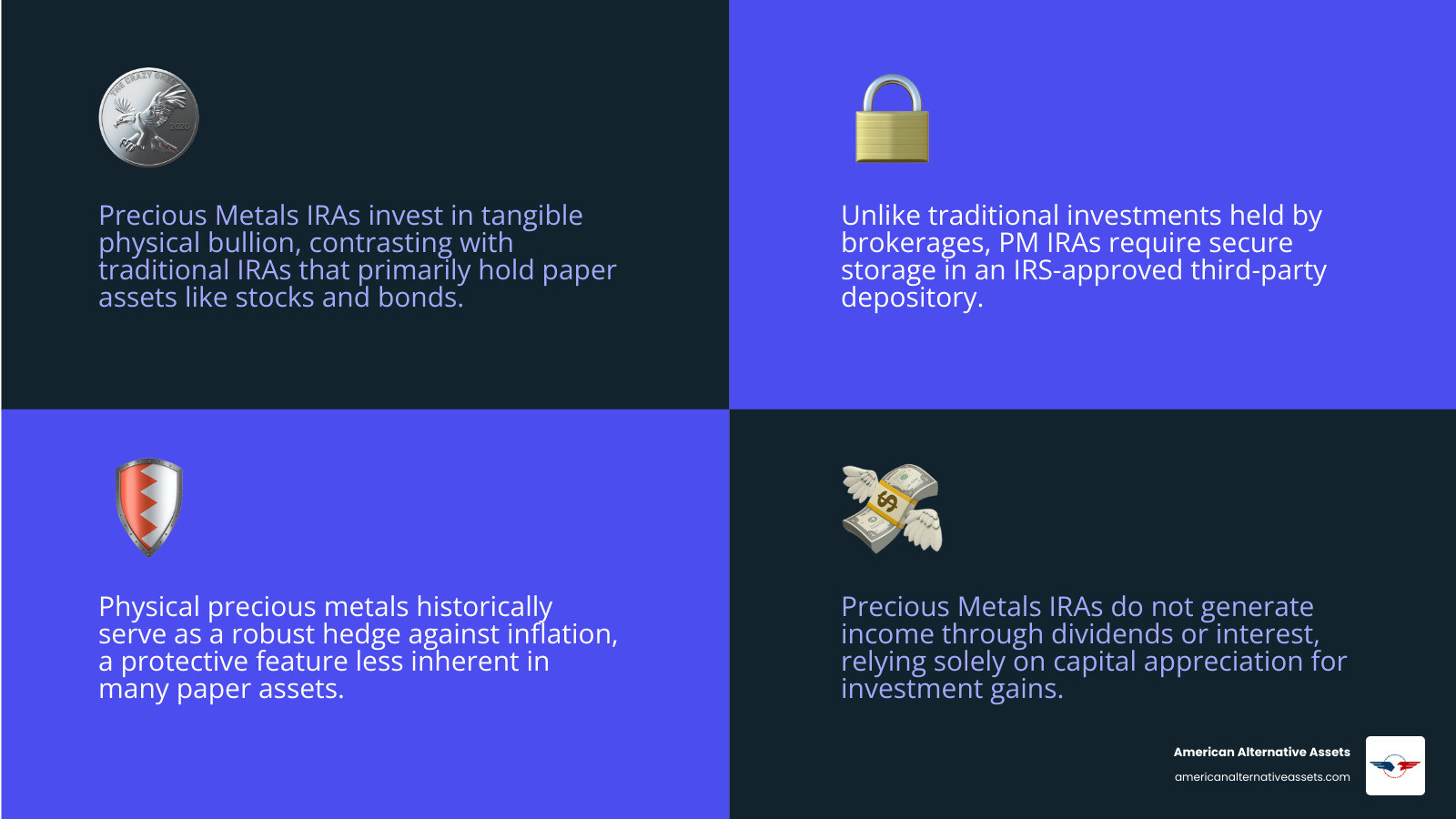
While most retirement advice centers on stocks and bonds, investing in precious metals IRA accounts offers a different path. This approach lets you hold actual physical gold, silver, platinum, and palladium in your portfolio, giving you something tangible in an increasingly digital world.
What is a Precious Metals IRA and How Does It Differ from a Traditional IRA?
A precious metals IRA is a type of Self-Directed IRA (SDIRA). While a traditional IRA typically limits you to paper assets like stocks and bonds, an SDIRA opens the door to alternative assets, including physical precious metals. The key difference is ownership: with a traditional IRA, you hold shares and certificates; with a precious metals IRA, you own actual metal bars and coins stored in a secure facility.
Both account types offer the same tax advantages (tax-deferred or tax-free growth), but only a precious metals IRA provides diversification beyond paper assets. When financial markets stumble, precious metals often move independently, adding a layer of protection and giving you more control over your investments. For a deeper dive, explore What is a Gold IRA? and the basics of a What is a Self-Directed IRA?.
What are the IRS-Approved Precious Metals?
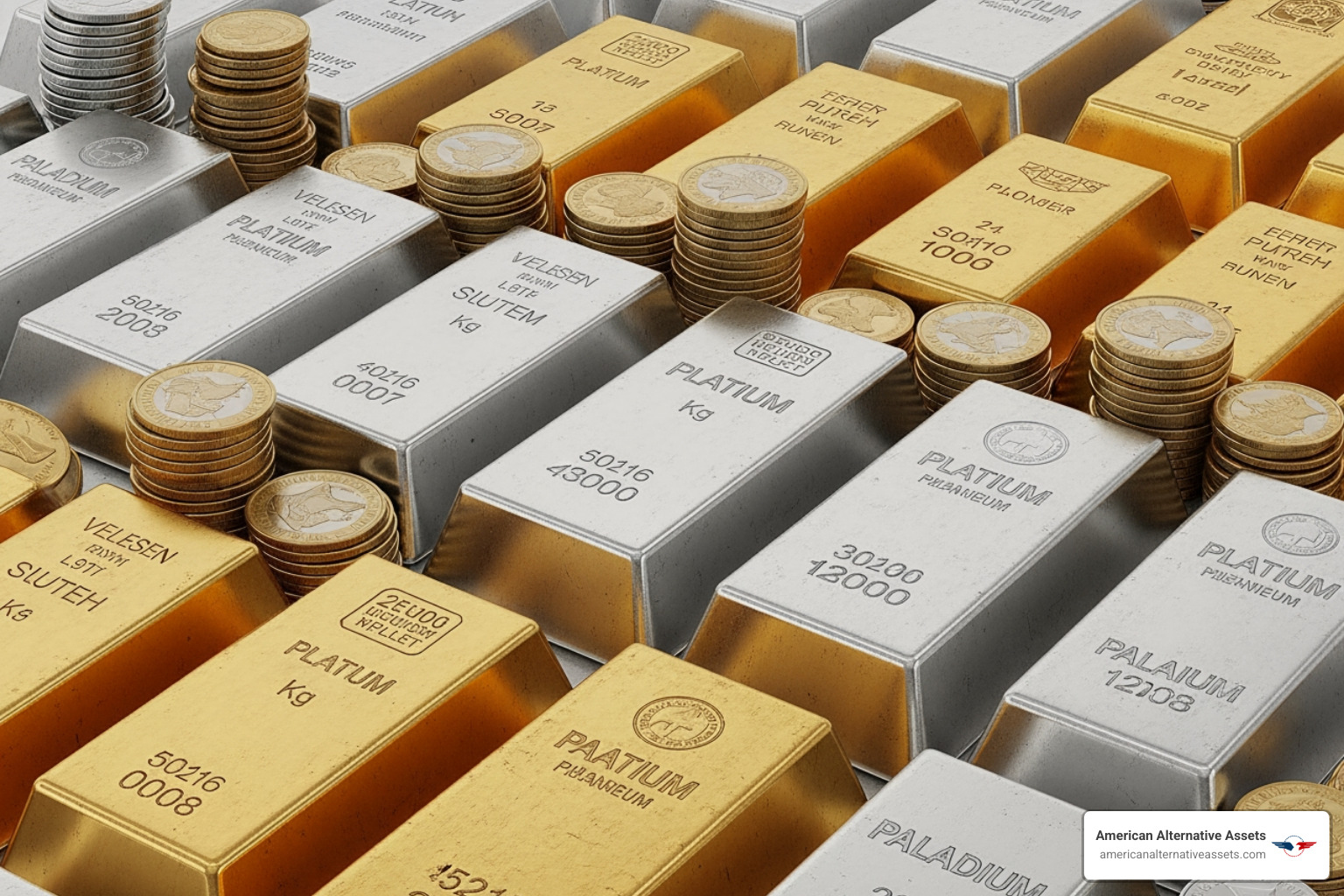
The IRS has strict purity standards to ensure you’re investing in legitimate bullion. Only four metals are approved: gold, silver, platinum, and palladium, each with specific fineness requirements.
- Gold must be at least .995 fine (99.5% pure). An exception is the American Gold Eagle coin, which is .9167 pure but specifically approved by the IRS.
- Silver must be .999 fine (99.9% pure).
- Platinum and palladium must be .9995 fine (99.95% pure).
Common IRS-approved products include American Eagle coins and Canadian Maple Leaf coins, along with various bars from recognized refiners. The IRS generally prohibits collectibles and jewelry in an IRA, focusing instead on investment-grade bullion. You can review the official IRS rules on collectibles for more details.
How Do Precious Metals IRAs Compare to Other Alternatives?
When investing in precious metals IRA accounts, it’s helpful to see how they stack up against other options.
Precious metals ETFs (Exchange-Traded Funds) track the price of a metal and are easy to trade. However, you own shares in a fund, not the physical metal itself. This introduces counterparty risk, as your investment is tied to the financial institution managing the fund.
Mining stocks are investments in companies that mine precious metals. Their value is affected by company performance, labor issues, and political instability, not just the metal’s price. This can lead to volatility that doesn’t always correlate with the metal’s value.
Physical precious metals IRAs offer direct ownership of tangible assets that exist outside the traditional financial system. This provides a hedge against systemic risks that paper-based investments, including metal-backed ETFs, may not fully address. For many investors, this deeper level of security and control is the primary appeal. To learn more, read our article Precious Metals IRA Myths Debunked: Separating Fact from Fiction.
The Pros and Cons of Investing in a Precious Metals IRA
Every investment has potential benefits and risks. When it comes to investing in precious metals IRA, understanding both sides helps you make an informed decision that aligns with your retirement goals. We believe in providing complete information so you can move forward with confidence.

The Advantages: Why Consider a Precious Metals IRA?
Many investors turn to precious metals IRAs for benefits that traditional paper assets cannot offer.
Diversification is a primary reason. Precious metals often move independently from stocks and bonds, which can reduce overall portfolio risk during market turbulence. Historically, they have also served as an inflation hedge, maintaining their value as the purchasing power of paper currency declines. This quality as a store of value and a tool for wealth preservation is rooted in their limited supply and enduring demand.
Furthermore, precious metals IRAs offer the same tax advantages as other retirement accounts. A Traditional IRA provides tax-deferred growth, while a Roth IRA offers tax-free growth and withdrawals. During times of geopolitical tension, metals often act as a safe haven, providing stability when other assets are volatile. Explore this further in Why Invest in a Gold IRA? and Geopolitical Tensions and Your Retirement: Why Precious Metals IRA Could Be Your Safety Net.
The Disadvantages and Risks of Investing in a Precious Metals IRA
It’s equally important to be aware of the challenges. Higher fees are a key consideration. Precious metals IRAs involve setup fees, annual custodian fees, and storage and insurance fees for the physical metals. These costs are necessary for security and compliance but impact overall returns.
Physical precious metals generate no income like dividends or interest; growth comes only from price appreciation. They also experience short-term price volatility. While liquidity is generally strong, converting physical metals to cash takes a few days, unlike selling stocks instantly. Finally, the industry has seen some bad actors, making it essential to work with a trusted company. The CFTC advisory on precious metals schemes offers guidance on what to avoid. For a balanced view, see our Gold IRA Pros and Cons.
Who Is a Precious Metals IRA Best Suited For?
This investment is not for everyone. Investing in precious metals IRA is best for:
- Long-term investors who see retirement planning as a marathon, not a sprint.
- Investors seeking diversification to balance a portfolio heavily weighted in stocks and bonds.
- Those concerned about economic stability, inflation, or currency devaluation.
- Retirees and pre-retirees focused on wealth preservation over aggressive growth.
It may not be ideal for those seeking regular income from their investments. Most advisors suggest a modest allocation, typically 5-10% of a portfolio, to gain the protective benefits without overexposure. For tips on discussing this with loved ones, see Navigating Family Discussions About Gold IRAs: What You Need to Know.
A Step-by-Step Guide to Investing in a Precious Metals IRA
Starting the journey of investing in precious metals IRA can feel complex, but we’re here to simplify it. At American Alternative Assets, we’ve helped countless families steer this process with confidence.
Step 1: Choose a Reputable Precious Metals IRA Company and Custodian
This first step is critical. You will work with two key partners: a precious metals dealer and an IRA custodian.
- The precious metals dealer (like American Alternative Assets) guides you in selecting and purchasing the gold, silver, platinum, or palladium for your IRA.
- The IRA custodian is an IRS-approved financial institution that manages your account, ensures compliance, and handles the administrative tasks.
When choosing your partners, perform due diligence. Check Better Business Bureau ratings, read customer reviews, and ask about their experience and fee structures. We encourage you to review our Precious Metals IRA Custodians Guide and Gold IRA Reviews to help you make an informed decision.
Step 2: Open and Fund Your Account
After selecting your partners, you’ll set up and fund your account. You’ll start by completing an account application with your custodian. Then, you will fund it using one of three main options:
- Direct contribution: Make annual contributions from your income, subject to IRS limits. For 2024, the limit is $7,000, or $8,000 if you are age 50 or older. See the IRS contribution limits for 2024.
- IRA to IRA transfer: Move funds directly from an existing IRA to your new precious metals IRA custodian. This is a tax-free and penalty-free process.
- 401(k) rollover: Move funds from a former employer’s plan (like a 401(k) or 403(b)) into your new IRA. This is common for those who have left a job or reached age 59 1/2. A direct rollover is the smoothest method.
Our team can assist you through the funding process. To understand how it all fits together, read How Does a Gold IRA Work?.
Step 3: Select and Purchase Your Precious Metals
With your account funded, you can now select the metals for your portfolio. Your account can hold gold, silver, platinum, and palladium, as long as they meet IRS fineness requirements. You can choose between bars and coins. Bars often offer more metal for your money, while coins like the American Eagle are highly recognizable.
Your precious metals dealer will help you understand your options and coordinate with your custodian to execute the purchase using the funds in your IRA. This ensures the transaction remains within your tax-advantaged account. For more insights, visit Gold IRA Investment.
Step 4: Secure Your Investment in an Approved Depository
This final step is non-negotiable for IRS compliance. All physical precious metals in an IRA must be stored in an IRS-approved, third-party depository. You cannot store them at home. Taking physical possession is treated as a taxable distribution, which could trigger taxes and penalties.
Approved depositories are highly secure, insured facilities like the Delaware Depository and Brink’s. You can typically choose between segregated storage (your specific metals are kept separate) or commingled storage (your metals are pooled with others of the same type). Your assets are fully insured during transit and storage. We work exclusively with leading depositories to ensure the highest level of security. Learn more at What are Depository Accounts and How Do They Work for Gold Storage?.
Key Financial Considerations: Fees, Storage, and Taxes
Understanding the full financial picture of investing in precious metals IRA is crucial for effective planning. The costs, storage rules, and tax implications all play a role in your long-term strategy. We believe in complete transparency so you can avoid surprises.
Understanding the Associated Fees
Precious metals IRAs typically have higher costs than standard IRAs due to the logistics of managing physical assets. Key fees include:
- Setup fees: A one-time charge for opening your account.
- Annual administration fees: Paid to your custodian for managing the account and ensuring IRS compliance.
- Storage and insurance fees: An annual cost paid to the depository for securely storing and insuring your physical metals.
- Transaction fees/Dealer markups: The spread included in the price when you buy or sell metals.
We recommend requesting a complete written breakdown of all fees from your dealer and custodian before committing. These fees are the price of holding tangible assets that can offer unique protection for your retirement wealth.
The Prohibition of Home Storage
There is no ambiguity on this point: you cannot store your IRA precious metals at home. IRS regulations mandate that all IRA assets be held by an approved third-party custodian. Taking physical possession is treated as a taxable distribution, meaning the value of the metals becomes taxable income. If you are under age 59 1/2, you would also face a 10% early withdrawal penalty.
Your metals must be stored in approved depositories, which are specialized, high-security facilities. Be wary of companies promoting “home storage IRAs,” as these arrangements can expose you to significant legal and financial risks.
Tax Implications and Withdrawal Rules
The tax treatment of a precious metals IRA mirrors that of a standard IRA.
- A Traditional Precious Metals IRA may allow for tax-deductible contributions, and assets grow tax-deferred. Withdrawals in retirement are taxed as ordinary income.
- A Roth Precious Metals IRA is funded with after-tax dollars, but investments grow tax-free, and qualified withdrawals in retirement are also tax-free.
Required Minimum Distributions (RMDs) apply to Traditional IRAs starting at age 73. Roth IRAs have no RMDs for the original owner. Early withdrawal penalties (an additional 10% tax) generally apply to distributions taken before age 59 1/2. We always recommend consulting with a qualified tax professional for advice specific to your situation. For more details, visit IRA Withdrawal Rules.
Frequently Asked Questions about Precious Metals IRAs
We encounter many questions from individuals considering investing in precious metals IRA. Here are answers to some of the most common inquiries.
Can I store the precious metals from my IRA at home?
No. IRS regulations explicitly prohibit this. All precious metals held within an IRA must be stored in an IRS-approved third-party depository. Taking physical possession is considered a taxable distribution by the IRS, which can trigger immediate income taxes and a 10% early withdrawal penalty if you are under age 59 1/2.
What is the minimum investment required to open a precious metals IRA?
The minimum investment varies by company. Some firms may require a significant initial investment, while others offer lower entry points. It is important to ask about minimums and all associated fees when comparing providers to understand the total cost.
How do I take a distribution from my precious metals IRA?
When you are ready to take distributions (typically at age 59 1/2 or older), you have two main options:
- In-Kind Distribution: Receive the physical precious metals themselves, shipped to you from the depository.
- Liquidate to Cash: Instruct your custodian to sell the metals and distribute the cash proceeds to you.
Your custodian will facilitate either process. Standard IRA distribution rules and taxes apply. It is always best to consult with a financial or tax advisor before taking a distribution.
Conclusion: Taking the Next Step Toward a Diversified Retirement
Investing in precious metals IRA is about taking control of your financial future in a tangible way. It offers a method to hold something real, an asset that exists outside the paper-based financial system.
Throughout this guide, we’ve covered what a precious metals IRA is, its pros and cons, and the steps to get started. We’ve discussed the benefits, like diversification and inflation protection, as well as the realities of fees and storage requirements. This balanced perspective is essential when making decisions about your retirement.
At American Alternative Assets, we’ve built our reputation on treating clients like family. Our white-glove service means we are with you at every step, from funding and purchasing to securing your metals. We believe in transparency, trust, and ethical practices. We will never pressure you or paint unrealistic pictures of guaranteed returns.
If you value wealth preservation and want to protect what you’ve worked hard to build, a precious metals IRA may be worth considering. It is a proactive step toward preparing for an uncertain economic future.
The journey toward a more diversified retirement begins with education. We invite you to take that next step with confidence, knowing you have a partner dedicated to your financial well-being.
This article is for informational purposes only and does not constitute financial advice. Please consult your financial advisor before making investment decisions.
Learn more about secure storage at an approved depository.
Investing in precious metals involves risk. Past performance does not guarantee future results.