







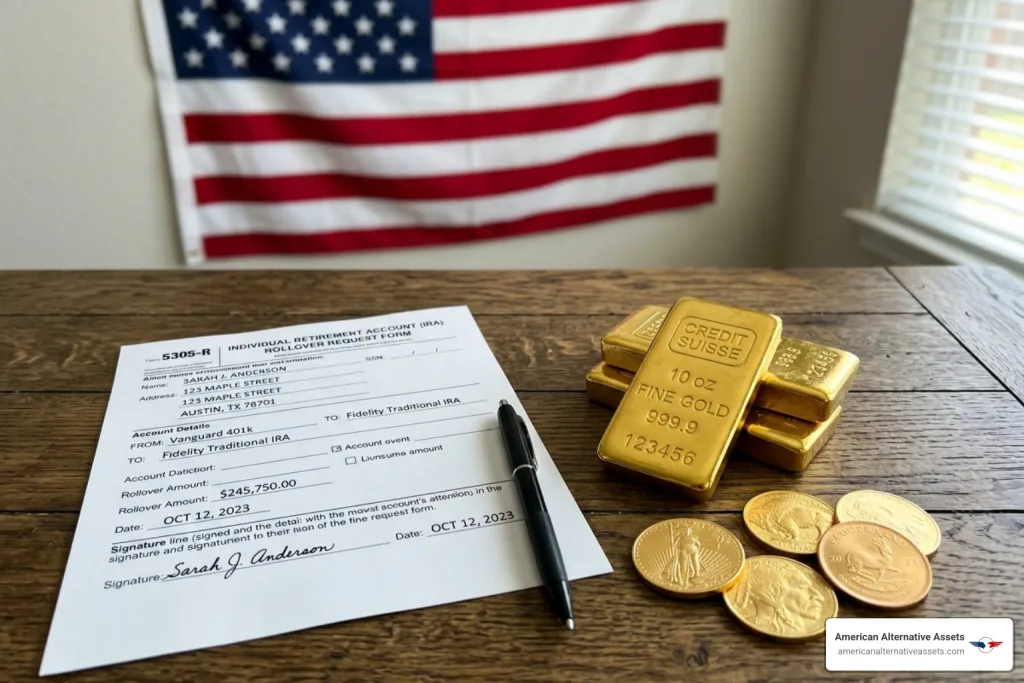
Why Investors Are Choosing an IRA Rollover to Gold Now
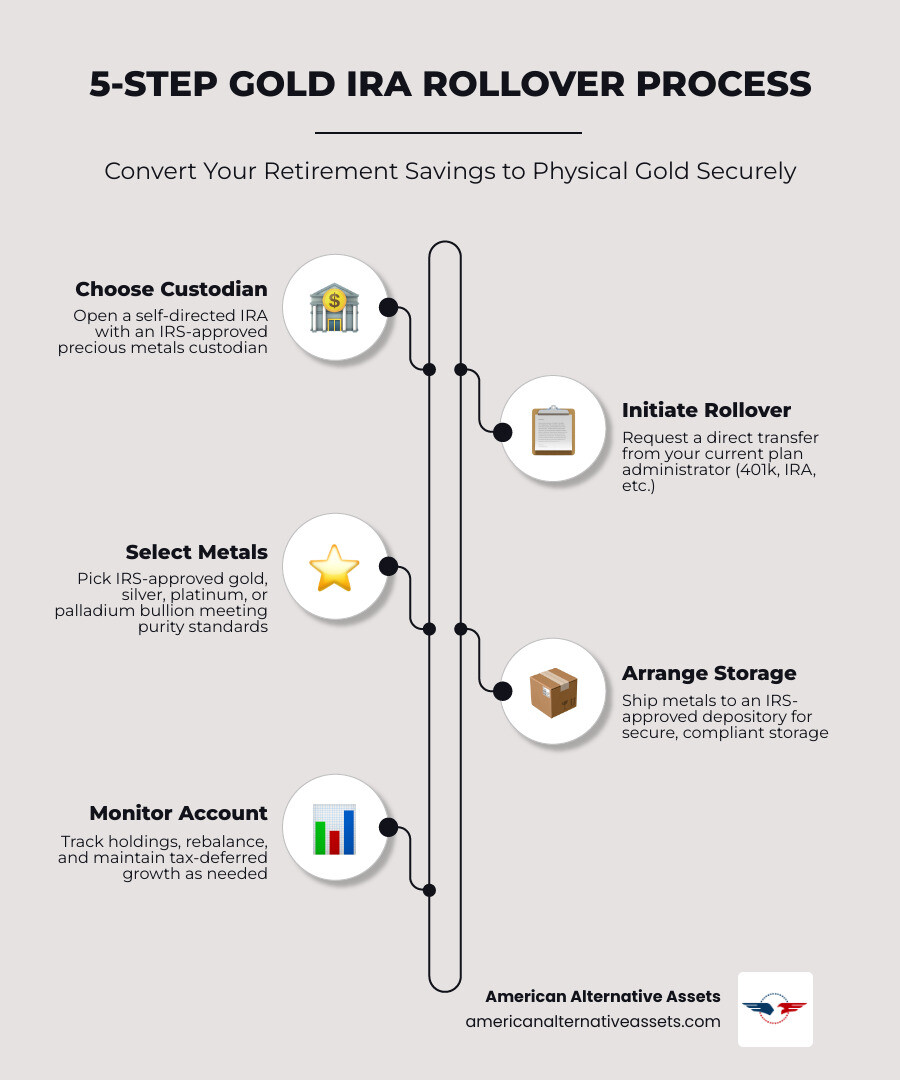
If you’re considering an IRA rollover to gold now, here is what you need to know to get started:
| Step | What Happens |
|---|---|
| 1. Choose a custodian | Open a self-directed IRA with an IRS-approved precious metals custodian |
| 2. Initiate the rollover | Contact your current plan administrator and request a direct transfer |
| 3. Select your metals | Choose IRS-approved gold, silver, platinum, or palladium bullion |
| 4. Arrange storage | Metals are shipped to an IRS-approved depository on your behalf |
| 5. Monitor your account | Track your holdings and rebalance as needed |
Key rule: A direct rollover moves funds straight from your existing retirement account to your new gold IRA, with no taxes and no penalties. You have 60 days to complete an indirect rollover if you receive the funds yourself.
Since 1971, the U.S. dollar has lost roughly 87% of its purchasing power, according to Bureau of Labor Statistics data. For many retirement savers, that is not a distant economic fact. It is a quiet threat to the savings they spent decades building.
At the same time, traditional retirement accounts are often heavily concentrated in stocks and bonds. When markets fall, those portfolios fall with them. There is no floor.
That is why more Americans are exploring whether physical gold belongs in their retirement strategy. Not to replace everything they have built, but to add a layer of protection that does not depend on any single market, currency, or institution.
A gold IRA rollover makes that possible. It allows you to move funds from an existing retirement account, such as a 401(k), Traditional IRA, or SEP IRA, into a self-directed IRA that holds physical precious metals. The process follows IRS rules, and when done correctly, it does not trigger taxes or early withdrawal penalties.
This guide walks you through exactly how it works.
I’m Shanon Davis, founder of American Alternative Assets, and my experience guiding investors through the IRA rollover to gold now process grew directly from watching the 2008 financial crisis expose how fragile paper-based retirement systems can be. Over the years, I’ve helped ordinary Americans move their retirement savings into tangible assets that don’t depend on anyone else’s promises.
This article is for informational purposes only and does not constitute financial advice. Please consult your financial advisor before making investment decisions. Investing in precious metals involves risk. Past performance does not guarantee future results.
Understanding the IRA Rollover to Gold Now
When we talk about an IRA rollover to gold now, we are describing a specific financial move: moving wealth from “paper” retirement accounts into a Gold IRA. Unlike a standard IRA held at a big-box brokerage, which limits you to stocks, bonds, and mutual funds, a gold IRA is a “Self-Directed” IRA (SDIRA).

This structure gives you the legal authority to own tangible assets. Instead of owning a digital ticker symbol that represents gold, you own the actual, physical bars and coins. This distinction is vital. In an era of digital bank failures and high-frequency trading, there is a profound sense of security in knowing your retirement is backed by something you can hold in your hand. According to the Gold IRA Rollover Guide 2026, this shift toward tangibility has become a cornerstone for those looking to “de-risk” their later years.
Why a Physical IRA Rollover to Gold Now Beats Paper Assets
Many investors ask us why they shouldn’t just buy a gold ETF or mining stocks. While those “paper” assets track the price of gold, they carry risks that physical gold does not.
First, there is counterparty risk. If you own a gold ETF, you own a contract. You are relying on the fund manager, the exchange, and the banking system to remain solvent and honest. If the system glitches, your “gold” is just a line of code. Physical gold in a Your Guide to Gold and Platinum IRA Rollovers has no counterparty. It is a private, tangible asset that has maintained value for thousands of years.
Furthermore, mining stocks are businesses. They are subject to management failures, environmental lawsuits, and labor strikes. Physical gold doesn’t have a CEO or a balance sheet to worry about. As the dollar continues its long-term devaluation, physical gold remains the ultimate inflation hedge, preserving the purchasing power of your hard-earned savings.
Eligible Retirement Accounts for Diversification
You might be surprised by how many types of accounts can be moved into a precious metals IRA. We frequently help clients transition funds from:
- Traditional 401(k)s: Usually from a former employer.
- Roth IRAs: For tax-free growth and distributions.
- SEP IRAs: Ideal for small business owners and the self-employed.
- 403(b) and 457(b) plans: Common for teachers and government employees.
- TSP (Thrift Savings Plan): If you are a veteran or federal employee, a Thrift Savings Plan Rollover is a standard way to diversify out of the government’s default funds.
IRS Compliance and Rollover Rules
The IRS is quite strict about how you move money. If you don’t follow the “playbook,” you could end up with a massive tax bill. One of the most important things to understand is the difference between a transfer and a rollover.
The IRS allows you to move funds as often as you like via direct “trustee-to-trustee” transfers. However, if you choose an indirect rollover (where the check is made out to you), you are subject to the “one-rollover-per-year” limit. Violating this is one of the Common gold IRA rollover mistakes and how to avoid them.
Executing Your IRA Rollover to Gold Now: Direct vs. Indirect
We always recommend the direct rollover or trustee-to-trustee transfer. In this scenario, the money moves from your current custodian directly to your new gold IRA custodian. You never touch the money, which means the IRS never sees it as a “distribution.” There is no tax withholding, and the paperwork is streamlined.
An indirect rollover is much riskier. Your current plan administrator will typically withhold 20% for federal taxes. You then have exactly 60 days to deposit the full 100% of the original amount into your new IRA. If you don’t have the cash on hand to cover that 20% withholding out of pocket, the IRS considers that missing 20% a distribution, hitting you with taxes and a potential 10% early withdrawal penalty. To Unlock Your Retirement: The Simple Steps to Transferring Your 401k to an IRA, direct is almost always the smarter path.
Purity Standards for IRS Approved Metals
You cannot simply put any gold coin into an IRA. The IRS has strict “fineness” or purity standards to ensure the quality of the assets held in retirement accounts. To How to Invest in Precious Metals with a Self-Directed IRA, the metals must meet these minimums:
- Gold: 99.5% purity (0.995 fineness).
- Silver: 99.9% purity (0.999 fineness).
- Platinum and Palladium: 99.95% purity (0.9995 fineness).
There is one notable exception: the American Eagle gold coin. Even though it is 22-karat (91.67% pure), the IRS specifically allows it in IRAs because it is a minted legal tender of the United States. However, most other “collectible” or “numismatic” coins are strictly prohibited.
Step-by-Step Process for a Successful Transition
Moving your retirement into gold doesn’t have to be a headache. We break it down into a simple, white-glove process.
- Choose a Custodian: You need an IRS-approved custodian that specializes in self-directed accounts. Standard banks usually won’t do this.
- Open Your Account: This usually takes 1 to 3 business days.
- Initiate the Transfer: We help you fill out the paperwork to tell your current 401(k) or IRA provider to send the funds over.
- Select Your Metals: Once the funds land in your new account, you decide which gold or silver bars and coins you want to purchase.
- Secure Shipment: Your custodian pays the dealer, and the metals are shipped securely to a depository.
Our From 401k to Gold IRA: A Seamless Rollover Guide provides more granular detail on each of these steps for those who want to dive deep into the logistics.
Finalizing Your IRA Rollover to Gold Now with Secure Storage
One of the most frequent questions we get is, “Can I keep the gold at my house?” The short answer is: No. The IRS requires that IRA-owned physical metals be held by a qualified third party in an approved depository. If you take the gold home, the IRS treats it as a full distribution of your account, meaning you’ll owe income taxes and penalties on the entire value.
Instead, your metals are stored in high-security vaults like Delaware Depository or Brink’s Global Services. You can choose between:
- Commingled Storage: Your metals are stored in a bulk space with metals of the same type from other investors.
- Segregated Storage: Your metals are kept in a separate, individual lockbox or vault space.
The Gold IRA timeline: How long setup takes often depends on how quickly your current plan administrator releases the funds, but once the money is there, the purchase and storage happen very quickly.
Avoiding Common Pitfalls and Choosing a Partner
The world of precious metals can sometimes feel overwhelming. To protect yourself, stay away from “home storage” schemes or companies that push “rare” collectible coins with massive markups. These are red flags that can lead to IRS audits and poor investment returns.
At American Alternative Assets, we believe in a relationship-first approach. We aren’t here for a one-time transaction; we want to help you protect your family’s legacy. Whether you are interested in a gold IRA or a Silver IRA, we focus on transparency, ethical practices, and real privacy.
Frequently Asked Questions about Gold Rollovers
Can I roll over my 401k while still employed?
Yes, in many cases. This is known as an “in-service distribution.” Many plans allow employees over the age of 59.5 to roll over a portion of their 401(k) into an IRA while they are still working. You’ll need to check with your plan administrator for their specific rules.
What are the tax implications of a gold rollover?
If you perform a direct transfer from a Traditional 401(k) to a Traditional Gold IRA, there are no tax implications. It is a tax-neutral event. If you convert a Traditional 401(k) to a Roth Gold IRA, you will owe taxes on the amount converted, but all future growth and distributions will be tax-free.
How long does the rollover process take?
Generally, the entire process takes between two to four weeks. The “bottleneck” is usually your current retirement plan provider. Some are quick to send funds, while others may take up to 10 business days to process the request.
Conclusion
The decision to execute an IRA rollover to gold now is often driven by a desire for peace of mind. In a world of fluctuating currencies and unpredictable markets, physical gold offers a sense of permanence. It is a proactive step toward financial preparedness.
At American Alternative Assets, we pride ourselves on providing a white-glove service that takes the “nervous” out of the nervous investor. We handle the heavy lifting, ensuring your transition is compliant, secure, and tailored to your goals.
Ready to take control? Secure your future today and discover why physical gold remains the ultimate hedge for the modern era.
This article is for informational purposes only and does not constitute financial advice. Please consult your financial advisor before making investment decisions. Investing in precious metals involves risk. Past performance does not guarantee future results.