








Why More Retirement Savers Are Turning to Physical Gold
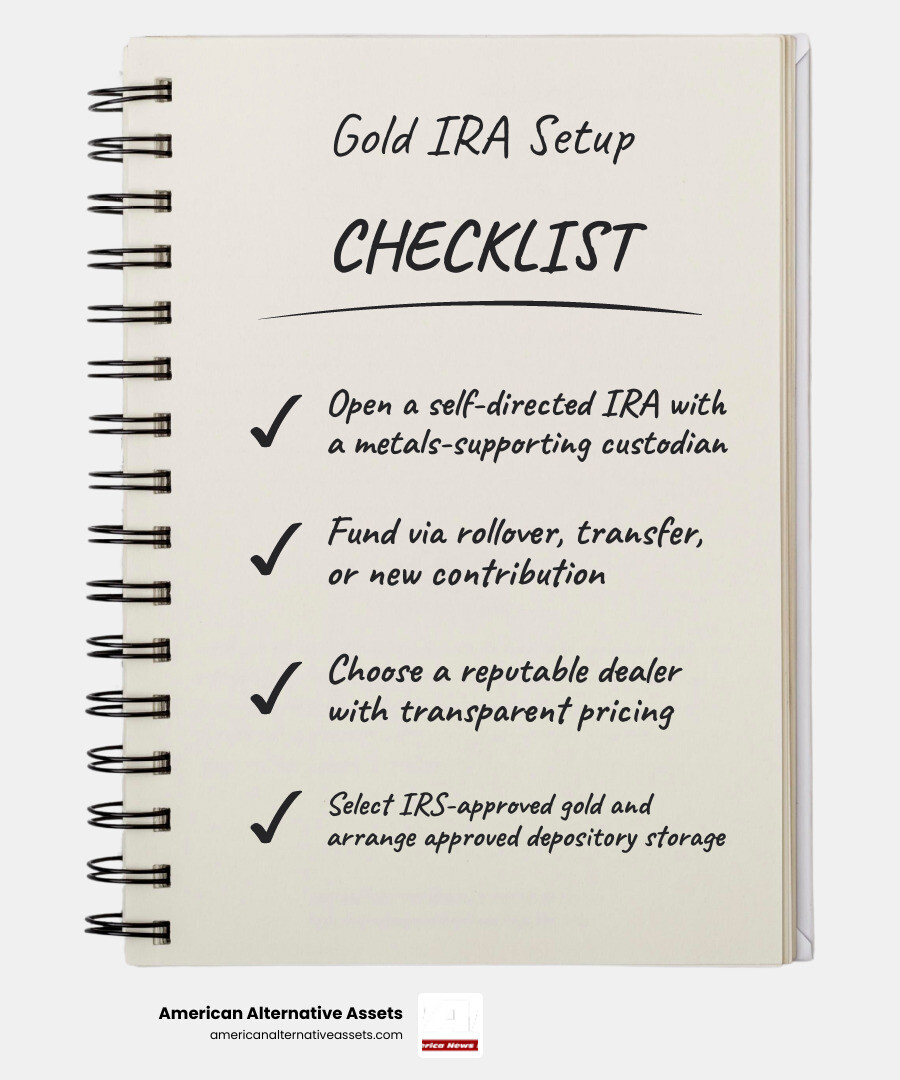
How to buy gold for IRA accounts is simpler than most people expect, and it can be done in five straightforward steps.
Here is a quick overview:
- Open a self-directed IRA with a custodian that supports physical precious metals
- Fund your account via a rollover, direct transfer, or new contribution
- Choose a reputable precious metals dealer with transparent pricing
- Select IRS-approved gold coins or bars that meet purity standards
- Arrange secure storage at an IRS-approved depository
That is the core process. The sections below walk through each step in detail.
Economic uncertainty has a way of focusing the mind. When inflation rises, markets swing, and paper assets feel increasingly fragile, many retirement savers start asking a simple question: Is there something more solid I can hold?
Physical gold has served as a store of value for thousands of years. Today, it can be held inside a tax-advantaged retirement account, giving investors both the durability of a tangible asset and the familiar benefits of an IRA structure.
Gold prices reached roughly $3,200 per ounce in 2025, a 44% yearly increase that outpaced the S&P 500. Analysts project prices between $3,000 and $3,700 by mid-2026, driven by inflation concerns and global trade uncertainty. That kind of performance has drawn serious attention from retirement investors who want more than stocks and bonds in their portfolios.
Most financial experts suggest keeping precious metals at around 5-10% of your total retirement savings as part of a balanced, diversified approach. Gold is widely seen as a hedge during periods of economic uncertainty, not a guarantee of returns.
This article is for informational purposes only and does not constitute financial advice. Please consult your financial advisor before making investment decisions.
I’m Shanon Davis, founder of American Alternative Assets, and after watching the 2008 financial crisis expose how fragile paper-based systems can be, I dedicated my career to helping everyday Americans understand how to buy gold for IRA accounts in a safe, compliant, and straightforward way. Let’s walk through exactly how it works.
What is a Gold IRA and Why Choose Physical Metals?
A physical gold IRA is a specialized type of self-directed Individual Retirement Account. While standard retirement accounts limit you to paper-based assets like mutual funds, stocks, and bonds, a self-directed IRA gives you the freedom to own real, physical assets. This includes physical gold, silver, platinum, and palladium bullion.
But why should you choose physical metals over the digital alternatives?
When you invest in physical gold, you are acquiring a tangible asset with no counterparty risk. Unlike paper assets, physical gold cannot go bankrupt, cannot be devalued by a corporate board, and does not rely on a financial institution’s promise to pay. It is a physical shield for your wealth, sitting securely in a vault.
To learn more about the foundational mechanics, you can read our guide on How Does a Gold IRA Work? or check out our main page on the Gold IRA to see how physical metals fit into your long-term plans.
Historically, physical gold has served as an exceptional inflation hedge and a reliable store of value during times of geopolitical tension. When the purchasing power of paper currency declines, the intrinsic value of physical gold typically shines. By placing physical gold inside a retirement account, you combine this age-old protective power with the tax advantages of an IRA, such as tax-deferred growth in a Traditional IRA or tax-free growth in a Roth IRA.
How to Buy Gold for IRA in 5 Simple Steps
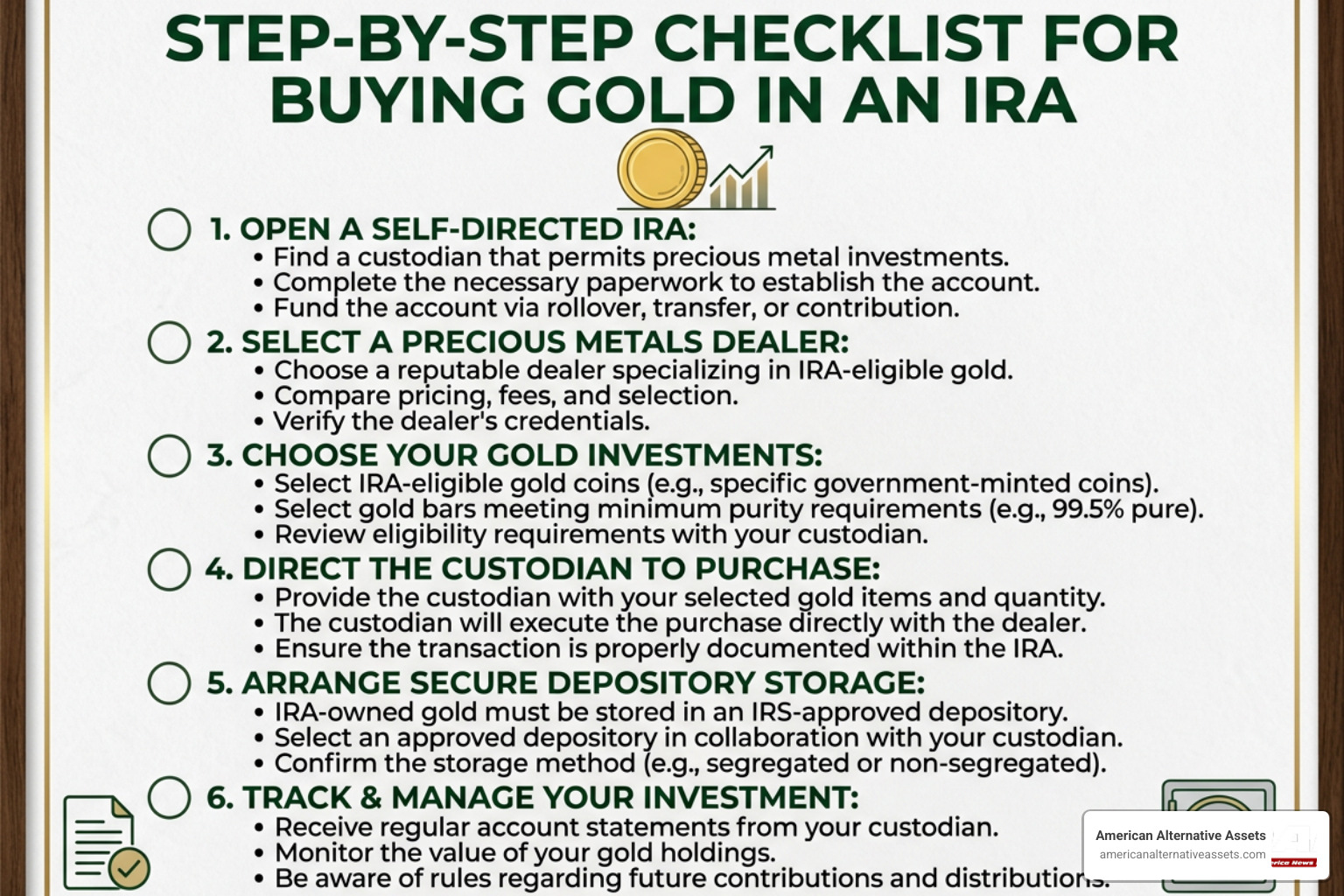
Opening a physical precious metals account does not have to be a complicated chore. By following a structured path, you can transition a portion of your paper-reliant retirement funds into physical gold without the administrative headaches.
To help you get started, we have outlined the entire process below. If you want a comprehensive look at the setup, you can read Your Golden Ticket: The Easy Way to Set Up a Gold IRA for a deep dive into the mechanics.
Step 1: Open a Self-Directed Account and Learn How to Buy Gold for IRA
The first step is selecting an IRS-approved custodian that specializes in self-directed accounts. Standard brokerages typically do not offer physical gold options because they are built to sell paper assets like stocks and mutual funds.
A self-directed custodian acts as the neutral administrator of your account. They handle the official reporting, execute your transaction requests, and ensure your account remains compliant with federal tax laws. When choosing a custodian, it is wise to look for established institutions with a track record of reliability. Organizations like Equity Trust Company are widely utilized in the industry to handle self-directed assets, which you can read about in this guide on How to Invest in Gold and Other Metals with an IRA .
During this phase, you will fill out the account application, establish your login credentials, and review the IRS IRA Guidelines to ensure you understand your rights and responsibilities as an account owner.
Step 2: Fund Your Account via Rollover or Transfer
Once your self-directed account is open, you need to fund it. There are three primary ways to do this:
- Direct Transfer: This is the most common method. If you have an existing Traditional or Roth IRA, you can request a direct transfer to your new self-directed IRA. The funds move directly between the custodians, meaning you never touch the money and face zero tax consequences.
- Rollover: If you have an active or former employer-sponsored plan, such as a 401k, 403b, or TSP, you can roll those funds into your new IRA. A direct rollover moves the money directly to your new account. An indirect rollover puts the funds in your hands first, meaning you must deposit them into your new IRA within 60 days to avoid taxes and penalties.
- Annual Contributions: You can also fund your account through yearly cash contributions. For 2026, the contribution limit is $7,500 for individuals under 50, and $8,600 for those over 50. If you are self-employed, a SEP Gold IRA allows contributions up to 25% of your net income or $70,000, whichever is lower.
Moving funds can seem intimidating, but we have designed the process to be as smooth as possible. For a step-by-step breakdown of how to move your funds without penalties, read How to Buy Gold for IRA Account Without the Headache.
Step 3: Choose a Reputable Precious Metals Dealer
Your custodian manages the account, but they do not sell the gold. For that, you need to partner with an experienced precious metals dealer.
This is where our team at American Alternative Assets comes in. Based in Woodland Hills, California, we specialize in providing a white-glove, relationship-first service. We believe in absolute transparency and ethical practices, ensuring you have a clear understanding of what you are purchasing.
When evaluating dealers, it is helpful to look at independent reviews, such as those found on The best gold IRA companies of June 2026 – CNBC . Working with a dealer that prioritizes education will help you make informed decisions. You can learn more about our approach on our American Alternative Assets Gold IRA page.
For clients located in California, it is also helpful to be aware of state-specific guidelines regarding precious metals purchases.
Step 4: Select Eligible Metals and Execute the Purchase to Learn How to Buy Gold for IRA
Once your account is funded and you have selected your dealer, you can choose the physical metals you want to buy.
The IRS does not allow you to put just any gold coin or bar into your retirement account. The metals must meet strict purity standards, which we will detail in the next section. Generally, you will choose between high-purity gold bullion bars and government-minted coins.
Once you make your selection, you will lock in the pricing with your dealer. The dealer will then send a Direction of Investment form to your custodian. Your custodian will pay the dealer using the funds in your IRA, and the dealer will prepare the physical metals for secure shipment. For a detailed list of eligible products, see The Definitive Guide to Buying Gold for IRA.
Step 5: Arrange Secure Storage in an Approved Depository
You cannot take physical possession of your IRA gold. If you store your retirement gold in a personal safe or a home vault, the IRS will treat it as a full distribution, meaning you could face immediate taxes and early withdrawal penalties.
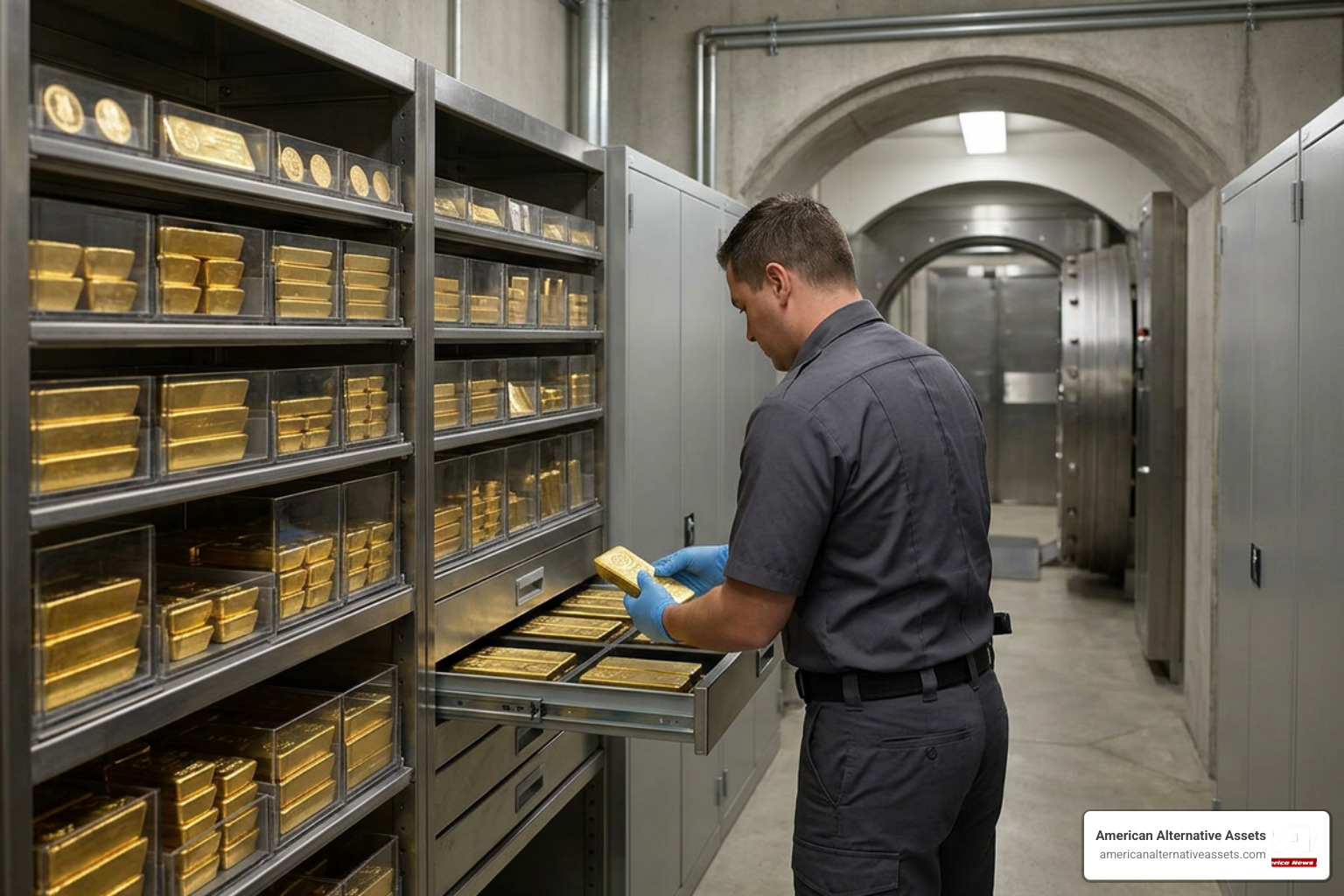
Instead, your physical gold must be shipped directly from the dealer to an IRS-approved depository. These are highly secure, specialized vaulting facilities that feature 24/7 monitoring, armed guards, and advanced physical security systems.
You can choose between commingled storage, where your metals are stored alongside the metals of other investors, or segregated storage, where your physical gold is kept in its own private, locked space. Once the depository receives and verifies your shipment, they will send a confirmation receipt to your custodian. For more details on storage options, check out our Gold IRA Guide.
IRS Rules, Purity Standards, and Storage Requirements
To preserve the tax-advantaged status of your retirement savings, you must adhere strictly to the rules established by the IRS. The regulatory framework focuses on two main areas: the purity of the metals and how they are stored.
The IRS sets minimum fineness standards for all precious metals held in an IRA:
- Gold: Must be at least .995 pure (99.5% pure)
- Silver: Must be at least .999 pure (99.9% pure)
- Platinum: Must be at least .9995 pure (99.95% pure)
- Palladium: Must be at least .9995 pure (99.95% pure)
There is one notable exception to the gold purity rule. The American Gold Eagle coin, which is minted by the U.S. government, has a purity of .9167 (91.67% pure). Despite falling below the .995 standard, the IRS explicitly permits the American Gold Eagle to be held in physical gold IRAs.
In addition to purity, the IRS strictly prohibits holding collectibles or numismatic coins in an IRA. Even if a rare coin contains pure gold, it cannot be included if its value is driven by historical rarity rather than its raw metal weight. For official guidance, you can consult the IRS Collectibles Guide.
Finally, the physical metals must be stored in an approved depository from day one. There are no legal exceptions that allow for personal home storage of IRA gold. Attempting to bypass this rule can lead to severe financial penalties and the loss of your account’s tax-deferred status.
Physical Gold vs. Paper Gold: Why Tangible Assets Win
When considering gold for your retirement, you might encounter paper-based alternatives, such as gold Exchange-Traded Funds (ETFs), mutual funds, or mining stocks. However, these paper assets carry distinct risks that do not apply to physical, tangible gold.
Paper gold investments are essentially financial contracts. When you buy a gold ETF, you do not own physical gold, you own a share of a trust that tracks the price of gold. This introduces counterparty risk. If the fund management company faces legal issues, operational failures, or bankruptcy, your investment could be severely impacted. Furthermore, some ETFs are settled in cash rather than physical metal, meaning you can never take delivery of the underlying gold.
Gold mining stocks carry company-specific risks. A mining company’s stock price is not just tied to the price of gold, it is also heavily influenced by labor disputes, environmental regulations, corporate management decisions, and the company’s debt levels. It is entirely possible for the price of gold to rise while a specific mining stock falls due to operational issues.
Physical gold in a self-directed IRA avoids these vulnerabilities. You own real, physical wealth that is stored securely on your behalf.
Here is a direct comparison of how physical gold IRAs stack up against paper-based gold investments:
| Feature | Physical Gold IRA | Gold ETFs / Mutual Funds | Gold Mining Stocks |
|---|---|---|---|
| Direct Ownership | Yes, you own physical coins and bars | No, you own paper shares or contracts | No, you own equity in a corporation |
| Counterparty Risk | None, the asset has intrinsic value | High, relies on fund managers and custodians | High, relies on corporate performance |
| Systemic Market Risk | Low, gold operates independently of Wall Street | Moderate, subject to brokerage and fund liquidations | High, moves with the broader stock market |
| Physical Delivery Option | Yes, you can take physical delivery at distribution | No, typically settled only in cash | No, equity shares only |
Frequently Asked Questions
Can I store my Gold IRA metals at home?
No. The IRS strictly prohibits storing precious metals held in an IRA at your home, in a personal safe, or in a local bank safe deposit box. All IRA-owned physical metals must be maintained by an approved custodian and stored in an IRS-compliant depository. Storing these metals at home will be treated as an unauthorized distribution, resulting in immediate taxation and potential early withdrawal penalties.
What are the contribution limits for a Gold IRA in 2026?
For the 2026 tax year, the annual contribution limit for Traditional and Roth IRAs is $7,500 for individuals under the age of 50. If you are age 50 or older, you can make an additional catch-up contribution of $1,100, bringing your total limit to $8,600. If you are utilizing a SEP IRA, the contribution limit is up to 25% of your net self-employment income, capped at a maximum of $70,000.
How long does it take to set up and fund a Gold IRA?
The entire process generally takes between two to four weeks. Opening the self-directed account itself is quick, often completed within a few business days. The funding phase takes the most time, as transferring funds from an existing custodian or rolling over a 401k typically takes one to three weeks depending on the responsiveness of your current financial institution. Once funded, purchasing and shipping the metals to the depository takes about one week.
Conclusion
Taking control of your retirement security requires a proactive approach. When paper assets face volatility and economic uncertainty looms, physical precious metals offer a time-tested path to diversification and wealth preservation.
At American Alternative Assets, we are committed to helping you navigate the process of buying physical gold for your IRA with ease. Operating out of Woodland Hills, California, we pride ourselves on delivering a white-glove, relationship-first service. We focus on trust, transparency, and education, ensuring you have the support you need at every step of your precious metals journey.
If you are ready to take the next step toward securing your retirement savings with physical assets, we are here to help. You can learn more about protecting your metals in premier facilities by reading about how to Secure your retirement with Delaware Depository storage. Contact us today to discuss your goals and begin building a more resilient financial future.
This article is for informational purposes only and does not constitute financial advice. Please consult your financial advisor before making investment decisions.
Investing in precious metals involves risk. Past performance does not guarantee future results.