








Investing in a Gold IRA: 2025 Secure Growth
Why Investing in a Gold IRA Matters for Your Retirement Security
Investing in a gold ira allows you to hold physical precious metals like gold, silver, platinum, and palladium within a tax-advantaged retirement account. Here’s what you need to know:
Key Takeaways:
- What it is: A Gold IRA is a self-directed IRA that holds physical precious metals instead of paper assets like stocks and bonds
- How it works: You open an account with a specialized custodian, fund it through contributions or rollovers, and purchase IRS-approved metals stored in secure depositories
- Main benefits: Portfolio diversification, protection against inflation, tax advantages (traditional or Roth), and ownership of tangible assets
- IRS requirements: Gold must be .995 pure or higher, silver .999 pure, and metals must be stored with an approved third-party custodian
- Getting started: Choose a reputable custodian, fund your account (up to $7,000 annually in 2024, or $8,000 if 50+), and select your physical metals
When my grandfather handed me a silver Morgan coin at age nine and said, “This is real money,” I didn’t understand. But decades later, after working in venture capital and watching the 2008 crash wipe out families who trusted paper assets, it finally clicked. The financial system is fragile, and physical precious metals offer something different: real value you can hold.
Many Americans feel the same unease today. Market volatility, inflation concerns, and economic uncertainty are driving more people to seek security beyond traditional stocks and bonds. A Gold IRA bridges this gap by combining the proven stability of physical precious metals with the tax benefits of a retirement account.
Unlike a traditional IRA limited to paper investments, a Gold IRA gives you direct ownership of tangible assets. When stocks crash or currencies lose value, physical gold has historically maintained its purchasing power. The U.S. dollar has lost over 97% of its value since 1913, while gold prices have increased over 9,000% in the same period.
But investing in a gold ira isn’t just about fear. It’s about smart diversification. Financial experts often recommend allocating around 10% of your portfolio to precious metals because they typically don’t correlate with traditional assets. When stocks fall, gold often rises. This balance can help protect your retirement savings during turbulent times while maintaining growth potential during stable periods.
I’m Shanon Davis, founder of American Alternative Assets, and I’ve spent years helping ordinary Americans understand that investing in a gold ira isn’t complicated or reserved for the wealthy. It’s a practical strategy for anyone who wants to protect what they’ve worked hard to build.
Investing in a gold ira definitions:
The Core Benefits of Investing in a Gold IRA
For many, the idea of a secure retirement conjures images of steady growth and peace of mind. However, in today’s unpredictable economic climate, achieving that security often requires looking beyond conventional investments. This is where investing in a gold ira truly shines. It offers a unique blend of benefits designed to fortify your retirement portfolio against the unexpected.

One of the primary advantages of a Gold IRA is its ability to provide genuine portfolio diversification. Unlike traditional assets such as stocks and bonds, gold prices do not correlate directly with the stock market. This means that when the stock market experiences a downturn, gold often acts as a reliable hedge, moving independently or even inversely. Gold typically does not have high correlations with traditional assets, so allocating a small portion of your portfolio to gold can bring significant diversification benefits. In fact, gold spot prices outperformed the S&P 500 and Dow Jones Industrial Average for the 20-year period ending in 2022. During the 2008 financial crisis, individuals who included gold in their portfolios experienced significantly better performance compared to those who maintained only stocks.
Beyond diversification, gold serves as a powerful hedge against inflation and economic uncertainty. Many investors view gold as a fundamental store of value, a tangible asset that historically preserves wealth when currencies lose purchasing power. The U.S. dollar, for instance, has seen a substantial decline in value since 1913, while gold has consistently grown in value and maintained its purchasing power over the same period. This makes it an invaluable asset for long-term wealth preservation, especially when concerns about inflation, interest rates, and economic policies are on the rise.
Furthermore, investing in a gold ira offers the same robust tax advantages as traditional IRAs. Whether you choose a Traditional Gold IRA or a Roth Gold IRA, your investments can grow either tax-deferred or tax-free, respectively. This allows your wealth to compound more effectively over time, free from annual tax burdens on gains within the account.
For a deeper dive into these advantages, explore Why Invest in a Gold IRA?. You can also examine Gold’s historical performance chart to see how it has performed over the long term.
Why Physical Gold is Key for Your Retirement
When we talk about investing in a gold ira, we are specifically advocating for physical gold, not paper assets like gold stocks or Exchange Traded Funds (ETFs). This distinction is crucial for true retirement security.
Paper gold products, which are designed to track gold’s price movements, introduce inherent counterparty risks not present with physical ownership. When you own a gold ETF, you own a share in a fund that may hold gold, but you do not directly own the physical metal itself. This means you are relying on the financial institution managing the fund, and in times of severe economic stress, the value of that paper asset could be compromised.
Physical bullion, whether in the form of coins or bars, endures. Unlike banks, brokerages, or the perpetually declining dollar, physical gold is a tangible asset that you can hold and ultimately take possession of at retirement. This direct ownership provides a level of security and peace of mind that paper derivatives simply cannot match. It is about true diversification, moving a portion of your wealth outside the traditional banking system and into something universally recognized as valuable.
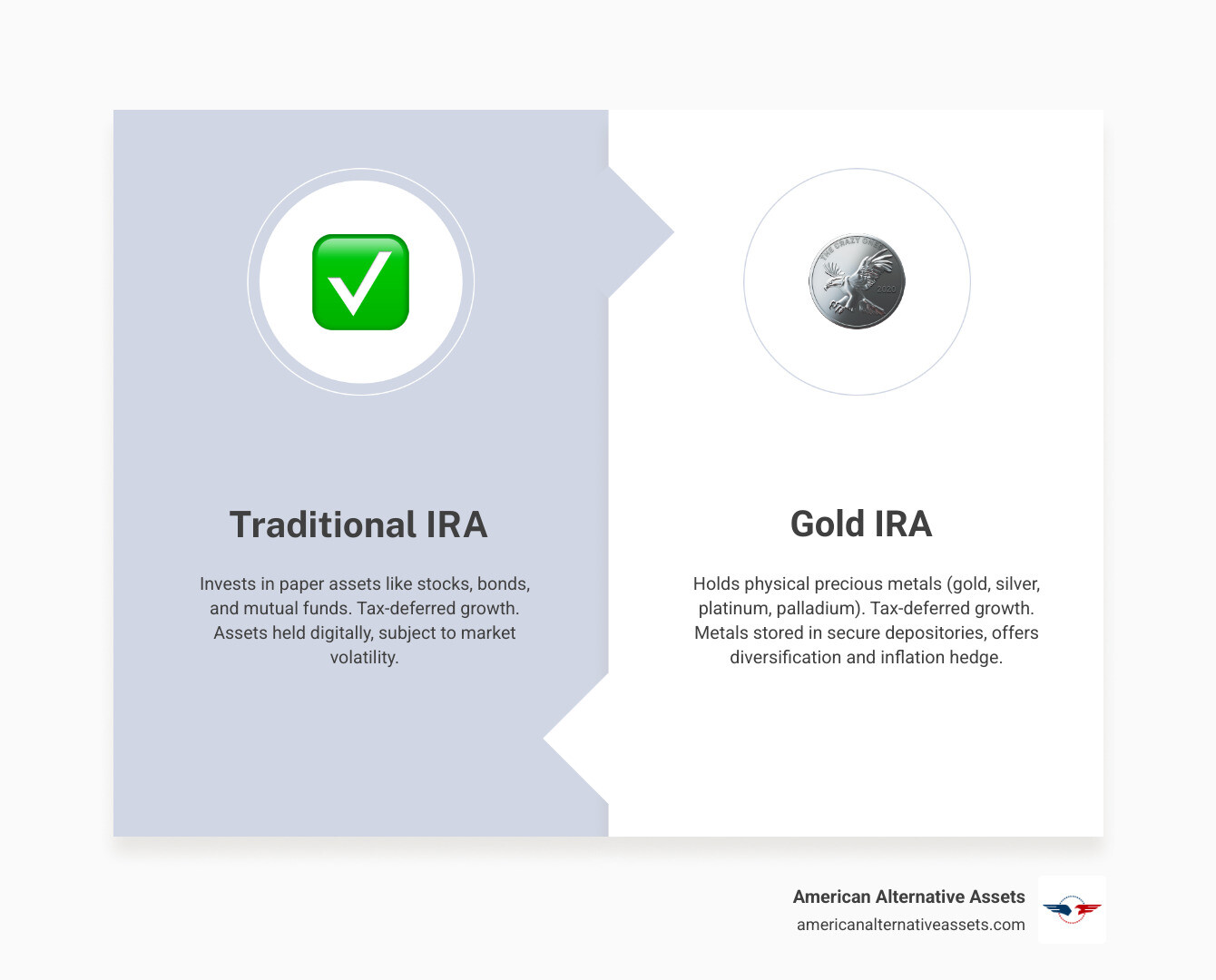
Conventional IRAs are limited to paper assets such as cash, stocks, bonds, and mutual funds. These investments, while familiar, may not provide the security investors need in volatile times. Precious metals IRAs allow investors to hold physical gold and other precious metals in their portfolios, offering a unique avenue for safeguarding your future. Understanding the nuances of this approach can help you weigh the Gold IRA Pros and Cons.
Tax Advantages of a Gold IRA
One of the most appealing aspects of investing in a gold ira is its integration with the established tax benefits of individual retirement accounts. A Gold IRA essentially operates as a self-directed Traditional or Roth IRA, allowing you to leverage powerful tax strategies for your precious metal holdings.
- Traditional Gold IRA: Contributions to a Traditional Gold IRA are often tax-deductible, meaning you can reduce your taxable income in the year you contribute. Your investments then grow tax-deferred, and you only pay taxes when you take distributions in retirement. This can be particularly advantageous if you expect to be in a lower tax bracket during retirement.
- Roth Gold IRA: With a Roth Gold IRA, you contribute after-tax dollars. The significant benefit here is that your investments grow tax-free, and qualified withdrawals in retirement are also completely tax-free. This makes Roth Gold IRAs an excellent choice if you anticipate being in a higher tax bracket later in life.
The contribution limits for Gold IRAs are the same as for traditional IRAs. In 2024, you can contribute up to $7,000 to an IRA. If you are 50 or older, you can make an additional catch-up contribution of $1,000, bringing your total to $8,000 for the year. This annual limit applies across all IRAs you own. For more detailed information on contribution rules and limits, you can refer to the IRS guidelines on More on IRA contribution limits.
These tax advantages, combined with the inherent stability of physical gold, make a Gold IRA a compelling option for those looking to optimize their retirement savings.
A Step-by-Step Guide to Opening and Funding Your Gold IRA
Starting on the journey of investing in a gold ira might seem complex at first glance, but with a clear roadmap, it becomes a straightforward process. At American Alternative Assets, we guide our clients through each step, ensuring a smooth transition of their retirement savings into physical precious metals.

The general process involves three main steps:
- Choosing a specialized custodian: Unlike traditional IRAs, Gold IRAs require a custodian equipped to handle physical precious metals.
- Funding your account: This can be done through direct contributions or, more commonly, by rolling over funds from an existing retirement account.
- Purchasing and storing your metals: Once funded, you will purchase IRS-approved physical gold, which will then be securely stored in an approved depository.
This process allows you to convert your IRA into a gold IRA, safeguarding your assets with tangible wealth. For a comprehensive overview of the mechanics, visit How Does a Gold IRA Work?.
Step 1: Selecting the Right Custodian and Company
The foundation of a successful Gold IRA lies in choosing a reputable and reliable custodian. This is a critical decision, as your custodian will be responsible for administering your account and ensuring compliance with IRS regulations. When selecting a custodian, we recommend looking for several key attributes:
- Reputation and Experience: Seek out custodians with a proven track record in the self-directed IRA and precious metals space. Their experience indicates a deep understanding of the unique requirements.
- Customer Service: A responsive and knowledgeable team is invaluable. You want a custodian that offers clear communication and assistance throughout the process.
- Transparent Fees: Ensure the custodian is upfront about all setup, annual, and transaction fees.
- IRS Approval: Confirm that the custodian is IRS-approved to handle precious metals IRAs.
- Positive Reviews: Check for positive customer reviews and a solid record of client satisfaction.
At American Alternative Assets, our unique selling proposition is our white-glove, relationship-first service. We believe in building trust and transparency through ethical practices, ensuring real privacy and protection for your wealth. We work with trusted IRS-approved custodians to facilitate your Gold IRA, providing you with peace of mind. For more guidance on this crucial step, explore our Precious Metals IRA Custodians Guide.
Step 2: Funding Your Account Through Contributions or Rollovers
Once you have selected your custodian, the next step is to fund your Gold IRA. There are two primary ways to do this:
- Direct Contributions: If you are eligible, you can make annual contributions directly to your Gold IRA, just as you would with a traditional IRA. As mentioned, for 2024, the limit is $7,000, with an additional $1,000 catch-up contribution if you are age 50 or older.
- Rollovers and Transfers: This is the most common method for funding a Gold IRA, especially if you have existing retirement savings. You can transfer funds from various types of accounts, including:
- 401(k)s, 403(b)s, TSPs: If you are no longer employed by the plan sponsor, you can often convert your 401(k) balance (or similar employer-sponsored plans) into a self-directed IRA. This process is typically done via a direct rollover.
- Existing IRAs (Traditional, Roth, SEP): You can also transfer funds from an existing IRA into your new Gold IRA.
There are generally three types of rollovers:
- Direct Rollover: The funds are moved directly from your old plan administrator or custodian to your new Gold IRA custodian. This is the safest and most recommended method, as no taxes are withheld, and you avoid any potential penalties.
- Trustee-to-Trustee Transfer: Similar to a direct rollover, this is when funds move directly between financial institutions, without you ever touching the money.
- 60-Day Rollover (Indirect Rollover): In this scenario, a check is made payable to you, and you are responsible for depositing the funds into your new Gold IRA within 60 days. We generally advise against this method due to the risk of missing the deadline and incurring taxes and penalties.
The rollover process can be done tax-free and penalty-free when executed correctly. Our team can assist you through this process, ensuring all paperwork is handled efficiently. To get started, you can complete our Gold IRA Intake Form.
Navigating IRS Rules, Fees, and Storage for Your Gold IRA
Investing in a gold ira comes with specific regulations and considerations to ensure compliance and protect your investment. The IRS has clear guidelines on what types of precious metals are allowed and how they must be stored. Understanding these rules, as well as the associated fees, is essential for a well-managed Gold IRA.
Understanding IRS-Approved Metals and Storage
The IRS allows physical precious metals to be held in self-directed IRAs, but not all metals qualify. This is because the IRS classifies most collectibles as prohibited assets within an IRA, which would trigger immediate taxes and penalties. However, there are specific exemptions for certain qualified precious metals.
For gold to be IRA-eligible, it must meet a minimum fineness requirement of .995 (or 99.5% purity). For silver, the minimum fineness is .999, and for platinum and palladium, it is .9995.
Common IRA-approved gold products include:
- American Gold Eagle coins: These are a notable exception to the .995 purity rule, as they are 22-karat (.9167 pure) but specifically exempted by the IRS.
- Canadian Gold Maple Leaf coins: Known for their .9999 purity.
- American Gold Buffalo coins: These are .9999 pure.
- Gold bars: These must be from an IRS-approved refiner and meet the .995 purity standard.
For a comprehensive understanding of what constitutes a collectible and its implications, you can refer to the IRS rules on collectibles in IRAs.
Crucially, physical gold held in an IRA cannot be stored at home, in a personal safe, or in a bank safe deposit box. This is a common misconception, and home storage of IRA assets is illegal, potentially resulting in massive fines and penalties, as the IRS would consider it an immediate taxable distribution. Instead, your precious metals must be held by an IRA custodian and stored in an IRS-approved depository. These facilities are highly secure, offering advanced vaults, 24/7 surveillance, and insurance to protect your assets. You may also have the option for “segregated storage,” which means your specific gold pieces are stored separately and remain identifiable as your property, rather than being commingled with other investors’ metals.
A Breakdown of Typical Fees When Investing in a Gold IRA
While investing in a gold ira offers significant benefits, it is important to be aware of the associated fees, which tend to be higher than those for traditional IRAs holding paper assets. These fees are primarily due to the specialized nature of handling physical precious metals, including their purchase, secure storage, and the administrative oversight required.
Typical fees you might encounter include:
- Setup Fees: A one-time fee charged by the custodian to establish your new Gold IRA account.
- Annual Administration Fees: These are recurring fees charged by the custodian for maintaining your account, handling paperwork, and ensuring IRS compliance.
- Storage and Insurance Fees: Because your physical gold must be stored in an IRS-approved, secure depository, you will incur fees for storage and insurance. These can sometimes be flat fees or a percentage of the metal’s value.
- Dealer Markups: When purchasing your gold from a dealer, there will be a markup over the spot price of the metal. It is essential to work with a transparent dealer to understand these costs.
While Gold IRAs do come with these additional costs, we believe the long-term security and diversification benefits they provide often outweigh these expenses. We prioritize transparent pricing and ethical practices to ensure you understand all costs upfront. To learn more about common misconceptions around these investments, read our article on Precious Metals IRA Myths Debunked: Separating Fact From Fiction.
Frequently Asked Questions About Investing in a Gold IRA
We understand that investing in a gold ira can bring up many questions. Here are some of the most common inquiries we receive, along with our expert insights.
How much of my portfolio should I allocate to gold?
This is a common and important question. While there’s no one-size-fits-all answer, financial experts often recommend allocating a modest portion of your overall investment portfolio to precious metals. A common recommendation is to place about 5% to 15% of your portfolio in gold.
The precise percentage depends on your personal risk tolerance, current investment goals, and overall diversification strategy. For instance, if you are particularly concerned about economic uncertainty or inflation, you might lean towards the higher end of that range. The goal is not to make gold your sole investment but to use it as a strategic component for stability and a hedge against volatility. Gold IRAs can be an excellent tool for diversifying a retirement account and hedging against financial factors, but it is generally recommended to keep only a small portion of retirement assets in them. For a deeper discussion on this topic, explore What Percentage of My Portfolio Should Be Allocated to Gold?.
What specific gold coins and bars are allowed in an IRA?
As we discussed, the IRS has strict purity standards for precious metals held in an IRA. For gold, this generally means a minimum fineness of .995.
Here is a list of popular and commonly approved gold products:
- American Gold Eagle Coins: These 22-karat coins are specifically exempted from the .995 purity rule by the IRS, making them eligible.
- American Gold Buffalo Coins: These coins boast a .9999 (99.99%) purity, making them highly eligible.
- Canadian Gold Maple Leaf Coins: Known for their .9999 purity.
- Austrian Gold Philharmonic Coins: Another high-purity option at .9999 fine gold.
- Gold Bars and Rounds: These must be produced by an IRS-approved refiner or assayer and meet the .995 purity standard. Common sizes include 1 ounce, 10 ounce, and 1-kilogram bars.
It is always best to confirm with your chosen custodian and precious metals dealer that the specific products you intend to purchase are indeed IRA-eligible before finalizing any transaction.
Can I take physical possession of my gold when I retire?
Yes, absolutely! This is one of the distinct advantages of investing in a gold ira compared to holding paper assets. When you reach retirement age (typically 59½ and beyond), you have several options for how to receive your distributions:
- In-Kind Distribution: You can choose to take physical delivery of your gold coins or bars directly from the depository. This means the actual physical precious metals are shipped to you.
- Cash Distribution: Alternatively, you can instruct your custodian to sell your gold and send you the cash proceeds.
- Required Minimum Distributions (RMDs): If your Gold IRA is a Traditional IRA, you will eventually be subject to RMDs, usually starting at age 73 (as of 2023). You can satisfy your RMDs by either selling a portion of your gold for cash or taking an in-kind distribution of the physical metal, with its value counting towards your RMD.
It is important to remember that withdrawals before age 59½ may be subject to a 10% penalty in addition to income taxes, just like with traditional IRAs. We recommend consulting with a tax professional to understand the specific tax implications of your distribution choices. The ability to take physical possession of your gold provides a tangible sense of security and control over your retirement assets.
Conclusion: Secure Your Future with a Tangible Asset
In an ever-changing financial landscape, the wisdom of diversification and the enduring value of tangible assets have never been more apparent. Investing in a gold ira offers a powerful strategy to fortify your retirement savings, providing a hedge against inflation, market volatility, and economic uncertainty. By holding physical precious metals within a tax-advantaged account, you gain a level of security and control that traditional paper assets cannot always deliver.
We believe in proactive financial planning and personal responsibility, empowering you to make informed decisions about your future. At American Alternative Assets, we are committed to being your trusted partner in wealth preservation. Our white-glove, relationship-first service, built on trust, transparency, and ethical practices, ensures that you receive real privacy and protection for your wealth, right here from our base in Woodland Hills, California.
Take the step towards securing your future with the timeless value of gold. Discover the Power of a Self-Directed Precious Metals IRA Today and explore our comprehensive precious metals IRA resources.
This article is for informational purposes only and does not constitute financial advice. Please consult your financial advisor before making investment decisions.
Investing in precious metals involves risk. Past performance does not guarantee future results.