








Why Asset Protection Matters More Than Ever
Asset protection strategies are legal and financial tools used to safeguard wealth from creditors, lawsuits, and economic uncertainty. These strategies range from simple insurance policies to advanced structures like trusts and LLCs.
Quick Overview: Core Asset Protection Strategies
- Insurance: Umbrella policies and specialized coverage.
- Asset Titling: Tenancy by the entirety and other joint ownership structures.
- Retirement Accounts: 401(k)s and IRAs with creditor protections.
- Business Entities: LLCs and corporations to isolate business risk.
- Trusts: Domestic and offshore asset protection trusts (DAPTs).
- Physical Assets: Precious metals held directly or in self-directed IRAs.
- Gifting: Strategic transfers within legal limits.
Most people only consider protecting their assets after a crisis hits, but by then, it’s often too late. Courts can reverse transfers made to avoid legitimate debts, which is why the best asset protection plan is built years in advance.
Economic uncertainty, market volatility, and rising litigation rates make protecting what you’ve earned more critical than ever. Whether you’re a business owner, a professional, or someone who has spent decades building wealth, you face real risks that can wipe out years of hard work.
I’m Shanon Davis, founder of American Alternative Assets. I’ve learned that effective asset protection strategies are about building financial resilience through tangible, secure holdings. That’s why we focus on helping Americans protect their wealth with physical precious metals.
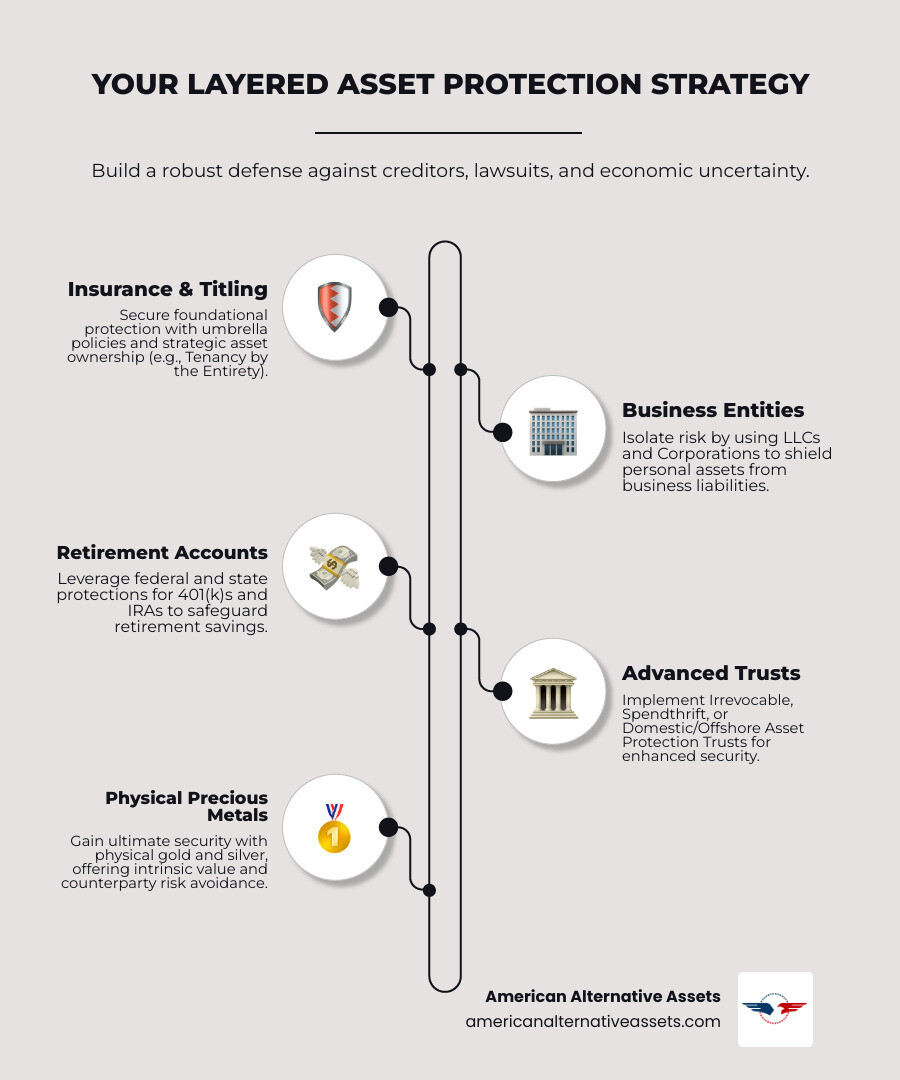
This infographic illustrates the layered approach to asset protection, starting with foundational insurance and proper titling, moving through business entities and retirement accounts, and culminating with advanced trusts and physical precious metals for maximum security.
Foundational Layers of Protection
Before exploring complex legal structures, establish the bedrock of any asset protection plan: insurance, asset titling, and retirement account protections. These are often the simplest and most cost-effective lines of defense.
The Role of Insurance in Your Plan
Insurance is your first line of defense against unexpected financial blows, designed to cover costs from lawsuits and claims. A multi-layered approach is best:
- Primary Liability Insurance: Ensure your homeowners, auto, and business policies have robust liability coverage.
- Umbrella Policies: An umbrella policy provides affordable excess liability protection above your primary insurance limits, kicking in when other policies are exhausted.
- Specialized Insurance: Professionals in high-risk fields should carry malpractice insurance. Business owners may need Directors and Officers (D&O) or Employment Practices Liability Insurance (EPLI).
The goal is for the insurance company to pay in the event of a claim, not you. For more insights, you can visit Asset Protection: How It Works and Strategies.
How Titling Your Assets Can Create a Shield
How you hold title to your assets can significantly impact their vulnerability to creditors.
- Tenancy by the Entirety: In states where it’s recognized, this form of ownership for married couples offers powerful protection. If only one spouse is sued, the asset generally cannot be taken by their creditor. Laws vary by state, so understanding California’s specific titling laws is crucial.
- Joint Tenancy with Rights of Survivorship: This ensures that upon one owner’s death, the property automatically passes to the surviving owner, bypassing probate.
- Titling in a Spouse’s Name: Placing assets solely in a spouse’s name can shield them from your individual creditors, but this strategy requires complete trust and transparency.

Always consult with legal counsel before changing asset titles to understand the implications under California law.
Leveraging Retirement Account Protections
Retirement savings often represent a large portion of wealth and come with built-in creditor protections.
- Employer-Sponsored Plans (401(k)s, 403(b)s): Governed by the Employee Retirement Income Security Act (ERISA), these plans offer robust federal protection from creditors.
- Individual Retirement Accounts (IRAs): While not covered by ERISA, IRAs often receive significant protection under state laws. It’s important to understand California’s specific laws regarding IRA exemptions.
- Maximizing Contributions: A simple and effective asset protection strategy is to consistently max out contributions to these protected accounts.
- Roth Conversions: Converting to a Roth IRA can be a strategic move. You pay taxes now, but qualified withdrawals are tax-free, and the account is shielded as a protected retirement asset.
Understanding these protections is a cornerstone of a resilient financial future. For more on securing your retirement, read our article Is Your 401(k) or IRA a Ticking Time Bomb? Robert Kiyosaki Warns of a Great Depression 2.0. Why a Gold IRA Could Be Your Retirement Lifeline.
Essential Asset Protection Strategies Using Legal Structures
Specific legal structures can create stronger barriers between your personal wealth and potential liabilities, which is especially important for business owners and real estate investors.

Using LLCs and Corporations to Isolate Risk
Limited Liability Companies (LLCs) and corporations are fundamental asset protection strategies because they legally separate business and personal assets.
- Limited Liability: The main advantage is “limited liability.” Owners are generally not personally responsible for business debts. If the business is sued, creditors can typically only pursue assets held within the business, leaving your personal assets untouched.
- Shielding Assets: This is crucial for entrepreneurs and owners of “toxic assets” like rental properties. Placing a rental property in an LLC can protect your personal wealth from tenant lawsuits. These entities also offer protection from personal creditors, who may only be able to obtain a “charging order” against your ownership interest, making it less attractive.
- Maintaining Formalities: To be effective, you must treat the entity as a separate legal person. This means keeping finances separate and following corporate rules. Failure to do so can lead to a court “piercing the corporate veil,” allowing creditors to reach your personal assets. Learn more about business structures like single-member LLCs here: More on single-member LLCs.
Understanding Homestead Exemptions
Homestead exemptions are state laws designed to protect a portion of a homeowner’s equity in their primary residence from creditors.
- Protection Level: The amount of protection varies significantly by state. California provides significant protection, but the specific amounts can vary. It’s essential for California residents to understand their current exemption limits.
- Filing Requirements: In many states, including California, you may need to file a “Declaration of Homestead” to claim these protections. Research the specific requirements in your county to ensure your home is protected.
Understanding your state’s homestead laws is a vital part of your asset protection strategies. You can find a general guide to homestead exemptions by state here: A guide to homestead exemptions by state.
Advanced Strategies: A Deeper Dive into Trusts and Gifting
For those with substantial wealth, more sophisticated asset protection strategies involving trusts and strategic gifting may be necessary. These tools offer greater protection but also come with more complexity and cost.
How Trusts Function as a Core Asset Protection Tool
Trusts are legal arrangements where a grantor gives a trustee the right to hold assets for a beneficiary. When structured correctly, they are powerful for asset protection.
- Irrevocable vs. Revocable: For asset protection, a trust must generally be irrevocable. In an irrevocable trust, you relinquish control, and the assets legally belong to the trust, making them generally inaccessible to your personal creditors. Revocable trusts offer no creditor protection.
- Spendthrift Provisions: Many asset protection trusts include “spendthrift clauses” to protect beneficiaries from their own creditors or mismanagement by restricting their ability to transfer their interest in the trust.
- Relinquishing Control: The key to a trust’s effectiveness is the grantor’s relinquishment of control. This is what legally separates the assets from you.
An Asset Protection Trust (APT) is a specific type of irrevocable trust designed to shield assets from creditors. Learn more about what an APT is here: What Is an Asset Protection Trust (APT)?.
Domestic vs. Foreign Asset Protection Trusts
APTs can be either domestic or foreign, each with different levels of protection and cost.
- Domestic Asset Protection Trusts (DAPTs): A DAPT is an irrevocable trust established in a U.S. state that permits them (currently over 20 states, but not California). The grantor can also be a discretionary beneficiary. While offering significant protection, DAPTs are still subject to U.S. jurisdiction and can be vulnerable to certain claims. Setup costs can range from $2,000 to $5,000 and up. You can find a list of states with DAPT laws here: List of states with DAPT laws.
- Foreign Asset Protection Trusts (Offshore Trusts): An offshore trust is established in a foreign country with favorable asset protection laws that often do not recognize U.S. judgments. This provides stronger protection but comes at a higher cost, generally starting at $20,000. These require careful planning and compliance with U.S. tax laws.
The choice between a domestic or foreign APT depends on your needs, asset value, and risk tolerance.
The Nuances of Gifting and Asset Transfers
Gifting assets can be a powerful asset protection strategy to reduce your taxable estate, but it requires careful planning.
- Gift Exclusions: For 2024, you can gift up to $18,000 per person ($36,000 for married couples) annually without gift tax implications. Beyond this, gifts count against a lifetime exemption of $13.61 million per individual.
- Look-Back Periods: Be aware of “look-back” periods. For example, Medicaid reviews asset transfers made in the five years prior to an application, and improper gifts can lead to penalties.
- Fraudulent Conveyance: It is critical to understand that any transfer made with the intent to defraud creditors can be reversed by a court. This is why asset protection must be done proactively, long before any claims arise. The IRS warns that if you continue to control assets after a transfer, they may still be seized.
Gifting is a long-term strategy that requires legal guidance to be effective.
The Ultimate Protection: Holding Tangible, Private Assets
While legal structures provide a framework for asset protection, some assets offer inherent security. We believe physical precious metals represent the ultimate form of tangible, private wealth protection.
Why Physical Precious Metals Are a Unique Asset Class
In a digital world, physical gold and silver stand apart, offering unique benefits that strengthen your asset protection strategies.
- Intrinsic Value: Gold and silver have held value for millennia, independent of any government or financial institution. Their value is not derived from a promise on a computer server.
- No Counterparty Risk: When you own physical gold or silver, you own the asset directly. There is no bank or broker standing between you and your wealth. Unlike paper assets, which rely on a third party’s promise to pay, physical metals eliminate this risk.
- Privacy and Portability: Physical precious metals offer a level of privacy few other assets can match when held outside the traditional banking system. They are also highly portable.
- A Potential Hedge Against Inflation: Precious metals have historically served as a hedge against inflation and currency devaluation, helping to preserve wealth during economic uncertainty. Learn more about the Gold Inflation Impact and Why the World Is Running to Gold (And What It Means for Your Wealth).
- Diversification: Physical precious metals provide crucial diversification, as they tend to perform differently than traditional paper assets, offering a buffer during market downturns. Explore our Wealth Preservation Strategies.
Owning physical metals provides true ownership and removes counterparty risk, offering a time-tested store of value.
Integrating a Precious Metals IRA into Your Asset Protection Strategies
A Precious Metals IRA combines the benefits of physical metals with the tax advantages and creditor protections of retirement accounts.
- Self-Directed IRA: A Precious Metals IRA is a self-directed IRA (SDIRA) that lets you hold physical, IRS-approved gold, silver, platinum, and palladium bullion in a tax-advantaged account.
- Tax Advantages: Like traditional IRAs, contributions may be tax-deductible, and investments grow tax-deferred.
- True Ownership: Unlike paper-based gold investments, a Precious Metals IRA means you own actual physical metals held in a secure, IRS-approved depository. See our guide on What Is a Gold IRA?.
- Improved Asset Protection: Combining physical metals with the creditor protections of an IRA is a powerful component of your asset protection strategies, allowing you to diversify your retirement savings away from paper assets.
We specialize in helping clients set up and manage Precious Metals IRAs. Our Investing Precious Metals IRA Guide provides comprehensive information to get you started.
Frequently Asked Questions about Asset Protection
When is the right time to start asset protection planning?
The best time to start asset protection planning is now. The core principle of effective asset protection strategies is proactive planning. Once a creditor claim exists or a lawsuit is filed, it’s often too late. Courts can reverse transfers made to avoid debts under fraudulent conveyance laws. Asset protection is about building a financial fortress during calm periods to ensure your wealth is secure for the long term.
Can asset protection strategies help with estate planning?
Yes. Asset protection strategies and estate planning work together to preserve and transfer wealth. Many tools, like trusts and strategic gifting, are fundamental to both.
- Generational Wealth Transfer: Irrevocable trusts can protect assets from your creditors and those of your beneficiaries, ensuring your legacy passes down through generations.
- Minimizing Estate Taxes: Strategic gifting can reduce the size of your taxable estate, minimizing potential estate taxes for your heirs.
- Ensuring Your Wishes: Trusts allow you to dictate how and when assets are distributed, avoiding the public probate process and ensuring your wishes are honored.
A comprehensive plan should address both immediate protection and long-term legacy goals.
Do I need a lawyer or financial professional?
Yes. This guide is for informational purposes only and is not financial or legal advice. Asset protection is a complex field tied to specific state and federal laws.
- Complexity and Customization: Laws vary significantly by state, and there is no one-size-fits-all plan. A professional can help assess your risks and tailor a strategy to your unique circumstances.
- Legal and Financial Expertise: An experienced attorney is crucial for drafting legal documents like trusts and LLC agreements. A qualified financial professional can help integrate these strategies with your investment, retirement, and tax planning.
We at American Alternative Assets work alongside your legal and financial advisors to ensure your physical precious metals investments integrate seamlessly into your overall plan.
Conclusion: Building Your Financial Fortress
Taking proactive steps to safeguard your wealth is essential. We’ve explored a range of asset protection strategies, from foundational measures like insurance and asset titling to advanced structures like LLCs and trusts, and the unique security of physical precious metals.
The key takeaway is the importance of a multi-layered approach. A robust plan combines several tactics to fortify your financial position and is most effective when implemented well in advance of any potential claims.
At American Alternative Assets, we help you take control of your financial future with tangible, private assets. Our white-glove service is built on trust and transparency, ensuring real privacy and protection for your wealth through physical precious metals IRAs.
Don’t wait until it’s too late. Start building your financial fortress today.
Learn more about secure storage options for your physical assets
Investing in precious metals involves risk. Past performance does not guarantee future results. This article is for informational purposes only and does not constitute financial advice. Please consult your financial advisor before making investment decisions.