








Why Americans Are Turning to Physical Gold for Retirement Security
A Gold IRA guide starts with one simple truth: you can hold physical precious metals in a retirement account. Here’s what you need to know:
What a Gold IRA Does:
- Allows us to own physical gold, silver, platinum, and palladium inside a tax-advantaged retirement account
- Provides the same tax benefits as a Traditional or Roth IRA
- Requires IRS-approved storage at a secure third-party depository
- Lets us diversify beyond paper assets like stocks and bonds
How It Works:
- You open a self-directed IRA with a qualified custodian
- You fund it through a rollover, transfer, or new contribution
- You select IRS-approved precious metals that meet strict purity standards
- Your metals are stored in an approved depository on your behalf
Key Requirements:
- Gold must be 99.5% pure, silver 99.9%, platinum and palladium 99.95%
- 2025 contribution limits: $7,000 ($8,000 if age 50 or older)
- Metals must remain in custodian storage until distribution
Many retirement savers worry their portfolios are too heavily weighted in paper assets. When markets swing or inflation rises, those concerns grow sharper. A Gold IRA offers a way to add tangible assets to your retirement plan, assets you actually own rather than shares of something someone else holds.
Physical precious metals have served as a store of value for thousands of years. While stocks can drop 50% or more in a matter of months, gold has historically maintained purchasing power over long periods. The U.S. dollar has lost over 97% of its value compared to gold since 1913, while gold prices have increased over 9,000% in that same timeframe.
The critical distinction: A Gold IRA holds physical metal, not paper contracts or mining stocks. You own real gold bars and coins stored in your name, not a promise from a financial institution.
I’m Shanon Davis, and after watching families lose everything in the 2008 crash, I built American Alternative Assets to help ordinary Americans understand this Gold IRA guide and step outside fragile paper-based systems. My work focuses on teaching people how to hold value that doesn’t depend on anyone else’s promises.
This article is for informational purposes only and does not constitute financial advice. Please consult your financial advisor before making investment decisions.
Simple guide to Gold IRA guide terms:
What is a Gold IRA? Understanding the Fundamentals
A Gold IRA is a specialized type of Individual Retirement Account (IRA) that allows you to invest in physical precious metals rather than traditional paper assets like stocks, bonds, or mutual funds. Essentially, it is a Self-Directed IRA that focuses specifically on physical gold, silver, platinum, and palladium.
The core idea behind a Gold IRA is to provide tangible ownership. Instead of holding a certificate that represents a claim on an asset, you hold the actual asset itself. This gives you direct investment control over a portion of your retirement savings, allowing you to diversify with physical assets.

How Gold IRAs Differ from Traditional IRAs
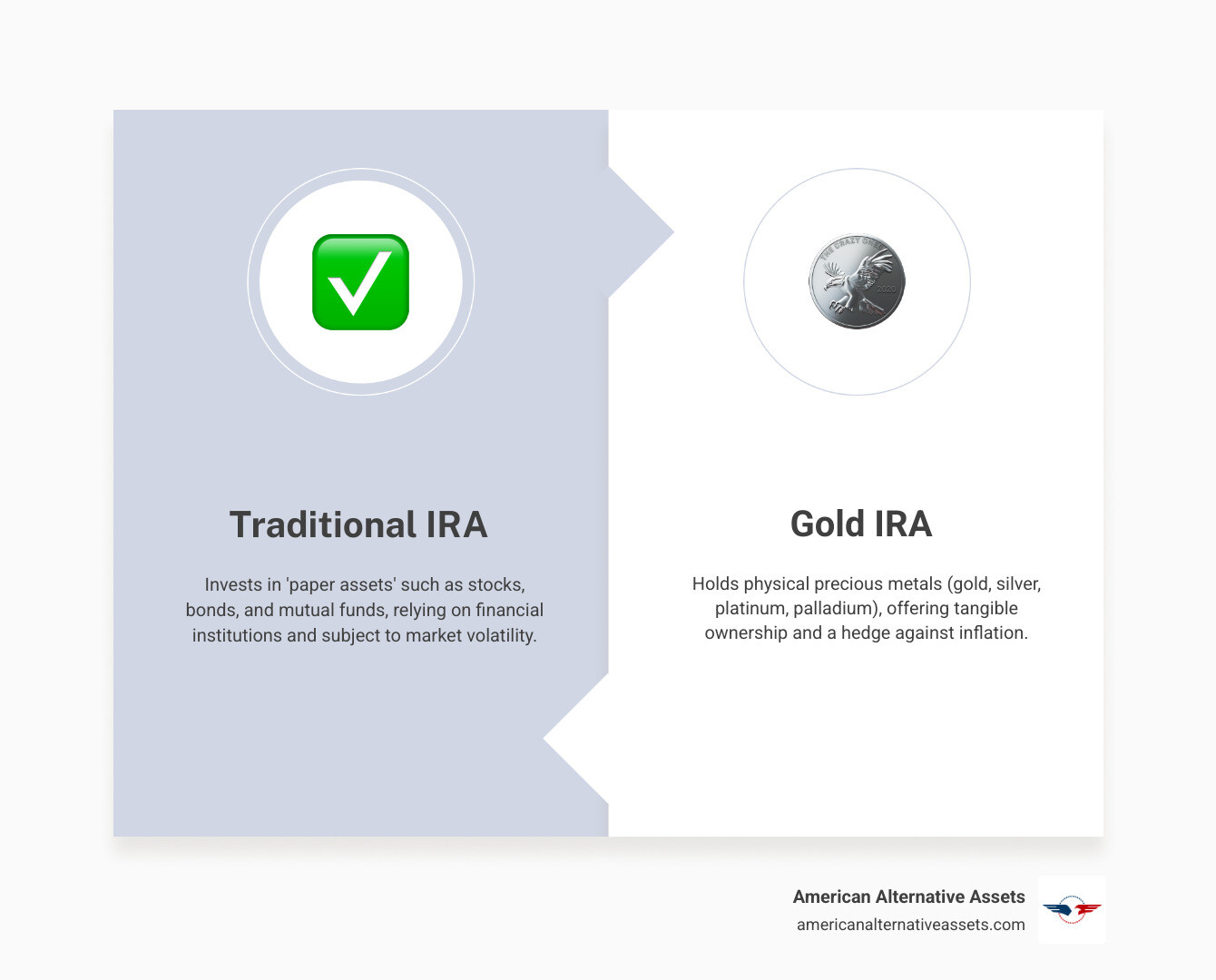
The primary difference between a Gold IRA and a traditional IRA lies in the assets they hold. A traditional IRA typically holds paper assets, while a Gold IRA holds physical precious metals. This distinction is crucial due to IRS rules concerning “collectibles.” Generally, the IRS prohibits IRAs from investing in collectibles, which includes most forms of physical precious metals.
However, there’s a vital exception. Specific types of gold, silver, platinum, and palladium that meet strict purity standards are exempt from the collectibles rule. This means you can legally hold these IRS-approved precious metals within your retirement account.
Like traditional IRAs, Gold IRAs offer significant tax advantages. Contributions to a Traditional Gold IRA may be tax-deductible, and your investments grow tax-deferred until retirement. With a Roth Gold IRA, contributions are made with after-tax dollars, allowing qualified withdrawals in retirement to be entirely tax-free. Understanding How Does a Gold IRA Work? helps clarify these unique benefits.
The Strategic Advantages of a Gold IRA
For many, a Gold IRA is a strategic tool for retirement planning. Our clients often consider a Gold IRA to minimize risk, hedge against stock market volatility, and preserve wealth over their lifetime. Let’s explore some of the main benefits of investing in a Gold IRA. For a balanced view, you can also consider our Gold IRA Pros and Cons article.
One of the most compelling reasons to invest in a Gold IRA is portfolio diversification. Gold has historically shown a low correlation with traditional assets like stocks and bonds. This means that when the stock market experiences a downturn, gold prices may not necessarily follow suit, and can even rise. This inverse relationship can help stabilize your overall portfolio during unpredictable market shifts.
Gold is also widely seen as an effective inflation hedge. Over the past 90 years, the U.S. dollar has lost nearly 99% of its purchasing power compared to gold. When the purchasing power of the dollar diminishes, gold often maintains or increases its value, protecting your savings from erosion. Research has consistently shown gold’s role as an inflation hedge.
Beyond diversification and inflation protection, gold serves as a reliable store of value. It has intrinsic worth, unlike fiat currencies which can be subject to devaluation. This makes it a powerful asset for long-term wealth preservation and a safe haven during times of economic uncertainty or geopolitical instability. Individuals who included gold in their portfolios during the 2008 financial crisis experienced significantly better performance compared to those who maintained only stocks.
A Gold IRA can be a smart choice if you prefer not to rely solely on the stock market, seek to invest in precious metals using IRA funds without facing taxes or penalties, and want greater control over your retirement savings. It’s about proactive planning and securing your future. Find more reasons to consider a Gold IRA in our article, Why Invest in a Gold IRA?.
Physical Gold vs. “Paper Assets”
The distinction between owning physical gold and “paper assets” representing gold is fundamental to understanding the value of a Gold IRA. When you invest in physical gold through an IRA, you gain direct ownership of a tangible asset. This means there’s no counterparty risk—you’re not relying on a financial institution’s promise or solvency. The value is inherent in the metal itself, providing a sense of security and a true store of value.
In contrast, “paper gold” assets like gold exchange-traded funds (ETFs) or mining stocks are not direct claims on physical metal. They carry risks that physical ownership avoids, such as counterparty risk, management fees, and market volatility tied to factors other than gold’s intrinsic value. With paper assets, you own a promise, not the metal itself. Our core mandate at American Alternative Assets is to advocate for investing in physical precious metals because we believe it offers superior protection and wealth preservation.
Your Comprehensive Gold IRA Guide: Setup, Funding, and Rules
Setting up a Gold IRA involves specific steps and adherence to IRS regulations. This section of our Gold IRA guide will walk you through the process, from choosing your account type to understanding funding options and storage requirements. We are here to help you steer these rules with ease, ensuring compliance every step of the way. For a detailed overview, refer to our Precious Metals IRA Rules Guide.
Step 1: A Beginner’s Gold IRA Guide to Account Setup
The first step in establishing your Gold IRA is to choose the type of IRA that best suits your financial goals. You can opt for a Traditional Gold IRA, a Roth Gold IRA, or even a SEP Gold IRA if you are self-employed or a small business owner. Each type offers distinct tax advantages, just like their traditional counterparts.
Next, you’ll need to select a qualified custodian. The IRS mandates that all IRA assets, including physical precious metals, be administered by an approved custodian. This custodian acts as the administrator for your account, handles all transactions, and ensures compliance with IRS regulations. Our IRA Precious Metals Custodians Complete Guide can help you make an informed choice. The application process typically involves filling out paperwork and establishing your account with the chosen custodian.
Step 2: Funding Your Account with a Rollover or Transfer
Once your Gold IRA account is established, the next step is funding it. The most common methods involve rollovers or transfers from existing retirement accounts.
A rollover occurs when you receive funds from your existing retirement account (e.g., a 401(k), 403(b), or another IRA) and then deposit them into your new Gold IRA within 60 days. While this is an option, a direct transfer (also known as a trustee-to-trustee transfer) is generally recommended. In a direct transfer, the funds move directly from your old custodian to your new Gold IRA custodian, minimizing risk and avoiding potential tax implications or penalties.
Eligible accounts for rollovers and transfers include Traditional IRAs, Roth IRAs, SEP IRAs, SIMPLE IRAs, 401(k)s, 403(b)s, 457 Plans, and Thrift Savings Plans (TSPs). Rollovers typically take one to three weeks to complete. Rollovers do not count towards your annual IRA contribution limits. For 2025, individuals can contribute up to $7,000 annually to an IRA, with an additional $1,000 catch-up contribution available for those aged 50 or older, totaling $8,000. The IRS provides extensive information on rollovers to guide you through the process.
Step 3: A Complete Gold IRA Guide to Selecting and Storing Metals
This crucial step involves selecting the precious metals for your Gold IRA and arranging for their secure storage. Not all precious metals are eligible for an IRA. The IRS sets strict purity standards:
- Gold must be at least 99.5% pure.
- Silver must be at least 99.9% pure.
- Platinum and Palladium must meet a 99.95% purity standard.
There are specific coins and bars that meet these requirements. For gold, popular eligible options include the American Gold Eagle (which has a special exception at 91.67% purity due to government statute), Canadian Gold Maple Leaf, and Australian Gold Kangaroo, as well as various gold bars from accredited refiners. For silver, the American Silver Eagle and Canadian Silver Maple Leaf are common choices. Our Investing in Precious Metals guide offers more detail.
Once purchased, your precious metals must be stored in an IRS-approved depository. This is a non-negotiable rule. You cannot store your IRA’s gold at home. Approved depositories are highly secure, insured facilities designed specifically for precious metals. You can learn more about these facilities in our article, What are Depository Accounts and How Do They Work for Gold Storage?.
When choosing storage, you might encounter options like segregated or commingled storage. Segregated storage means your specific metals are kept separate from others, while commingled storage means your metals are stored with other investors’ identical metals. Many investors prefer segregated storage for added peace of mind.
Understanding Costs, Taxes, and Distributions
While Gold IRAs offer distinct advantages, it’s wise to understand the associated costs and tax implications. Expect account setup fees, annual administration fees charged by your custodian, and storage fees for the depository. These fees cover the secure handling and safekeeping of your physical assets.
The tax benefits of a Gold IRA largely mirror those of traditional IRAs. Your investments grow tax-deferred (Traditional Gold IRA) or tax-free (Roth Gold IRA, for qualified distributions). This allows your wealth to compound more efficiently over time.
When it comes to distributions, the rules are similar to other IRAs. Generally, you can begin taking penalty-free withdrawals at age 59½. Withdrawals before this age may incur a 10% penalty in addition to regular income tax. For Traditional Gold IRAs, Required Minimum Distributions (RMDs) typically begin at age 73. A unique aspect of a Gold IRA is the option for in-kind distributions, meaning you can choose to take physical possession of your precious metals rather than selling them for cash.
Frequently Asked Questions about Gold IRAs
We understand you might have more questions as you consider a Gold IRA. Here are answers to some common inquiries:
What types of precious metals can I hold in a Gold IRA?
You can hold physical gold, silver, platinum, and palladium in a Gold IRA. Each metal must meet strict IRS purity requirements to be eligible for inclusion in a retirement account. For example, gold must be 99.5% pure, silver 99.9% pure, and platinum and palladium 99.95% pure. This ensures that your investment is recognized as a legitimate retirement asset.
Can I store my IRA’s gold at home?
No, absolutely not. IRS rules mandate that precious metals held within an IRA must be stored by an approved third-party custodian in a secure, insured depository. Home storage is strictly prohibited and is considered an immediate distribution by the IRS, which can trigger significant taxes and penalties. As detailed by tax professionals, attempting to store IRA-held metals at home can lead to serious financial repercussions.
How are distributions from a Gold IRA taxed?
The tax treatment of distributions depends on the type of Gold IRA you have. Distributions from a Traditional Gold IRA are taxed as ordinary income, similar to a traditional 401(k) or IRA. If you have a Roth Gold IRA, qualified distributions are completely tax-free, provided the account has been open for at least five years and you are at least 59½ years old.
Conclusion: Secure Your Future with Tangible Assets
As we’ve explored in this Gold IRA guide, incorporating physical precious metals into your retirement strategy offers compelling benefits. From portfolio diversification and serving as an inflation hedge to providing tangible ownership and a reliable store of value, a Gold IRA can add a robust layer of security to your financial future. It’s about proactive retirement planning and taking control of your financial well-being.
At American Alternative Assets, we pride ourselves on providing white-glove, relationship-first service. We understand the importance of trust, transparency, and ethical practices when it comes to protecting your wealth. Our goal is to ensure real privacy and protection for your assets, helping you steer the complexities of precious metals investing with confidence.
Don’t let economic uncertainties or market volatility dictate your retirement future. Take the first step toward securing your assets with physical precious metals.
Take the first step and learn more about securing your retirement with a Gold IRA today.
This article is for informational purposes only and does not constitute financial advice. Please consult your financial advisor before making investment decisions.
Investing in precious metals involves risk. Past performance does not guarantee future results.