







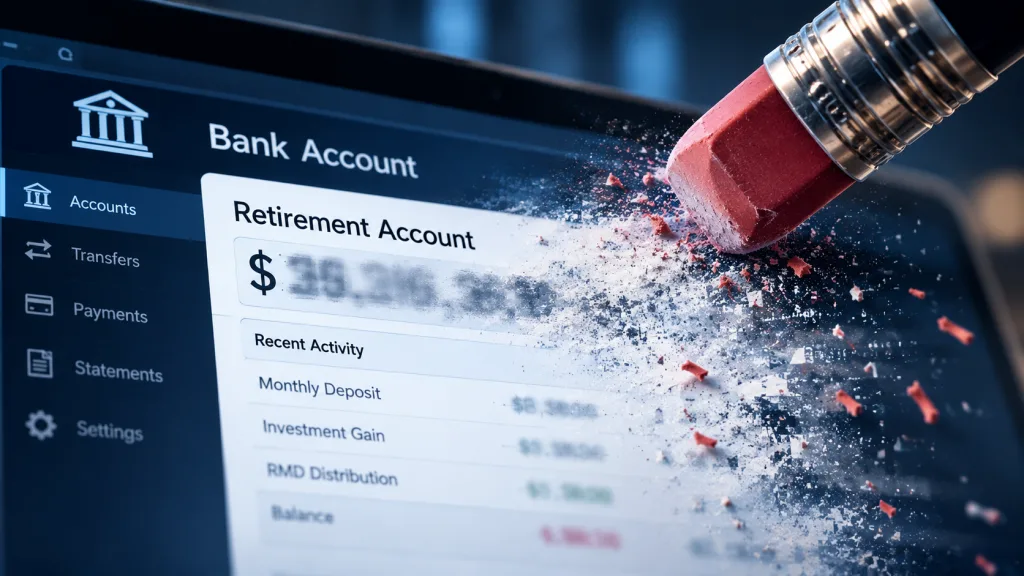
Decades of savings. Years of careful planning. And for most retirees, all of it exists as numbers on a screen.
Now the world’s top financial officials are preparing for the day those numbers come under attack.
This week, finance leaders from the G7, the group of seven major economies including the United States, agreed to run emergency drills simulating AI-powered cyber attacks on the financial system.
The goal: find out whether today’s response plans would actually hold up.
Days earlier, the International Monetary Fund warned that an AI-enabled attack on a critical banking service could shake confidence in the system itself.
And the Bank of England went even further.
It says banks can no longer assume their defenses will stop AI-driven attacks, and it’s now working with them on how to recover if critical systems and data are hit.
Think about what that means.
The people responsible for protecting the financial system are no longer just planning how to stop an attack.
They’re planning for what happens after one gets through.
Why retirees should pay attention
Your 401(k). Your IRA. Your checking account. Your Social Security deposit.
None of it exists in a vault with your name on it. It exists as data.
And data can be locked, corrupted, or wiped out in minutes.
AI is making cyber attacks faster, cheaper, and harder to detect than ever before.
Even if accounts are eventually restored, recovery can take days or weeks.
For a working saver, that’s a headache.
For a retiree who depends on that money to pay the bills, it can be a crisis.
The question isn’t whether the system has safeguards. It does.
The question is whether you want every dollar you’ve saved to depend on them.
The lesson: that’s why you need to diversify
When everything you own sits in the same kind of account, it’s all exposed to the same kind of risk.
One breach. One outage. One bad day for the system. And all of it is affected at once.
That’s the real case for diversification.
Not just spreading your money across different stocks, but across different types of assets.
Some digital. Some physical. Some tied to the markets. Some that aren’t.
That way, if one part of your retirement takes a hit, the rest is still standing.
Before the next headline hits, ask yourself:
If my accounts were frozen tomorrow, what would I still have?
And:
Is all of my retirement exposed to the same risks?
For thousands of years, gold and silver have kept their value through wars, crashes, and every technology shift in between.
A gold coin can’t be hacked out of existence. It can’t be erased with a keystroke.
That’s why many retirees add physical precious metals as one part of a diversified retirement strategy.
Technology will keep changing, and so will the threats that come with it. But after decades of saving, you deserve a retirement that doesn’t depend on a single system staying online.
Is your retirement too concentrated in one asset?
Talk through your options in a free, no-obligation strategy call with a Precious Metals Specialist.
Book a Free Strategy CallAmerican Alternative Assets is a precious-metals dealer and does not provide investment, legal, tax, or retirement advice. Decisions regarding the purchase or sale of precious metals are solely the customer’s responsibility and should be made based on the customer’s own research and judgment. Source: Yahoo! Finance