







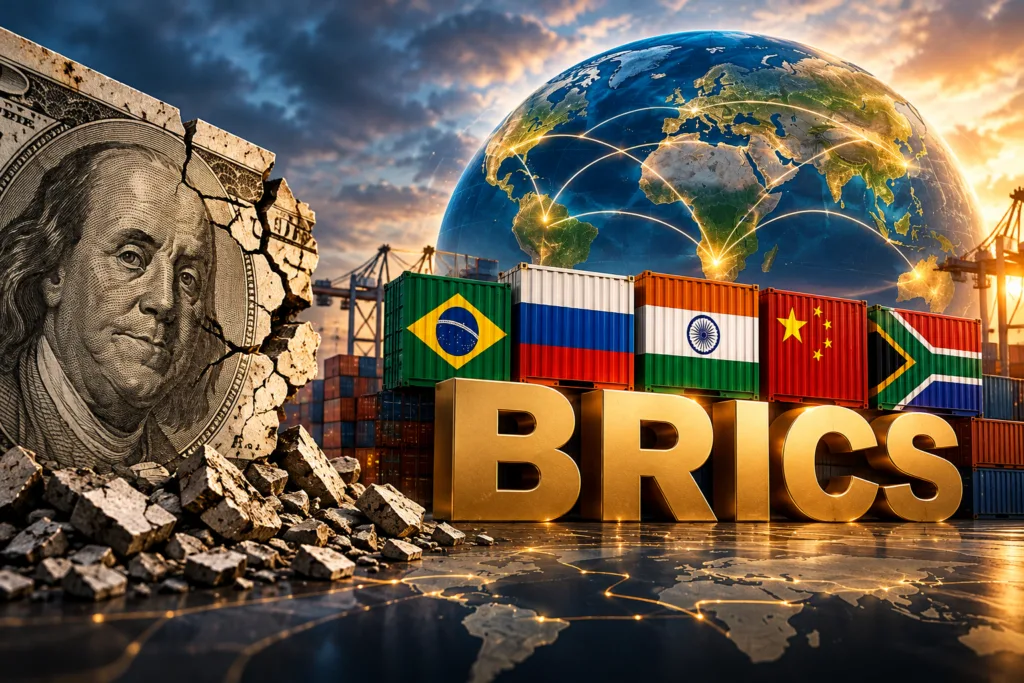
The world’s largest emerging economies are developing ways to trade without relying on the U.S. dollar. And the shift could have long-term implications for America’s financial future.
According to an October 20, 2026 report from Mint, South African diplomat Anil Sooklal confirmed that BRICS nations are working to expand trade in their own currencies and develop alternative payment systems.
While BRICS is not currently pursuing a shared currency, its members want to reduce their dependence on the U.S. dollar for international transactions.
Sooklal pointed to growing concerns over U.S. tariffs, sanctions, and the country’s influence over the global financial system as reasons behind the effort.
Why retirees should pay attention
For decades, the U.S. dollar has played a dominant role in global trade and financial reserves.
But what happens if more countries begin conducting business without it?
Over time, reduced international demand for dollars could put pressure on the currency’s value, although that outcome is far from guaranteed.
For retirees, the concern is purchasing power.
If the dollar weakens, imported goods and certain everyday expenses could become more expensive.
That matters when you’re living on a fixed income and relying on savings accumulated over decades.
Importantly, BRICS isn’t replacing the dollar overnight. The dollar remains the world’s dominant reserve currency. But efforts to create alternative payment systems show that some countries are preparing for a less dollar-dependent future.
The lesson: Is your retirement too dependent on the dollar?
You can’t control how other countries conduct trade or what happens to the dollar’s global role.
But you can evaluate how exposed your retirement savings are to currency and inflation risks.
Ask yourself:
-
How would a weaker dollar affect your retirement purchasing power?
-
Are all your retirement savings concentrated in dollar-denominated financial assets?
-
Have you considered diversification beyond traditional stocks and bonds?
Physical gold and silver are among the assets retirees may consider when evaluating currency uncertainty and diversification. Precious metals carry their own risks and do not guarantee protection against dollar declines.
The dollar doesn’t have to collapse for changes in purchasing power to affect your retirement. Understanding your options today can help you prepare for uncertainty tomorrow.
Is your retirement too concentrated in one asset?
Talk through your options in a free, no-obligation strategy call with a Precious Metals Specialist.
Book a Free Strategy CallAmerican Alternative Assets is a precious-metals dealer and does not provide investment, legal, tax, or retirement advice. Decisions regarding the purchase or sale of precious metals are solely the customer’s responsibility and should be made based on the customer’s own research and judgment. Source: Mint