








Introduction: Securing Your Retirement with Tangible Assets
A Gold IRA rollover is the process of transferring funds from an existing retirement account (like a 401(k) or traditional IRA) into a self-directed IRA that holds physical precious metals such as gold, silver, platinum, or palladium. This strategy allows you to diversify your retirement savings with tangible assets while maintaining the tax-advantaged status of your account.
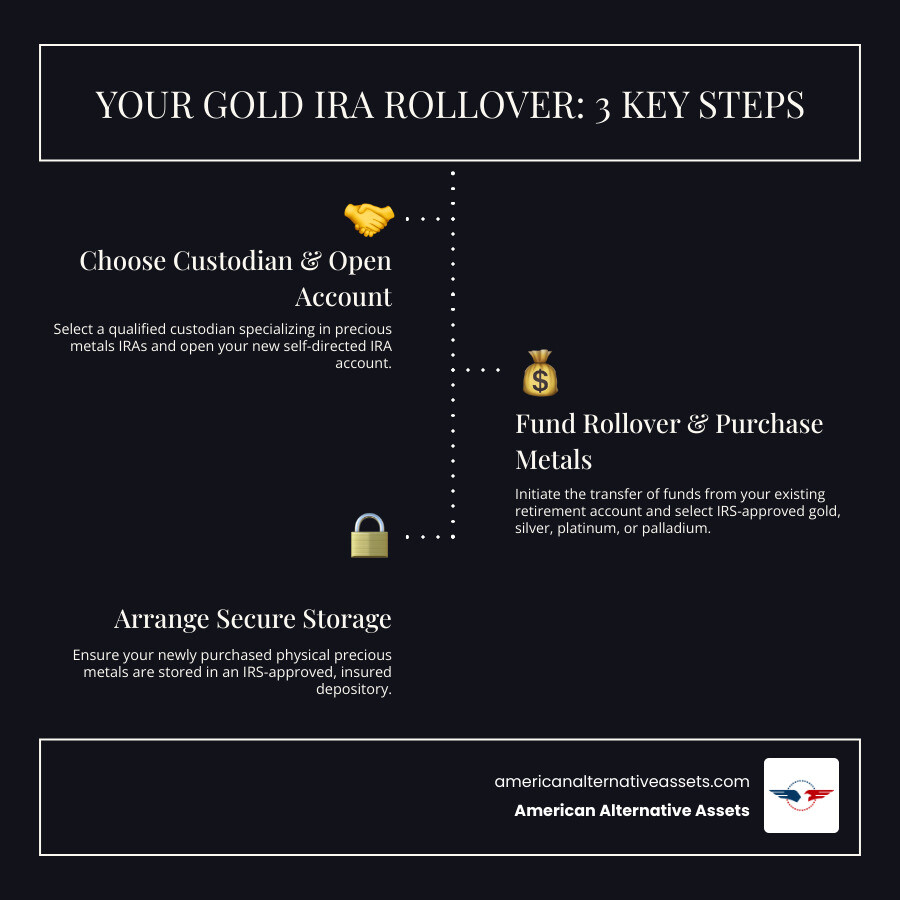
Quick Answer: How Does a Gold IRA Rollover Work?
- Choose a qualified custodian that specializes in precious metals IRAs
- Open a self-directed IRA account with that custodian
- Initiate the rollover by contacting your current plan administrator
- Select IRS-approved metals that meet purity standards (gold .995+, silver .999+, platinum .9995+)
- Arrange secure storage in an IRS-approved depository
When my grandfather handed me a silver Morgan coin at nine years old and said, “This is real money,” I didn’t fully understand. But decades later, after watching the 2008 crash unfold while working in venture capital, his words made perfect sense. Markets swing on emotion, not fundamentals, and families lost everything not because of bad decisions, but because the system itself was fragile.
Physical precious metals offer something different. Unlike paper assets that depend on corporate earnings or market sentiment, gold and platinum have intrinsic value. They’re tangible, they’re yours, and they don’t rely on anyone else’s promise. That’s why more Americans are exploring Gold IRA rollovers as a way to protect a portion of their retirement savings from economic uncertainty and inflation.
The process isn’t complicated, but it does require understanding IRS rules, choosing the right custodian, and knowing which metals qualify. This guide walks you through every step, from eligibility to execution, so you can make an informed decision about whether a Gold IRA rollover is right for your retirement strategy.
I’m Shanon Davis, founder of American Alternative Assets. After years in venture capital, I built this company to help ordinary Americans hold value outside the fragile paper system, including through properly structured Gold IRA rollovers that prioritize physical metals over paper promises.
Gold IRA rollover vocab explained:
What Is a Gold IRA and Why Consider It?
A Gold IRA is a specialized type of self-directed individual retirement account (SDIRA) that allows you to hold physical precious metals, like gold, silver, platinum, and palladium, as investments within your retirement portfolio. Unlike traditional IRAs that typically invest in stocks, bonds, and mutual funds (often referred to as “paper assets”), a Gold IRA lets you diversify with tangible assets.
Why would someone consider a Gold IRA rollover? Many individuals look to Gold IRAs as a hedge against economic volatility, inflation, and currency devaluation. Historically, precious metals have maintained their value during times of economic uncertainty, offering a potential safe haven for retirement savings. By diversifying a portion of your retirement funds into physical precious metals, you can gain more control over your investments and potentially safeguard your wealth from market fluctuations. It’s about moving beyond the traditional Wall Street products and embracing alternative assets for long-term value preservation.
The Key Difference: Physical Gold vs. “Paper Gold”
At American Alternative Assets, we firmly believe in the power of physical precious metals. There’s a crucial distinction between owning actual gold or platinum bullion and investing in “paper gold” assets like gold stocks or Exchange Traded Funds (ETFs).
When you own physical gold or platinum in your IRA, you hold a tangible asset with intrinsic value. This direct ownership means there’s no counterparty risk, which is the risk that the other party in a financial contract might default. The value of your physical metal is tied to the global market price of the commodity itself, not the performance of a mining company’s stock or the solvency of an ETF provider. Physical metals offer a layer of security that paper assets simply cannot replicate, providing a tangible foundation for your retirement wealth.
Types of Precious Metals IRAs
Just like traditional retirement accounts, Gold IRAs come in different flavors, each with its own tax advantages:
- Traditional Gold IRA: Contributions to a Traditional Gold IRA may be tax-deductible, and your investments grow tax-deferred. You pay taxes on your distributions in retirement, generally when you might be in a lower tax bracket.
- Roth Gold IRA: Contributions to a Roth Gold IRA are made with after-tax dollars, meaning they are not tax-deductible. However, your investments grow tax-free, and qualified distributions in retirement are also completely tax-free. Many investors find the tax-free growth of a Roth Gold IRA particularly appealing for long-term wealth building.
For 2025, the standard IRA contribution limit is $7,000 for individuals under 50 years old. If you’re aged 50 or above, you can make an additional catch-up contribution of $1,000, bringing your total contribution limit to $8,000. These limits apply to both Traditional and Roth IRAs, including those holding precious metals.
Your Step-by-Step Guide to the Gold IRA Rollover Process
Starting on a Gold IRA rollover might seem like a grand adventure, but with a clear map, it’s a smooth journey. We’ve broken down the process into five manageable steps to help you steer it with confidence.

Step 1: Choose a Reputable Gold IRA Custodian
The first, and arguably most critical, step is selecting a qualified and trustworthy self-directed IRA custodian. This institution will administer your account, ensure compliance with IRS regulations, and facilitate your precious metal transactions and storage. Think of them as the gatekeepers of your tangible assets.
When choosing a custodian, we recommend thorough research and due diligence. Look for a company with a solid track record, ideally one that has been in business for at least 5-10 years. Peruse online reviews and check for accreditation with organizations like the Better Business Bureau. For example, you can check BBB accreditation to gauge a company’s reputation and customer satisfaction. Transparent fees and responsive customer support are also key indicators of a reliable partner. At American Alternative Assets, we pride ourselves on our white-glove, relationship-first service, built on trust and transparency, ensuring real privacy and protection for your wealth.
Step 2: Open Your Self-Directed IRA
Once you’ve chosen your custodian, the next step is to open your self-directed IRA account. This typically involves completing an application form, which will require your personal data, beneficiary selections (if applicable), and details on how you plan to fund your account. This is your foundation for investing in alternative assets, giving you the power to choose investments beyond traditional stocks and bonds. You can learn more about how self-directed IRAs work on NerdWallet’s guide to self-directed IRAs.
Step 3: Fund Your New Account via Rollover
With your new Gold IRA account established, it’s time to fund it. This is where the “rollover” comes into play. You’ll initiate the transfer of funds from your existing retirement account (like a 401(k), 403(b), or another IRA) to your new Gold IRA custodian.
You’ll need to contact your current plan administrator or IRA provider to request the rollover. They will provide the necessary forms and guidance to move your funds. This step is crucial for maintaining the tax-advantaged status of your retirement savings. We’ll dig deeper into the differences between direct and indirect rollovers shortly, but generally, a direct rollover is the simplest and safest method.
Step 4: Select and Purchase IRS-Approved Metals
After your new Gold IRA is funded, you’ll work with your precious metals dealer (which can be your custodian or a separate, trusted dealer) to select and purchase the physical metals for your account. This is where your investment decisions take shape.

It’s absolutely essential that the metals you choose meet the strict purity standards set by the IRS. For gold, the fineness must be at least .995 (99.5% pure). Silver must be .999 pure, and platinum and palladium must be .9995 pure. Common examples of IRS-approved metals include American Gold Eagles, Canadian Gold Maple Leafs, and various gold, silver, and platinum bullion bars from accredited refiners. Choosing non-approved metals is a common mistake that can lead to significant tax implications, which we’ll discuss later.
Step 5: Arrange for Secure, Insured Storage
Unlike your jewelry collection, physical precious metals held in an IRA cannot be stored at home. The IRS mandates that all IRA-held precious metals must be stored in an approved, third-party depository. This ensures the security and integrity of your investment and prevents any potential self-dealing issues.
Your custodian will typically have established relationships with several IRS-approved depositories. You’ll arrange for your purchased metals to be shipped directly to one of these secure facilities. You can usually choose between segregated storage (where your specific metals are kept separate from others) or commingled storage (where your metals are pooled with others of the same type and fineness). Regardless of the choice, your metals will be insured and professionally managed. You’ll receive confirmation once your metals arrive and are processed at the depository. The concept of a depository is critical, as highlighted by Investopedia’s definition of a depository.
Understanding Rollover Rules, Eligibility, and Fees
Navigating retirement savings involves understanding a few rules of the road. When it comes to a Gold IRA rollover, compliance with IRS regulations is paramount to maintaining the tax-advantaged status of your hard-earned savings. Let’s break down the key aspects.
Eligibility for a 401(k) to Gold IRA Rollover
Not all retirement accounts are created equal when it comes to rollovers. However, many common retirement plans are eligible for a Gold IRA rollover:
- 401(k)s: Funds from a 401(k) are frequently rolled over. If you’re no longer employed by the company that sponsored the 401(k), you generally have full eligibility. If you’re still employed, you may need to wait until you leave your job to initiate a full rollover, unless your plan allows for “in-service distributions” (often available after age 59½).
- 403(b)s: Similar to 401(k)s, these plans (common for employees of public schools and tax-exempt organizations) are typically eligible for rollovers.
- Thrift Savings Plans (TSPs): Federal employees can roll over funds from their TSP accounts.
- Traditional IRAs and Roth IRAs: You can also roll over funds from an existing Traditional or Roth IRA into a Gold IRA.
The IRS provides a comprehensive chart detailing the various accounts you can roll money from and into. It’s always a good idea to consult this resource or your plan administrator to confirm your specific eligibility.
IRS-Approved Precious Metals
The IRS has strict guidelines on what types of precious metals can be held in an IRA. These rules are designed to ensure that the investments are legitimate and not merely collectibles. The key factor is purity:
- Gold: Must be at least .995 (99.5%) pure. This includes most gold bullion bars and rounds. Notable exceptions include American Gold Eagle coins, which are 22-karat (.9167 fineness) but are specifically approved due to their status as U.S. legal tender. Other gold coins like Canadian Maple Leafs also meet the .995 purity standard.
- Silver: Must be at least .999 (99.9%) pure. This includes most silver bullion bars, rounds, and coins like American Silver Eagles and Canadian Silver Maple Leafs.
- Platinum and Palladium: Both must be at least .9995 (99.95%) pure. This typically includes bullion bars and rounds.
Anything that doesn’t meet these purity standards, or is considered a collectible under 26 U.S.C. 408(m), is not allowed. Attempting to purchase non-eligible items with IRA funds would be treated as a distribution by the IRS, triggering potential taxes and penalties.
Common Fees Associated with a Gold IRA
As with any managed retirement account, a Gold IRA has fees for the administration and safekeeping of your assets. These are charged by your custodian and depository for their services:
- Account Setup Fee: A one-time fee to establish your new Gold IRA, typically around $50.
- Annual Administration Fee: Charged by the custodian for managing your account, record-keeping, and IRS reporting. These fees usually range from $75 to $300 per year.
- Secure Storage Fees: This is the cost for safely storing your physical precious metals in an IRS-approved depository. Storage fees can range from $100 to $300 per year, depending on the value of your holdings and whether you opt for segregated or commingled storage.
- Transaction Fees: Some custodians or dealers may charge fees for buying, selling, or transferring precious metals within your IRA. These can range from $25 to $100 per transaction.
It’s important to understand all fees upfront when choosing your custodian to avoid any surprises down the road.
Direct vs. Indirect Rollovers: Making the Right Choice
When it comes to transferring funds for your Gold IRA rollover, you generally have two main methods: a direct rollover or an indirect rollover. Understanding the differences is crucial for a smooth, tax-compliant process.
| Feature | Direct Rollover | Indirect Rollover |
|---|---|---|
| Fund Handling | Funds move directly between custodians | Funds are sent to you, then you deposit them |
| Tax Withholding | No mandatory tax withholding | 20% mandatory federal tax withholding (from 401k) |
| 60-Day Rule | Not applicable | Strict 60-day deadline to deposit funds |
| Risk of Penalties | Very low | High if 60-day deadline is missed |
| Processing Time | Typically a few days to two weeks | May take longer due to check clearing and your action |
| Complexity | Simpler, less prone to errors | More complex, requires careful management |
The Direct Rollover Method
A direct rollover is generally the preferred and safest method for a Gold IRA rollover. In this scenario, your existing retirement plan administrator (e.g., your 401(k) provider) or your current IRA custodian directly transfers your funds to your new Gold IRA custodian. You never physically handle the money.
This method offers several advantages:
- Simplicity: It’s a straightforward, custodian-to-custodian transfer, requiring less work and worry on your part.
- No Withholding: Because the funds don’t pass through your hands, there is no mandatory 20% federal tax withholding, which often applies to distributions from employer-sponsored plans.
- Avoids 60-Day Rule: The strict 60-day deadline for depositing funds does not apply, eliminating the risk of missing it and incurring taxes or penalties.
Direct rollovers typically take a few days to process, ensuring your funds move efficiently to their new home. Investopedia offers a detailed explanation of a direct rollover.
The Indirect Rollover Method
With an indirect rollover, your existing retirement plan administrator or IRA provider issues a check for your funds, made out to you. You then have 60 days from the date you receive the funds to deposit them into your new Gold IRA.
This method carries significant risks and complexities:
- 20% Mandatory Tax Withholding: If you’re rolling over from an employer-sponsored plan like a 401(k), your plan administrator is legally required to withhold 20% of your distribution for federal taxes. To roll over the full amount and avoid it being treated as a taxable distribution, you would need to come up with the 20% from other sources and deposit it into your new IRA.
- Strict 60-Day Deadline: You must deposit the full amount (including any withheld taxes, if you want to roll over the original full amount) into your new Gold IRA within 60 days. Failure to meet this deadline means the entire amount not rolled over is treated as a taxable distribution, and if you’re under 59½, it may also be subject to a 10% early withdrawal penalty.
- Potential for Delays: Indirect rollovers may require up to five business days for checks to clear, adding pressure to meet the 60-day window.
Given these complexities and risks, we strongly recommend a direct rollover whenever possible to safeguard your retirement savings. You can find more information about the rules for an indirect rollover on Investopedia.
Common Mistakes to Avoid and Tax Implications
Navigating a Gold IRA rollover requires attention to detail. A single misstep can lead to unnecessary taxes or penalties, eroding the very wealth you’re trying to protect. Let’s explore common pitfalls and the tax consequences of your choices.
Mistakes to Avoid During the Rollover Process
We’ve helped countless clients through this process, and we’ve seen the common traps. Here are the top mistakes to steer clear of:
- Choosing Non-Approved Metals: As discussed, the IRS has strict purity standards. Purchasing metals that don’t meet these requirements can lead to your IRA being disqualified, and the purchase treated as a taxable distribution. Always verify eligibility with your custodian and dealer.
- Not Understanding the Fee Structure: It’s important to have a clear understanding of the fee structure for your account. Before choosing a custodian, be sure to ask for a transparent breakdown of all service charges, including any fees for account setup, administration, and storage.
- Missing the 60-Day Indirect Rollover Deadline: This is perhaps the most costly mistake. Failure to deposit funds from an indirect rollover within the 60-day window means the entire amount becomes taxable income. If you’re under 59½, an additional 10% early withdrawal penalty will apply. For example, failing to roll over $10,000 could result in significant taxes and penalties. The IRS permits only one rollover per year between IRAs, making careful handling of the process very important.
- Attempting Home Storage: This is a big no-no. The IRS explicitly prohibits storing IRA-held precious metals at your home or in a personal safe. Your metals must be held by an approved custodian in an IRS-approved depository. People who have tried to go that route before have found out the hard way that the IRS doesn’t take kindly to people who ignore the rules regarding IRA custodianship, leading to severe penalties and disqualification of the IRA.
Understanding the Tax Implications of Your Gold IRA Rollover
The tax implications of your Gold IRA rollover depend on the type of accounts involved:
- Traditional IRA to Traditional Gold IRA: This is generally a tax-deferred transfer. You won’t pay taxes on the rollover itself, and your investments will continue to grow tax-deferred until you take distributions in retirement.
- Roth IRA to Roth Gold IRA: A direct transfer from a Roth IRA to a Gold IRA incurs no taxes, as both accounts are funded with after-tax dollars. Your investments continue to grow tax-free, and qualified distributions remain tax-free. You can learn more about Roth rollovers from the IRS’s guide on rolling over to a Roth IRA or designated Roth account.
- Rollovers from Pre-Tax 401(k)s or other Employer Plans: If you roll over funds from a pre-tax 401(k) (or 403(b), TSP) into a Traditional Gold IRA, the rollover is tax-deferred. If you choose an indirect rollover, 20% mandatory federal tax withholding will apply, and you’ll need to make up that amount from other sources to roll over the full original sum and avoid it being treated as a taxable distribution.
It is always advisable to consult with a tax professional to understand the specific implications for your personal financial situation.
Frequently Asked Questions about Gold IRA Rollovers
We know you have questions, and we’re here to provide clear answers. Let’s tackle some of the most common inquiries about Gold IRA rollovers.
Can I roll over a 401(k) from a current employer?
Generally, no, you cannot roll over a 401(k) from a current employer while you are still employed there, unless you are over age 59½ and your plan allows for “in-service distributions.” Most Gold IRA rollovers from employer-sponsored plans, such as 401(k)s or 403(b)s, are initiated after you leave your job. This is because your current employer’s plan typically restricts when funds can be moved out. Always check with your current 401(k) plan administrator to understand their specific rules and options.
How long does a Gold IRA rollover take?
The timeline for a Gold IRA rollover can vary depending on the method and the efficiency of the institutions involved:
- Direct Rollovers: These are generally the quickest. Once all paperwork is submitted and approved, a direct transfer from your old custodian to your new Gold IRA custodian can typically take a few days to two weeks.
- Indirect Rollovers: These can take longer. After your previous plan administrator processes the distribution check, it may require up to five business days for the check to clear. The remaining time depends entirely on how quickly you deposit the funds into your new Gold IRA within the strict 60-day deadline. Funds may then appear in your new Gold IRA within 14 business days after deposit.
Working with experienced professionals can help streamline the process and ensure timely completion.
What are the contribution limits for a Gold IRA?
A Gold IRA is a type of Individual Retirement Account, so it adheres to the same annual contribution limits as Traditional and Roth IRAs. For 2025, if you are under 50 years old, you can contribute up to $7,000. For those aged 50 and above, an additional “catch-up” contribution of $1,000 is allowed, bringing the total to $8,000.
These limits apply to new contributions. Funds transferred through a Gold IRA rollover from an existing retirement account do not count towards these annual contribution limits, allowing you to move larger sums into your precious metals IRA.
Take Control of Your Retirement Future
In a world filled with economic uncertainties and fluctuating markets, taking proactive steps to safeguard your retirement savings is more important than ever. A Gold IRA rollover offers a unique opportunity to diversify your portfolio with tangible, historically stable assets like physical gold and platinum, protecting your wealth from potential inflation and market downturns.
At American Alternative Assets, we are passionate about empowering individuals with financial preparedness and personal responsibility. Our white-glove, relationship-first service is designed to guide you through every step of the Gold IRA rollover process with trust, transparency, and ethical practices. We believe in building lasting wealth through real privacy and protection for your assets.
Don’t let your retirement future be solely dependent on paper promises. Explore the value of tangible asset diversification and partner with a trusted specialist.
Explore your Gold IRA options today
This article is for informational purposes only and does not constitute financial advice. Please consult your financial advisor before making investment decisions.
Investing in precious metals involves risk. Past performance does not guarantee future results.