








Why Your Retirement Deserves More Than Paper Promises
When you transfer 401k to IRA, you’re taking control of your financial future by moving retirement funds from an employer-sponsored plan into an Individual Retirement Account (IRA). Here’s what you need to know:
Quick Answer: Transfer 401k to IRA in 3 Steps
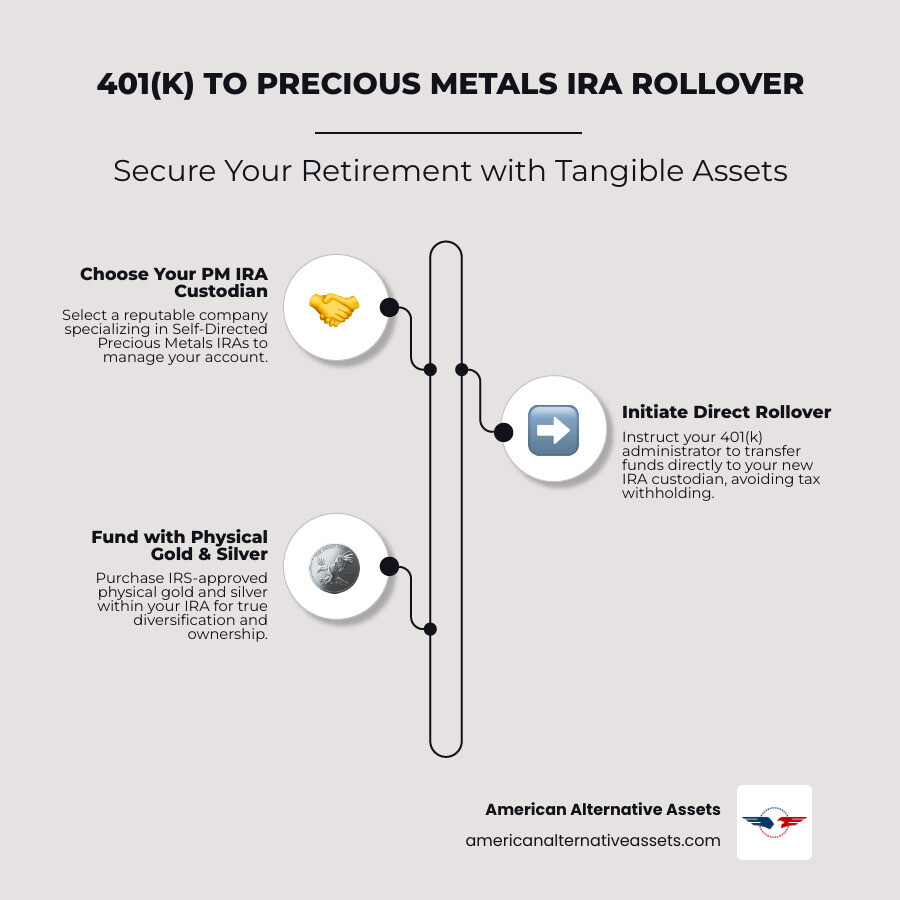
- Choose a Self-Directed Precious Metals IRA – Select this IRA type to hold physical gold and silver, aligning with your goal of tangible asset ownership
- Initiate a direct rollover – Contact your 401(k) administrator and request they send funds directly to your new IRA custodian (avoids 20% tax withholding)
- Complete the transfer – Fill out required paperwork and ensure funds move within 60 days if you receive a check directly
“This is real money.” That’s what my grandfather told me when I was nine, handing me a silver Morgan coin. I didn’t understand it then, but after decades in venture capital and watching the 2008 crash wipe out families who thought their paper assets were safe, I finally got it.
Most Americans have their retirement locked in employer-sponsored 401(k) plans. These accounts typically offer just 20 to 40 mutual fund options, all paper-based assets tied to market volatility. When you leave a job, you face a choice. You can leave your money in your old employer’s plan, roll it to your new employer’s 401(k), cash it out (and face taxes plus a 10% penalty if you’re under 59½), or transfer 401k to IRA.
The stakes are high. A 1% increase in fees could reduce your retirement account balance by 28%. If you have less than $1,000 in your account, your employer can simply cash it out and hand you a check (minus 20% tax withholding). Between $1,000 and $5,000? They can move it into an IRA without asking you.
The real question isn’t just whether to transfer, it’s what kind of IRA you choose. While many people roll their 401(k) into a Traditional or Roth IRA that still holds paper assets like stocks and bonds, there’s another path. A Self-Directed Precious Metals IRA lets you own physical gold and silver, tangible assets that have held value for thousands of years while currencies and paper markets have come and gone.
I’m Shanon Davis, and after watching the fragility of paper-based systems firsthand, I built American Alternative Assets to help ordinary Americans transfer 401k to IRA accounts backed by physical precious metals, not promises. Here’s how the process works and why it matters for your financial security.
Transfer 401k to IRA basics:
- gold backed ira account
- gold in retirement portfolio
- how to invest in precious metals with a self-directed ira
Why Consider a 401(k) to Precious Metals IRA Rollover?
For many, a 401(k) is a familiar retirement vehicle, but it often comes with limitations. When you transfer 401k to IRA, especially a Precious Metals IRA, you’re not just moving money-you’re potentially upgrading your retirement strategy. This move can offer greater control, improved diversification, and the peace of mind that comes from owning tangible assets. We believe your retirement deserves more than promises tied to the fluctuating value of paper.
The Limitations of a Standard 401(k)
Standard 401(k) plans, while convenient, often come with significant restrictions. They typically offer a limited menu of investment options-around 20 to 40 mutual funds. These funds are predominantly composed of paper assets like stocks, bonds, and ETFs, which are inherently tied to market performance and can be vulnerable during economic downturns. This narrow selection means you have less control over your portfolio’s composition and often cannot truly diversify beyond traditional financial instruments.
Moreover, employer-sponsored plans are subject to the decisions and influence of your employer, not solely your own financial goals. This can lead to a lack of transparency regarding fees and performance. As we’ve seen, even a seemingly small 1 percent increase in fees could reduce your retirement account balance by a staggering 28 percent over time. If you’re wondering about the impact of fees, our Retirement Advisor Fees Calculator can help illustrate this point. The reliance on paper assets, as highlighted in “The Retirement Crisis No One Saw Coming: How Tariffs Just Wrecked Americans 401ks,” underscores the need for diversification away from purely paper-based investments.
The Advantages of Taking Control with a Precious Metals IRA
When you transfer 401k to IRA and specifically choose a Precious Metals IRA, you open up a world of tangible benefits. This type of Self-Directed IRA allows you to hold physical gold and silver bullion, offering a true hedge against inflation and economic instability that paper assets simply cannot provide. We believe in direct ownership of tangible assets because it provides a foundation of security that isn’t dependent on the performance of a company or the stability of a currency.
This move offers the potential for greater diversification, allowing you to move beyond the limited choices of a typical 401(k) and incorporate assets that often move independently of stocks and bonds. Consolidating your various retirement accounts into a single IRA can also simplify your financial life, making it easier to manage your investments and track your progress toward your Retirement Planning goals. Additionally, IRAs often provide more flexibility in estate planning compared to employer plans, giving you greater control over how your wealth is passed on to your beneficiaries. Exploring Types of Retirement Accounts can further clarify these advantages.
The Two Rollover Methods: Direct vs. Indirect
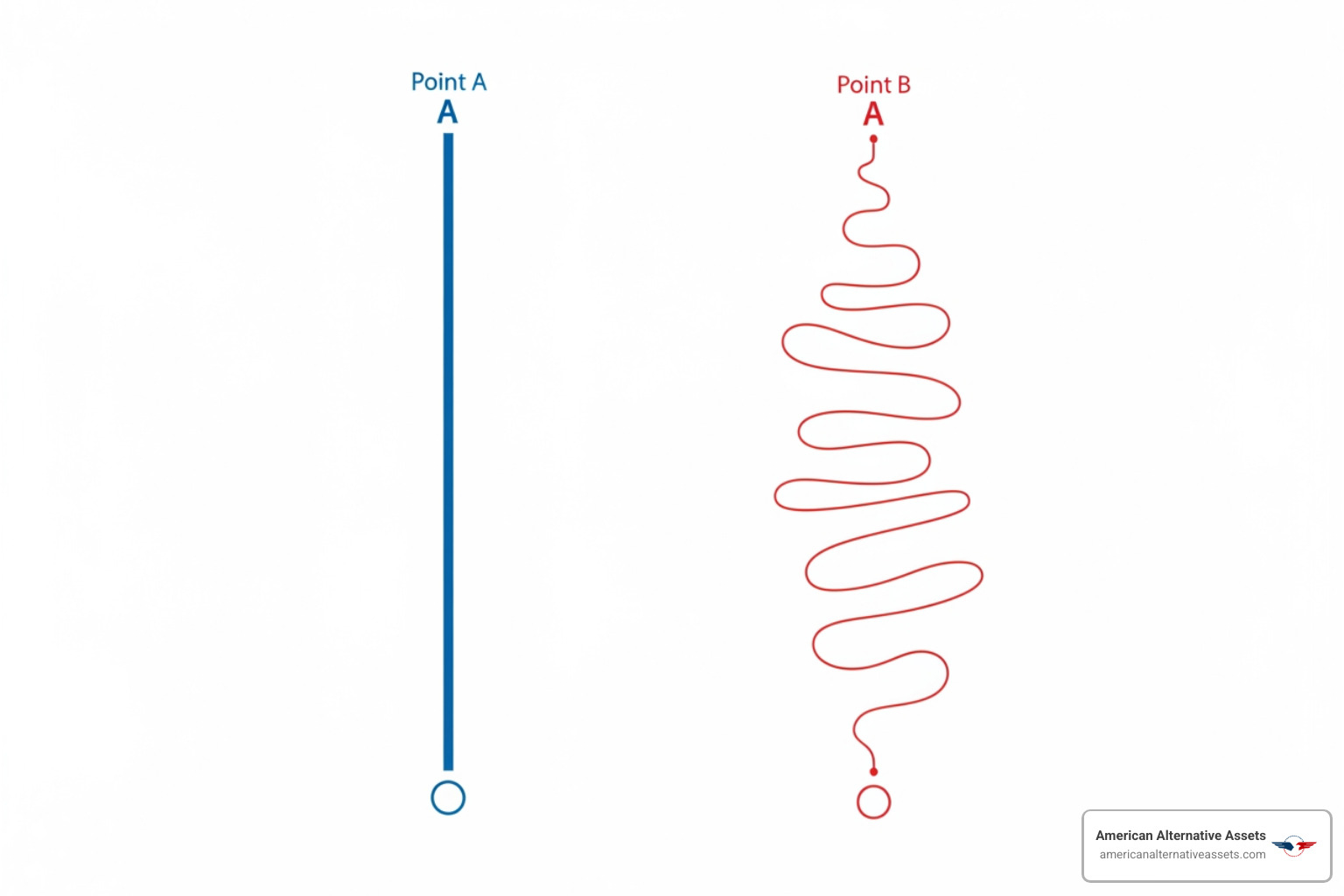
When you decide to transfer 401k to IRA, you generally have two main ways to move your funds: a direct rollover or an indirect rollover. Understanding the differences is crucial, as each method has distinct implications for taxes, timing, and potential penalties. We always recommend the most secure and straightforward path to protect your hard-earned retirement savings.
The Safest Path: The Direct Rollover
A direct rollover is, without a doubt, the preferred method when you transfer 401k to IRA. With a direct rollover, your old 401(k) plan administrator transfers your money directly to your new IRA custodian. The funds never pass through your hands, meaning there is no mandatory tax withholding and no risk of missing a critical deadline. This trustee-to-trustee transfer is the simplest and most secure way to move your retirement assets, ensuring a seamless transition without unexpected tax complications. It’s like moving money from one secure vault to another, directly and efficiently.
The Riskier Route: The Indirect Rollover
While possible, an indirect rollover carries more risks and potential complications. In this scenario, your old 401(k) plan pays the money directly to you. The catch? Most plans are required to withhold 20% of the distribution for federal income taxes, even if you intend to roll it over. You then have a strict 60-day deadline from the date you receive the funds to deposit the entire amount (including the 20% that was withheld, which you’d need to replace from other sources) into your new IRA.
If you miss this 60-day window, or if you don’t roll over the full amount (including the withheld portion), the distribution becomes taxable income. Furthermore, if you’re under age 59½, you’ll likely incur an additional 10% early withdrawal penalty. This method places the burden and risk squarely on your shoulders, making it a less-than-ideal choice for safeguarding your retirement funds. For more details on this, the IRS provides guidance on distributions subject to the 60-day rule.
Choosing Your IRA: The Path to True Diversification with Physical Precious Metals
When you transfer 401k to IRA, the choice of IRA type is paramount. It determines not only your investment options but also your level of true diversification. While many IRAs still rely on paper assets, we advocate for a different approach: a Self-Directed Precious Metals IRA, which allows you to hold tangible assets like physical gold and silver. This is where real diversification begins.
| Feature | Standard IRA (Paper Assets) | Self-Directed Precious Metals IRA (Physical Gold & Silver) |
|---|---|---|
| Asset Type | Stocks, bonds, mutual funds, ETFs, cash | Physical gold, silver, platinum, palladium bullion (IRS-approved) |
| Ownership | Indirect ownership of underlying assets | Direct ownership of tangible, physical metals |
| Diversification | Diversification within paper asset classes | Diversification beyond paper assets, into tangible, real-world wealth |
| Hedge Against Inflation | Limited, often correlated with market | Strong, historically proven hedge against inflation and currency devaluation |
| Market Volatility | Highly susceptible to market fluctuations and geopolitical events | Often acts as a safe haven during market downturns |
| Tangibility | No physical asset | You own physical precious metals, stored securely |
| Control | Dependent on fund managers, market forces | Direct control over physical assets, chosen by you |
| “Paper Promises” | Value tied to company performance, government stability | Intrinsic value, independent of paper markets |
| Geopolitical Risk | Vulnerable to global economic and political instability | Historically resilient during times of geopolitical uncertainty |
Standard IRAs: Still Tied to Paper Assets
Most Traditional and Roth IRAs, while offering more investment choices than a 401(k), still primarily invest in paper assets like stocks, bonds, mutual funds, and exchange-traded funds (ETFs). These assets share a fundamental vulnerability: their value is intrinsically linked to the performance of corporations, governments, and the broader financial markets.
This means that during periods of economic instability or market downturns, these assets can all move in the same direction, downwards. There’s a correlation that can leave your portfolio exposed, regardless of how many different stocks or bonds you hold. The lack of physical ownership means your wealth exists as numbers on a screen, subject to the whims of algorithms, policy changes, and global events. As we discuss in “Geopolitical Tensions and Your Retirement: Why Precious Metals IRA Could Be Your Safety Net,” relying solely on paper assets can leave your retirement vulnerable.
Self-Directed Precious Metals IRAs: Opening up Tangible Assets like Gold and Silver
A Self-Directed Precious Metals IRA fundamentally shifts your investment paradigm. Instead of holding paper assets, your IRA owns physical gold, silver, platinum, or palladium bullion. This provides true diversification, allowing your retirement portfolio to include assets that have historically preserved wealth and acted as a hedge against inflation and currency devaluation.
We believe that physical ownership of tangible assets like gold and silver offers a unique form of security. Your wealth isn’t just a promise-it’s a physical commodity with intrinsic value. This allows for genuine control over your wealth, providing a counterweight to the volatility and uncertainty often associated with paper markets. Understanding the Precious Metals IRA Rules Guide is key to maximizing these benefits. As we often ask, Why Invest in a Gold IRA? The answer lies in the enduring power of tangible assets to protect and grow your retirement savings.
Your Step-by-Step Guide to a 401(k) to Precious Metals IRA Transfer

Ready to make the move and transfer 401k to IRA with physical precious metals? The process is designed to be straightforward, especially when guided by experts. Here’s a clear, step-by-step breakdown of how we help our clients at American Alternative Assets steer this important transition. For a deeper dive into the mechanics, our guide on How Does a Gold IRA Work? is an excellent resource.
Step 1: Choose a Reputable Precious Metals IRA Company
Your first and most crucial step is to partner with a trusted Precious Metals IRA company. We pride ourselves on offering white-glove, relationship-first service, built on trust, transparency, and ethical practices. Our team provides expert guidance and comprehensive account setup assistance, ensuring a seamless process from start to finish. We’ll help you establish your Self-Directed IRA with an IRS-approved custodian, which is a non-negotiable requirement for holding physical precious metals in an IRA. For more insights on this, refer to our Precious Metals IRA Custodian Complete Guide.
Step 2: Initiate the Direct Rollover from Your 401(k)
Once your Precious Metals IRA is established, we’ll help you initiate the direct rollover from your existing 401(k). This involves contacting your 401(k) administrator and completing the necessary paperwork to request a direct, trustee-to-trustee transfer of funds to your new IRA custodian. Specifying a direct rollover is key to avoiding mandatory tax withholding and potential penalties. We’ll guide you through this process to ensure a smooth and tax-efficient transfer of your funds.
Step 3: Fund Your New Self-Directed Precious Metals IRA
After you’ve initiated the direct rollover, the funds from your 401(k) will be transferred directly to your new Self-Directed Precious Metals IRA. Because this is a direct, trustee-to-trustee transfer, it is not considered a taxable event. Your account will then be funded and ready for the next exciting step: selecting your precious metals.
Step 4: Select Your IRS-Approved Precious Metals
With your account funded, you’ll work with us to select your IRS-approved precious metals. This includes choosing between gold or silver, and deciding on specific forms like coins or bars. It’s vital that the metals meet strict IRS purity standards (e.g., 99.5% fineness for gold). We provide expert guidance to help you build a tangible portfolio that aligns with your diversification goals. Your selected metals will then be securely stored at an IRS-approved depository. Our Gold IRA Investing Guide offers valuable insights into making these choices.
Key Rules and Considerations for Your Rollover
Understanding the rules governing rollovers is essential to ensure your transfer 401k to IRA is successful and tax-compliant. These regulations, set by the IRS, are designed to protect your retirement savings, but missteps can lead to unexpected taxes and penalties. We’re here to help you steer these complexities.
Understanding the 60-Day and One-Rollover-Per-Year Rules
The 60-day rule is a critical deadline, primarily applicable to indirect rollovers. If you receive a distribution directly from your 401(k) or IRA, you generally have 60 days to deposit those funds into another eligible retirement account to avoid immediate taxation and potential penalties. Missing this deadline means the distribution is considered taxable income, and if you’re under 59½, a 10% early withdrawal penalty may apply. The IRS offers specific guidance on Rollovers of retirement plan and IRA distributions.
Separately, for IRA-to-IRA rollovers (where you receive the check directly, not a trustee-to-trustee transfer), there’s a “one-rollover-per-year” rule. This means you generally cannot make more than one indirect rollover from any of your IRAs within a 12-month period, aggregating all your IRAs. However, this rule does not apply to direct trustee-to-trustee transfers, which is another reason we advocate for the direct rollover method when you transfer 401k to IRA.
Navigating Required Minimum Distributions (RMDs)
Required Minimum Distributions (RMDs) are amounts that traditional IRA and 401(k) account holders must start withdrawing from their accounts once they reach a certain age. As of January 1, 2023, the age for taking RMDs is 73. A crucial point to remember is that if you are subject to RMDs for a given year, you must take that year’s RMD from your old 401(k) before you roll over the remaining funds to an IRA. Any amount that qualifies as an RMD cannot be rolled over. Attempting to roll over an RMD can lead to tax penalties. Our guide on Required Minimum Distributions (RMDs): Rules and Penalties provides more detailed information.
There is a “still-working” exception for 401(k)s, which allows some individuals to defer RMDs from their current employer’s 401(k) past age 73 if they are still employed by that company and don’t own a significant portion of the business. However, this exception typically does not apply to IRAs, meaning if you roll your 401(k) into an IRA, you’ll likely be subject to RMDs at age 73 regardless of your employment status.
Early Withdrawal Penalties and Exceptions
Generally, distributions from 401(k)s or IRAs taken before age 59½ are subject to your ordinary income tax rate plus an additional 10% early withdrawal penalty. This is a significant consideration when accessing your retirement funds.
However, the IRS does provide several exceptions to this 10% penalty. These can include distributions due to disability, death, certain unreimbursed medical expenses, qualified higher education expenses, or up to $10,000 for a first-time home purchase. While these exceptions exist, we always advise careful planning to avoid early withdrawals from your retirement savings. It’s also worth noting that some 401(k) plans offer the “Rule of 55,” which allows individuals who leave their job (or are terminated) in the year they turn 55 or later to take penalty-free withdrawals from that specific 401(k) plan. This rule does not apply to IRAs.
Take Control of Your Financial Future with Physical Precious Metals
Your retirement journey is a marathon, not a sprint, and every decision you make regarding your hard-earned savings is critical. Choosing to transfer 401k to IRA is a powerful step towards greater control and flexibility. However, the ultimate security often lies in what your IRA holds.
At American Alternative Assets, we believe in the enduring power of tangible assets. In a world increasingly reliant on paper promises and susceptible to market volatility, physical gold and silver offer a time-tested foundation for wealth preservation. By diversifying your retirement portfolio with precious metals, you’re not just investing; you’re securing your retirement with assets that have historically maintained their value through economic shifts and geopolitical uncertainties.
We are dedicated to helping you achieve this security through our white-glove service, built on trust, transparency, and ethical practices. We ensure real privacy and protection for your wealth, guiding you through every step of establishing and funding your Self-Directed Precious Metals IRA.
Take the proactive step to safeguard your future. Learn more about Navigating Your Golden Years with Confidence: How American Alternative Assets Simplifies Precious Metal investing.
Ready to explore how physical gold and silver can fortify your retirement? Discover the Power of a Self-Directed Precious Metals IRA Today.
This article is for informational purposes only and does not constitute financial advice. Please consult your financial advisor before making investment decisions.
Investing in precious metals involves risk. Past performance does not guarantee future results.