








Why Physical Asset Protection Is the Foundation of Lasting Wealth
Physical asset protection is the practice of securing tangible property, people, and high-value items from theft, damage, natural disasters, and unauthorized access.
Here is a quick overview of what effective physical asset protection involves:
- Identify your assets – buildings, equipment, vehicles, inventory, and valuables like precious metals
- Assess your risks – theft, vandalism, workplace violence, natural disasters, and cyber-physical threats
- Apply layered security controls – physical barriers, access control, surveillance, and monitoring systems
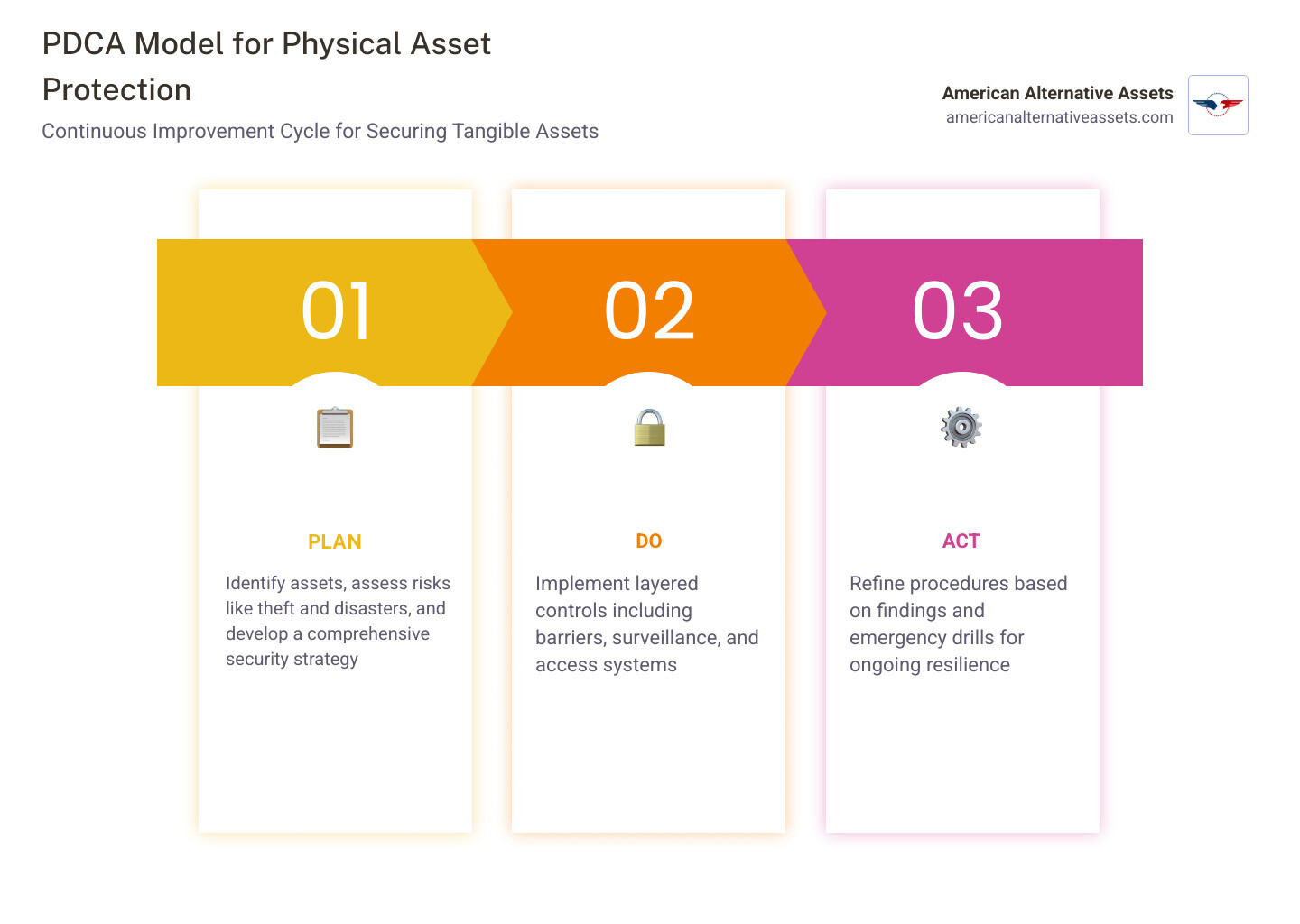
- Use a management framework – structured programs like the Plan-Do-Check-Act (PDCA) model help you design, implement, and continuously improve your protection strategy
- Plan for emergencies – disaster recovery and facility shutdown procedures minimize losses when the unexpected happens
The stakes are real. An estimated 3.8 million workers experienced workplace violence in 2022 alone, a figure that has risen 50% since 2019. Construction and industrial equipment theft costs the industry billions every year. And for individuals holding physical wealth like gold or silver, basic homeowners’ insurance typically covers precious metals for as little as $250 per item type, leaving most holdings dangerously underprotected.
The core idea is simple. Real assets require real protection. Whether you are a business securing critical equipment or an individual safeguarding tangible wealth, a structured approach to physical asset protection is not optional. It is essential.
I am Shanon Davis, and my background in venture capital, combined with a lifelong appreciation for tangible assets rooted in my grandfather’s words about “real money,” has shaped my understanding of physical asset protection as a cornerstone of sound wealth preservation. That perspective is what drives the work we do at American Alternative Assets, where we help people protect what truly holds value.
The Strategic Importance of Physical Asset Protection
In our modern world, we often get caught up in the digital realm. We worry about firewalls and passwords, which are certainly important, but we sometimes forget that the most valuable things we own still exist in the physical world. Whether it is the people who make our organizations run or the physical gold that anchors a retirement portfolio, physical asset protection is the bedrock of any serious security strategy.
When we talk about assets, we are looking at two main categories. Tangible assets include your property, infrastructure, equipment, and people. Intangible assets include things like your brand reputation and proprietary information. Interestingly, the ANSI/ASIS PAP.1-2012 Standard defines an organization’s assets as the people, property, information, and intangibles based in facilities. This means that even your reputation can be physically protected by securing the environment where your business operates.

One of the most sobering reasons to prioritize this is the rise in workplace violence. With an estimated 3.8 million workers falling victim in 2022, organizations must realize that their most precious “physical asset” is their workforce. Implementing a robust Physical Asset Protection Management System (PAPMS) is not just about locking doors, it is about creating an environment where people feel safe and organizational resilience is built into the culture.
We believe that risk ownership is a team sport. It is not just the job of the security guard at the front desk. Every person in an organization should understand how to identify a vulnerability, from a propped-open door to an unidentified visitor. By using the PDCA (Plan-Do-Check-Act) model, we can treat security as a living process that evolves as threats change.
Technological Innovations in Physical Asset Protection
The days of relying solely on a heavy padlock and a flashlight are long gone. Today, we have access to incredible technology that makes physical asset protection more proactive than ever.
AI-enhanced surveillance is a game changer. Instead of a human guard trying to watch twenty screens at once (and inevitably missing the one where someone is climbing a fence), AI can filter through the noise. It can distinguish between a stray cat and a person with a crowbar, alerting security only when there is a genuine threat. This reduces “alarm fatigue” and ensures that when an alert sounds, people take it seriously.
For those managing high-value equipment, GPS tracking for high-value equipment has become a necessity. Construction and industrial equipment theft is a billion-dollar problem. We have seen cases where a generator is moved outside a geofenced area at 3:00 AM, triggering an instant alert. This allows for rapid response and recovery before the equipment is stripped for parts or shipped across state lines.
Cloud-based access control and biometric solutions also offer a level of precision we could only dream of a decade ago. Mobile credentials allow employees to use their smartphones to enter secure areas, eliminating the risk of lost physical keys or cloned badges. If an employee leaves the company, their access can be revoked instantly from a central dashboard, regardless of where the facility is located.
Operational Procedures for Physical Asset Protection
Technology is wonderful, but it is only as good as the procedures behind it. We always recommend starting with a thorough vulnerability assessment. This means looking at your facility from the perspective of an intruder. Where are the weak points? Is the lighting sufficient? Are the high-value assets stored in the center of the building or near an easily accessible loading dock?
Once you identify the risks, you need clear Asset Protection Strategies that everyone understands. This includes:
- Facility Shutdown Protocols: If a natural disaster like a wildfire or a major storm is approaching, who is responsible for securing the site? Do you have a checklist for powering down equipment and securing hazardous materials?
- Emergency Response Planning: Everyone should know exactly what to do in the event of a security breach or workplace violence incident. This requires regular training and drills, not just a dusty manual on a shelf.
- Disaster Recovery: If the worst happens and assets are lost or damaged, how quickly can you resume operations? This involves everything from insurance documentation to backup power systems.
In California, we are particularly aware of natural disaster risks. Proper physical asset protection means ensuring that outdoor equipment is either moved inside or securely anchored when high winds or storms are forecast. It also means knowing if your neighbors store hazardous materials that could affect your site during an emergency.
Advanced Security Controls and Layered Defense
The most effective way to protect any physical asset is through a “layered defense” or “defense in depth.” Think of it like an onion. If a thief peels back one layer, they should immediately find themselves facing another obstacle.
The first layer is your perimeter. This includes fences, gates, and clear signage. The goal here is deterrence. If a facility looks difficult to break into, many opportunistic criminals will simply move on to an easier target.
The second layer is the building exterior. This involves reinforced doors, high-quality locks, and monitored entry points. This is where access control systems shine, ensuring that only authorized personnel can cross the threshold.
The third layer is interior security. This is where you protect your highest-value assets. For a business, this might be the server room or a secure storage area for inventory. For an individual, this is where you might employ specialized safes or vaults.
| Physical Controls | Digital/Technological Controls |
|---|---|
| Fences and Bollards | AI-Enhanced Video Analytics |
| High-Security Locks | Biometric Access (Fingerprint/Iris) |
| Reinforced Doors/Windows | GPS Tracking and Geofencing |
| Security Guards | Cloud-Based Monitoring Systems |
| Safes and Vaults | Intrusion Detection Sensors |
Convergence of Physical and Cybersecurity
We live in a world where physical security and cybersecurity are no longer separate departments. They are two sides of the same coin. This is known as “convergence.”
Most modern physical security tools, like cameras and smart locks, are part of the Internet of Things (IoT). While this makes them incredibly convenient, it also makes them potential targets for hackers. If a cybercriminal can hack into your security camera system, they can use it to scout your facility or even disable the alarms before they arrive in person.
An integrated security model addresses these vulnerabilities. It ensures that your physical security hardware is protected by robust network security. This means using encrypted communications, changing default passwords on all devices, and ensuring that security software is always kept up to date. When physical and cyber teams work together, the result is a much more resilient organization.
Securing High-Value Tangible Wealth
When we shift our focus from corporate facilities to personal wealth, the principles of physical asset protection remain the same, but the tactics become more personal. For those who understand the value of physical gold and silver, the question of storage is paramount.
Many people start with home storage. While we appreciate the desire for 24/7 access, basic home security is often insufficient for significant holdings. Basic homeowners’ insurance policies are notorious for their low limits on precious metals, often covering only a few hundred dollars. To truly protect your wealth at home, you need more than a standard lockbox.
Strategic hiding places and “hiding in plain sight” can be effective for smaller amounts. For instance, a high-quality book safe tucked away on a shelf full of real books is much less likely to be targeted than a visible, unbolted safe in a master closet. Thieves are often in a rush, they check the obvious spots first.
However, for larger amounts of wealth, professional solutions are often the wisest choice. This is where the Precious Metal Security: Ultimate Guide becomes an essential resource. Professional vaulting services offer a level of security that is nearly impossible to replicate at home, including 24/7 armed guards, advanced seismic sensors, and comprehensive insurance.
For our clients, we often discuss the benefits of third-party storage facilities like the Delaware Depository. These facilities are specifically designed for the high-security storage of precious metals, providing peace of mind that your physical wealth is protected by the best technology and personnel in the industry.
Physical Gold vs Paper Assets
At American Alternative Assets, we are firm believers that if you can’t hold it, you don’t truly own it. This is the fundamental difference between physical gold and “paper gold” like ETFs or gold mining stocks.
Paper assets are subject to counterparty risk. If the institution holding the paper fails, or if the market experiences extreme volatility, your “investment” could vanish or become inaccessible. You are essentially holding a promise, and promises can be broken.
Physical gold, on the other hand, is a tangible asset with no default risk. It has been a store of value for thousands of years. When you own physical coins or bars, you have a direct claim on that wealth. It doesn’t rely on a CEO’s performance or a bank’s solvency.
Furthermore, physical gold provides a level of privacy and portability that digital assets simply cannot match. In an era of increasing financial surveillance, the ability to hold a portion of your wealth in a tangible, private form is a key component of physical asset protection. This is why many of our clients choose to incorporate physical metals into their retirement strategy through IRA Gold Storage, combining the tax advantages of an IRA with the security of physical ownership.
Frequently Asked Questions about Physical Asset Protection
What are the primary threats to physical assets today?
The threats are diverse and evolving. Theft and burglary remain the most common concerns for both businesses and individuals. However, we are also seeing a significant increase in workplace violence and “smash-and-grab” incidents. Natural disasters, such as the wildfires and floods we see in California, pose a massive risk to physical infrastructure. Finally, we cannot ignore cyber-physical attacks, where hackers target the very systems meant to protect our assets.
How does a layered security approach work?
Think of it as a series of hurdles. A layered approach starts at the perimeter (fences, lighting, cameras). If someone gets past that, they hit the building shell (reinforced doors, alarms). If they get inside, they face interior controls (locked offices, biometric scanners). The final layer is the asset level (safes, vaults, or GPS trackers). The more layers you have, the more time it takes for an intruder to reach the prize, increasing the likelihood that they will be caught or discouraged.
Why is physical gold considered a secure asset?
Physical gold is widely seen as a hedge during times of economic uncertainty because it has intrinsic value. Unlike a currency that can be printed into oblivion or a stock that can go to zero, gold cannot be manufactured or “deleted.” It is a finite resource that requires real effort to extract and refine. Its tangibility means you are not reliant on the digital grid or the stability of a specific financial institution to maintain your wealth.
Conclusion
Protecting what you have worked hard to build requires a proactive and structured approach. Whether it is securing a corporate headquarters in Woodland Hills or safeguarding your family’s future with physical gold, the principles of physical asset protection are your best defense against an unpredictable world.
We live in a time when financial preparedness and personal responsibility have never been more important. Diversifying your holdings into tangible assets is a powerful way to build a resilient foundation for your wealth. At American Alternative Assets, we pride ourselves on our white-glove, relationship-first service. We are here to provide the transparency and ethical guidance you need to navigate alternative investments.
If you are ready to take control of your financial future and move beyond the risks of paper-based assets, we invite you to explore the possibilities of a Precious Metals IRA. It is about more than just investing, it is about ensuring real privacy and protection for the wealth you have spent a lifetime creating.
Secure your future with a Physical Gold IRA
Disclaimers: This article is for informational purposes only and does not constitute financial advice. Please consult your financial advisor before making investment decisions. Investing in precious metals involves risk. Past performance does not guarantee future results. Gold is widely seen as a hedge during times of economic uncertainty.