








What Every American Should Know About Private Gold Ownership
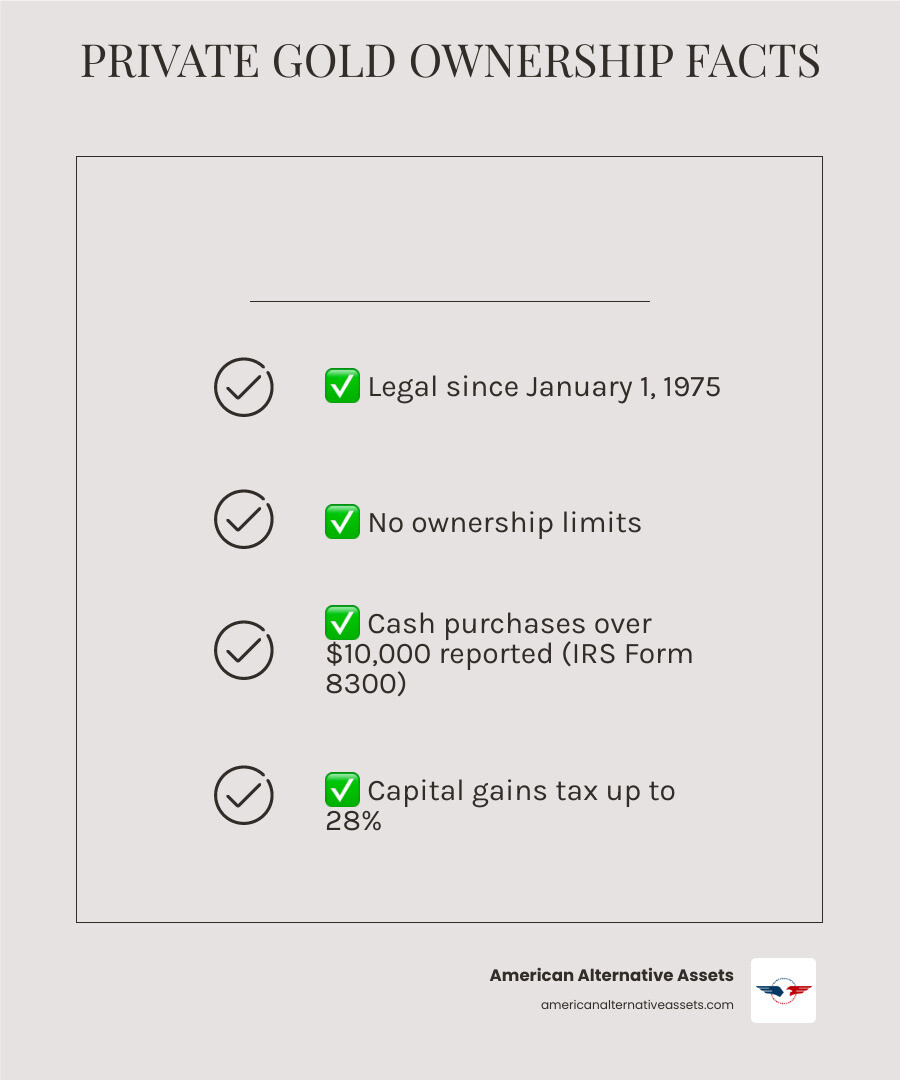
Private gold ownership is completely legal in the United States today, with no limits on how much you can hold.
Here is a quick summary of the key facts:
| Topic | Key Fact |
|---|---|
| Legal to own? | Yes, since January 1, 1975 |
| Ownership limit | None, you can own as much as you want |
| Cash purchase reporting | Dealers must report cash transactions over $10,000 (IRS Form 8300) |
| Capital gains tax | Up to 28% on profits when you sell |
| Gold IRA allowed? | Yes, since 1997, with IRS-approved storage required |
| Bringing gold into the US | No duty, but must declare amounts over $10,000 |
But knowing gold is legal to own is just the starting point. The rules around buying, selling, storing, and reporting gold are more nuanced than most people realize. With economic uncertainty pushing more Americans toward tangible assets, getting the details right matters.
For decades, the US government banned private gold ownership entirely. That 41-year restriction, from 1933 to 1975, still causes confusion today. Many people remain unclear on what today’s rules actually allow, what triggers a reporting requirement, and how to stay compliant while protecting their wealth.
This guide breaks down the essentials so you can own physical gold with confidence. It also explains why many investors prefer physical precious metals inside a Precious Metals IRA, where metals are held in IRS-approved storage.
I’m Shanon Davis, founder of American Alternative Assets, and my background in venture capital, combined with lessons from the 2008 financial crisis, shaped my conviction that physical precious metals can play an important role in long-term diversification. In this article, I will walk you through what you need to know to own gold legally, privately, and wisely, with a special focus on physical precious metals IRAs.
Is Private Gold Ownership Legal in the United States?
Yes. Since January 1, 1975, it has been legal for U.S. citizens to own gold in any quantity. This restoration of rights occurred when President Gerald Ford signed Public Law 93-373, ending a 41-year prohibition that had restricted Americans from holding gold bullion.
Today, there are no federal laws placing a cap on how much gold an individual can own or buy. Whether you want to hold a few fractional coins or a 400-ounce “Good Delivery” bar, the law allows it. You do not need a license, and you do not need to register your holdings with a central authority.

The Current Status of Private Gold Ownership
In the modern era, private gold ownership is a practical way to diversify with a tangible asset. For retirement savers, a common approach is to hold physical precious metals inside a Precious Metals IRA, where the metals are stored at an IRS-approved facility.
At American Alternative Assets, we focus exclusively on physical precious metals for long-term preparedness. Unlike paper claims, physical bullion is a real, identifiable asset that is not dependent on a fund structure or a brokerage platform. You can learn more about our physical gold services to see how we help investors understand their options.
Historical Restrictions and the 1933 Gold Ban
To appreciate the freedom we have today, it helps to look back at the restriction era.
On April 5, 1933, President Franklin D. Roosevelt issued Executive Order 6102, which forbade the hoarding of gold coin, bullion, and certificates.
The rationale was tied to the monetary system of the time. During the Great Depression, the U.S. was still on a gold standard. To increase the money supply, policymakers needed more flexibility than the gold standard allowed. By requiring citizens to surrender gold at $20.67 per ounce, the government cleared the way for the Gold Reserve Act of 1934, which revalued gold to $35 per ounce.
While there were exemptions for jewelry and small amounts of collector coins (up to $100 in value), the ban was enforced. It was not until the mid-1970s that the right of private gold ownership was restored.
Reporting Requirements for Private Gold Ownership
While it is legal to own as much gold as you want, there are specific guardrails regarding how you buy and sell it. The government generally does not track what you own, but it does track certain types of transactions, especially when large amounts of cash are involved.
The most critical regulation is IRS Form 8300. Under the Bank Secrecy Act and the USA Patriot Act, any precious metals dealer who receives more than $10,000 in cash, which includes physical currency and certain monetary instruments like cashier’s checks or money orders under $10,000, must report the transaction to the IRS.
Tax Obligations and Capital Gains
When it comes to the IRS, gold is generally treated as a collectible. This means that if you hold your gold for more than a year and then sell it for a profit, you may be subject to a long-term capital gains tax rate of up to 28 percent.
You are required to report these sales on Schedule D of your tax return. It is important to keep records of your cost basis, which is what you paid for the gold, including any dealer premiums or commissions, so taxes are calculated on the profit. To help you stay compliant, we recommend you learn about gold tax rules in more detail.
Privacy and Anonymous Transactions
A common question is, “Can I buy gold anonymously?” The answer depends on your method of payment.
If you use a bank wire or a personal check, the dealer generally does not have to file a Form 8300, regardless of the amount. The transaction is private in the sense that the dealer is not reporting it to the IRS, though your bank will have a record of the transfer.
On the selling side, dealers are required to file a Form 1099-B only for specific types and quantities of gold, such as 25 ounces or more of Krugerrands or Maple Leafs. For many other popular items, like the American Gold Eagle, there is often no 1099-B reporting requirement for the seller. If you are considering a Precious Metals IRA, keep in mind that IRA metals must be held in IRS-approved storage, which emphasizes proper documentation and custody rules rather than personal possession.
Global Trends in Private Gold Ownership
Americans are often surprised to learn that we aren’t the biggest fans of gold on the world stage. In many other cultures, private gold ownership isn’t just an “alternative” investment—it is the primary way families save for the future.
Recent data shows a fascinating divide in how much gold people hold privately. While central banks are buying gold at record rates (over 1,100 tonnes in 2022 alone), private citizens in Europe and Asia are leading the way in per capita holdings.
| Country | Avg. Per Capita Gold (Grams) | Total Private Holdings (Tonnes) |
|---|---|---|
| Austria | 220g | 388t |
| Germany | 205g | 9,089t |
| Switzerland | 95g | 265t |
| India | ~18-20g | 24,000 – 34,600t |
| China | ~20-22g | 31,000t |
Cultural Drivers of Private Gold Ownership
Why do Germans and Austrians own so much more gold than Americans or even the Swiss? The answer lies in historical memory. Germany experienced devastating hyperinflation in the 1920s, where life savings were wiped out in weeks. That “cultural trauma” has been passed down through generations, making gold the ultimate symbol of stability. In Germany, private investors hold nearly 2.7 times more gold than their own central bank!
In India and China, the drivers are both cultural and practical. Gold jewelry is a traditional wedding gift and a primary form of “portable wealth.” Indian households alone are estimated to hold up to 34,600 tonnes of gold, making them the largest private holders of the metal in the world. For these families, gold is a hedge against currency devaluation and a lack of trust in local banking systems. You can explore more about these investor benefits in owning gold and how they apply to your own strategy.
Comparing Central Bank Reserves to Private Holdings
It’s a common misconception that most of the world’s gold is locked away in government vaults. In reality, the vast majority of the 170,000 to 187,000 tonnes of gold in existence is in private hands.
In many countries, the “people’s bank” is much larger than the national bank. For instance, Czechs have twice as much gold at home as their national bank holds in its reserves. This global trend highlights a growing distrust in fiat currencies and a return to “sound money” that individuals can control themselves.
Physical Bullion vs. Paper Gold: Protecting Your Wealth
At American Alternative Assets, we believe there is an important difference between owning physical gold and owning a paper product that tracks gold.
Paper gold, which includes gold ETFs (Exchange Traded Funds), mining stocks, and gold futures, is essentially a contract. You may gain price exposure, but you do not possess the metal. This can introduce counterparty risk. If a custodian, broker, or other intermediary faces operational problems, access and settlement may be affected.
Physical bullion, on the other hand, is a tangible asset. When you own physical coins or bars, including inside a Precious Metals IRA with IRS-approved storage, you are holding allocated metal rather than a paper claim. Many investors prefer this structure because it is straightforward and focuses on direct ownership.
The Risks of Paper Based Assets
Many investors choose paper products because they seem simple to buy and sell. However, paper markets can have tradeoffs that physical owners should understand:
- Ongoing Costs: Many products include ongoing administrative costs that can affect long-term results.
- Lack of Possession: Many gold ETFs do not allow individual investors to take physical delivery of the metal.
- Market Structure Risk: Some paper markets use leverage and layers of intermediation, which can add complexity during periods of stress.
If you are looking for direct ownership, 24k bullion is a common choice for investors who want high purity metals in a physical form.
Secure Storage and the Precious Metals IRA
Once you decide on private gold ownership, the next question is always, “Where do I put it?”
You have three main options:
- Home Storage: A high-quality floor safe can provide immediate access but carries risks, including theft and loss.
- Bank Safety Deposit Boxes: These offer strong security, but access is limited to bank hours.
- Professional Depositories: This is a common choice for larger holdings. These are high-security, insured facilities that specialize in precious metals.
The Taxpayer Relief Act of 1997 opened a powerful new door, the Precious Metals IRA. This allows you to hold physical gold, and in many cases physical silver, within a tax-advantaged retirement account. However, the IRS is strict about custody. You cannot store IRA gold in your home. It must be held in an IRS-approved depository. We help our clients navigate these gold storage options to support compliant, secure ownership.
International Travel and Customs Regulations
If you decide to move your gold across borders, you need to be aware of the FinCEN 105 rule. While there is generally no duty or tax on bringing gold bullion into the U.S., you must declare it if the total value of your monetary instruments, which includes certain gold coins, exceeds $10,000.
Failure to declare can lead to penalties or seizure. If you follow the rules and file the paperwork, you are entitled to move your wealth internationally. For those using a Precious Metals IRA, metals typically remain within approved custody and storage networks, which can simplify compliance and documentation.
Frequently Asked Questions about Private Gold Ownership
How much gold can a private individual legally own?
In the United States, there is absolutely no limit. You can own as much gold as your budget allows. The 1933 ban is a thing of the past, and today’s laws fully support your right to accumulate physical wealth.
Does the US government track every gold purchase?
No. The government generally only gets involved if you use a large amount of physical cash (over $10,000), which triggers a Form 8300. Purchases made via bank wire or check are private between you and the dealer, although your bank will have a record of the wire itself.
Are there taxes on bringing gold into the US?
Generally, no. Pure gold bullion is considered an investment and is usually duty-free. However, you must declare any amount over $10,000 to U.S. Customs (FinCEN Form 105) when entering the country.
Conclusion
At American Alternative Assets, we believe that private gold ownership is a practical step toward financial preparedness and diversification. For many long-term investors, the most structured way to hold physical metals is through a Precious Metals IRA, which allows physical gold, and in many cases physical silver, to be stored in IRS-approved facilities.
Our mission is to provide a relationship-first experience built on education, clear processes, and ethical practices. Whether you are looking to take physical delivery for personal storage or want to set up a secure, tax-advantaged Gold IRA, we are here to help you understand your options.
This article is for informational purposes only and does not constitute financial advice. Please consult your financial advisor before making investment decisions.
Investing in precious metals involves risk. Past performance does not guarantee future results.