








Why IRA Gold Storage Matters for Your Retirement Security
IRA gold storage is the secure, IRS-compliant way to hold physical precious metals within your Individual Retirement Account. Here’s what you need to know:
- IRS Requirement: All precious metals held in an IRA must be stored by an approved trustee or custodian at a third-party depository, not at home.
- Storage Options: Choose between segregated storage (your metals stored separately) or commingled storage (pooled with others but ownership tracked).
- Key Players: Your IRA custodian administers the account, while an IRS-approved depository physically stores and insures your metals.
- Costs: Annual storage fees vary by depository and storage type, ensuring security and compliance.
- Access: You can visit your metals by appointment or take physical possession as an IRA distribution (subject to taxes and penalties if under age 59.5).
“This is real money.” That’s what my grandfather told me when he handed me a silver Morgan coin at age nine. He was talking about the weight of something tangible, something that didn’t depend on anyone else’s promise.
Physical gold and silver are fundamentally different from paper assets like stocks, bonds, or ETFs. When you own physical metals in your IRA, you hold a tangible asset that has preserved wealth for thousands of years. You’re not relying on a company’s performance or a government’s fiscal policy. You’re holding real, solid value.
But owning physical gold in an IRA comes with one critical requirement: secure, IRS-compliant storage. The IRS doesn’t allow you to keep your IRA gold at home or in a personal safe. It must be stored at an approved third-party depository that meets strict security and insurance standards.
Why does this matter? Because improper storage can trigger immediate taxation of your entire IRA, plus penalties. The IRS treats any violation of the storage rules as a distribution, meaning you could lose the tax-advantaged status that makes IRAs so valuable in the first place.
This guide will walk you through everything you need to know about IRA gold storage. You’ll learn the IRS rules, understand the role of custodians and depositories, find how to choose the right storage option, and get answers to the most common questions about accessing your metals.
I’m Shanon Davis, founder of American Alternative Assets. After spending years in venture capital watching paper wealth evaporate during the 2008 crash, I built this company to help Americans protect their retirement with physical precious metals and steer the complexities of IRA gold storage. My goal is to give you the knowledge and confidence to make informed decisions about securing your financial future.
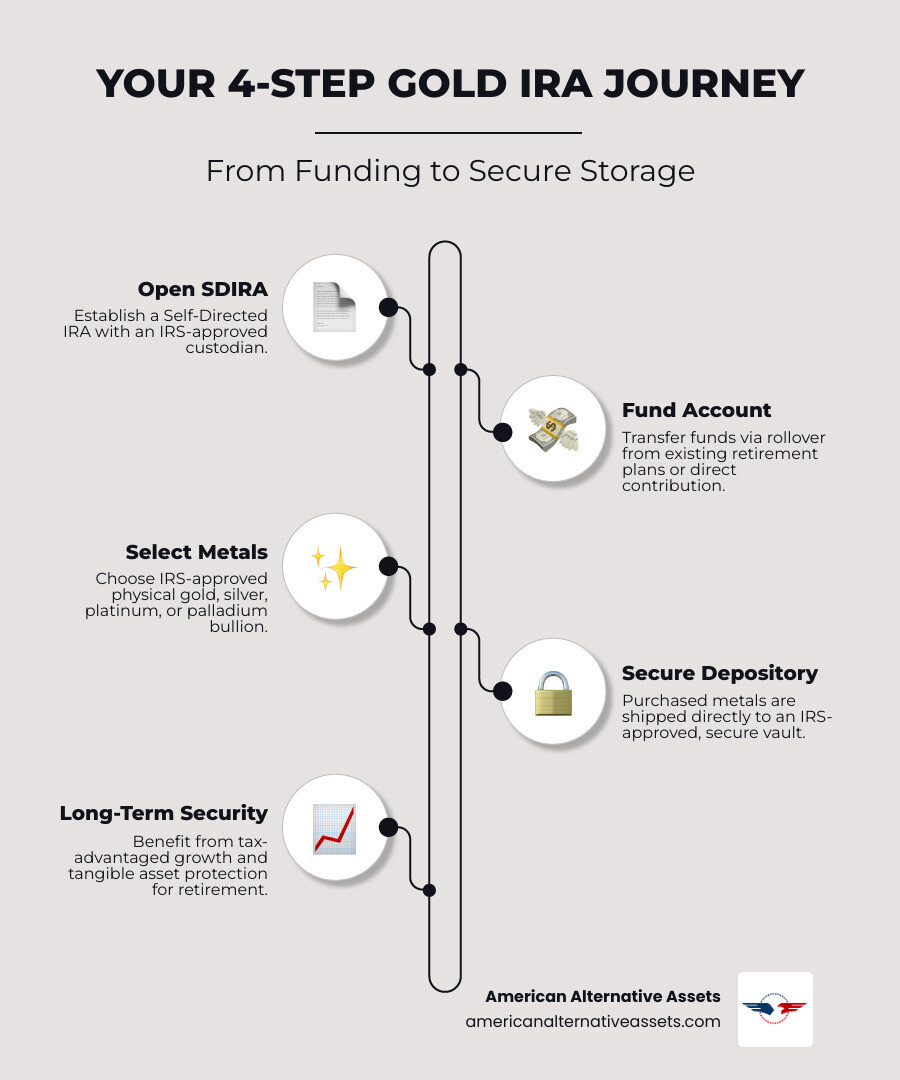
IRA gold storage vocabulary:
The Foundation: IRS Rules for Precious Metals IRA Storage
The IRS sets clear rules for IRA gold storage. The most crucial is the “physical possession” rule: all precious metals in a Self-Directed IRA must be held “in the physical possession of a trustee.” This means you cannot store them at home or in a personal safe deposit box.
The IRS requires that all precious metals held in an IRA be stored by a qualified trustee or custodian. This trustee or custodian then subcontracts the actual physical storage to an IRS-approved depository. The custodian is the administrator of your IRA, while the depository is the secure facility where your metals physically reside.
Attempting to store IRA gold at home is a prohibited transaction with severe consequences. The IRS treats this as a distribution, which can disqualify your entire IRA, making its full value taxable as ordinary income. You would also face a 10% early withdrawal penalty if under age 59½. As a Journal of Accountancy case summary highlighted, an IRA owner’s personal possession of gold coins led to significant tax consequences. Full compliance with IRS regulations is essential to protect your wealth.
For personal holdings, you can store metals at home, in a bank safe deposit box, or a private vault. For IRA assets, that flexibility disappears. The strict regulatory framework is in place to ensure the integrity of your tax-advantaged retirement account.

Understanding IRS-Approved Precious Metals
Not all shiny metals are created equal in the eyes of the IRS when it comes to IRAs. While the appeal of physical gold is strong, specific criteria must be met for precious metals to be eligible for inclusion in an IRA.
Here’s a list of approved metals for IRAs:
- Gold: Must be at least 99.5% pure (.995 fineness), in the form of bars or coins. Examples include American Gold Eagles, Canadian Gold Maple Leafs, Austrian Gold Philharmonics, and specific gold bars.
- Silver: Must be at least 99.9% pure (.999 fineness), in the form of bars or coins. Examples include American Silver Eagles, Canadian Silver Maple Leafs, and specific silver bars.
- Platinum: Must be at least 99.95% pure (.9995 fineness), in the form of bars or coins. Examples include American Platinum Eagles and specific platinum bars.
- Palladium: Must be at least 99.95% pure (.9995 fineness), in the form of bars or coins. Examples include Canadian Palladium Maple Leafs and specific palladium bars.
The IRS has bullion rules for IRAs that specify these minimum fineness requirements. The most important thing to understand up front is that the IRS does not publish one neat “official list” of depositories you must use. What the IRS cares about is the custody rule. IRA bullion needs to be in the physical possession of a bank or an IRS-approved nonbank trustee.
The IRS generally prohibits “collectibles” in IRAs. However, it makes an exception for certain highly refined bullion held by an approved trustee. This is why jewelry, rare coins, or other less pure metals are excluded from IRAs, as they fall under the “collectibles” rule.
For a deeper dive into these regulations, we encourage you to review our Precious Metals IRA Rules Guide.
The Risks of Non-Compliant IRA Gold Storage
The IRS takes compliance seriously, and so do we. Attempting to circumvent the strict storage rules for your IRA gold storage can lead to severe and costly consequences, undermining the very purpose of your retirement account.
The primary risks of non-compliant storage include:
- Early Distribution Penalties: If the IRS deems home storage a “distribution,” you could face a 10% early withdrawal penalty on your IRA’s entire value if you are under 59½. This applies to both traditional and Roth IRAs, with some exceptions.
- Loss of Tax-Advantaged Status: Violating storage rules can cause the IRS to disqualify your entire IRA, not just the gold. This means losing the tax-deferred or tax-free growth that makes IRAs valuable.
- Full Taxation of IRA Assets: A disqualified IRA means the full market value becomes immediately taxable as ordinary income. This could push you into a higher tax bracket and create a substantial tax bill.
- The “Checkbook IRA” LLC Scheme: Some promoters suggest using an LLC to create a “checkbook IRA” for home storage. The IRS has clarified this is a prohibited transaction due to self-dealing rules. If finded, your entire retirement account could be deemed a distribution.
- A Court Case Ruling Against Home Storage: This is not just theoretical. The Tax Court case of Andrew McNulty et al. v. Commissioner of Internal Revenue set a precedent against home storage, confirming it violates IRS regulations. Getting caught means facing income taxes, significant penalties, and interest.
Protecting your retirement savings means adhering to the rules. We are committed to helping you steer these complexities to ensure your wealth is both secure and compliant.
Custodians and Depositories: Your Gold IRA Storage Partners
Navigating IRA gold storage involves understanding the roles of two crucial partners: your IRA custodian and the precious metals depository. These two entities work in tandem to ensure your physical precious metals are held securely and in compliance with IRS regulations.

The Role of the IRA Custodian
The IRA custodian is the regulated financial institution that administers your Self-Directed IRA. Think of them as the gatekeeper and record-keeper for your retirement account. Their responsibilities include:
- Administration: They handle all the paperwork, ensure compliance with IRS rules, and process transactions for your IRA.
- Record-Keeping and Reporting: They maintain detailed records of your assets, transactions, and account value, and submit required reports to the IRS.
- Facilitating Transactions: When you buy or sell precious metals for your IRA, the custodian facilitates these transactions, ensuring funds are properly allocated and metals are transferred to and from the depository.
- Partnering with Depositories: Custodians work with a network of IRS-approved depositories. They select and vet these facilities to ensure they meet the stringent security and insurance standards required for IRA assets. You, as the account holder, typically choose from the depositories approved by your custodian.
The IRS requires a qualified trustee or custodian to manage all IRA assets. The qualifications for becoming a non-bank trustee are daunting, including requirements for extensive experience, a net worth of at least $250,000, and employee bonding. This stringent vetting underscores the custodian’s vital role in safeguarding your assets.
For more detailed information on selecting the right partner, explore our Precious Metals IRA Custodians Guide.
Segregated vs. Commingled Storage: What’s the Difference?
When your precious metals arrive at an IRS-approved depository for IRA gold storage, you typically have a choice between two main types of storage: segregated (also known as allocated) and commingled (also known as unallocated) storage. Understanding the differences is key to making an informed decision that aligns with your preferences and budget.
Segregated (Allocated) Storage:
With segregated storage, your specific precious metal items (e.g., individual gold bars with unique serial numbers) are stored separately from other clients’ metals. They are earmarked specifically for your account, and you retain legal title to those exact pieces. This means if you deposit a specific 10-ounce gold bar, that exact bar is kept in your designated storage area within the vault. This option offers a higher level of transparency and peace of mind, as you know precisely which metals belong to you.
Commingled (Unallocated) Storage:
In commingled storage, your precious metals are stored alongside other clients’ metals of the same type and fineness. While your ownership is carefully recorded by the depository and your custodian, you do not own specific, identifiable pieces of metal. Instead, you own a proportionate share of the total metals held in the commingled vault. For example, if you own 10 ounces of gold in commingled storage, the depository holds 10 ounces of gold for you, but it might not be the exact 10-ounce bar you originally deposited. This is often the lowest-cost option and is commonly used for standard IRA bullion.
Here’s a quick comparison:
| Feature | Segregated (Allocated) Storage | Commingled (Unallocated) Storage |
|---|---|---|
| Cost | Generally higher due to individual tracking and handling | Generally lower due to economies of scale |
| Asset Tracking | Your specific items (e.g., by serial number) are tracked | You own a portion of a larger pool of identical metals |
| Investor Preference | Preferred by those who want to own specific, identifiable assets | Preferred by those prioritizing cost-efficiency |
| Peace of Mind | Knowing your exact metals are set aside for you | Trust in the depository’s and custodian’s record-keeping |
The choice between segregated and commingled storage impacts your fees and peace of mind. Segregated storage costs more due to the effort of tracking individual items, but many investors value knowing their exact metals are set aside. Both options are fully secured and insured at an IRS-approved depository.
Choosing the Right Depository for Your Precious Metals
Selecting the right depository for your IRA gold storage is a critical decision that directly impacts the security and compliance of your retirement assets. We carefully consider several factors to ensure your precious metals are protected with the utmost care.
Factors for Selection
When evaluating a precious metals depository, we recommend considering the following:
- Security Measures: Top-tier depositories use state-of-the-art security, including Class 3 vaults, 24/7 surveillance, armed guards, and biometric access controls. We prioritize facilities with heavy investment in physical and technological security.
- Insurance Coverage: Comprehensive insurance is non-negotiable. Your metals should be fully insured against theft, damage, or loss, often by major insurers like Lloyd’s of London.
- Geographic Location: Proximity might be a factor for some investors. We focus on reputable domestic depositories that offer secure, reliable service.
- Audit Frequency and Transparency: Regular, independent audits verify the stored metals. A transparent depository provides clear audit reports for accountability.
- Fee Structures: Storage fees can be a flat rate or a sliding scale based on your holdings’ value. We work with partners who offer transparent, competitive fees.
Commonly Used and Recommended Depositories
While the IRS does not publish an official list of approved depositories, several facilities are widely recognized and trusted within the industry for IRA gold storage. These depositories have established track records, robust security, and work seamlessly with leading IRA custodians.
Here are some commonly used and recommended depositories:
- Delaware Depository: The Delaware Depository Service Company (DDSC) is widely used for precious metals storage and is also known in the exchange-licensed vaulting world. They are a privately held company with locations in Wilmington, Delaware, and Boulder City, Nevada, providing highly secure storage and substantial insurance coverage. We often partner with custodians who use DDSC for our clients’ holdings.
- Brink’s Global Services: A globally recognized leader in secure logistics and storage, Brink’s offers highly secure vaulting services. They have a long history dating back to 1859 and are known for their comprehensive security measures and armored transportation.
- International Depository Services (IDS): IDS operates multiple secure precious metals depositories. They are accredited with major exchanges and offer both segregated and commingled storage options, known for their rigorous security protocols and customer service.
The choice of depository often depends on your IRA custodian’s partnerships. Custodians typically have a list of approved depositories, which streamlines the process. This integrated approach ensures efficiency and compliance. We work with custodians who partner with these trusted facilities to ensure your assets are in capable hands.
Costs, Access, and Taking Possession of Your Gold
Understanding the financial and logistical aspects of your IRA gold storage is just as important as selecting the metals themselves. Let’s dig into the typical costs, how you can access your metals, and the conditions under which you can take physical possession.
Understanding Storage Fees
Storing precious metals in an IRA depository comes with associated fees, which are a necessary cost for maintaining the security, insurance, and IRS compliance of your assets.
- Annual Costs: Storage fees are typically charged annually. These fees cover the depository’s operational costs, including security, insurance, auditing, and administrative services.
- How Fees are Calculated: Fees can be structured in a couple of ways:
- Flat Rate: Some depositories or custodians offer a flat annual fee, regardless of the value of your holdings, up to a certain limit. This can be advantageous for larger accounts.
- Sliding Scale (Percentage-Based): More commonly, fees are calculated as a percentage of the total market value of your precious metals. This percentage typically decreases as the value of your holdings increases.
- Factors Influencing Cost: The type of storage (segregated vs. commingled), the specific depository, and the total value of your assets will all influence the annual fee. We believe these costs are a worthwhile investment for the security and peace of mind it provides.
We do not list specific prices, as costs vary and are subject to change. However, we ensure our custodian partners provide transparent fee structures.
Can You Visit or Physically Access Your IRA Gold?
Many investors appreciate the tangible nature of physical gold and often wonder about the ability to see or access their holdings.
- Visiting your precious metals: Yes, you can arrange an appointment through your custodian to visit the depository and inspect your metals. As these are high-security facilities, visits are by appointment only and follow strict protocols.
- Taking Physical Possession as a Distribution: While you can visit your gold, taking it home is an IRA distribution. This is taxable and subject to early withdrawal penalties if you are under age 59½.
- In-Kind Distributions vs. Cash Liquidation: When you are eligible to take distributions from your IRA (typically at age 59½ or older, or due to specific exceptions), you have two main options:
- In-Kind Distribution: You can choose to receive your physical precious metals directly from the depository. The metals are shipped to you, or you can pick them up in person, and this is considered a distribution at their current market value.
- Cash Liquidation: You can also choose to sell your precious metals within your IRA, and the proceeds are then distributed to you as cash.
- Tax Implications of Withdrawals: Distributions from a Traditional IRA are generally taxed as ordinary income. Distributions from a Roth IRA are typically tax-free and penalty-free if you are over 59½ and have held the account for at least five years.
- Early Withdrawal Penalties: If you take a distribution, including an in-kind distribution of physical metals, before age 59½, it will generally be subject to your ordinary income tax rate plus a 10% early withdrawal penalty. However, there are exceptions to these early distribution penalties for certain circumstances, such as disability, qualified first-time home purchases, or unreimbursed medical expenses.
- In-Kind Distributions vs. Cash Liquidation: When you are eligible to take distributions from your IRA (typically at age 59½ or older, or due to specific exceptions), you have two main options:
It is important to differentiate between viewing your assets and withdrawing them. Viewing confirms your ownership, while withdrawing has significant tax and penalty implications if not done under the correct conditions.
Frequently Asked Questions about IRA Gold Storage
We understand that investing in physical precious metals for your retirement can bring up many questions, especially regarding IRA gold storage. Here, we address some of the most common inquiries to provide clarity and peace of mind.
Can I store my Gold IRA assets at home?
No. IRS rules under Internal Revenue Code Section 408(m) are clear: precious metals in an IRA must be held by an approved third-party trustee or custodian. Storing IRA gold at home is a prohibited transaction treated as a taxable distribution. This can trigger significant taxes on your IRA’s entire value, plus a 10% early withdrawal penalty if you are under 59½. We strongly advise against this risk.
What is the difference between a custodian and a depository?
This is a fundamental distinction in IRA gold storage. The custodian is the financial institution that administers your IRA account, handling paperwork, compliance, and transactions. The depository is the secure, third-party vault that physically stores and insures your precious metals on behalf of your custodian. Essentially, the custodian manages your account, and the depository protects your physical assets.
What are the typical costs for IRA gold storage?
Annual fees for IRA gold storage are charged by the depository and facilitated through your custodian. Costs vary based on storage type (segregated vs. commingled) and asset value, and can be a flat rate or a sliding scale. These fees cover security, insurance, and administration. We do not provide specific pricing, as rates fluctuate, but we work with partners who offer transparent fees. These costs are a vital expense for securing your retirement wealth.
Conclusion: Securing Your Golden Years with the Right Storage
As we’ve explored, IRA gold storage is a nuanced but essential aspect of safeguarding your retirement wealth with physical precious metals. The non-negotiable need for IRS-compliant storage, coupled with the importance of choosing trusted partners, forms the bedrock of a secure and prosperous financial future.
We believe that physical gold provides a tangible layer of protection for your retirement, offering stability and independence from the volatility of traditional paper assets. By understanding and adhering to the IRS rules, leveraging the expertise of reputable custodians, and selecting secure, insured depositories, you can confidently integrate precious metals into your retirement strategy.
At American Alternative Assets, our commitment is to guide you through every step of this process. We pride ourselves on white-glove, relationship-first service, built on trust, transparency, and ethical practices, ensuring real privacy and protection for your wealth. We empower our clients to make informed decisions, ensuring their physical precious metals are stored securely and compliantly, just as my grandfather understood the enduring value of real money.
Take control of your retirement with a secure, physical asset. Explore how we can help you steer the complexities of precious metals IRAs and secure your financial independence.
Learn more about the premier Delaware Depository
This article is for informational purposes only and does not constitute financial advice. Please consult your financial advisor before making investment decisions.
Investing in precious metals involves risk. Past performance does not guarantee future results.