







Why Storing Silver Coins the Right Way Matters More Than You Think
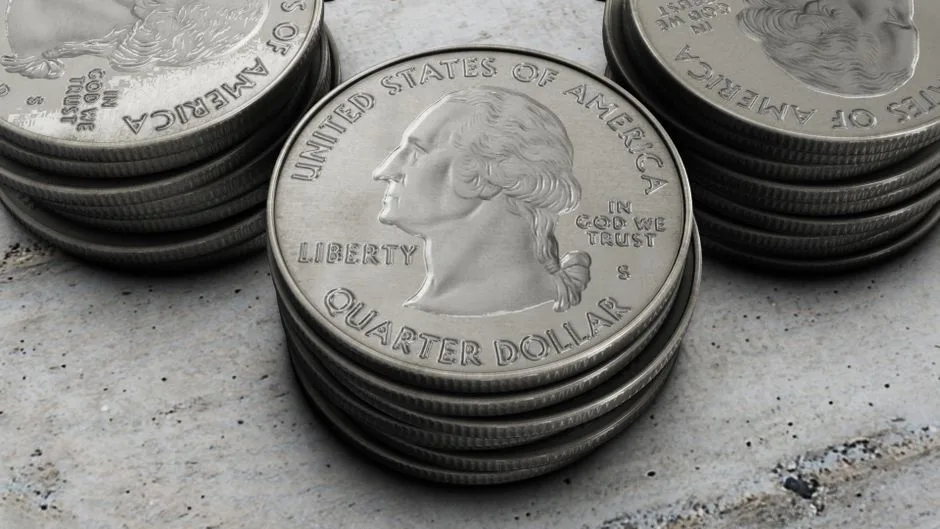
Storing silver coins properly is one of the most important steps you can take to protect their value and condition over time.
Here is a quick overview of how to do it right:
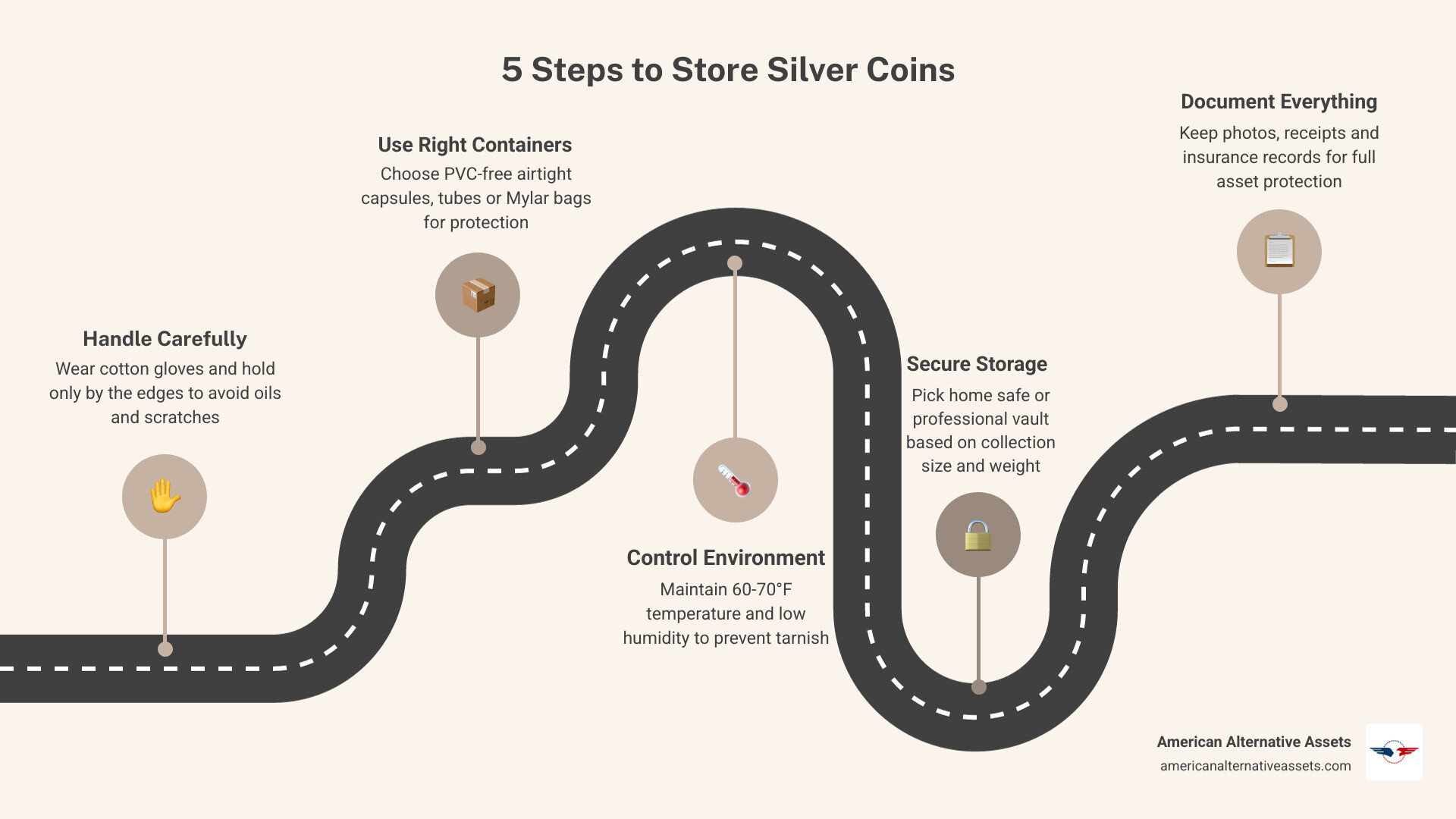
- Handle carefully — always hold coins by the edges and wear cotton gloves
- Use the right containers — airtight, PVC-free capsules, tubes, or Mylar bags
- Control the environment — keep temperatures between 60°F and 70°F with low humidity
- Choose secure storage — a quality home safe or professional depository depending on your collection size
- Document everything — photos, purchase records, and insurance coverage
Silver is a physical asset with real, lasting value. But it is also reactive. It tarnishes when exposed to air, moisture, sulfur compounds, and even the oils from your skin. Poor storage does not just affect how your coins look. For numismatic or collectible coins, it can directly affect what they are worth.
There is also the practical side. Silver takes up far more space than most people expect. For the same dollar value, silver requires roughly 128 times more storage space than gold. A $50,000 silver holding weighs around 189 pounds. That changes how you think about where and how to store it.
I’m Shanon Davis, and my relationship with physical silver goes back to childhood, when my grandfather placed a Morgan dollar in my hand and told me it was “real money.” That early lesson, combined with years in venture capital watching paper-based wealth evaporate during the 2008 crisis, shaped everything I now know about storing silver coins as part of a sound, tangible wealth strategy.
Easy storing silver coins glossary:
Step 1: Master Proper Handling and Cleaning Techniques
When you first start storing silver coins, the temptation to touch them is real. There is something satisfying about the weight of a silver eagle in your palm. However, we always advise our clients to handle their metals as little as possible. Your skin produces natural oils and acids that can leave permanent fingerprints on the surface of the silver. Over time, these marks can turn into dark, unsightly tarnish that is difficult to remove without damaging the coin.
The first rule of handling is to wear clean, white cotton gloves. Avoid latex or rubber gloves, as these often contain sulfur compounds that cause silver to tarnish almost instantly. If you do not have gloves, ensure your hands are washed and completely dry, then hold the coin only by its edges. Never touch the “face” or the flat surface of the coin.
Another tip we often share is to avoid speaking directly over your coins. It sounds a bit extreme, but microscopic droplets of saliva can land on the metal and cause spotting or pitting over time. When you are organizing your collection, keep a respectful distance or wear a light mask. For more detailed advice on the basics, you can check out this A Quick Start Guide to Precious Metals Storage.
Avoiding the Risks of Cleaning
A common mistake new collectors make is trying to “shine up” their silver. We cannot emphasize this enough: do not clean your silver coins unless it is absolutely necessary. Most professional coin dealers and numismatists prefer “original” surfaces, even if they have a bit of natural toning.
Cleaning often involves abrasive chemicals or cloths that create tiny scratches, known as hairlines, on the coin’s surface. These scratches can significantly reduce the numismatic value of a rare coin. If a coin has actual dirt or debris on it, the safest method is to use a very mild soap and warm distilled water. Pat it dry gently with a soft, lint-free cloth. Never rub the coin. If you have a high-value or rare coin that needs attention, it is always best to seek professional conservation services. For more insights on maintaining the integrity of your physical assets, see How to Safely Store Your Gold and Silver – U.S. Money Reserve.
Step 2: Choose the Right Materials for Storing Silver Coins
The containers you choose are your first line of defense against the elements. Not all plastic is created equal. Many common household storage items, like sandwich bags or standard plastic bins, are made with chemicals that are disastrous for silver.
When storing silver coins, you must ensure everything that touches the metal is acid-free and PVC-free. Polyvinyl chloride (PVC) is a common plasticizer used to make plastic soft and pliable. Over time, PVC breaks down and releases an acidic gas that creates a sticky, green slime on silver coins. This “PVC damage” can eat into the metal and ruin a collection.
Instead, look for archival-quality materials:
- Airtight Capsules: These are hard plastic holders designed for individual coins. They provide excellent protection against physical scratches and limit air exposure.
- Coin Tubes: If you have a large number of the same type of coin, such as American Silver Eagles, tubes are a space-efficient way to store them. Ensure they are the official mint tubes or high-quality BPA-free alternatives.
- Mylar Bags: These are excellent for larger items or for adding an extra layer of protection around coin flips. Mylar is an inert material that does not off-gas.
For those looking to understand the broader standards of protection, we recommend reading The Essential Standards for Physical Asset Protection.

Materials to Avoid
It is just as important to know what to keep away from your silver. Rubber bands are one of the biggest enemies of silver. They contain sulfur, which reacts with silver to create a black, stubborn tarnish. Even if the rubber band is not touching the coin directly, the gases it releases in a closed safe can cause damage.
Other materials to avoid include:
- Acidic Paper: Standard envelopes or cardboard boxes contain acids that will yellow or darken silver.
- Cardboard Flips with Staples: If you use cardboard flips, ensure they are the “staple-less” variety or be very careful not to scratch other coins with the metal staples.
- Wood Cabinets: Unless they are specifically designed for coins and made of inert woods like mahogany (and even then, with caution), wood can release vapors that affect silver.
Step 3: Control the Environment to Prevent Tarnish
Silver is sensitive to its surroundings. If you are storing silver coins at home, you need to think like a museum curator. The primary culprits for tarnish are humidity, heat, and air pollution.
The ideal temperature for silver storage is between 60 and 70 degrees Fahrenheit. Large swings in temperature are particularly dangerous because they can cause the metal to expand and contract, and more importantly, they can lead to condensation inside “airtight” containers. Humidity should be kept low, ideally around 40% to 50% relative humidity.
High humidity accelerates the chemical reaction between silver and the sulfur compounds in the air. This is why we tell our clients to avoid storing their silver in basements, attics, or bathrooms. These areas are prone to dampness and temperature spikes. For a deeper dive into home storage logistics, How To Store Silver Coins At Home | Storables offers some practical tips.
Managing Light and Air Exposure
Light can also play a role in the degradation of your storage materials. UV rays can cause plastic holders to become brittle or yellow over time. It is best to keep your collection in complete darkness.
Air is the carrier for hydrogen sulfide, the gas responsible for that classic black silver tarnish. While it is nearly impossible to eliminate air entirely, you can minimize its impact. Using silica gel packets in your safe or storage box is a cheap and effective way to soak up excess moisture. You can also use anti-tarnish strips, which are designed to “catch” sulfur molecules before they reach your coins. For more on the physical security of your environment, see Protecting What You Can Touch: Essential Physical Asset Security.
Step 4: Evaluate Home vs. Professional Storing Silver Coins Options
One of the most frequent questions we hear at American Alternative Assets is: “Should I keep my silver at home or use a depository?” The answer depends on your goals, the size of your collection, and your personal comfort level.
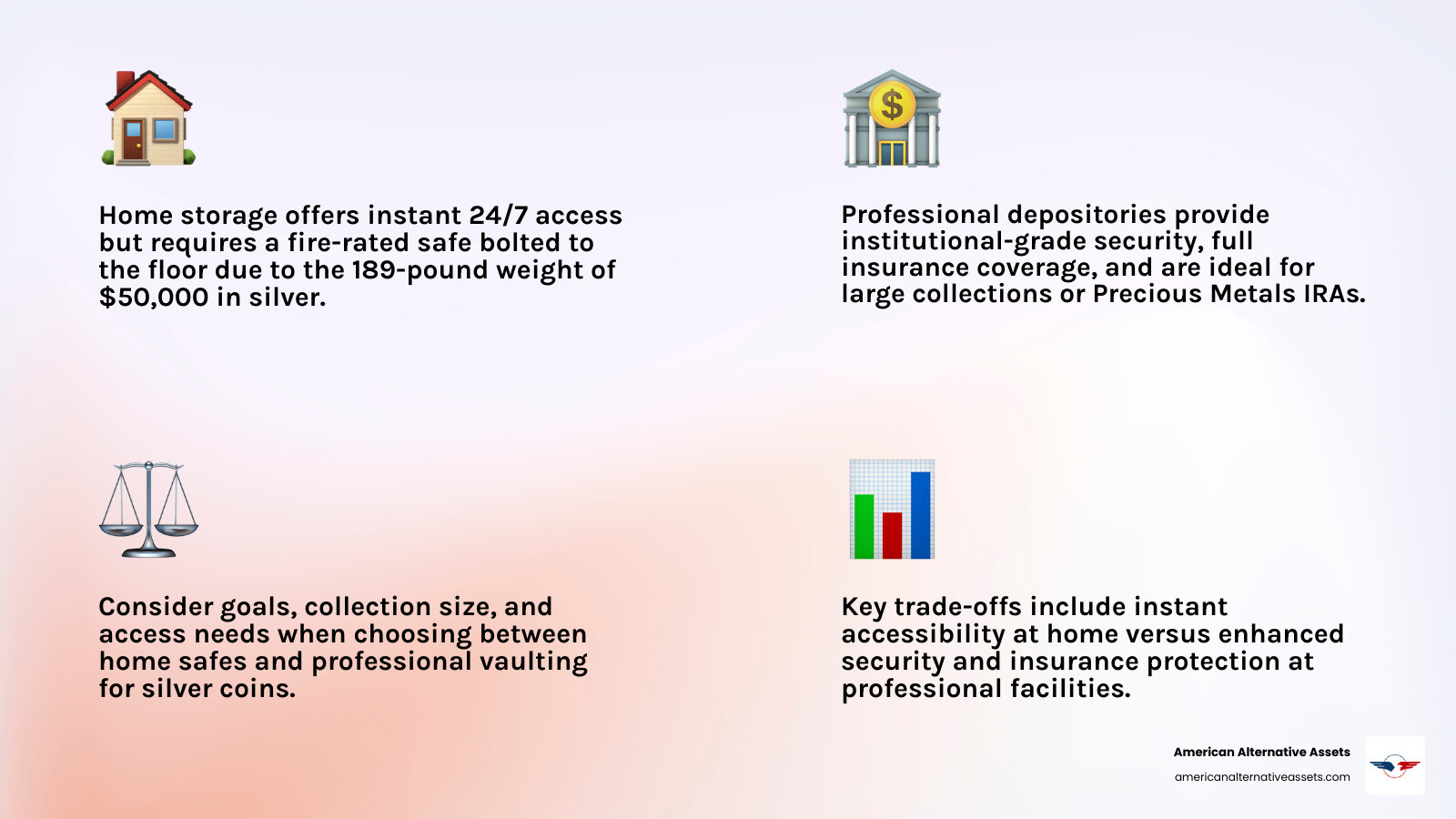
Home Storage: Many people prefer home storage because it offers immediate access. If you want your silver available for an emergency, having it in a high-quality home safe is a solid choice. However, you must consider the physical weight. As we mentioned, $50,000 worth of silver weighs nearly 189 pounds. That is not something you can easily grab and run with. If you are keeping silver at home, invest in a safe that is fire-rated and, most importantly, bolted to the floor. A safe that a burglar can simply wheel away on a dolly is just a convenient carrying case for your wealth.
Professional Depositories: For larger holdings, or for silver held within a Precious Metals IRA, professional depositories are often the superior choice. These facilities offer institutional-grade security that no home safe can match. They are also fully insured, meaning your investment is protected against theft or natural disasters.
| Feature | Home Storage | Professional Depository |
|---|---|---|
| Accessibility | Instant, 24/7 | Requires notice/travel |
| Security | Dependent on safe/alarm | Institutional grade |
| Insurance | Requires extra rider | Included in storage fees |
| Privacy | High (if kept quiet) | High (fully segregated) |
| Cost | One-time safe purchase | Ongoing annual fees |
The Logistics of Silver Volume
When storing silver coins, you have to plan for the bulk. Silver takes up 128 times more space than gold for the same dollar value. This means that while you can hide $100,000 of gold in a small floor safe, the equivalent amount of silver might require a dedicated cabinet or a very large, heavy safe.
If you are a resident in California, perhaps near our Woodland Hills office, you might be familiar with local coin dealers like those found through the Better Business Bureau Woodland Hills. They can often tell you stories of customers who underestimated the weight of a “monster box” (500 coins). A single monster box measures 15″ x 8.5″ x 4.5″ and weighs about 40 pounds. If you have ten of them, you are looking at 400 pounds of metal. You need to ensure your flooring can handle that kind of concentrated weight. For a comprehensive look at security, check out our Precious Metal Security Ultimate Guide.
Step 5: Secure and Document Your Physical Assets
Whether you choose home storage or a depository, documentation is vital. We always recommend keeping a detailed inventory log. This should include:
- The type of coin (e.g., American Silver Eagle, Canadian Maple Leaf)
- The year of mintage
- The quantity
- The date of purchase and the price paid
- High-resolution photographs of both sides of the coins
Keep this record in a separate location from the silver itself. A digital copy in an encrypted cloud drive and a physical copy in a different building is a good strategy. This documentation is essential for insurance purposes. Most standard homeowner’s insurance policies have very low limits for “money” or “bullion,” often as low as $200. You will likely need a specific “valuable items rider” to cover a significant collection. For those interested in the specifics of IRA storage, see IRA Gold Storage.

Professional Vaulting for Large Collections
For those who value peace of mind above all else, professional vaulting is the gold standard. When you use a service like the Delaware Depository, your metals are held in a secure, climate-controlled environment.
One major advantage of professional storage is the option for “segregated storage.” This means your specific coins are kept in a separate, labeled space, ensuring that the exact coins you deposited are the ones you receive back. This is different from “unallocated” storage, which we generally advise against, as it can introduce counterparty risk. Professional facilities also undergo regular independent audits to verify that every ounce is accounted for. To learn more about how these accounts work, visit What Are Depository Accounts and How Do They Work for Gold Storage?.
Frequently Asked Questions about Storing Silver Coins
Should I clean my silver coins before storing them?
In almost every case, the answer is no. Most experts, including those at major mints, discourage cleaning silver bullion or collectible coins. Cleaning can cause permanent surface damage that lowers the coin’s value. Natural “toning” or tarnish is often preferred by collectors as it proves the coin’s age and authenticity. If a coin is truly dirty, use only the mildest methods or consult a professional.
Is it safe to use a bank safe deposit box for storing silver coins?
While bank boxes are secure, they have several drawbacks. First, the contents are not insured by the bank or the FDIC. If the bank is robbed or suffers a fire, you could lose everything. Second, your access is limited to banking hours. In a true financial crisis, banks may close their doors, leaving your assets out of reach. Finally, there is a lack of privacy, as government agencies can sometimes seize box contents under certain legal conditions.
How much space do I need for a large silver collection?
More than you think! Remember the 128:1 ratio compared to gold. If you are planning to invest heavily in silver, you need to account for both the volume and the weight. A standard monster box is about the size of a large shoebox but weighs 40 pounds. If you are building a significant “stack,” you may need a dedicated, reinforced storage area or a professional vaulting solution to handle the physical logistics.
Conclusion
At American Alternative Assets, we believe that physical silver is one of the most effective ways to diversify your wealth and protect your future. Unlike paper assets like ETFs or mining stocks, which are subject to the whims of Wall Street and management decisions, physical silver is a tangible asset that you can touch and control.
Whether you are just starting with a few ounces or looking to move a significant portion of your retirement into a Precious Metals IRA, storing silver coins correctly is the key to preserving that wealth for the long term. Our white-glove service is built on the idea that every client deserves a relationship-first approach, ensuring that your privacy and your assets are protected with the highest ethical standards.
If you are ready to take the next step in securing your financial future, we are here to help you navigate physical metals. From choosing the right coins to finding the perfect storage solution, we provide the transparency and expertise you need. Secure your future with a Precious Metals IRA today.
This article is for informational purposes only and does not constitute financial advice. Please consult your financial advisor before making investment decisions.
Investing in precious metals involves risk. Past performance does not guarantee future results.