







Why Understanding How to Invest in Gold and Silver Matters Now
How to invest in gold and silver is a question more Americans are asking as economic uncertainty grows. Here’s your quick answer:
Main Ways to Invest in Physical Precious Metals:
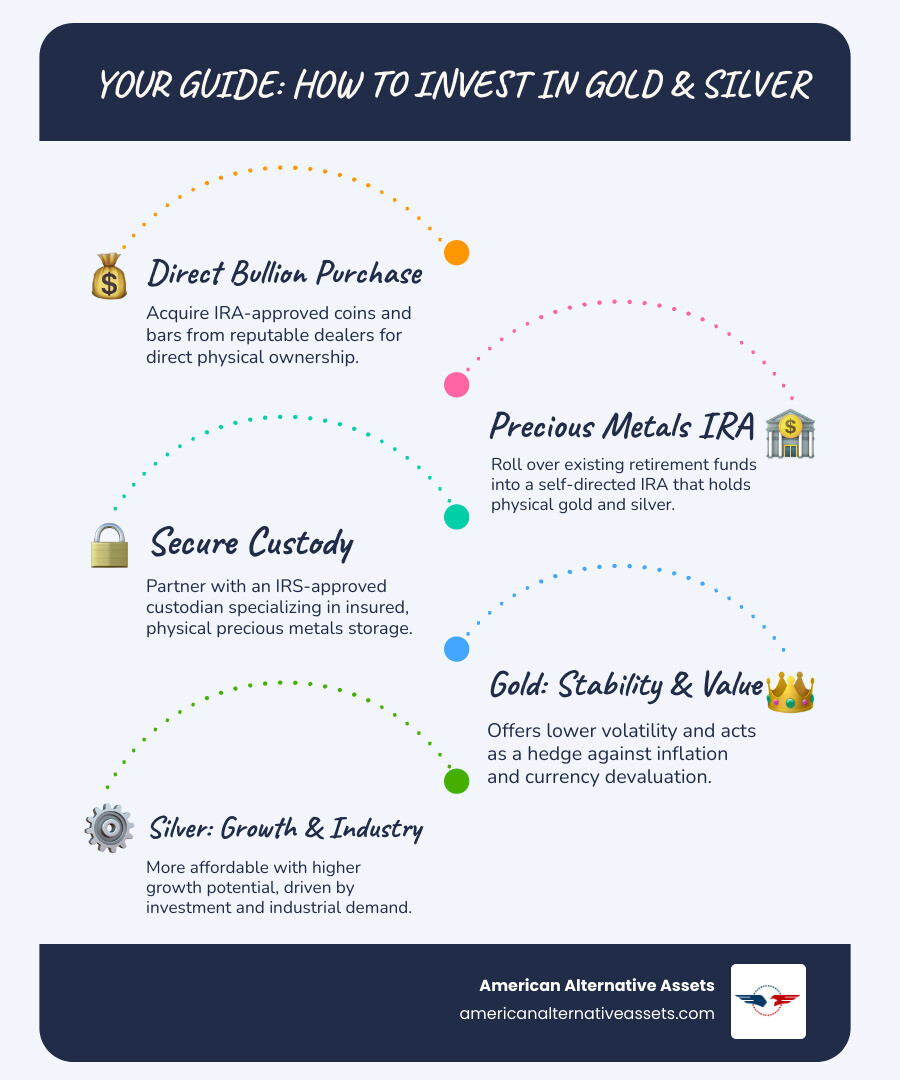
- Buy Physical Bullion Directly – Purchase IRA-approved coins and bars from reputable dealers
- Open a Precious Metals IRA – Roll over funds from existing retirement accounts into a self-directed IRA that holds physical metals
- Work with a Trusted Custodian – Partner with an IRS-approved custodian who specializes in physical precious metals storage
Key Consideration: Physical ownership of gold and silver provides direct control over your assets, with no counterparty risk or dependence on paper promises from financial institutions.
The choice between gold and silver depends on your goals. Gold offers stability and wealth preservation with lower volatility. Silver provides affordability and higher growth potential, driven by both investment demand and industrial applications in solar panels and electric vehicles.
Throughout history, gold and silver have served as stores of value during economic stress and political upheaval. When market volatility sends traditional investments into uncertainty, these precious metals often demonstrate remarkable resilience. In 2025, gold broke above $4,000 per ounce for the first time ever, reflecting growing concerns about inflation, currency devaluation, and geopolitical instability.
My grandfather handed me a silver Morgan coin when I was nine and said, “This is real money.” Decades later, after watching the 2008 crash destroy family wealth built on paper promises, I understood what he meant. I’m Shanon Davis, and I’ve spent years helping Americans understand how to invest in gold and silver through physical ownership, not paper substitutes. My mission is to help you hold value that doesn’t depend on anyone else’s promises.
How to invest in gold and silver word roundup:
Why Savvy Investors Turn to Gold and Silver
Savvy investors choose to invest in gold and silver for a variety of compelling reasons, primarily centered around wealth preservation and portfolio resilience. These precious metals have a long-standing history as reliable assets during times of economic turbulence and uncertainty.
One of the primary reasons is their role as an inflation hedge. When the purchasing power of fiat currencies erodes due to inflation, gold and silver have historically maintained their value, helping to preserve wealth. This characteristic is particularly appealing during periods of significant currency devaluation concerns.
Precious metals also offer crucial portfolio diversification. Unlike traditional assets such as stocks and bonds, gold and silver often move independently of the broader financial markets. This lack of correlation means they can act as a buffer during stock market downturns, helping to stabilize a portfolio. As Ray Dalio, a prominent investor, recommends, holding a 5-10% allocation to gold can be a wise strategy for an “all-weather” portfolio.
Furthermore, gold and silver are widely regarded as safe-haven assets. During periods of geopolitical instability or economic crisis, investors flock to these tangible assets, driving up their demand and often their price. We’ve seen this historically, such as in 2015 during Greece’s economic crisis, when bank withdrawals were limited to 60 euros per day, or in 2017 in Puerto Rico, where banks limited withdrawals to $100 per day after a hurricane. In such scenarios, physical cash, and by extension, physical precious metals, become essential. These events highlight the importance of holding assets that exist outside the traditional banking system.
These metals serve as a long-term store of value. They have been recognized as money for thousands of years, holding their purchasing power across generations. This makes them a fundamental component of effective wealth preservation strategies for individuals and even central banks. Indeed, Central Banks Are Betting Big on Gold, and we should be prepared for what’s coming.
The Tangible Advantage: Physical Metals vs. Paper Assets
When we talk about how to invest in gold and silver, it’s crucial to understand the fundamental difference between owning physical metals and holding paper assets that merely track their price. For true wealth preservation and security, we advocate for the tangible advantage of physical precious metals.
The Security of Physical Ownership
Owning physical gold and silver provides unparalleled security and peace of mind. This is about direct ownership, where you hold the actual asset, not a promise or a derivative. This means there is no counterparty risk. You are not relying on a bank, a brokerage, or a fund manager to honor a claim. The value is intrinsically linked to the metal itself, existing outside the traditional financial system.
In times of crisis, the utility of physical metals becomes profoundly clear. When banks limit withdrawals, power grids fail, or digital systems crash, physical gold and silver retain their value and liquidity. They offer true crisis utility and a degree of financial privacy that paper assets cannot match. This makes them a potent defense against threats like The CBDC Threat: Why Physical Precious Metals Are Your Last Line of Financial Defense. Our clients value the ability to have investing physical gold as a core part of their strategy.
The Risks of Paper “Gold” and “Silver”
While seemingly convenient, paper assets like gold or silver stocks and ETFs come with inherent risks that physical metals do not. These investments often involve counterparty risk, meaning your investment’s value depends on the solvency and integrity of the issuing institution or the underlying assets they claim to hold. If that entity faces financial trouble, your “gold” or “silver” investment could be jeopardized.
With paper assets, you typically have no direct claim to the metal itself. You own shares in a fund or a company, not a specific amount of physical gold or silver. This can lead to a lack of physical access in times of crisis, precisely when the tangible nature of precious metals is most valued. Furthermore, these paper instruments are often subject to market correlation, meaning they may still fall in value during a broader market downturn, diminishing their diversification benefits. For us, true ownership means holding the metal in your hands or in a secure, allocated vault, not merely a certificate or a digital entry.
How to Invest in Gold and Silver: A Guide to Physical Ownership
For those committed to genuine wealth preservation, understanding how to invest in gold and silver through physical ownership is paramount. We focus on two primary avenues: purchasing physical bullion directly and leveraging the strategic advantages of a Precious Metals IRA.
Purchasing Physical Bullion: Coins and Bars
The most straightforward way to acquire precious metals is by purchasing physical bullion in the form of coins and bars. This involves finding reputable dealers who can guarantee authenticity and provide transparent pricing. When considering a purchase, understand the concept of premiums over spot price. This premium covers manufacturing, distribution, and the dealer’s margin. While you want to minimize premiums for long-term appreciation, ensuring authenticity and quality from a trusted source is more important.
For investment-grade metals, especially those intended for a Precious Metals IRA, specific purity standards are crucial. For gold, this typically means a minimum fineness of 0.995 (99.5% pure), though certain coins like the American Gold Eagle are exceptions at 0.9167 purity. Silver bullion generally requires a minimum purity of 0.999. You can learn more about different types of bullion in our guide on Precious Metals Coin Types.
Once acquired, secure storage options are vital. For smaller amounts, a high-quality home safe might suffice. However, for larger holdings, professional, insured third-party depositories offer superior security. Remember the Golden Rules for Investors: What to Know Before Buying Physical Precious Metals to protect your investment. We are here to help you Buy Gold and Silver with confidence.
How to invest in gold and silver using a Precious Metals IRA
A powerful strategy for many investors is to incorporate physical gold and silver into their retirement planning through a Precious Metals IRA. This allows for tax-advantaged growth within a self-directed IRA structure.
One of the most common ways to fund a Precious Metals IRA is through rollovers from 401(k)s and other IRAs. This process allows you to transfer existing retirement funds into a new, self-directed IRA that can hold physical gold and silver, without incurring immediate taxes or penalties. This is an excellent way to diversify your retirement savings away from traditional paper assets. We offer comprehensive guides on What is a Gold IRA? and various Types of Retirement Accounts to help you understand your options.
A Precious Metals IRA requires two key entities: an IRS-approved custodian to administer the account and ensure compliance, and a depository for the secure, insured storage of your physical metals. These depositories are highly secure facilities, often insuring your gold and silver for up to $1 billion. We can help you steer the process of selecting a custodian, as outlined in our IRA Precious Metals Custodians Complete Guide. It’s important to understand the Precious Metals IRA Rules Guide to ensure your investments comply with IRS regulations.
While there are annual contribution limits for IRAs, rollovers from existing retirement accounts typically do not count towards these limits, allowing for larger transfers of wealth into physical precious metals.
Gold vs. Silver: Which Metal Is Right for Your Portfolio?
Deciding between gold and silver, or a combination of both, is a common question for investors exploring how to invest in gold and silver. Both metals offer unique characteristics that can complement a diversified portfolio.
| Metric | Gold | Silver |
|---|---|---|
| Price | Higher per ounce, typically more expensive entry point | Lower per ounce, more accessible for smaller investments |
| Volatility | Lower, more stable price movements | Higher, more significant price fluctuations |
| Industrial Demand | Primarily jewelry and investment, some high-tech electronics | Significant industrial demand (solar, EVs, electronics), also jewelry/investment |
| Market Role | Primarily monetary asset, ultimate safe haven, store of value | Dual role: monetary asset and industrial commodity |
| Gold-to-Silver Ratio | Historically higher value relative to silver | Historically lower value relative to gold |
The Case for Gold: The Monetary Standard
Gold has long been revered as the ultimate store of value and a monetary standard. Its scarcity, durability, and historical acceptance have cemented its role as a premier wealth preservation asset. For investors seeking stability, gold offers lower volatility compared to silver, making it a more conservative option during uncertain times.
The demand for gold is consistently strong, not just from individual investors, but significantly from central bank demand. Central banks around the world often hold large reserves of gold as a hedge against currency fluctuations and economic instability. Gold also boasts a higher price density, meaning a smaller physical amount represents significant value, simplifying storage.
Many financial experts, including Ray Dalio, recommend a considered allocation of 5-10% of a portfolio to gold for its diversification benefits. Our guide on Investor Benefits in Owning Gold digs deeper into why gold shines in a portfolio.
The Case for Silver: The Dual-Purpose Metal
Silver, often called “poor man’s gold,” presents a different set of investment characteristics. Its affordability makes it a more accessible entry point for new investors or those looking to acquire larger physical quantities. However, silver is known for its higher volatility potential, which can translate into greater percentage gains during bull markets, but also more significant drawdowns. For those asking Is Silver a Good Investment?, its unique attributes are worth exploring.
A key differentiator for silver is its substantial industrial demand. Over half of silver’s demand comes from industrial applications, making it a crucial component in various modern technologies. This includes its essential role in solar panels as a key conductive layer and its increasing use in electric vehicles (EVs), which use about three times as much silver as combustion-engine vehicles. This industrial demand provides an additional layer of support for silver’s price, separate from its monetary role.
We often look at the gold-to-silver ratio analysis to gauge the relative value of the two metals. Historically, gold was valued at 10-20 times as much as silver, and over the past century, the gold-to-silver ratio has averaged about 50-to-1. When this ratio is high, it can suggest that silver is undervalued compared to gold, presenting a potential opportunity for investors. Indeed, History Suggests Silver Could Follow Gold’s Rise, especially given its dual demand drivers.
Frequently Asked Questions about Investing in Precious Metals
What factors influence the price of gold and silver?
The prices of gold and silver are influenced by a complex interplay of various global factors:
- Supply and Demand: Like any commodity, the basic economics of supply from mining and recycling versus demand from investors, industry, and jewelry fabrication play a significant role.
- Central Bank Policies: Decisions by central banks regarding interest rates, quantitative easing, and currency interventions can profoundly impact precious metal prices. For instance, the price of gold is inversely correlated to Interest Rates, particularly real interest rates. When real interest rates are low, gold, which offers no yield, becomes more attractive relative to interest-bearing assets.
- Inflation Data: High or rising inflation often boosts demand for gold and silver as investors seek to preserve purchasing power.
- Geopolitical Events: Conflicts, political instability, and global crises tend to drive investors towards safe-haven assets, increasing demand for gold and silver.
- Currency Strength: A weaker US dollar often makes gold and silver more affordable for international buyers, increasing demand and price, and vice-versa.
- Industrial Consumption: Especially for silver, its extensive use in electronics, solar energy, and electric vehicles means that industrial demand and technological advancements can significantly influence its price.
What is the gold-to-silver ratio?
The gold-to-silver ratio is simply the number of ounces of silver it takes to buy one ounce of gold. It’s a metric that investors use to compare the relative value of the two precious metals.
Historically, the ratio has fluctuated significantly. During the past century, it has averaged about 50-to-1, meaning it typically took 50 ounces of silver to buy one ounce of gold. However, it has been as low as 10-to-1 and as high as over 100-to-1 at different points in history.
What it indicates about relative value: A high gold-to-silver ratio (e.g., above 80-to-1) can indicate that silver is undervalued relative to gold, suggesting a potential opportunity for silver investors. Conversely, a very low ratio might suggest gold is undervalued.
Using the ratio as an investment signal: Savvy investors often monitor this ratio. When silver is historically cheap compared to gold, some might consider allocating more to silver, anticipating that the ratio will eventually revert to its mean. It’s a tool for understanding market sentiment and potential shifts in value between the two metals.
What are the key considerations for how to invest in gold and silver?
When considering how to invest in gold and silver, several key factors should guide your decisions to ensure they align with your broader financial strategy:
- Investment Goals: Are you seeking long-term wealth preservation, a hedge against inflation, portfolio diversification, or potential capital appreciation? Your goals will influence whether gold or silver, or a combination, is more suitable.
- Risk Tolerance: While both metals are considered safe havens, silver typically exhibits higher volatility than gold. Understand your comfort level with price fluctuations.
- Time Horizon: Precious metals are generally considered long-term investments. Their value tends to manifest over extended periods, particularly during economic cycles.
- Diversification Strategy: How do precious metals fit into your overall portfolio? They should act as a complement, helping to balance risk and provide stability.
- Importance of Physical Ownership: For true protection and peace of mind, we believe physical ownership is paramount. This means holding actual coins and bars, ideally within a secure, allocated storage solution like a Precious Metals IRA, rather than relying on paper-backed promises.
Secure Your Financial Future with Tangible Assets
Understanding how to invest in gold and silver is more than just a financial decision, it’s a commitment to securing your financial future with tangible assets. We’ve explored the enduring reasons why investors turn to these precious metals: their power as an inflation hedge, their role in portfolio diversification, and their unwavering status as safe havens during times of crisis.
The distinction between physical metals and paper assets is critical. While paper investments may offer convenience, they carry inherent counterparty risks and lack the fundamental security and crisis utility of direct physical ownership. With physical gold and silver, you hold real wealth, free from the promises of third parties.
Gold offers stability and acts as a cornerstone for wealth preservation, while silver provides an accessible entry point with significant growth potential, driven by its crucial role in modern industries. The choice depends on your individual goals and risk tolerance, but the underlying principle remains the same: owning real assets.
At American Alternative Assets, we are your trusted partner in this journey. Our white-glove, relationship-first service is built on trust, transparency, and ethical practices, ensuring real privacy and protection for your wealth. We specialize in helping clients like you take control of your retirement by facilitating investments in physical precious metals, primarily through Precious Metals IRAs. We believe in empowering you with the knowledge and tools to confidently steer today’s economic landscape.
We invite you to Discover the Power of a Self-Directed Precious Metals IRA Today and start on a path toward greater financial security.
Disclaimer: This article is for informational purposes only and does not constitute financial advice. Please consult your financial advisor before making investment decisions. Investing in precious metals involves risk. Past performance does not guarantee future results.