








Why Traditional Investment Strategies May Not Be Enough
An alternative investments guide helps you understand assets beyond stocks, bonds, and cash that may offer diversification, downside protection, and potential for higher returns in changing economic conditions.
Quick Reference: What You Need to Know
- What they are: Investments outside traditional stocks, bonds, and cash (private equity, real estate, precious metals, commodities)
- Key benefits: Portfolio diversification, low correlation to public markets, potential inflation protection
- Main drawbacks: Illiquidity, complexity, higher minimum investments
- Most accessible options: Physical precious metals, REITs, certain commodities
- Typical time horizon: 5-10+ years for many alternatives
- Who should consider them: Investors seeking diversification beyond traditional markets
For most of us, investing means buying stocks and bonds. But there’s an entire universe of other options that may offer higher returns and greater diversification.
Traditional investments like stocks and bonds have served investors well for decades. But they share a common weakness: they tend to move together. When stocks fall, bonds don’t always provide the cushion they once did. In 2022, typical 60/40 portfolios declined by about 16% as both stocks and bonds dropped simultaneously.
That’s where alternative investments come in. These are assets that don’t fit into the traditional categories. They include private equity, real estate, commodities, and precious metals. What makes them valuable is their potential to perform differently than stocks and bonds, providing what financial experts call “non-correlated” returns.
The case for alternatives is getting stronger. From 2008 to 2022, private equity returned about 12% per year, outperforming global stocks by 5.7%. BlackRock CEO Larry Fink recently suggested that the future standard portfolio may shift from the traditional 60/40 mix to a 50/30/20 allocation, with that 20% dedicated to alternative investments.
But not all alternatives are created equal. Many require significant capital, years-long commitments, and deep expertise to evaluate. Some have complex structures. Others, like certain venture capital investments, can be highly speculative.
The good news is that some alternatives are more accessible than others. Physical precious metals, for example, can be held directly in specialized retirement accounts, offering tangible assets with centuries of history as wealth preservation tools.
My name is Shanon Davis, and I’ve spent decades in finance, from early lessons with a silver Morgan coin to building ventures in the alternative investment space. This alternative investments guide draws on that experience to help you understand how these assets work, which ones make sense for different situations, and how to approach them with confidence.
This article is for informational purposes only and does not constitute financial advice. Please consult your financial advisor before making investment decisions. Investing in precious metals involves risk. Past performance does not guarantee future results.
Important alternative investments guide terms:
What Are Alternative Investments and How Do They Differ?
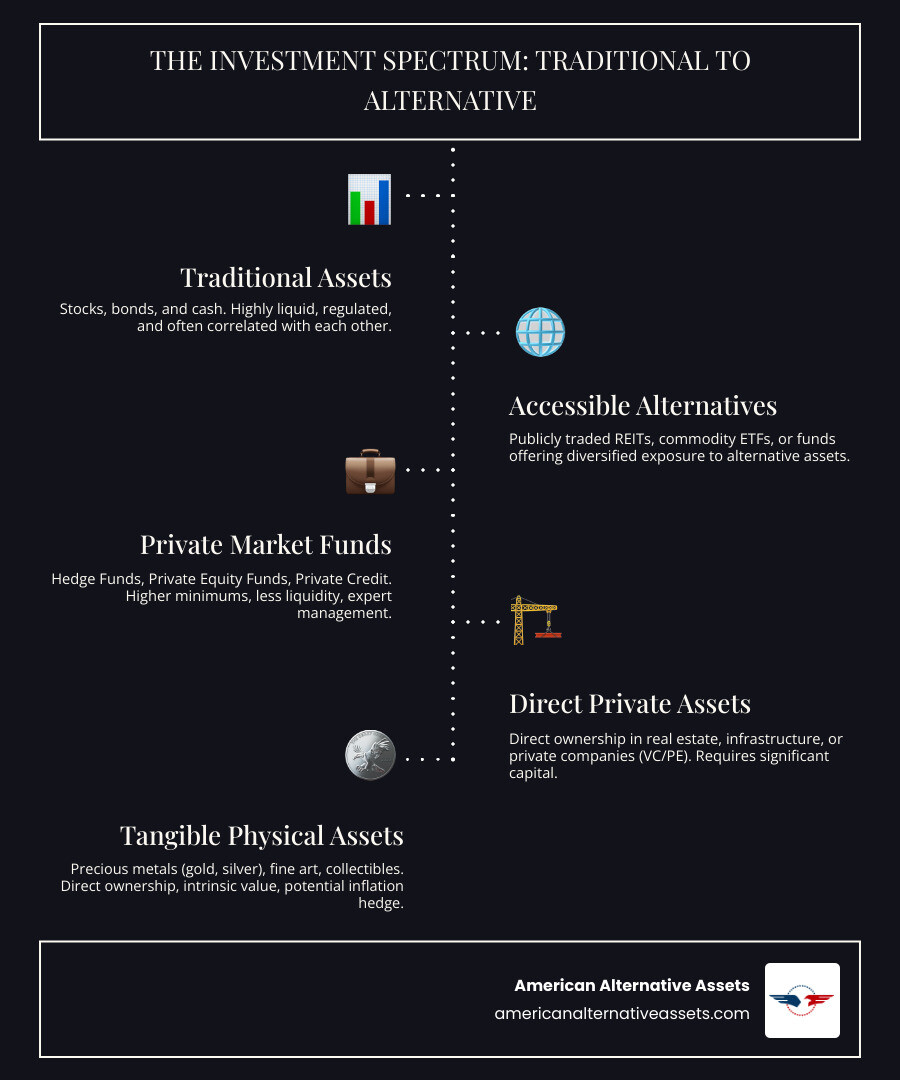
Alternative investments are assets that do not fall into the traditional categories of stocks, bonds, or cash. They are a diverse group, often characterized by their unique investment strategies, structures, and risk-return profiles. While traditional investments are typically liquid, transparent, and highly regulated, alternatives often operate with less liquidity, less transparency, and different regulatory frameworks. This alternative investments guide aims to shed light on these distinctions.
We can see the key differences by comparing traditional and alternative investments:
| Feature | Traditional Investments (Stocks, Bonds) | Alternative Investments |
|---|---|---|
| Liquidity | High, easily bought and sold on public exchanges | Generally low, can be difficult to sell quickly |
| Regulation | Highly regulated by bodies like the SEC | Varying regulation, often less stringent for private assets |
| Complexity | Relatively straightforward, widely understood | Often complex structures, strategies, and valuation |
| Correlation | High correlation with each other and market cycles | Low or negative correlation to traditional markets |
| Accessibility | Widely accessible to all investors, low minimums | Often restricted to accredited investors, higher minimums |
The benefits of portfolio diversification
One of the primary reasons we explore alternative investments is their potential to improve portfolio diversification. Diversification is a strategy designed to reduce risk by investing in a variety of assets. The idea is that a portfolio constructed with different kinds of assets will, on average, yield higher long-term returns and lower risk than any individual investment found within the portfolio.
Alternative investments often have a low correlation with traditional markets. This means they tend to perform differently than stocks and bonds during various economic cycles. For instance, if stocks are experiencing a downturn, certain alternatives might remain stable or even increase in value, helping to balance overall portfolio performance. This non-correlated nature is crucial for reducing volatility and protecting our wealth during inevitable periods when some investments are performing poorly. By spreading risk across different asset classes, we can pursue our long-term investment objectives with greater resilience.
Understanding the risks and drawbacks
While the benefits of alternative investments are compelling, it is equally important to understand their associated risks and drawbacks. This alternative investments guide wouldn’t be complete without a clear look at the potential downsides.
The most significant characteristic, and often a drawback, is illiquidity. Many alternative investments cannot be sold or exchanged quickly for cash without affecting their selling price. Our capital might be locked into these investments for set periods, sometimes for several years. This can be a challenge if we need quick access to our funds.
The complexity of alternative investments can also be a hurdle. They often involve intricate structures, sophisticated strategies, and unique valuation methods. For example, hedge funds may use derivatives, leverage, and hedging strategies that require a deep understanding of financial markets. This complexity also means that due diligence can be more involved, demanding a thorough investigation into the investment’s underlying assets, management team, and operational processes.
Finally, barriers to entry can exist, such as higher minimum investment requirements. While some alternatives are becoming more accessible, many are still primarily reserved for accredited investors or institutions. For example, investing in a masterpiece like a van Gogh painting can cost $81 million, making it largely inaccessible for most individual investors.
Common Types of Alternative Investments
The universe of alternative investments is vast and varied, encompassing a wide range of assets and strategies. Here, we explore some of the most common types that this alternative investments guide covers:

- Private Equity (PE): This involves investing in companies that are not publicly traded on a stock exchange. Private equity funds typically acquire significant stakes in private companies, aiming to improve their operations and eventually sell them for a profit. From 2008 to 2022, private equity returned about 12% per year, outperforming global stocks by 5.7%.
- Venture Capital (VC): A subset of private equity, venture capital focuses on providing funding to startups and early-stage companies with high growth potential. Venture capitalists invest in innovative businesses, hoping they will become the next big success story. However, this comes with significant risk; for example, the highly publicized failure of Theranos serves as a cautionary tale of the speculative nature of some venture investments. Over a 15-year period, venture funds returned almost 10% per year, outperforming global stocks by about 4%.
- Private Credit: This involves direct lending to companies, often those that find it difficult to secure financing from traditional banks. Private credit funds work like bonds, providing loans in exchange for interest payments. Over the past 15 years, private credit funds have returned 9% per year, offering returns in the ballpark of stocks while often being considered lower risk.
- Real Estate: Investing in real estate can take many forms, from direct ownership of properties to investing in Real Estate Investment Trusts (REITs) or private real estate funds. Real estate can generate income through rent and capital appreciation. Investing in farmland, for example, is often seen as a “safe haven” investment due to its low correlation to the stock market.
- Hedge Funds: These are pooled investment funds that use a variety of complex strategies, including leverage, short selling, and derivatives, to generate returns. They are actively managed and aim for positive returns regardless of market direction.
- Commodities: These are raw materials like gold, silver, oil, natural gas, and agricultural products such as corn and wheat. Investing in commodities can be done through direct ownership of the physical products.
- Collectibles: This broad category includes items like art, fine wine, antiques, and even rare memorabilia. While some might jokingly include a lock of Mick Jagger’s hair in this category, the point is that their value is derived from rarity and demand rather than traditional financial metrics.
A practical alternative investments guide for individual investors
While many alternative investments have historically been the domain of institutional and accredited investors, the landscape is evolving. However, accessibility remains a key challenge for individual investors, often due to high minimums and specific regulatory requirements. Many alternative assets are restricted to “accredited” or “qualified” investors, who are deemed to have the necessary financial sophistication and net worth to handle the associated risks.
For those of us seeking to diversify our portfolios with alternatives, it is crucial to understand the distinction between liquid alternatives and direct private market investments.
- Liquid Alternatives: These are alternative investment strategies offered in more accessible formats, such as mutual funds or exchange-traded funds (ETFs). They aim to replicate the returns of traditional alternative strategies (like hedge funds) but offer daily pricing and greater liquidity. While liquid alternatives provide easier access, they may still have lock-up periods or restrictions on the percentage of illiquid assets they can hold.
- Direct Private Market Investments: These involve direct ownership or investment in non-publicly traded assets, such as private equity funds, private real estate, or private credit. These typically have higher minimums, longer lock-up periods, and are less liquid.
For many individual investors in California and across the US, focusing on more accessible, tangible assets can be a pragmatic approach. This often means considering physical ownership of assets versus “paper” assets. For instance, when investing in commodities, understanding the difference between buying physical gold and silver versus investing in gold or silver ETFs or mining stocks is critical. This distinction will be explored further in the next section of this alternative investments guide.
How alternatives can serve as an inflation hedge
Inflation is the silent thief of purchasing power, eroding the value of our savings over time. An effective alternative investments guide should address how certain alternatives can act as a hedge against inflation. An inflation hedge is an asset that is expected to retain or increase its value during periods of rising prices.
Many alternative investments possess characteristics that make them suitable inflation hedges:
- Real Estate: Property values and rental income often rise with inflation, providing a natural hedge. Land, for example, is a finite resource, and its value tends to appreciate over the long term, often outpacing inflation.
- Commodities: Raw materials like oil, gas, and agricultural products are directly impacted by inflation. As the cost of goods and services rises, so too does the price of the underlying commodities needed to produce them.
- Infrastructure: Investments in essential infrastructure like utilities, toll roads, and communication networks often have revenues tied to inflation, providing stable, long-term cash flows that can resist inflationary pressures.
- Precious Metals: Historically, precious metals like gold and silver have been widely seen as a store of value and a safe haven during times of economic uncertainty and inflation. Gold, in particular, has demonstrated a near-perfect lack of correlation to equities over a 10-year period (-0.01), making it a valuable diversifier and inflation hedge. It is supported by risks of debt defaults and inflation, acting as a counterweight to financial assets. Gold’s political and geographical neutrality further improves its unique diversifying characteristic.
The Tangible Advantage: A Physical Assets Alternative Investments Guide
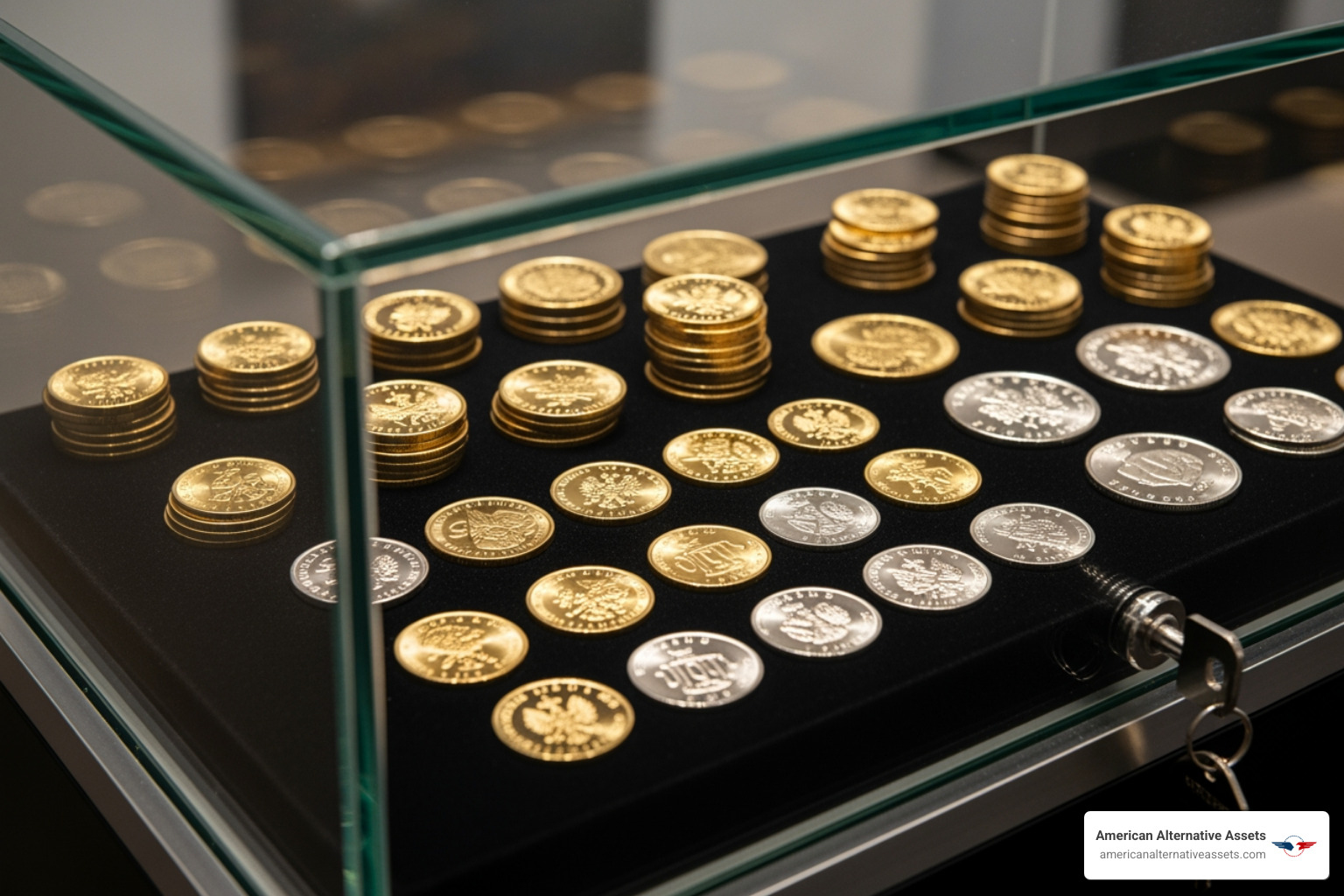
When we talk about tangible assets, we mean something you can physically hold, touch, and own directly. This is a crucial distinction in our alternative investments guide, especially when considering assets like precious metals. The unique value of physical, tangible assets lies in their intrinsic worth and the direct control they offer us.
Precious metals, such as gold and silver, embody this tangible advantage. For centuries, they have served as a universal currency and a reliable store of value. Unlike a digital entry in an account or a share in a company, physical gold and silver are finite, universally recognized, and not subject to the same counterparty risks as many other investments. Owning the physical asset directly provides a sense of security and permanence that is hard to replicate with other investment vehicles.
Physical metals vs. paper assets
The distinction between physical metals and “paper assets” is paramount for anyone considering precious metals as an alternative investment. This alternative investments guide emphasizes why direct ownership of physical metals is often preferred.
“Paper assets” in the precious metals space typically refer to:
- Gold/Silver ETFs (Exchange-Traded Funds): These funds hold gold or silver on behalf of investors, and shares are traded on stock exchanges. While they offer liquidity, we do not directly own the physical metal. We own shares in a fund that promises to hold metal. This introduces counterparty risk; we rely on the fund’s integrity and management.
- Mining Stocks: Investing in mining companies means we own a share of a business that extracts precious metals, not the metals themselves. The company’s performance depends on management, operational efficiency, and other factors, not just the price of gold or silver.
- Futures Contracts: These are agreements to buy or sell a commodity at a predetermined price on a future date. They are highly leveraged and speculative, primarily used by sophisticated traders for hedging or short-term speculation, not for long-term wealth preservation through physical ownership.
The core issue with paper assets is counterparty risk. This is the risk that the other party in a financial transaction will not fulfill their obligations. If we own a physical gold coin, that risk is minimal. If we own an ETF share, we are relying on the ETF provider, the custodian, and the regulatory environment. In times of extreme market stress, the ability of these paper assets to deliver on their promise can become a concern.
Owning physical gold and silver, on the other hand, means we hold the asset directly. It is a fundamental form of wealth that has endured through countless economic cycles and political changes. This tangible nature provides a unique layer of protection and peace of mind, making it a compelling component of an alternative investments guide focused on wealth preservation.
A modern alternative investments guide to precious metals IRAs
For those of us looking to combine the benefits of physical precious metals with the tax advantages of a retirement account, a Precious Metals IRA is a powerful option. This alternative investments guide highlights how we can access physical gold and silver for retirement planning through a Self-Directed IRA (SDIRA).
A Self-Directed IRA allows us to invest in a broader range of alternative assets than a traditional IRA, including physical precious metals. The process typically involves:
- Establishing an SDIRA: We open an SDIRA account with a specialized custodian that can administer alternative assets like precious metals.
- Funding the SDIRA: We can fund our SDIRA through contributions or, more commonly, by performing a 401(k) to IRA rollover. This allows us to transfer funds from an existing 401(k), 403(b), TSP, or other qualified retirement plan into our SDIRA, often tax-free. Rollovers are a common technique to bypass annual IRA contribution limits and can be done tax-free, even for early distributions.
- Purchasing Eligible Metals: With our SDIRA funded, we then instruct our custodian to purchase eligible physical gold, silver, platinum, or palladium bullion from a reputable dealer. The IRS has specific rules permitting precious metals in IRAs, as outlined in 26 U.S.C. 408(m). These rules specify that only certain types of bullion and coins, meeting minimum fineness requirements, are eligible. For example, American Eagle series coins and bullion that meets minimum fineness requirements are generally accepted.
- Secure Storage: The purchased physical metals are then securely stored in an approved depository, not at our home. This ensures compliance with IRS regulations and provides professional security for our assets.
The tax advantages of a Precious Metals IRA are similar to those of traditional IRAs, offering tax-deferred growth (for Traditional SDIRAs) or tax-free withdrawals in retirement (for Roth SDIRAs). This enables our physical precious metal holdings to potentially grow over time within a tax-advantaged wrapper, providing a robust component for our retirement strategy.
Key Considerations Before Investing in Alternatives
Before we dive into alternative investments, it is essential to ask ourselves some critical questions. A well-rounded alternative investments guide empowers us with the right questions for thoughtful decision-making.
Here is a list of key questions we should consider:
- What is my risk tolerance? Alternative investments can be more volatile and complex than traditional assets. Are we comfortable with the potential for significant fluctuations or longer periods without liquidity?
- What is my time horizon? Many alternative investments, particularly private equity or real estate, require long-term commitments, often 5 to 10 years or more. Do our financial goals align with these longer holding periods?
- Do I need liquidity? Given the illiquid nature of many alternatives, it is crucial to assess if we might need access to these funds in the short to medium term. We should only invest capital we are confident we won’t need immediately.
- Do I fully understand the investment? Alternatives can be complex. Have we done our homework? Do we understand the underlying assets, the investment strategy, the management team, and all associated risks? If not, we should seek expert guidance.
- How does this fit my overall financial goals? Will this alternative investment complement our existing portfolio? Does it align with our objectives for growth, income, or wealth preservation?
The importance of thorough due diligence cannot be overstated. Given the complexity and often less regulated nature of some alternatives, we must carefully investigate every aspect of an investment opportunity. This includes scrutinizing offering documents, understanding the track record of the investment manager, and seeking independent advice from financial professionals. By doing our homework, we can make informed decisions that align with our financial well-being.
Conclusion: Diversify Your Future with Confidence
When traditional investment strategies are being re-evaluated, alternative investments offer a compelling path to diversification, potential for higher returns, and crucial protection against economic uncertainties. This alternative investments guide has shown us that by looking beyond stocks and bonds, we can open up new opportunities to strengthen our portfolios.
The unique role of tangible assets, particularly physical precious metals like gold and silver, stands out for wealth preservation. In a financial landscape increasingly dominated by digital and paper assets, the intrinsic value and direct ownership of physical metals provide a foundational layer of security and peace of mind.
At American Alternative Assets, with locations in Woodland Hills, California, we believe in empowering our clients to take a proactive approach to financial planning. We specialize in helping individuals invest in physical precious metals, primarily through Precious Metals IRAs. Our white-glove, relationship-first service is built on trust, transparency, and ethical practices, ensuring real privacy and protection for your wealth.
We invite you to explore how physical precious metals can play a vital role in your diversified portfolio. To learn more about secure storage for your physical assets, please visit our website: Learn more about secure storage for your physical assets.
This article is for informational purposes only and does not constitute financial advice. Please consult your financial advisor before making investment decisions. Investing in precious metals involves risk. Past performance does not guarantee future results.