








Why Americans Are Turning to Physical Precious Metals for Retirement Security
Gold and silver IRA accounts allow you to hold physical precious metals in a tax-advantaged retirement account instead of traditional paper assets like stocks or bonds. Here’s what you need to know:
- What it is: A Self-Directed IRA that holds physical gold, silver, platinum, or palladium
- How it works: You transfer funds from an existing 401(k) or IRA into a custodian-managed account, then purchase IRS-approved precious metals stored in a secure depository
- Key benefit: True diversification with tangible assets outside the traditional banking system
- Tax advantages: Same as traditional or Roth IRAs, either tax-deferred or tax-free growth depending on account type
- Who holds it: An IRS-approved custodian manages the account while an approved depository stores your physical metals
Your retirement savings often exist as numbers on a screen, paper promises from distant institutions. A Precious Metals IRA offers another way, letting you own real, physical gold and silver within a tax-advantaged retirement account. This means owning actual coins and bars in your name, not paper certificates, mining stocks, or ETFs.
This isn’t about chasing returns. It’s about holding something that has maintained value for thousands of years while getting the same tax benefits as a traditional IRA.
The financial landscape is changing. The dollar’s purchasing power is declining while stock valuations are near historic highs. More Americans are realizing that true diversification means owning assets outside the traditional financial system.
Gold and silver don’t depend on anyone’s promise. They can’t be printed or devalued by monetary policy. Unlike paper assets, they give you direct ownership of something real.
Setting up a Precious Metals IRA is simpler than most people think. You can fund it by rolling over an existing 401(k) or IRA without triggering taxes or penalties. But like any retirement strategy, there are rules to follow. The IRS has specific requirements for which metals qualify and how they must be stored. Understanding these rules protects your investment.
This guide walks you through everything you need to know about gold and silver IRA accounts, from how they work to the steps for setting one up.
I’m Shanon Davis. After the 2008 crisis exposed the fragility of paper-based systems, I’ve dedicated my work to helping Americans secure their retirement with physical precious metals. I believe true retirement security starts with assets you actually own.
What is a Precious Metals IRA?
A Precious Metals IRA is a Self-Directed IRA (SDIRA) that lets you hold physical gold, silver, platinum, or palladium in your retirement portfolio. Unlike conventional IRAs limited to paper assets like stocks and bonds, an SDIRA gives you the freedom to own tangible assets, providing a unique path to wealth preservation.

This direct ownership of physical metals offers a distinct approach to retirement planning, providing control and tangibility that many investors seek in uncertain times.
Traditional vs. Roth Precious Metals IRAs
Just like standard IRAs, Precious Metals IRAs can be structured as either Traditional or Roth accounts, each offering different tax benefits:
- Traditional Precious Metals IRA: Contributions are often made with pre-tax dollars and may be tax-deductible. Your investments grow tax-deferred, with taxes paid upon withdrawal during retirement. This can be advantageous if you expect to be in a lower tax bracket in retirement.
- Roth Precious Metals IRA: Contributions are made with after-tax dollars and are not tax-deductible. The significant benefit is that your investments grow tax-free, and qualified withdrawals in retirement are also tax-free. This is often favored by those who expect to be in a higher tax bracket during retirement.
The choice between a Traditional and Roth Precious Metals IRA depends on your financial situation and long-term tax strategy.
How It Differs from a Standard IRA
The main difference between a Precious Metals IRA and a standard IRA is the assets they can hold. Standard IRAs are limited to paper assets like:
- Stocks
- Bonds
- Mutual funds
- Certificates of Deposit (CDs)
- Exchange-Traded Funds (ETFs)
These common investments do not offer direct ownership of physical assets. A Precious Metals IRA, as a Self-Directed IRA, breaks free from these limits, giving you the ability to:
- Directly own physical metals: You hold actual gold, silver, platinum, or palladium bullion, not shares in a company.
- Gain true diversification: You diversify your portfolio beyond assets tied to the performance of corporations or government debt.
- Control your investments: You have greater control over your investment choices, aligning your savings with your personal economic outlook.
This fundamental difference makes a Precious Metals IRA a powerful tool for protecting wealth with tangible assets.
The Core Benefits of a Physical Gold and Silver IRA
Investing in a physical gold and silver IRA account offers a unique set of benefits for retirement planning, particularly for those seeking stability and protection.
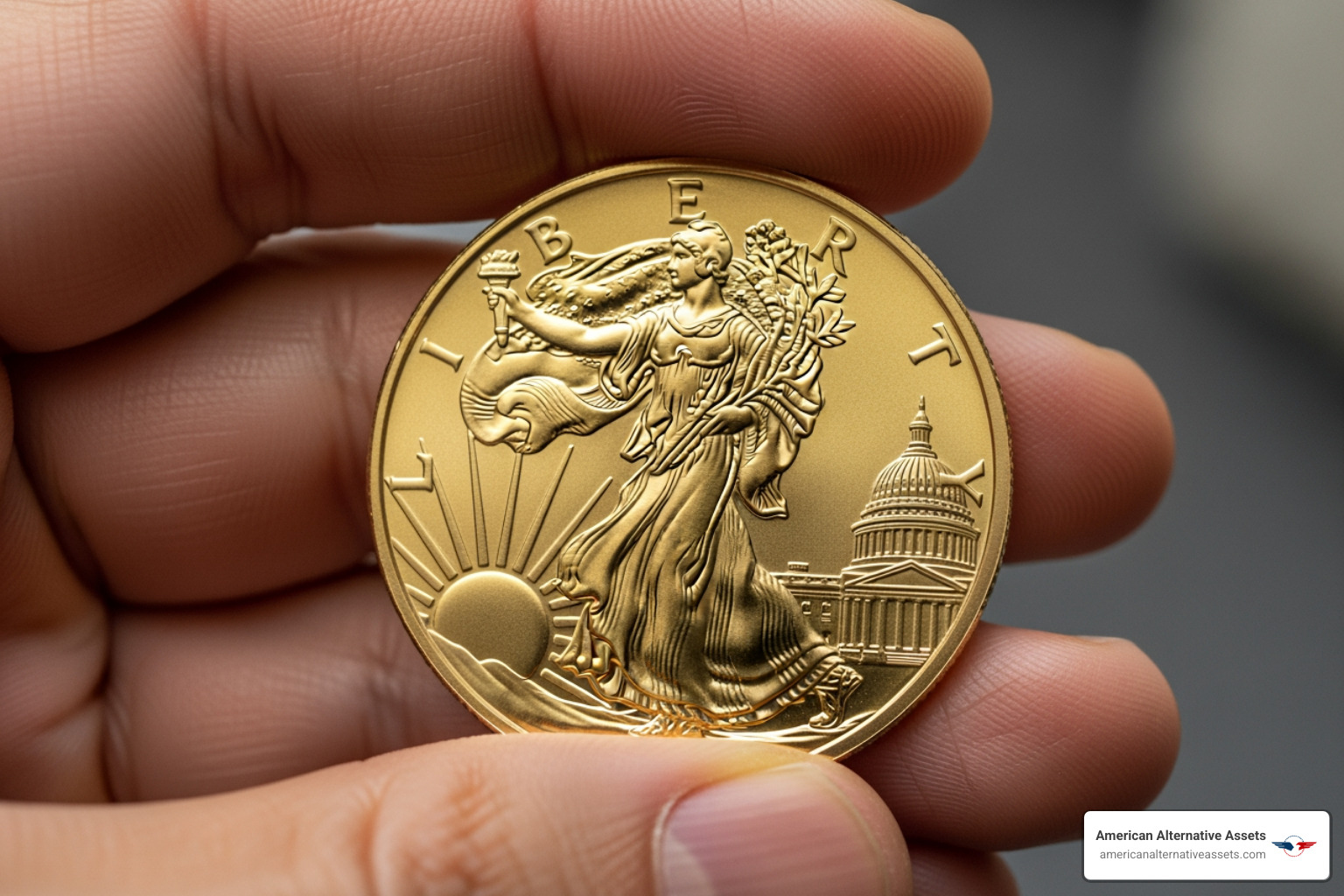
These accounts are widely seen as a prudent way to:
- Hedge against inflation: Precious metals have historically maintained their purchasing power when the value of fiat currencies declines.
- Protect against currency devaluation: Physical gold and silver act as a store of value, independent of government fiscal policies.
- Provide a tangible store of value: Unlike paper assets, physical precious metals are real, finite assets with intrinsic value.
- Offer portfolio diversification: Gold and silver often perform differently than stocks and bonds, providing balance during market volatility.
- Ensure tangible asset security: Your assets are physical and held outside the traditional banking system, offering security against systemic financial risk.
- Benefit from tax-advantaged growth: Your metals grow on either a tax-deferred or tax-free basis, depending on your account type.
A Hedge Against Economic Uncertainty
During economic uncertainty like market downturns or inflation, physical precious metals have often served as a safe haven, showing resilience when other assets falter. For instance, gold’s value rose significantly after the 2008 financial crisis and during the 2020 pandemic. While past performance isn’t a guarantee, this trend highlights gold’s role in preserving purchasing power. Gold’s value is often independent of stocks or central bank policies, offering protection against falling currencies and market volatility.
True Diversification with Tangible Assets
True diversification means owning assets that behave differently under various economic conditions, especially assets outside the traditional banking system. A physical gold and silver IRA account helps you achieve this by:
- Moving beyond paper assets: You move wealth into physical commodities not subject to the same counterparty risks as stocks or bonds.
- Owning assets outside the traditional banking system: Your metals are stored in an independent, IRS-approved depository, reducing exposure to financial sector vulnerabilities.
- Reducing counterparty risk: With physical bullion, you hold the asset directly, eliminating the risk that a third party might default on an obligation.
This approach helps build lasting financial security, providing peace of mind knowing a portion of your retirement is held in tangible assets.
How to Set Up and Fund Your Precious Metals IRA
Establishing a Precious Metals IRA is a straightforward process with the right guidance. At American Alternative Assets, our commitment to white-glove, relationship-first service ensures transparency and ease every step of the way.
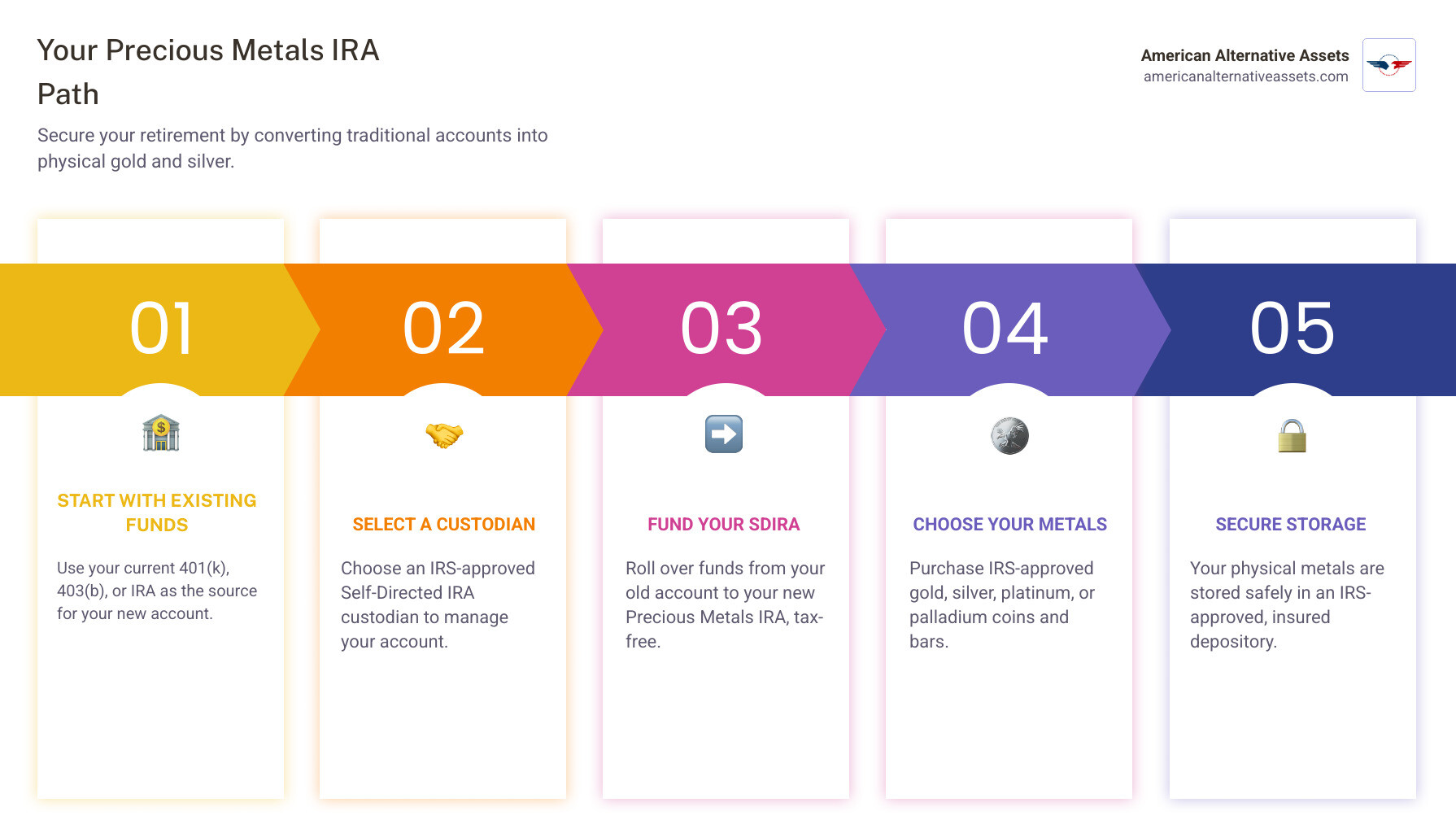
Here is a step-by-step guide:
- Choose a Partner: Select a reputable precious metals provider, like American Alternative Assets, that specializes in gold and silver IRA accounts. We will guide you through the entire process.
- Open the Account: We will assist you in opening a Self-Directed IRA with an IRS-approved custodian, designated to hold physical precious metals.
- Fund the Account: You will fund your new SDIRA through a transfer, rollover, or direct contribution.
- Select Your Metals: Once funded, you will choose the IRS-approved gold, silver, platinum, or palladium products you wish to purchase.
- Secure Storage: Your chosen metals will be shipped to a secure, IRS-approved depository for safekeeping.
Common funding methods include:
- 401(k) Rollover: Transferring funds from a previous employer’s 401(k), 403(b), or TSP account.
- IRA Transfer: Moving funds from an existing Traditional, Roth, or SEP IRA.
- Annual Contribution: Making new contributions directly to your Precious Metals IRA, subject to IRS limits.
The Role of the Custodian and Depository
A compliant Precious Metals IRA involves two distinct entities: the custodian and the depository.
- The Custodian: A Self-Directed IRA custodian is a financial institution that administers your account. They handle all paperwork, ensure IRS compliance, process transactions, provide statements, and report to the IRS.
- The Depository: An IRS-approved depository is a secure, third-party facility where your physical precious metals are stored, as mandated by the IRS to prevent “self-dealing”. These facilities offer high-level security, insurance for your assets against theft or damage, and independent auditing to verify your holdings.
You cannot personally store the precious metals for your IRA. All physical assets must be held by an IRS-approved third-party depository.
Understanding the Associated Fees
Precious Metals IRAs involve fees to cover secure management and compliance. These ensure the proper administration, storage, and insurance of your tangible assets. Generally, these costs include a one-time account setup fee, an annual administration fee, and an annual fee for secure storage and insurance. At American Alternative Assets, we believe in complete transparency. We will provide a clear breakdown of all costs associated with your Precious Metals IRA.
Funding Your Account: Rollovers and Transfers
Funding your gold and silver IRA account can be done in several ways, all designed to maintain the tax-advantaged status of your savings. The most common methods are:
- 401(k) Rollovers: You can roll over funds from a previous employer’s 401(k), 403(b), or TSP into your new Precious Metals IRA, generally tax-free and penalty-free.
- IRA to IRA Transfers: You can transfer funds directly from an existing Traditional, Roth, or SEP IRA. This custodian-to-custodian transfer is typically the easiest method. While The IRS only permits one rollover (per account) during 12 months for indirect rollovers, you are allowed unlimited custodian-to-custodian IRA transfers.
- Annual Contributions: You can also fund your account with new, annual contributions, subject to IRS limits.
The funding process is designed to be seamless. We work with your current plan administrator or custodian to handle all paperwork correctly, maintaining the tax-advantaged status of your funds. For indirect rollovers, where funds are paid to you, there is a 60-day window to deposit them into your new SDIRA to avoid taxes and penalties.
Understanding the Rules for Gold and Silver IRA Accounts
The IRS has specific rules for which precious metals can be held in an IRA and how they must be stored. Following these guidelines is essential to maintain the tax-advantaged status of your gold and silver IRA account.
IRS-Approved Precious Metals
Not all gold and silver products are eligible for a Precious Metals IRA. The IRS has strict purity standards. Generally, eligible metals must meet the following fineness levels:
- Gold: .995 (99.5%) pure or higher. The American Gold Eagle coin is a notable exception, as it is 22-karat (.9167 pure) but still IRS-approved.
- Silver: .999 (99.9%) pure or higher.
- Platinum: .9995 (99.95%) pure or higher.
- Palladium: .9995 (99.95%) pure or higher.
Eligible forms include bullion bars, rounds, and specific government-minted coins. Some of the most popular approved coins for IRAs include:
- American Eagle Gold Bullion Coins
- Austrian Gold Vienna Philharmonic Coins
- Canadian Gold Maple Leaf Coins
- British Gold Britannia Coins
- American Gold Buffalo Bullion Coins
- Australian Gold Kangaroo/Nugget Coins
- American Eagle Silver Bullion Coins
- Austrian Silver Vienna Philharmonic Coins
- Canadian Silver Maple Leaf Coins
- British Silver Britannia Coins
- American Eagle Platinum Bullion Coins
- Canadian Platinum Maple Leaf Coins
The US Mint produces several IRA-eligible coins that meet these requirements. Working with a knowledgeable provider ensures your selected metals are fully compliant with IRS regulations, helping you avoid tax penalties.
What are the contribution limits for gold and silver ira accounts?
The contribution limits for gold and silver IRA accounts are the same as for Traditional and Roth IRAs. For 2024 and 2025, the limits are:
- For individuals under age 50: You can contribute up to $7,000 per year.
- For individuals age 50 and older: You can contribute an additional $1,000 as a “catch-up” contribution, for a total of $8,000 per year.
These limits apply to your total contributions across all your IRAs. For self-employed individuals, SEP IRAs have different, higher limits. For example, in 2024, individuals can set aside up to 25% of compensation or $69,000, whichever is less.
You can find the most current information directly from the IRS contribution limits information.
What are the tax implications of gold and silver ira accounts?
The tax implications of gold and silver IRA accounts mirror those of standard IRAs:
- Traditional Precious Metals IRA: Contributions may be tax-deductible, and investments grow tax-deferred. You pay ordinary income tax on withdrawals in retirement.
- Roth Precious Metals IRA: Contributions are made with after-tax dollars, but investments grow tax-free, and qualified withdrawals in retirement are also tax-free.
Required Minimum Distributions (RMDs): Traditional Precious Metals IRAs have RMDs starting at age 73 (or 75 for those born after 1960), calculated by your custodian using the IRS’s “Uniform Lifetime Table.” Roth IRAs do not have lifetime RMDs, offering more flexibility.
Early Withdrawals: Withdrawals before age 59 1/2 are generally subject to ordinary income tax and a 10% early withdrawal penalty, unless an IRS exception applies.
Understanding these tax rules is crucial. We always recommend consulting with a qualified tax professional to discuss your specific situation.
Physical Metals vs. Paper Assets: Why Ownership Matters
When considering gold and silver IRA accounts, it is vital to understand the difference between owning physical metals and investing in paper assets that track their price, like Gold ETFs or mining stocks. The distinction lies in true ownership and risk.
| Feature | Physical Gold IRA | Gold ETF / Mining Stock |
|---|---|---|
| Ownership | Direct ownership of tangible bullion | Indirect ownership (shares in a fund or company) |
| Counterparty Risk | Low; assets held by independent depository | High; reliant on the fund/company’s solvency |
| Tangibility | Physical asset you can hold (upon distribution) | Intangible; a financial instrument |
| Security | Independent of banking system, enduring value | Subject to financial system risks, company performance |
Gold ETFs and mining stocks are not physical assets; they are paper derivatives. While they offer exposure to gold’s price movements, they do not provide the security of owning the physical commodity.
The Risks of Gold ETFs and Mining Stocks
Investing in Gold ETFs or mining stocks carries risks not found with owning physical bullion:
- Lack of Tangible Backing: You don’t own the physical metal, only a claim on it. The liquidity of these claims could be uncertain in a crisis.
- Management Fees: ETFs charge annual fees that can erode returns.
- Market Correlation: Mining stocks are often correlated with the stock market, and their performance depends on company operations, not just the price of gold.
- Company Performance Risk: Mining stocks expose you to risks like labor disputes, operational failures, or political instability.
- Not a Direct Hedge: Paper assets don’t provide the same direct hedge against currency devaluation or systemic risk as physical metals.
These paper assets do not provide the same security and peace of mind that comes with owning physical bullion.
The Security of Owning Physical Bullion
The security of owning physical bullion in a Precious Metals IRA stems from its direct, tangible nature:
- Direct Ownership: You are the legal owner of specific, identifiable precious metals, which eliminates intermediary risk.
- Control Over Your Assets: You maintain control over the assets within your IRA, even while stored by a third-party depository.
- No Intermediary Risk: Your investment is not subject to the solvency or performance of a financial institution.
- A Timeless Store of Value: Gold and silver have served as a store of wealth for millennia, making them an enduring asset.
Physical bullion endures. It is a tangible representation of wealth that stands apart from the promises of governments or corporations.
Frequently Asked Questions about Precious Metals IRAs
We understand that investing in gold and silver IRA accounts can bring many questions. Here are some of the most common inquiries we receive:
Can I store the precious metals for my IRA at home?
No. IRS regulations require all physical assets in a Precious Metals IRA to be stored at an IRS-approved third-party depository. This rule prevents “self-dealing” and ensures the assets are for retirement, not personal use. Per Internal Revenue Code IRC-408n, your precious metals must be stored at a 3rd party (non-bank) depository. Storing them at home is considered a taxable distribution and can lead to significant penalties. Source: https://www.irs.gov/retirement-plans/retirement-plan-investments-faqs
What happens when I want to take a distribution?
When you reach retirement age, typically 59 1/2, you have several options for taking distributions from your Precious Metals IRA:
- In-Kind Distribution: You can take physical possession of your precious metals. Your custodian will arrange for the metals to be shipped to you from the depository. This is a distribution and will be a taxable event for Traditional IRAs.
- Liquidating Metals for Cash: You can instruct your custodian to sell your precious metals. The cash proceeds are then deposited into your IRA and can be distributed to you. This is also a taxable event for Traditional IRAs.
For Traditional IRAs, distributions are taxed as ordinary income. For Roth IRAs, qualified distributions are tax-free. It’s wise to consult a tax professional before initiating a distribution to understand the tax implications.
Can I have more than one IRA?
Yes, you can have multiple IRAs, such as a Traditional, Roth, and a Precious Metals IRA, for diversification. However, your total annual contribution limit applies across all your IRAs combined. For example, if you contribute the maximum to a Traditional IRA, you cannot contribute additional funds to a Roth or Precious Metals IRA in the same year, beyond any eligible catch-up contributions.
Conclusion: Secure Your Future with Tangible Wealth
In a world filled with economic uncertainties and fluctuating markets, securing your retirement with tangible assets like physical gold and silver offers a compelling path to financial preparedness. A gold and silver IRA account provides the unique benefits of diversification, security, and control, all within a tax-advantaged framework.
At American Alternative Assets, we are dedicated to helping you steer this landscape with confidence. Our white-glove, relationship-first service ensures transparency and ethical practices, providing you with real privacy and protection for your wealth. We believe in empowering you to take proactive steps toward a more resilient retirement.
By incorporating physical precious metals into your retirement plan, you are choosing enduring assets that have historically preserved purchasing power and provided stability when traditional paper assets have faltered. It is about building a foundation of wealth that you truly own, independent of the volatility of the financial system.
We invite you to explore how a Precious Metals IRA can strengthen your retirement portfolio. Learn more about securing your retirement with a Precious Metals IRA.
Investing in precious metals involves risk. Past performance does not guarantee future results.