








Understanding the Price of Pure Gold
The 24 carat gold bullion price reflects the current market value of the purest form of gold available for investment. Here’s what you need to know:
Current Price Indicators:
- Per Ounce: Live spot prices are available on major financial news outlets and precious metals dealer websites.
- Per Gram: Divide the troy ounce price by 31.1.
- Per Kilo: Multiply the troy ounce price by 32.15.
Key Pricing Components:
- Spot Price: The wholesale price for immediate delivery.
- Premium: Additional costs for minting, fabrication, and dealer services.
- Purity: 24-carat gold is 99.99% fine, the standard for investment-grade bullion.
My grandfather handed me a silver Morgan coin when I was nine and said, “This is real money.” That moment stayed with me, especially after the 2008 crash revealed how fragile paper-based systems are.
Unlike paper assets, 24-carat gold bullion represents tangible wealth. It’s physical, portable, and doesn’t depend on anyone else’s promise to hold value. The price changes constantly based on supply, demand, and global events. Understanding how to track the 24 carat gold bullion price helps you make informed decisions about protecting your wealth.
As the founder of American Alternative Assets, I’ve spent years helping people understand how physical precious metals, often held within a Precious Metals IRA, can protect wealth. My focus is on teaching how to hold real value that doesn’t depend on someone else’s balance sheet, with the 24 carat gold bullion price as a key indicator.
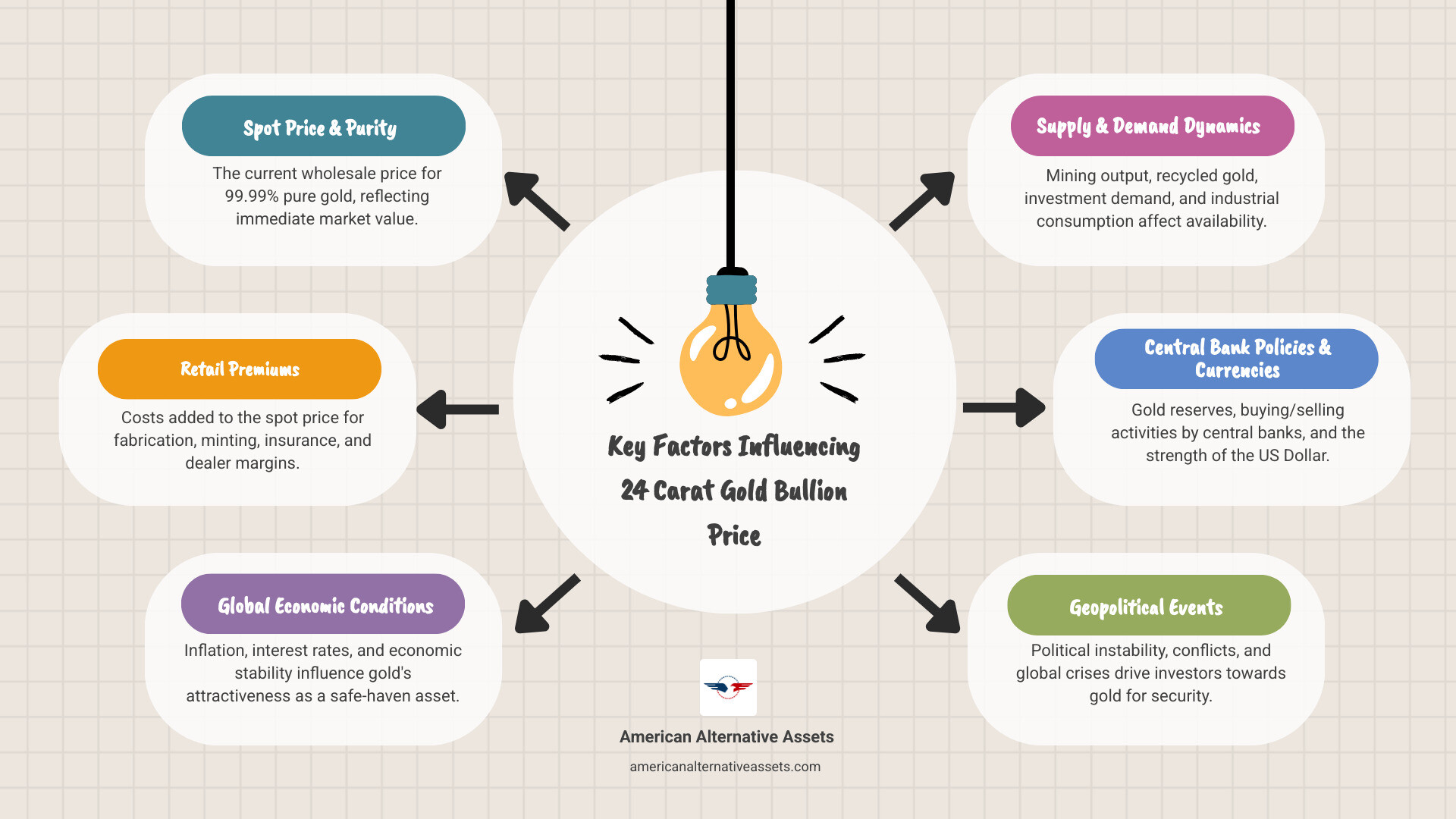
What is the 24 Carat Gold Bullion Price and How is it Determined?

The 24 carat gold bullion price is the market value of gold that is 99.99% pure, also known as .9999 fine gold. This price is primarily based on the spot price, which is the baseline for all transactions.
The spot price of gold is the current market price for one troy ounce of gold available for immediate delivery. It is a key indicator in financial markets, determined by continuous trading on global commodities markets like those in London and New York. These markets operate nearly 24 hours a day during the week, with prices influenced by economic data, geopolitical events, and market sentiment. Investors can track live gold prices on reputable financial news sites or data providers. To find the price per gram, divide the troy ounce price by 31.1. For a kilo, multiply the troy ounce price by 32.15.
How does the spot price relate to the retail price?
The spot price represents the wholesale price for large gold bars. When you purchase physical 24 carat gold bullion as an investor, you pay a retail price that is slightly higher than the spot price. This difference is known as the premium.
Premiums cover the costs of bringing physical gold to the retail market, including fabrication, minting, transportation, insurance, storage, and dealer overhead. Smaller bullion products, such as 1 ounce coins or bars, typically have higher premiums per ounce than larger bars because the fixed costs are spread over a smaller amount of gold.
Why is 24 carat purity significant for pricing?
The 99.99 percent purity of 24 carat gold is essential for its pricing and investment appeal. This level of fineness is significant for several reasons:
- Investment grade standard: 24 carat gold is the widely accepted standard for investment grade bullion, making it eligible for inclusion in a Precious Metals IRA. Products such as widely recognized 24 carat coins are valued for their full weight in gold. When we speak of gold as a store of wealth, we are usually referring to this high level of purity.
- Intrinsic value: Because it contains no other metals, 24 carat gold bullion has an intrinsic value that is directly tied to the global spot price. This simplifies its valuation and reinforces its reliability as a tangible asset.
- Global acceptance: Its high purity supports global recognition and liquidity. 24 carat gold is understood and valued worldwide based on its pure gold content, which makes it a highly desirable asset for wealth preservation.
What Factors Influence the Price of 24-Carat Gold Bullion?
The 24 carat gold bullion price is dynamic, reflecting numerous global forces. Understanding these influences is key to making informed investment decisions.
Global Economic Conditions
Economic stability, or the lack of it, significantly impacts gold prices. During times of economic uncertainty, recessions, or market volatility, gold often acts as a safe haven asset. When traditional investments falter, investors tend to move to gold, which can increase its demand and price. In periods of strong economic growth, some investors may shift part of their focus away from gold, which can put downward pressure on its price.
Supply and Demand
Like any commodity, the principles of supply and demand are fundamental.
- Supply: This is influenced by mining output, extraction costs, and the political stability of gold producing nations. Central bank sales can also increase supply.
- Demand: This comes from central banks, the jewelry industry, industrial uses, and investors seeking physical bullion or other gold related assets. Investor demand for physical bullion tends to rise during times of fear or inflation.
Inflation Hedge
Gold is widely regarded as a potential hedge against inflation. When fiat currencies lose purchasing power, the value of gold has often moved higher over time. This is because gold has maintained its long term value, which makes it a common choice for those focused on preserving wealth when inflation expectations are lifted.
Currency Fluctuations
The value of the United States Dollar has a strong inverse relationship with gold prices because gold is priced in dollars. A stronger dollar can make gold more expensive for foreign buyers, which can reduce demand. A weaker dollar often makes gold more affordable for non dollar investors, which can support increased demand and higher prices.
Geopolitical Events
Geopolitical tensions and conflicts can cause spikes in the 24 carat gold bullion price. Investors often view gold as a reliable asset during a crisis, because it is largely separate from the turmoil that affects specific nations or companies. Events such as wars or major international disputes can lead to a flight to safety, with gold being a primary beneficiary.
Investors who want to see how these factors show up in real time often watch price charts from services that track the live spot price of gold.
How do central banks and major exchanges impact the price?
Central banks and major exchanges are pivotal in shaping the 24 carat gold bullion price.
Central Banks: These institutions hold large gold reserves. Their buying and selling can influence global supply and demand. When central banks accumulate gold, it can signal confidence in the metal as a store of value and can support prices.
Major Exchanges: Gold pricing is largely influenced by trading on major commodity exchanges.
- London Bullion Market Association (LBMA): The LBMA is central to the global over the counter gold market and its benchmark prices are widely used.
- COMEX: As a leading futures exchange, trading activity on COMEX affects the spot price because futures prices reflect expectations about future supply and demand.
What is the difference between physical gold and gold derivatives?
Understanding the difference between owning physical gold and investing in gold derivatives is crucial. We advocate exclusively for the direct ownership of physical precious metals, because it offers superior protection and control compared to paper based products.
| Feature | Physical Gold Bullion (for example, 24 Carat Gold Bars and Coins) | Gold Derivatives (for example, ETFs, Futures, Options) |
|---|---|---|
| Ownership | Direct, tangible ownership of the metal | Indirect exposure through a contract or share |
| Asset Type | Real, tangible asset | Paper asset or financial instrument |
| Counterparty Risk | Very low, you own the asset directly | Present, depends on the solvency of the issuer or exchange |
| Storage | Requires secure vaulting or personal storage | No personal storage of metal, the asset is held on paper |
| Fees | One time premium over spot price, potential storage fees | Ongoing management and trading fees can apply |
| Liquidity | Highly liquid through a global network of dealers | Dependent on exchange trading; subject to halts and counterparty failure |
| Control | Full control over your tangible asset | Dependent on the structure and management of the product |
Physical gold offers the security of direct ownership, which reduces the counterparty risk that is inherent in paper based products such as derivatives. While derivatives may appear convenient, their annual fees and structural risks can erode their effectiveness as long term wealth preservation tools. For investors who want to hold enduring value outside the financial system, the advantages of direct physical ownership, often secured within a Precious Metals IRA, are the central focus.
How Can You Invest in 24-Carat Gold Bullion?

Investing in 24 carat gold bullion means holding the physical metal, primarily in the form of gold bars or gold coins. The best choice depends on your goals, such as whether you prioritize long term wealth preservation or the flexibility to liquidate smaller portions over time.
Which is a better investment: gold bars or gold coins?
Both 24 carat gold bars and coins offer direct exposure to the 24 carat gold bullion price, but they suit different strategies.
Gold Bars:
- Lower premiums: Bars generally have lower premiums over the spot price compared to coins of the same weight, which makes them cost effective for acquiring more gold for each dollar invested.
- Storage efficiency: Larger bars are more compact and efficient to store in secure vaults.
- Purity: Investment grade bars are typically 24 carat, or .9999 fine gold.
Gold Coins:
- Divisibility and liquidity: Coins offer greater divisibility, which allows you to sell smaller portions of your holdings. Their recognition makes them highly liquid in many markets.
- Collectibility: Some 24 carat coins may have a collectible value, although for pure investment, many investors focus on the bullion value.
- Accessibility: Smaller denomination coins make it easier for investors to start building a gold portfolio gradually.
For investors focused on minimizing acquisition costs, gold bars are often the preferred choice because of their lower premiums. Coins can be a strong option for those who prioritize flexibility and smaller transaction sizes.
Why should you avoid buying gold below the spot price?
Our advice is firm, never attempt to buy gold below the spot price.
If an offer sounds too good to be true, it almost certainly is.
Here is why:
- Counterfeit risk: The most significant risk is encountering counterfeit products. Scammers often try to attract buyers with impossibly low prices.
- Supply chain costs: The legitimate gold supply chain involves mining, refining, minting, and secure transport, all of which have real costs.
- Dealer costs: Reputable dealers have business overhead and must earn a profit. The premium you pay above spot covers these costs and supports authentic, properly sourced products.
- Authenticity assurance: Trustworthy dealers provide authenticated products, often with assay cards or certificates that state purity and weight. Buying below spot usually bypasses these essential safeguards.
The spot price represents the value of the pure metal. The premium reflects the real world cost of making that metal available to you in physical form. Always work with reputable dealers who charge fair premiums for physical bullion, ideally within a structure such as a Precious Metals IRA where your holdings are stored in an approved depository.
What is Gold’s Historical Performance and Role in a Portfolio?
Gold has earned a reputation as a cornerstone of wealth preservation over millennia. Its historical performance supports its unique role in a diversified investment portfolio, particularly as a potential safeguard during economic instability.
Long term Value and Diversification
For thousands of years, gold has served as a store of wealth because it has tended to hold purchasing power over the long run. This enduring value illustrates gold’s ability to transcend economic cycles and currency devaluations. As an asset, gold is also a powerful diversifier because its price has often moved differently than stocks and bonds during periods of market volatility. When stocks are under pressure, gold prices have at times moved higher, which can improve overall portfolio stability.
Hedge Against Inflation
One of gold’s most discussed attributes is its potential role as a hedge against inflation. When the purchasing power of fiat currencies declines, the price of gold has often risen over long periods, helping to preserve wealth. This is because gold’s supply is limited and it cannot be created at will by policy decisions.
What is the historical 24 carat gold bullion price performance?
The historical performance of the 24 carat gold bullion price highlights its resilience and long term appreciation, although it can be volatile in the short term.
- Long term appreciation: Gold has shown a notable average annual rate of return over extended periods. For example, from the early 1970s, when the United States moved away from the gold standard, through 2022, gold produced an average annual return of around 7 to 8 percent according to widely cited market data.
- Performance during crises: Gold has often held up or advanced when other assets struggled. During the 2008 financial crisis, gold was one of the few assets that showed a gain for the year. It also performed well during later periods of uncertainty, such as the COVID 19 pandemic and heightened geopolitical tensions, reaching new nominal highs.
A common way to understand gold’s staying power is through a simple comparison. In ancient Rome, a high quality toga and sandals cost roughly the same amount of gold as a well made business suit and shoes cost in gold terms today. While currencies and prices have changed dramatically, gold has tended to maintain similar real world purchasing power across centuries.
These historical patterns are why many investors consider 24 carat gold bullion an important component of a long term strategy to preserve wealth, especially within tax advantaged vehicles such as Precious Metals IRAs.
How does the gold and silver ratio relate to gold pricing?
The gold and silver ratio measures how many ounces of silver it takes to purchase one ounce of gold. It is a useful tool for understanding the relative value of these two precious metals.
- Relative value indicator: A high ratio suggests that silver may be inexpensive relative to gold, while a low ratio might indicate that silver is expensive compared to gold.
- Investment timing tool: Some investors use the ratio as a broad strategic indicator, adjusting their mix of physical gold and silver over time to seek more ounces of metal, not as a timing tool for short term trading.
- Market sentiment gauge: The ratio can also reflect broader market sentiment. In times of acute economic uncertainty, gold may outperform silver, which can result in a higher ratio.
By understanding this relationship, investors can take a more informed approach when deciding how to divide their precious metals allocation between physical gold and physical silver within a long term plan.
Frequently Asked Questions about 24 Carat Gold Bullion
Is 24 carat gold a suitable investment for a retirement account?
For many investors, 24 carat gold bullion can be an appropriate component of a retirement strategy when held through a Precious Metals IRA. This type of account allows you to hold physical gold, silver, platinum, or palladium bullion within a tax advantaged retirement structure, subject to IRS rules.
Reasons some investors consider this approach include:
- Tax advantages: Like traditional IRAs, a Precious Metals IRA can allow investments to grow on a tax deferred basis until retirement, depending on the specific account type.
- Long term wealth protection: By holding tangible 24 carat gold, you are investing in an asset that has historically helped many investors preserve purchasing power during periods of inflation and currency devaluation.
- Diversifying retirement savings: Adding physical gold bullion introduces an asset that has often behaved differently from stocks and bonds. This can reduce overall portfolio risk and may improve stability over full market cycles.
- Tangible assets in an IRA: A Precious Metals IRA holds actual physical 24 carat gold bullion on your behalf in a secure, IRS approved depository. This structure can provide the peace of mind that comes with owning a tangible asset with limited counterparty risk.
At American Alternative Assets, we work with clients in California and across the United States to help them understand the process of establishing and funding Precious Metals IRAs that hold physical bullion.
What is the difference between a troy ounce and a regular ounce?
This is an important distinction when discussing precious metals.
- Troy ounce, oz t: This is the standard unit for precious metals. One troy ounce equals approximately 31.1035 grams.
- Regular ounce, avoirdupois ounce: This is the common ounce used for everyday items, equal to approximately 28.3495 grams.
A troy ounce is slightly heavier than a regular ounce. When you see the 24 carat gold bullion price quoted per ounce, it refers to a troy ounce.
Why is gold considered a safe haven asset?
Gold’s status as a safe haven asset is rooted in its historical behavior and inherent characteristics. During times of economic uncertainty, market downturns, or currency devaluation, investors often turn to gold. Its value is not tied to any single government or corporation, and it has an intrinsic value recognized globally. This broad acceptance supports its liquidity and can make it a useful asset during geopolitical crises, when other parts of the financial system feel less certain.
This article is for informational purposes only and does not constitute financial advice. Please consult your financial advisor before making investment decisions.
Investing in precious metals involves risk. Past performance does not guarantee future results.
Conclusion
Understanding the 24 carat gold bullion price is more than just tracking numbers. It is about understanding the fundamental principles of wealth preservation. We have explored how the spot price forms the baseline, how premiums make physical bullion available to investors, and how purity makes 24 carat gold a widely used standard for investment grade bullion. We have also examined the many factors, from global economics and central bank policies to geopolitical events, that influence its value.
Just as important, we have highlighted the distinct advantages of physical gold bullion over paper based products. Tangible ownership and reduced counterparty risk are central considerations for many investors who want greater control over their wealth. For those looking to protect a portion of their retirement savings, a Precious Metals IRA can offer a way to hold physical gold within a tax advantaged account.
In a world of financial uncertainty, being deliberate about your wealth strategy is important. Tracking the price of 24 carat gold bullion is a useful step, and combining that knowledge with thoughtful action, such as adding physical metals to a diversified plan, can help strengthen long term financial preparedness.
We invite you to learn more about how physical precious metals can support your financial goals. Take control of your financial future by learning how to buy gold and silver.
This article is for informational purposes only and does not constitute financial advice. Please consult your financial advisor before making investment decisions.
Investing in precious metals involves risk. Past performance does not guarantee future results.