





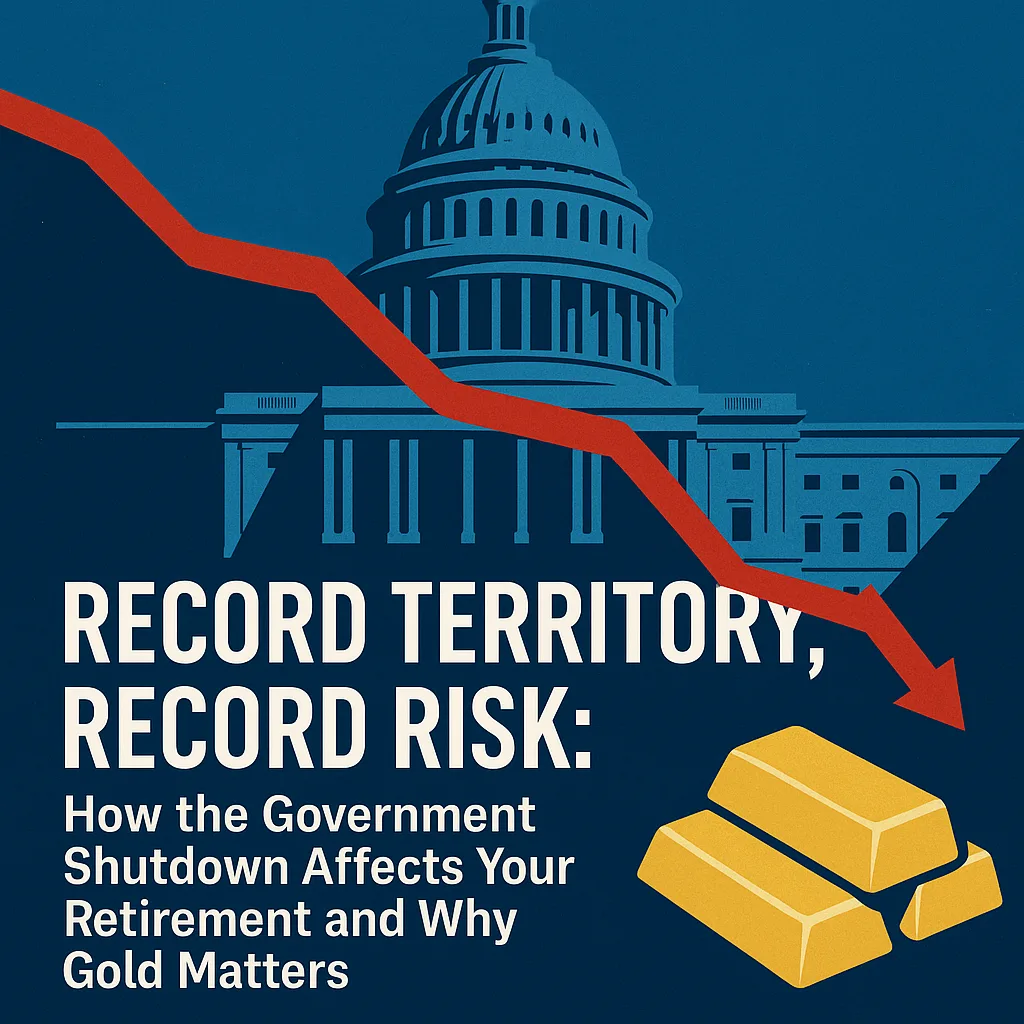
Record Territory, Record Risk: How the Government Shutdown Affects Your Retirement and Why Gold Matters
1. What’s happening with the shutdown
When the U.S. federal government shutdown began on October 1, 2025, it marked a critical funding lapse as Congress failed to pass the required appropriation bills. This is not just political theater. It is a real-world disruption with consequences for retirement planning.
Here are some of the immediate effects:
-
Economic data collection and publication, including key inflation indices, are delayed or suspended.
-
Many federal services are operating with reduced staff, leading to slower service and longer wait times.
-
The Congressional Budget Office estimates the economy could lose $7 to $14 billion in output due to the shutdown.
2. What this means for retirement benefits and savings
If you are retired or planning to retire soon, you may wonder whether Social Security or Medicare will be affected. The direct payments remain protected, but the ripple effects go deeper.
What remains protected:
-
Social Security benefits continue, as they are funded through trust funds and not annual congressional appropriations.
-
Medicare services and payments also continue as part of mandatory federal spending.
Where the risk lies:
-
Processing new claims, updating earnings records, and verifying benefits may be delayed.
-
With economic data stalled, cost-of-living adjustments (COLA) could be delayed or based on outdated metrics.
-
Market volatility tied to government dysfunction may impact portfolios, especially for retirees relying on 401(k)s or IRAs.
3. Why this creates a stronger case for diversification
This shutdown is a warning sign. While benefit checks continue, the broader system shows signs of strain and that uncertainty poses risks to retirement security.
-
Planning becomes harder when key economic data is not available.
-
Fiscal instability and rising debt raise concerns about long-term sustainability.
-
If inflation increases and the dollar weakens, fixed-income sources like pensions or Social Security lose real purchasing power.
This combination of factors makes it essential to diversify and seek financial protection beyond traditional investments.
4. How gold enters the picture
Gold is often considered a hedge during times of economic uncertainty, inflation, and currency weakness. These are exactly the conditions we are seeing.
Why retirees are looking at gold:
-
It holds its value when fiat currencies come under pressure.
-
It can act as a counterbalance to volatility in stocks and bonds.
-
It provides a level of independence from government-driven systems and political risk.
Gold is not a replacement for retirement income, but it can serve as a stabilizer and safe harbor when other assets falter.
5. What retirees should do now
If you are nearing or in retirement, now is the time to reassess your financial readiness:
-
Review your benefits access – Ensure your Social Security and Medicare information is accurate and accessible in case service delays worsen.
-
Consider inflation – Rising inflation can erode the real value of your fixed benefits.
-
Diversify your holdings – Rebalance your retirement savings to include some alternative assets, including gold.
-
Explore gold IRAs or direct holdings – Consider whether you want to hold physical gold or use tax-advantaged retirement vehicles that include gold.
-
Stay informed – This shutdown may be temporary, but its ripple effects could last longer. Stay aware of future COLA changes, Medicare shifts, and fiscal policy developments.
6. Bottom line
The 2025 government shutdown highlights the fragility of systems many retirees rely on. While your checks may still arrive, the underlying volatility in the economy, politics, and public programs makes it essential to plan ahead.
Gold may not be a cure-all, but as part of a well-balanced plan, it can help hedge against the kinds of uncertainty we are seeing now. It is a smart move to help protect what you have worked so hard to build.