








Your Partner in Securing Physical Assets
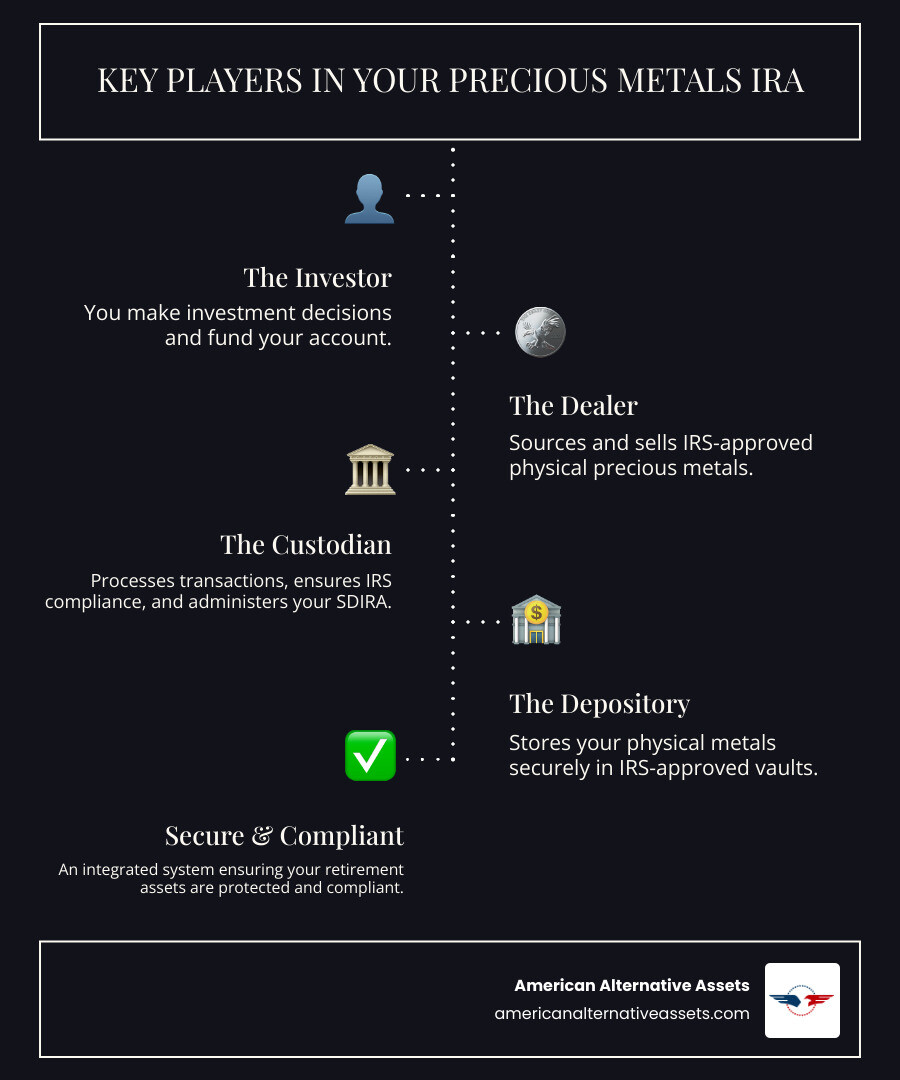
A precious metals IRA custodian is an IRS-approved financial institution that holds and manages the physical gold, silver, platinum, or palladium in your retirement account. They handle all administrative tasks, ensure IRS compliance, coordinate with depositories for secure storage, and process transactions on your behalf.
Key Responsibilities of a Precious Metals IRA Custodian:
- Account Administration – Opens and maintains your Self-Directed IRA
- Transaction Processing – Executes buy and sell orders for physical metals
- IRS Reporting – Files required forms (5498, 1099-R) for tax compliance
- Storage Coordination – Works with IRS-approved depositories to secure your metals
- Record Keeping – Tracks all account activity and metal holdings
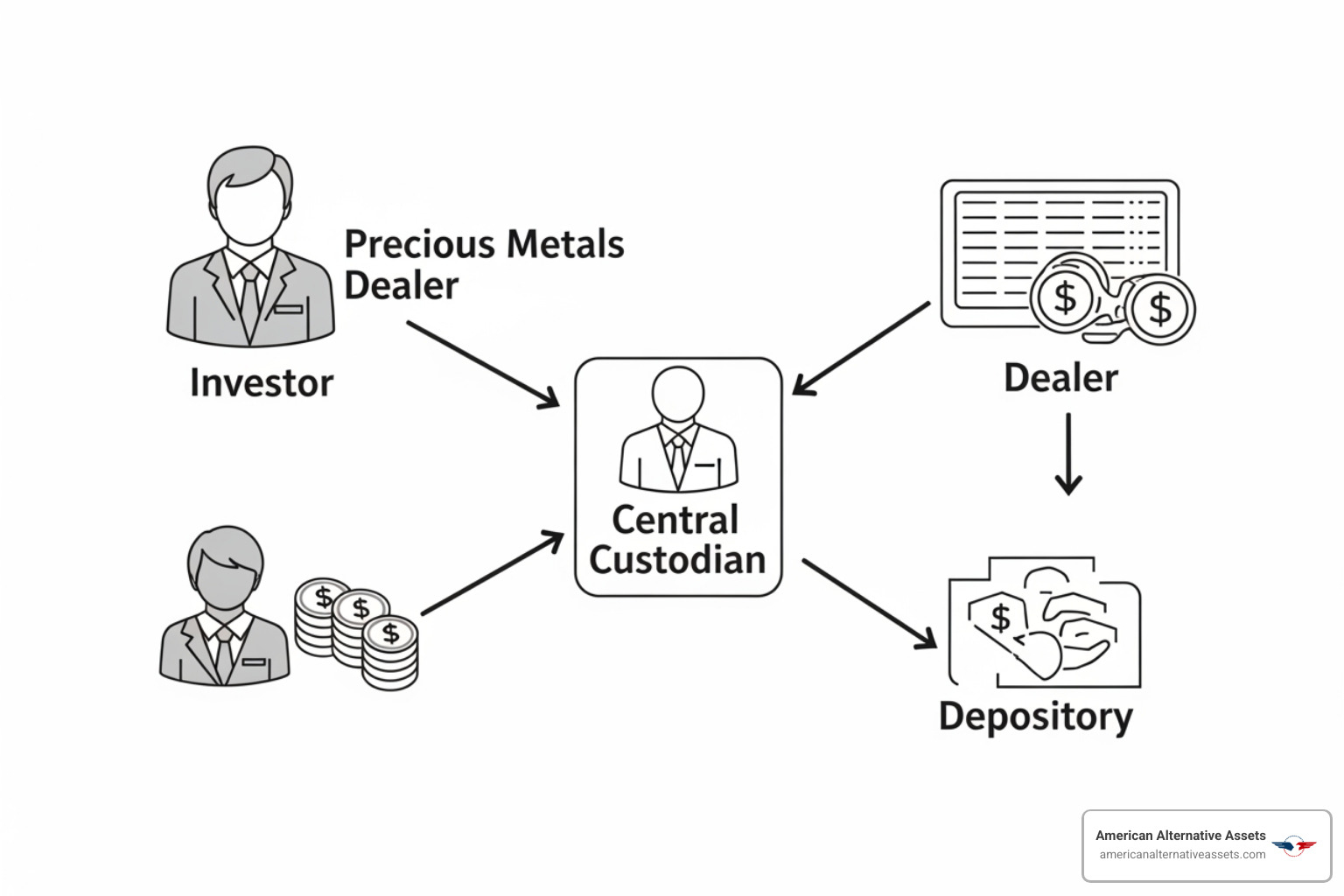
When you invest in a Precious Metals IRA, you’re not just buying paper certificates or ETFs. You’re acquiring physical gold and silver coins or bars that must be stored in an IRS-approved depository. The custodian acts as the essential bridge between you, your chosen precious metals dealer, and the secure vault where your assets are held.
Unlike traditional IRAs that hold stocks and bonds, a Self-Directed Precious Metals IRA requires specialized knowledge. Your custodian must understand the specific IRS rules for physical asset purity, acceptable forms of bullion, and storage requirements. They are responsible for ensuring every transaction meets federal regulations, providing the essential compliance framework for your investments.
The process is straightforward once you understand the roles. You make the investment decisions. Your dealer sources the physical metals. Your custodian processes the paperwork and payments. And an independent depository stores your assets in a secure, insured vault.
I’m Shanon Davis, and after decades in venture capital, I founded American Alternative Assets to help families protect their wealth with physical precious metals through properly structured IRAs. A precious metals IRA custodian is the partner who makes this possible by handling all the administrative requirements while you maintain control of your investment choices.
The Essential Role of a Precious Metals IRA Custodian
The Internal Revenue Service (IRS) mandates that all retirement accounts, including those holding precious metals, must have an approved custodian. This isn’t just a suggestion, it’s a fundamental requirement designed to protect investors and ensure compliance with tax laws. A precious metals IRA custodian serves as a third-party administrator, overseeing the assets within your account and ensuring that all transactions adhere to strict IRS regulations.
Why is this third-party involvement so crucial? Because a Self-Directed IRA (SDIRA) allows you to invest in a broader range of assets than a traditional IRA, including physical precious metals. This flexibility comes with specific rules, and the custodian acts as your guide through this regulatory landscape. They specialize in managing physical assets, a stark contrast to conventional IRAs that are typically limited to paper assets like stocks, bonds, and mutual funds. Without a specialized custodian, holding physical gold, silver, platinum, or palladium in your IRA simply isn’t possible.
Our role at American Alternative Assets is to help you steer this process, ensuring your retirement savings are held securely and compliantly. We believe in empowering our clients with knowledge, so they can make informed decisions about their financial future. Understanding the custodian’s role is a critical first step.
To dig deeper into the concept of self-directed retirement planning, you might find our guide on What is a Self-Directed IRA? particularly helpful.
Core Duties and Responsibilities
A precious metals IRA custodian takes on a comprehensive set of duties to safeguard your retirement assets and maintain IRS compliance. These responsibilities are far more than just holding your metals; they encompass the entire administrative lifecycle of your IRA.
First and foremost is account administration. This involves opening and maintaining your Self-Directed IRA, ensuring all your personal and account details are accurate and up to date. They are the record keepers, carefully tracking all account activity and metal holdings.
Next, custodians are responsible for transaction processing. When you decide to purchase or sell precious metals for your IRA, your custodian executes these orders. This includes handling the paperwork, processing payments to the dealer, and coordinating the delivery of your metals to an approved depository. They ensure that funds are transferred correctly and that your investment instructions are carried out precisely.
Perhaps one of the most critical duties is IRS reporting and compliance management. Your custodian is tasked with filing all necessary forms with the IRS, such as Form 5498, which reports your IRA contributions and the fair market value of your account, and Form 1099-R, which reports distributions. This meticulous reporting ensures your IRA remains in good standing with tax authorities, protecting you from potential penalties. They stay abreast of evolving tax regulations, ensuring your precious metals IRA adheres to all legal requirements. Annual fees charged by custodians often cover these essential recordkeeping and tax reporting services.
The Custodian vs. The Dealer: Understanding the Difference
While both the precious metals IRA custodian and the precious metals dealer are integral to your investment journey, they serve distinctly different functions. Understanding this separation of roles is crucial for a smooth and compliant experience.
The precious metals IRA custodian is the administrative backbone of your Self-Directed IRA. Their role is to process transactions, manage paperwork, ensure IRS compliance, and coordinate the secure storage of your metals. They are the gatekeepers, ensuring everything is done by the book according to your directions. Their function is purely administrative, focused on the compliant management of your account.
The precious metals dealer, on the other hand, is the vendor from whom you acquire your physical metals. They source and sell the gold, silver, platinum, or palladium that you choose to include in your IRA. You, as the investor, are responsible for conducting due diligence when selecting a dealer. This involves researching their reputation, pricing, and customer service. We always advise our clients to be thorough in this selection, as it’s a critical step in securing your assets.
For instance, you might check a dealer’s credentials with reputable industry organizations. You can Check dealer credentials with FINRA or Verify membership in the Professional Numismatists Guild to ensure you are working with a trustworthy and ethical provider. This separation ensures checks and balances, with the custodian focusing on compliance and administration, and the dealer focusing on the acquisition and sale of the physical metals.
How Your Precious Metals are Handled and Stored
Once you’ve decided to invest in physical precious metals through a Self-Directed IRA, understanding the process of how your metals are handled and securely stored becomes paramount. It’s a carefully orchestrated process involving your funding, purchase authorization, and finally, the delivery to a specialized depository.
The journey begins with the funding process. You’ll fund your IRA through various methods, such as an IRA-to-IRA transfer, a rollover from an existing 401(k) or other qualified retirement plan, an annual contribution, or a conversion from a Traditional IRA to a Roth IRA. Once your IRA account is funded, your custodian will have the capital ready for your investment.
Next comes purchase authorization. You, the investor, will select your desired precious metals from your chosen dealer. Once you’ve negotiated the price and terms with the dealer, you’ll authorize your custodian to proceed with the purchase. This typically involves submitting an investment authorization form along with the dealer’s invoice to your custodian. Your custodian then issues payment to the dealer on your behalf.
Finally, the depository delivery occurs. After the purchase is complete, your dealer will arrange for the physical metals to be shipped directly to an IRS-approved depository. Your metals never touch your hands until you take a distribution, ensuring compliance with IRS regulations. This systematic approach guarantees the security and integrity of your physical precious metals throughout the investment lifecycle.
For a more detailed look at how this process unfolds, explore our guide on How Does a Gold IRA Work?.
IRS-Approved Metals: Purity and Fineness Requirements
Not all precious metals are created equal when it comes to inclusion in an IRA. The IRS has very specific requirements regarding the type, purity, and fineness of gold, silver, platinum, and palladium that can be held within a Self-Directed IRA. These regulations are in place to ensure that the metals are investment-grade bullion, not collectibles.
Here are the fineness requirements for IRA-eligible precious metals:
- Gold: Must be 99.5% pure (.9950 fineness)
- Silver: Must be 99.9% pure (.9990 fineness)
- Platinum: Must be 99.95% pure (.9995 fineness)
- Palladium: Must be 99.95% pure (.9995 fineness)
These purity standards apply to both bullion bars and certain eligible coins. For example, popular eligible gold coins include the American Gold Eagle (which has a unique exemption at 22 karat or .9167 pure due to its government minting), Canadian Gold Maple Leaf, and Austrian Gold Philharmonic. Similarly, the American Silver Eagle and Canadian Silver Maple Leaf are widely accepted. Bullion must also be produced by an accredited or certified refiner, assayer, or national government mint.
If metals purchased for an IRA do not meet these strict requirements, they are treated as “collectibles” by the IRS. This can lead to a “deemed distribution,” meaning the IRA owner is considered to have received a distribution, which is generally taxed as ordinary income and could incur an early withdrawal penalty if you are under age 59½. This is a significant consideration that your precious metals IRA custodian helps you avoid by ensuring all metals meet the necessary standards.
One common misconception we encounter is the idea of home storage. It is absolutely prohibited by the IRS to store your IRA precious metals at home. All physical assets owned through an IRA must be held in a secure, IRS-approved depository. Attempts to circumvent this rule, often through complex LLC structures, are highly risky and have been signaled by the IRS as likely to be disqualified, potentially leading to severe tax consequences and penalties. Your custodian ensures your metals are always stored compliantly.
To learn more about one of the most popular IRA-eligible gold coins, read our article on American Gold Eagle Bullion.
Secure Storage: The Role of the Depository
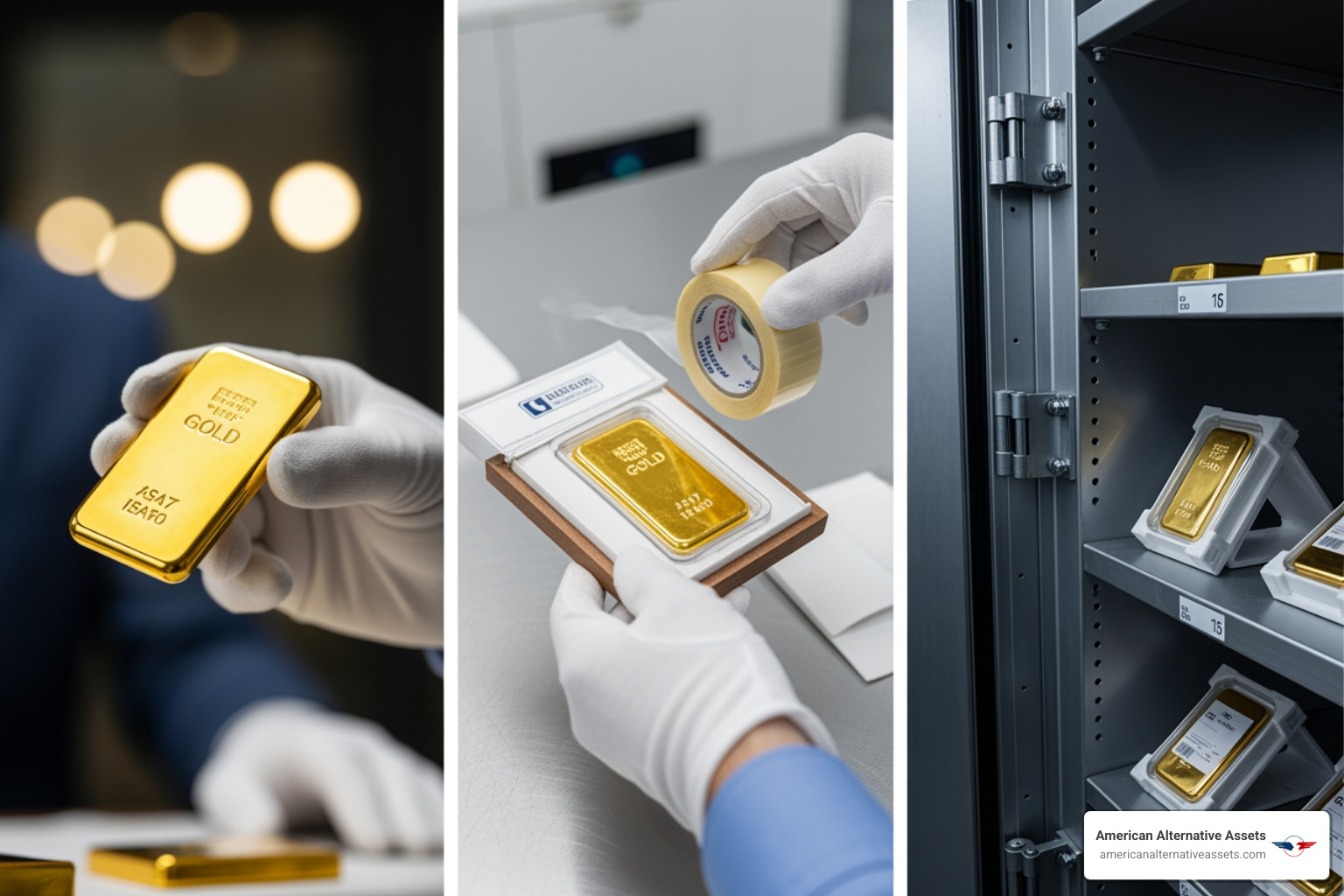
Once your IRA-eligible precious metals are purchased, they start on their journey to a secure, IRS-approved third-party depository. This is a non-negotiable step in maintaining the tax-advantaged status of your Precious Metals IRA. These specialized facilities are designed for the ultra-secure storage of valuable assets, offering a level of protection far beyond what any home safe or bank safety deposit box could provide.
At American Alternative Assets, we work with highly reputable depositories such as Delaware Depository Services Co. (DDS) and International Depository Services Group (IDS). These facilities are recognized for their robust security measures, state-of-the-art vaults, and comprehensive insurance coverage.
When it comes to storage, you typically have two main options:
- Segregated Storage: This option means your specific metals are kept separate from those of other investors, clearly identified with your account information. When you eventually take a distribution, you receive the exact same metals that you originally purchased. This provides an added layer of peace of mind for many investors who prefer their assets to remain distinct.
- Non-Segregated (Commingled) Storage: With this option, your metals are commingled with those of other customers. While you don’t get your exact metals back, you are guaranteed to receive “like” metals of the same type, quantity, and fineness. This option is often slightly less expensive than segregated storage.
Regardless of the option you choose, your metals are fully insured against loss, theft, or damage while in the depository. Annual storage fees, typically around $100 per year, usually include this essential insurance coverage. Your precious metals IRA custodian coordinates directly with the depository, ensuring proper documentation, secure transport, and accurate record-keeping of your stored assets.
For a deeper dive into how these secure facilities function, we encourage you to read What are Depository Accounts and How Do They Work for Gold Storage?.
Navigating the Financials: Funding, Fees, and Taxes
Investing in a Precious Metals IRA involves understanding the financial mechanics behind it, from how you fund your account to the fees you might encounter and the significant tax advantages it offers. These are all critical components your precious metals IRA custodian helps you manage.
Funding Your Precious Metals IRA
There are several pathways to fund your Precious Metals IRA, giving you flexibility based on your current financial situation and retirement planning goals:
- IRA Transfers: This is a common and straightforward method. If you have an existing Traditional, Roth, SEP, or SIMPLE IRA with another custodian, you can transfer funds directly to your new Precious Metals IRA without incurring any tax penalties. This is often the easiest way to establish your account.
- 401(k) Rollovers: If you have an old 401(k) from a previous employer, you can typically roll those funds over into a Self-Directed IRA. This allows you to convert traditional paper assets into physical precious metals. Rollovers can be direct (funds go straight from your old plan to your new IRA custodian) or indirect (you receive a check, then deposit it into your new IRA within 60 days). Direct rollovers are generally preferred to avoid potential missteps.
- Annual Contributions: Just like a traditional IRA, you can make annual contributions to your Precious Metals IRA, subject to IRS limits. For 2024, these limits are $7,000 for individuals under 50, and $8,000 for those aged 50 or older.
Your precious metals IRA custodian will guide you through the necessary paperwork for each funding method, ensuring the process is seamless and compliant with IRS regulations. This allows you to leverage existing retirement savings to diversify into physical precious metals.
For a comprehensive overview of how to fund and manage your precious metals retirement account, consult our Precious Metals Retirement Account Complete Guide.
Understanding the Fee Structure
Transparency in fees is a cornerstone of our service at American Alternative Assets. When investing in a Precious Metals IRA, you will typically encounter a few categories of fees, all managed or coordinated by your precious metals IRA custodian. These fees cover the essential services required to administer your account and securely store your physical assets.
Common fees include:
- One-Time Setup Fee: This fee covers the initial administrative costs of establishing your Self-Directed IRA account. It typically ranges between $30 and $50.
- Annual Administrative Fee: This is a yearly fee charged by your custodian for the ongoing management of your account, including record-keeping, IRS reporting, and processing transactions. This fee is usually around $100 per year.
- Annual Storage Fee: Paid to the depository, this fee covers the secure vaulting and insurance of your physical precious metals. This is also commonly around $100 per year and includes comprehensive insurance coverage for your assets.
We strive to ensure our clients have a clear understanding of all associated costs upfront. These fees are necessary for maintaining the integrity and compliance of your Precious Metals IRA, protecting your investment for the long term.
Tax Advantages and Implications
One of the most compelling reasons to consider a Precious Metals IRA is the significant tax advantages it offers, mirroring those of traditional retirement accounts. Your precious metals IRA custodian plays a vital role in ensuring these benefits are realized through diligent compliance.
Precious metals held within a Self-Directed IRA are treated like any other IRA asset for tax purposes. This means you benefit from tax-deferred growth with a Traditional IRA. Contributions might be tax-deductible, and your investments grow without being taxed annually. Taxes are only paid when you take distributions in retirement.
Alternatively, if you opt for a Roth IRA, your contributions are made with after-tax dollars, but your investments grow tax-free, and qualified distributions in retirement are also tax-free. This can be a powerful advantage, especially if you anticipate being in a higher tax bracket later in life.
It’s important to be aware of contribution limits, which apply to all IRAs. For 2024, these are $7,000 for individuals under 50, and $8,000 for those aged 50 or older. Adhering to these limits is crucial for maintaining the tax-advantaged status of your account.
Also, be mindful of early withdrawal penalties. Generally, if you take distributions from your IRA before age 59½, you may face a 10% penalty in addition to ordinary income taxes. Your custodian will report these distributions to the IRS via Form 1099-R.
Understanding these tax implications is key to maximizing the benefits of your Precious Metals IRA. We always recommend consulting with a certified tax expert to discuss the specifics of your individual situation. For more detailed information, you can Learn more about tax concepts for gold investing.
Frequently Asked Questions about the Precious Metals IRA Custodian
We understand that investing in a Precious Metals IRA can bring up many questions. Here, we address some of the most common inquiries our clients have about the role and functions of their precious metals IRA custodian.
What qualities should I look for in a precious metals IRA custodian?
Choosing the right precious metals IRA custodian is a decision that significantly impacts the security and compliance of your retirement savings. We advise looking for several key qualities:
- Expertise in Physical Assets: The ideal custodian should specialize in Self-Directed IRAs that hold physical precious metals. This specialization ensures they have the knowledge and systems to handle the unique requirements of tangible assets, unlike custodians focused solely on paper investments.
- Specialization in Self-Directed IRAs: Look for a custodian with a proven track record in administering SDIRAs. Companies that have been in business for decades, such as those with 30 or 40 years of experience, often demonstrate the stability and depth of knowledge required.
- Proven Track Record: Seek custodians with a strong reputation, backed by good ratings from organizations like the Better Business Bureau (BBB) and a history of reliable service.
- Transparent Fee Schedule: A trustworthy custodian will have clear, straightforward fees for setup, annual administration, and storage. Flat-rate fees can be particularly advantageous as they provide predictability, regardless of your account balance.
- Strong Client Service: Excellent customer support, with knowledgeable, in-house staff who are readily available to answer your questions, is invaluable. You want a custodian who can efficiently process your requests and provide timely assistance.
At American Alternative Assets, we prioritize partnering with custodians who embody these qualities, ensuring our clients receive top-tier service and security for their precious metals IRA.
Does my custodian make investment decisions for me?
No. A key benefit of a Self-Directed IRA is that you are in control. You make all the investment decisions, choosing the specific precious metals you want to purchase from the dealer you select. The custodian’s role is to act on your instructions—they are the administrative partner who handles the paperwork, processes the transaction, and ensures IRS compliance. This structure empowers you to direct your own retirement strategy while the custodian manages the essential administrative functions.
How are the precious metals in my IRA valued?
The valuation of precious metals within your IRA is an important aspect for reporting purposes and understanding your account’s performance. Your precious metals IRA custodian is responsible for determining the fair market value of your holdings, typically on an annual basis for IRS reporting.
The value of your precious metals is generally based on the spot price of the metal. The spot price represents the current market price at which a precious metal can be bought or sold for immediate delivery. This price is in constant flux, reflecting global supply and demand dynamics.
The spot price does not include any markups, markdowns, or commissions that might be factored into the retail purchase or sale price you negotiate with a dealer. It is a baseline value used for accurate accounting and IRS compliance. Your custodian uses this spot price to provide a fair market valuation of your precious metals for reporting on forms like Form 5498. This ensures that the value reported to the IRS accurately reflects the intrinsic value of your tangible assets.
You can easily track the market value of your precious metals. Many online resources provide real-time spot prices. For example, you can Check live bullion values to stay informed about the current market prices of gold, silver, platinum, and palladium.
Conclusion: Partnering for a Secure Future
The precious metals IRA custodian is an indispensable partner in your journey towards a diversified and secure retirement. Their administrative expertise, commitment to IRS compliance, and coordination with secure depositories are what make it possible to hold physical gold, silver, platinum, and palladium within a tax-advantaged retirement account. We understand the importance of having a trusted entity manage these critical aspects, allowing you to focus on your investment strategy.
At American Alternative Assets, we champion the cause of financial preparedness and personal responsibility. We believe that diversifying your retirement portfolio with tangible assets like physical precious metals can provide a robust hedge during times of economic uncertainty. Our white-glove, relationship-first service is built on trust, transparency, and ethical practices, ensuring real privacy and protection for your wealth.
By choosing a specialized custodian, you gain peace of mind, knowing that your precious metals are securely stored and your IRA remains compliant. This partnership empowers you to take control of your financial future, building a retirement portfolio that stands resilient against market fluctuations and inflation. We are here to help you secure your financial future, ensuring your precious metals are protected every step of the way.
To explore the secure storage options for your precious metals, including details on one of our trusted partners, you can Learn more about secure storage at the Delaware Depository.
This article is for informational purposes only and does not constitute financial advice. Please consult your financial advisor before making investment decisions.
Investing in precious metals involves risk. Past performance does not guarantee future results.