








Why Securing Your Tangible Wealth Matters
Precious metal security is about protecting your physical gold and silver investments from theft, damage, counterparty risk, and seizure. Here are the primary concerns and solutions:
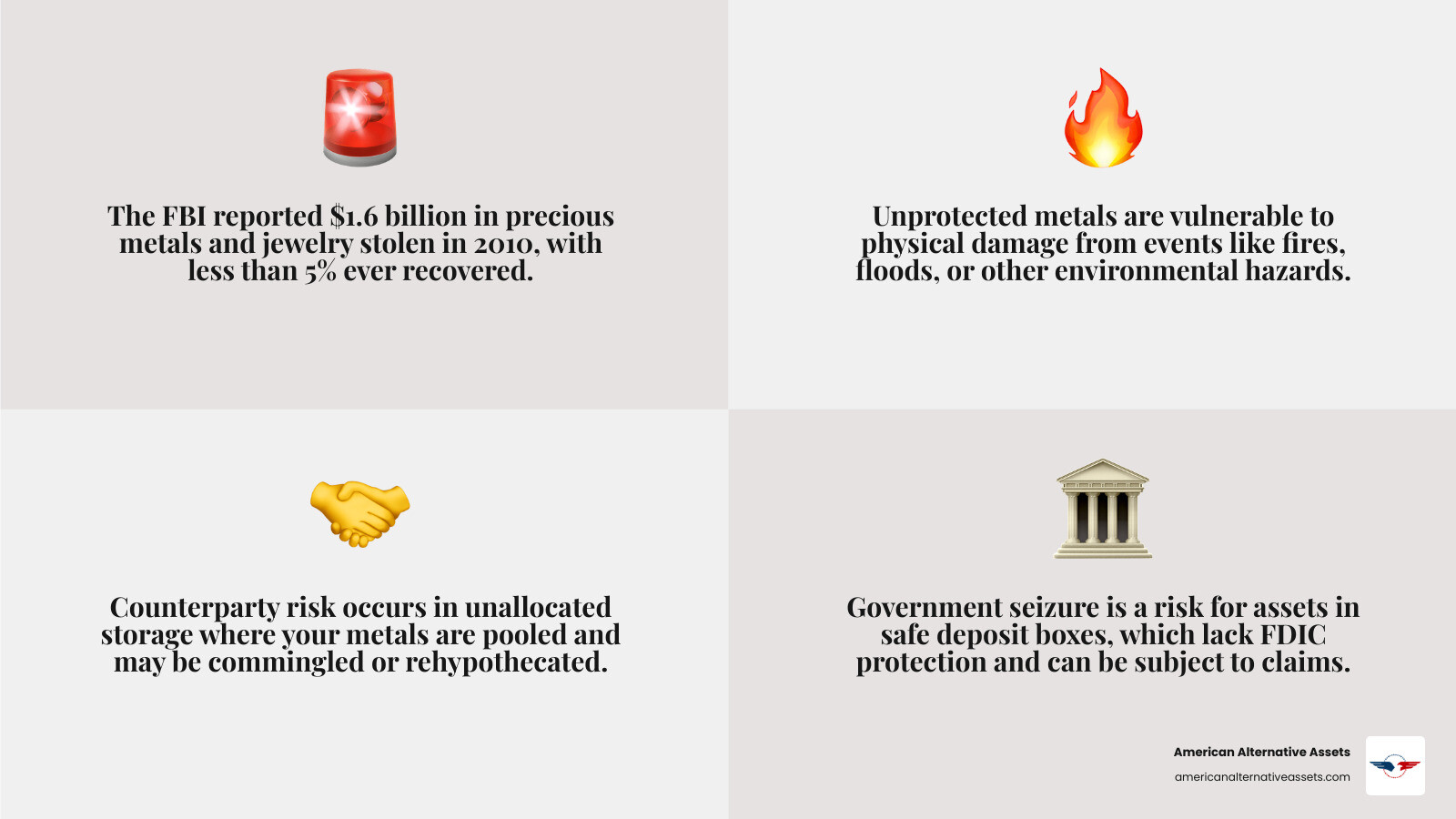
- Theft Risk: The FBI reported $1.6 billion worth of precious metals and jewelry stolen in 2010, with less than 5% ever recovered.
- Storage Options: Home safes, bank safe deposit boxes, and professional depositories each offer different levels of security, accessibility, and insurance.
- Allocated vs. Unallocated Storage: Allocated storage means your specific metals are segregated and identified as yours, while unallocated storage pools assets with counterparty risks.
- Insurance: Reputable depositories provide all-risk insurance (often through Lloyd’s of London), while bank safe deposit boxes typically have no insurance coverage.
- IRA Requirements: Precious Metals IRAs require third-party storage at IRS-approved depositories.
My grandfather handed me a Morgan silver dollar when I was nine years old and said, “This is real money.” That moment stayed with me through decades in venture capital, where I watched the 2008 crash expose how fragile paper-based systems truly are.
Physical precious metals are different from paper assets. You can hold gold and silver in your hand. They don’t depend on a company’s balance sheet, a bank’s solvency, or a government’s promise. But owning physical metals creates a new challenge: where do you keep them?
The answer matters more than most investors realize. A home safe might work for small amounts, but what about $50,000 in silver that weighs over 200 pounds? Bank safe deposit boxes seem secure until you learn they’re not insured and can be seized. Professional vaults offer institutional-grade security, but not all storage arrangements are created equal.
The wrong storage decision can turn a smart investment into a liability. The right one provides true peace of mind.
I’m Shanon Davis, founder of American Alternative Assets. After working in venture capital and witnessing the 2008 financial crisis firsthand, I built a company focused on helping Americans protect their wealth through physical precious metals and proper precious metal security practices.
Precious metal security vocabulary:
At-Home vs. Professional Storage: Weighing Your Options
When considering precious metal security, one of the first decisions we face is where to store our valuable assets. The choice between keeping your metals at home or entrusting them to a professional storage facility involves balancing convenience, cost, accessibility, and, most importantly, security. Each option comes with its own set of advantages and disadvantages. For many, a diversified approach, spreading holdings across different secure locations, provides an optimal layer of protection, mitigating various risks.
The Reality of Storing Precious Metals at Home
Storing precious metals at home offers immediate accessibility and privacy. You can touch, feel, and admire your gold and silver whenever you wish. This can be appealing for smaller holdings. However, this convenience comes with significant security concerns.
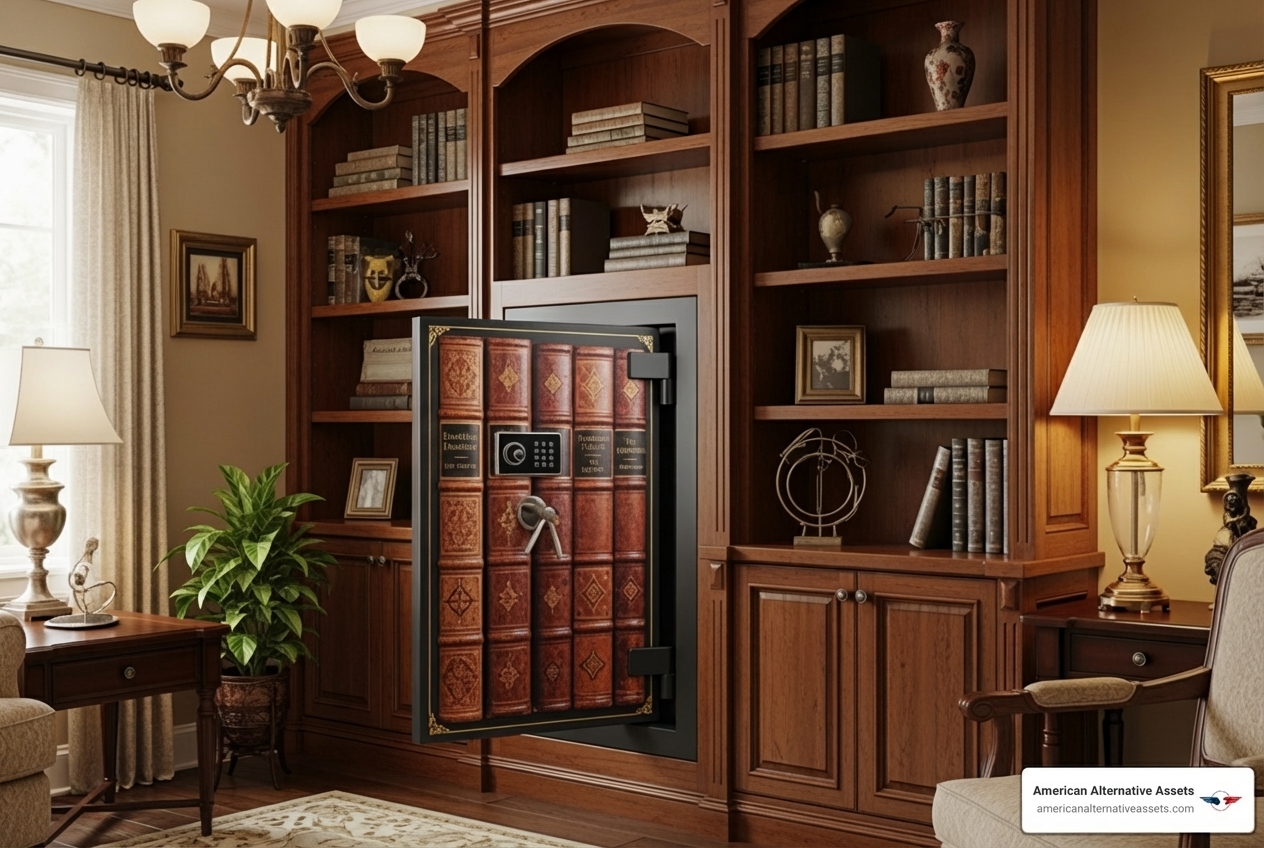
For at-home storage, a high-quality home safe is a common choice. When selecting one, we look for key features such as strong steel construction, pry-resistant doors, and reliable locking mechanisms. Fireproof ratings are crucial to protect against heat damage, and waterproofing can safeguard against floods or leaks. For added precious metal security, we advise bolting the safe to the floor or a wall, making it nearly impossible for thieves to remove.
Some creative individuals also use diversion safes, which are cleverly disguised as everyday household objects. As Brickhouse Security points out, a diversion safe resembling a can of shaving cream can easily fool most thieves, provided it looks genuine and is placed in an appropriate location, like a bathroom cabinet. Beyond safes, some prefer various in-home hiding spots, but these often lack robust protection against determined intruders.
A critical aspect often overlooked with home storage is insurance. While your homeowner’s policy might cover some valuables, it often has strict limits for precious metals. We might need to purchase a separate insurance rider, which typically costs around 1% of the metals’ value annually.
Another practical consideration is the sheer weight and space required for larger quantities of certain precious metals, especially silver. For instance, a $50,000 holding in silver can weigh over 200 pounds, making home storage impractical and physically challenging for many. The FBI’s statistics on precious metal theft, where less than 5% of stolen items are recovered, serve as a stark reminder of the risks associated with keeping significant wealth in an unsecured or inadequately secured home environment. For more on managing your physical gold, you can explore Investing Physical Gold.
The Hidden Risks of Bank Safe Deposit Boxes
Bank safe deposit boxes have traditionally been seen as a secure option for valuables. They offer a degree of physical security and are often perceived as being protected by the bank’s robust vault infrastructure. However, when it comes to precious metal security, these boxes come with several significant drawbacks that we believe investors should understand.
Firstly, and perhaps most importantly, contents of bank safe deposit boxes are not covered by FDIC insurance. This means if the bank’s vault is compromised due to theft, fire, or natural disaster, your precious metals might not be protected. This is a critical distinction from cash deposits, which are typically FDIC insured.
Access to safe deposit boxes is also limited to banking hours, which can be inconvenient, especially in an emergency or during market volatility when quick access might be desired. Furthermore, these boxes offer limited privacy. FinCEN and Patriot Act rules require financial institutions to maintain records on their customers, and in rare cases, safe deposit box contents can be seized by the IRS, other government agencies, or even private creditors. This potential for government seizure is a major concern for those seeking true financial privacy and asset protection.
Given these limitations, bank safe deposit boxes are generally not ideal for storing large holdings of precious metals, nor are they suitable for metals held within a Precious Metals IRA, which has specific IRS-mandated storage requirements. We advocate for understanding your gold storage options thoroughly, as detailed in Understanding Your Gold Storage Options with American Alternative Assets.
The Gold Standard of Precious Metal Security: Professional Vaulting
For those serious about precious metal security, professional vaulting, often referred to as third-party depositories, represents the gold standard. These facilities are purpose-built to protect high-value assets and offer a level of security far beyond what most individuals or even banks can provide.
Professional depositories implement layers of sophisticated security measures. This includes high-tech surveillance systems, advanced access controls like biometric scanners, and highly trained security personnel. Factors like location, which should ideally be in a low-crime area adjacent to law enforcement, also contribute significantly to overall security.
Many of these facilities also manage armored transit and logistics, ensuring the secure movement of precious metals from the point of purchase to the vault. This comprehensive approach minimizes risk at every step of the storage process.

Allocated vs. Unallocated: A Critical Distinction for Your Security
One of the most important concepts in professional precious metal security is the distinction between allocated and unallocated storage. This difference can significantly impact your ownership rights and protection against counterparty risk.
Allocated storage means your specific metals are segregated and identified as yours. When you choose allocated storage, you are assigned specific bars, coins, or rounds with unique serial numbers or identifying marks. These metals are stored in a segregated account, meaning they are never commingled with other customers’ assets. Crucially, your assets are held as bailment, not as a deposit or consignment. This legal distinction means the metals are off the depository’s balance sheet and cannot be seized to pay the depository’s debts if the company were to face financial difficulties. This ensures you own the physical asset directly, not just a claim to a quantity of metal.
In contrast, unallocated storage involves pooled assets. With unallocated storage, you own a claim to a certain quantity of precious metal, but not specific, identifiable bars or coins. Your metals are commingled with those of other clients and the depository’s own holdings. This arrangement introduces significant counterparty risk. If the depository faces financial distress, there’s a risk that your claim might not be fully honored, or your assets could be caught up in bankruptcy proceedings. This is akin to holding a “paper asset” claim rather than direct ownership of physical metals. We strongly advocate for allocated storage to ensure true ownership and protection. For a deeper dive into these storage types, see What Are Depository Accounts and How Do They Work for Gold Storage?.
Decoding the Security Features of a Top-Tier Depository
When we select a professional depository, we look for a suite of robust security features that go beyond simply having a strong vault. These features are designed to provide multi-layered precious metal security.
One key indicator of vault strength is its Underwriters Laboratories (UL) rating. These ratings measure a vault’s resistance to intrusion. For example, a UL Class III vault indicates it would take a skilled criminal approximately two hours to break into. Reputable depositories, such as those used by the IDS Group and Money Metals Depository, use top-of-the-line UL Class 3 vaults, often custom-built with armored steel and hardened concrete.
Beyond the physical structure, modern depositories employ state-of-the-art security systems:
- 24/7 Monitoring: Multi-redundant, UL-rated alarm systems are monitored around the clock by off-site specialists.
- Access Control: This includes gated and electronically controlled entrances, keycard access for employees, and biometric systems for higher security areas. All visitors typically require appointments and strict vetting.
- Dual Control Protocols: No single individual can access or move assets alone. This “dual control” procedure requires at least two authorized personnel to be present for any interaction with the precious metals.
- Staff Vetting: Employees are thoroughly vetted, often full-time, experienced professionals dedicated to precious metals storage, rather than temporary staff.
- Bonded Warehouses: Some facilities operate as bonded warehouses, which are government-secured locations that provide improved security and often facilitate customs clearance for international shipments. Brink’s, for example, offers secure logistics and bonded warehouses in the US.
These comprehensive measures ensure that from the facility’s design to its daily operations, every aspect is geared towards maximum precious metal security. This commitment to protection is why precious metals matter now more than ever, as they represent a secure, tangible asset in an uncertain world. Find out more at Why Precious Metals Matter Now More Than Ever.
The Role of Insurance and Audits in Precious Metal Security
Even with the most advanced physical security measures, unforeseen events can occur. This is where comprehensive insurance and rigorous auditing play a vital role in precious metal security, offering an essential layer of financial protection and transparency.
Insurance is paramount. Reputable depositories provide all-risk insurance coverage for your precious metals. This means your holdings are protected against a wide range of perils, including theft, physical damage (like fire or flood), and even mysterious disappearance. A common and highly respected insurer in this space is Lloyd’s of London, which underwrites policies for many top-tier depositories, including IDS Group and Money Metals Depository. This all-risk coverage is crucial, as it typically far exceeds what a standard homeowner’s policy or bank safe deposit box insurance might offer, providing true peace of mind. Some depositories even maintain complementary policies for acts of terrorism and employee theft.
Beyond insurance, audits ensure accountability and verify the integrity of your holdings. There are typically two types of audits:
- Internal Audits: These are conducted regularly by the depository’s own staff, often weekly, to reconcile inventory and ensure operational protocols are followed.
- Third-Party Audits: Independent auditors, external to the depository, conduct annual checks to verify the existence and quantity of stored precious metals. This provides an unbiased, objective verification of holdings.
Transparency is also key. Some depositories offer clients the ability to view their specific holdings, either in person or via video, once a year. This level of verification, combined with insurance and audits, reinforces trust and demonstrates the depository’s commitment to protecting your investment. This approach to security protects not just your assets, but also the investor benefits in owning gold, ensuring your wealth is genuinely preserved. Find more at Investor Benefits in Owning Gold.
Securing Your Future: Precious Metals in a Self-Directed IRA
For many investors, precious metal security extends to their retirement savings. While traditional IRAs often focus on paper assets like stocks and ETFs, a Self-Directed Precious Metals IRA offers a powerful alternative: the ability to hold physical gold, silver, platinum, and palladium within a tax-advantaged retirement account. This allows you to diversify your portfolio with tangible assets, providing a unique form of protection against the economic instability and inflation that can impact paper-based investments.
A key aspect of Precious Metals IRAs is that IRS regulations mandate that the physical metals must be stored with an approved third-party depository. This means you cannot keep your IRA metals at home or in a bank safe deposit box. This requirement ensures a high level of precious metal security and compliance for your retirement assets. By choosing an IRS-approved depository, you gain access to institutional-grade security, insurance, and auditing, all while adhering to regulatory guidelines.
Legal and Regulatory Aspects of IRA Precious Metal Security
The Internal Revenue Service (IRS) has specific rules governing what types of precious metals can be held in an IRA and how they must be stored. Understanding these legal and regulatory aspects is crucial for maintaining the tax-advantaged status of your retirement account and ensuring proper precious metal security.
The IRS requires that all physical precious metals held within an IRA be stored with an approved third-party depository. This is not just a suggestion, but a mandatory rule. The depository must be a non-bank trustee or an organization approved by the IRS. This requirement means that your gold, silver, platinum, or palladium coins and bars cannot be stored at home, in a personal safe, or in a bank safe deposit box.
The role of the custodian is also vital. An IRA custodian is responsible for holding your assets, facilitating transactions, and ensuring compliance with all IRS regulations. They work with approved depositories to handle the physical storage of your metals. Prohibited transactions, such as taking personal possession of your IRA metals before retirement age, can lead to significant penalties.
For a comprehensive understanding of the custodians involved and how they ensure precious metal security within an IRA, we recommend reviewing our Precious Metals IRA Custodians Guide. Additionally, a detailed explanation of the process can be found in How Does a Gold IRA Work?.
Choosing the Right Depository for Your Gold IRA
Selecting the appropriate depository is a critical step in establishing and maintaining the precious metal security of your Gold IRA. Not all depositories are created equal, and careful vetting is essential.
When choosing a depository for your IRA metals, we focus on several key considerations:
- IRS Approval: Ensure the depository is recognized and approved by the IRS for IRA storage. This is non-negotiable.
- Allocated Storage: We strongly advocate for depositories that offer fully allocated storage. As discussed, this means your specific metals are segregated and held in your name, providing direct ownership and protection against counterparty risk.
- Insurance Verification: Confirm that the depository provides comprehensive, all-risk insurance coverage, preferably underwritten by a reputable insurer like Lloyd’s of London, covering the full value of your holdings.
- Security Features: Look for robust physical and operational security, including UL-rated vaults, 24/7 surveillance, multi-layered access controls, and audited processes.
- Reputation and Transparency: Research the depository’s history, client testimonials, and commitment to transparency through regular audits.
- Location Options: While we are based in California, many clients choose depositories in strategically secure locations across the United States. For example, the Delaware Depository is a well-known and highly respected facility offering top-tier precious metal security.
Making an informed decision about your depository is a cornerstone of a sound Gold IRA Investment strategy, ensuring both compliance and robust asset protection.
Frequently Asked Questions about Securing Your Bullion
What is the most secure way to store a large amount of gold?
For significant holdings, a professional, insured, and audited depository offering fully allocated storage is widely considered the most secure method. It mitigates risks of home theft and the limitations of bank deposit boxes, providing institutional-grade protection through multi-layered security systems, 24/7 surveillance, and stringent access controls.
Are my stored precious metals insured in a depository?
Reputable depositories provide comprehensive, all-risk insurance, often through underwriters like Lloyd’s of London. This covers the full value of your holdings against theft, damage, and loss, a critical feature not available with bank boxes or standard homeowner’s policies. We always verify the specifics of the insurance policy to ensure complete coverage.
Can I visit my precious metals in a depository?
Many high-security depositories allow clients to view their holdings by appointment. This provides transparency and peace of mind that your specific assets are secure and accounted for. Some facilities even offer video viewings as a convenient alternative. For more details on this, you can explore Visiting Your Precious Metals at a Bullion Depository.
Conclusion: Taking the Next Step to Safeguard Your Wealth
Navigating precious metal security can seem complex, but it’s the essential step to truly protecting the tangible wealth you hold outside of paper-based financial systems. We’ve explored the limitations of home storage and bank safe deposit boxes, highlighting the superior protection offered by professional depositories. The critical distinction between allocated and unallocated storage, the importance of robust security features, and the role of insurance and audits are all vital components of a sound security strategy.
For your retirement savings in a Gold IRA, using a secure, IRS-approved depository is not just a recommendation, it’s a requirement. This ensures your tangible assets are protected while adhering to regulatory guidelines.
At American Alternative Assets, we believe in white-glove, relationship-first service, built on trust, transparency, and ethical practices. We are here to help steer these choices, ensuring real privacy and protection for your wealth. To learn more about one of the most trusted storage facilities for your IRA, we invite you to explore the Delaware Depository.
Investing in precious metals involves risk. Past performance does not guarantee future results. This article is for informational purposes only and does not constitute financial advice. Please consult your financial advisor before making investment decisions.