







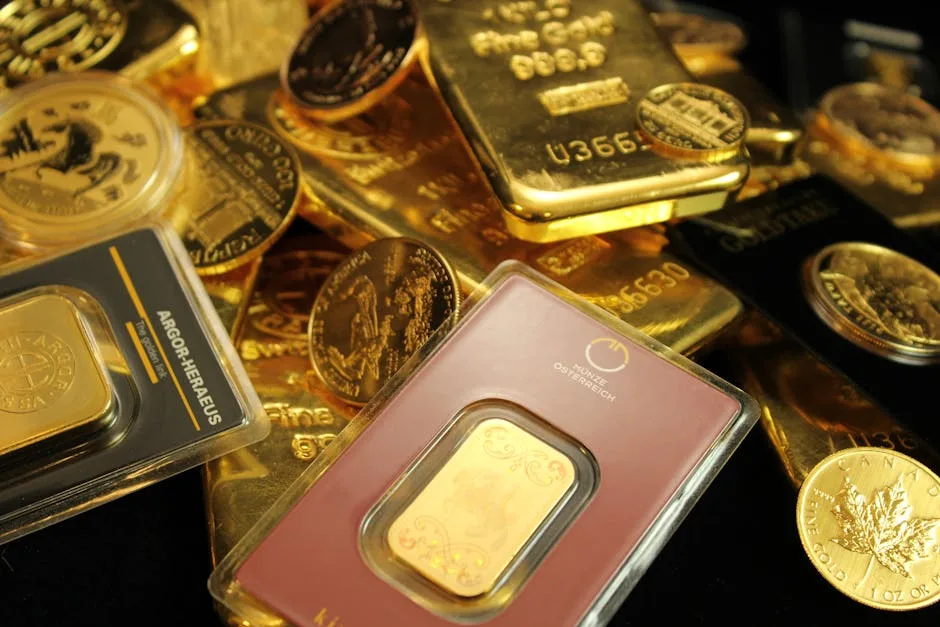
Why Understanding Gold Matters Now More Than Ever
Learn about gold and you will find it is more than the metal in wedding rings or Olympic medals. Gold is a time-tested store of value, a hedge against economic uncertainty, and a tangible asset that has preserved wealth for thousands of years.
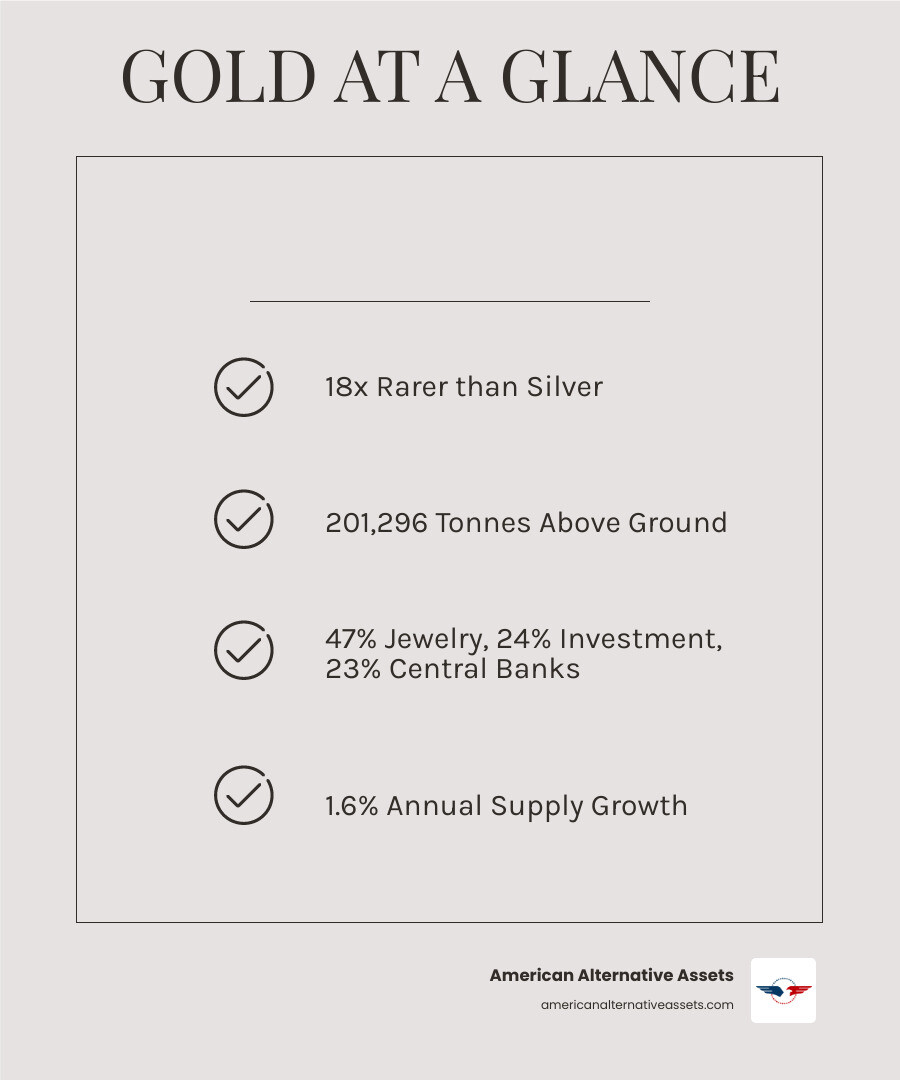
Gold at a Glance:
- What it is: A rare, chemically inert precious metal (symbol: Au) that does not corrode, rust, or decay
- Total above ground: Approximately 201,296 tonnes, all of which could fit in a cube roughly 22 meters on each side
- Primary uses today: Jewelry (47 percent), investment (24 percent), central bank reserves (23 percent), technology (7 percent)
- Key investment appeal: Physical ownership can provide protection against inflation, currency devaluation, and market volatility without counterparty risk
- Rarity: 18 times rarer than silver, with above ground supply growing by only about 1.6 percent per year
When my grandfather handed me a silver Morgan coin at age nine, he said, “This is real money.” Years later, after watching the 2008 crash from inside venture capital, I better understood what he meant. That experience helped inspire American Alternative Assets, which focuses on helping people learn about gold and other physical precious metals as tools for protecting wealth outside the fragile paper system.
This guide walks through gold’s unique properties, its role in history, and how you can hold physical gold in a retirement account.
Simple guide to Learn about gold terms:
The Essence of Gold: Properties, History, and Enduring Value
Gold’s allure is rooted in its unique physical and chemical properties, scarcity, and long history as a symbol of wealth and power. To truly learn about gold, it helps to understand what makes this element special.

Gold’s Physical and Chemical Properties
Gold, represented by the chemical symbol Au, derives its name from the Latin word “aurum”, meaning “shining dawn.” Its atomic number is 79, which places it on the periodic table as a transition metal.
Pure gold has several properties that make it valuable:
- Malleability and ductility: Gold is the most malleable and ductile of all metals. A single gram can be beaten into a sheet about one square meter in size or drawn into a very long wire. This allows it to be shaped into intricate jewelry and wafer thin gold leaf.
- Density: Gold is dense, with a specific gravity of about 19.3 when pure. It feels heavy for its size, a characteristic often used to help detect counterfeit gold.
- Corrosion resistance and durability: Gold is highly resistant to most acids, and it does not rust, tarnish, or decay under normal conditions. This chemical stability is why gold artifacts from thousands of years ago still retain their luster today. The only common substance that can dissolve gold is aqua regia, a mixture of nitric and hydrochloric acids, or certain alkaline cyanide solutions.
- Electrical conductivity: Gold is an excellent conductor of electricity, second only to silver and copper. This makes it useful in modern electronics, where it is used in corrosion resistant connectors for computers, mobile phones, and other devices.
- Stable isotope: Gold has one stable and naturally occurring isotope, 197Au. This consistency supports its uniform behavior in nature and industry.
- Distinctive color: Gold’s yellow color is a consequence of relativistic effects on its electrons. Without these quantum mechanical effects, gold would appear more silvery. You can learn more about the causes of gold’s color.
These properties, along with its rarity, contribute to gold’s enduring value. The total amount of gold above ground grows by only about 1.6 percent per year, so supply is limited.
The History of Gold as Money
The earliest known gold artifacts date back to the 5th millennium BC in what is now Bulgaria. Finds like those from the Varna Necropolis show that humans recognized gold’s beauty and rarity early in history. You can read more about the mystery of the Varna Gold and the world’s oldest gold object.
For millennia, gold has been accepted as a medium of exchange and a store of wealth. Ancient civilizations, such as the Egyptians, prized gold for jewelry, religious artifacts, and royal adornments.
Standardized gold currency appeared around 610 BC in Lydia with some of the first known gold coins, the Lydian Lion. These early coins marked a shift in economic history by establishing a portable and divisible form of money. You can read more about the world’s oldest coin, the Lydian Lion.
From the Roman Empire’s reserves, to European exploration of the Americas, to the California Gold Rush of 1848, gold has influenced major events. The California Gold Rush in particular reshaped the American West and the region that is now home to many of our clients in California. You can learn more about the California Gold Rush.
In the 19th and early 20th centuries, many countries adopted the Gold Standard, which linked national currencies to specific amounts of gold. This system provided a measure of stability because currencies were backed by a tangible asset. The United States ended formal gold convertibility in 1971 when the dollar was decoupled from gold. You can learn about the history of the Gold Standard.
Today, most countries use fiat currencies, which are backed by government decree rather than a physical commodity. Even so, gold remains an important monetary asset, and central banks continue to hold it as part of their reserves.
Understanding Gold Purity and Alloys
Pure gold is striking, but it is also relatively soft. To improve durability and to achieve different colors, gold is often alloyed, or mixed, with other metals. The purity of gold is measured using the karat system.
- Karat system: Pure gold is 24 karat (24k), meaning all 24 parts of the metal are gold. Lower karat numbers indicate a blend with other metals such as copper, silver, nickel, or palladium.
- Common alloys:
- 18k gold: Contains 75 percent pure gold (18 parts gold and 6 parts other metals). It is a popular choice for fine jewelry because it balances purity and durability.
- 14k gold: Contains 58.3 percent pure gold (14 parts gold and 10 parts other metals). It is common in everyday jewelry because of its hardness and relative affordability.
- 10k gold: Contains 41.7 percent pure gold (10 parts gold and 14 parts other metals). This is the minimum legal standard for gold jewelry in the United States.
- Colored gold alloys: By mixing gold with different metals, jewelers create colors beyond traditional yellow. Rose gold gets its reddish hue from copper. White gold usually includes palladium, nickel, or silver. Green gold can be made by alloying with silver and sometimes cadmium. You can explore more about jewelry alloys and their colors.
- Bullion purity: For investment grade physical gold, purity is important. Gold bullion bars and coins typically have a purity of at least 99.5 percent, and often 99.99 percent. Some widely recognized coins, such as the American Gold Eagle, use a 22k alloy for durability, but the gold content in each coin is precisely measured and guaranteed.
From Mine to Market: How to Learn About Gold Production and Demand
Understanding where gold comes from and who uses it is a key part of learn about gold as a global commodity. The journey from deep within the Earth to final use involves complex processes and worldwide trade.

Gold Mining, Production, and Global Reserves
Gold is a finite resource. While trace amounts are found in many places, large, high grade deposits are rare. Global gold mine production was estimated at about 3,100 tonnes in 2022, and economically recoverable reserves were estimated at around 52,000 tonnes.
China has been the world’s largest producer in recent years. Other major producers include Australia, Russia, the United States, and Canada. In the United States, Nevada is a major gold producing state, and California, with its long history of gold mining, still contributes to domestic output.
After centuries of mining, new deposits are harder and more expensive to find and develop. This helps support gold’s scarcity.
Recycling also contributes to supply. In 2022, recycled gold added about 1,140 tonnes, mostly from old jewelry and end of life electronics. This highlights both gold’s durability and its role in technology.
Ethical and environmental considerations
Gold mining can have environmental and social impacts, including:
- Pollution: The use of chemicals such as cyanide in gold extraction can lead to spills and water contamination if not managed carefully. Mercury, historically used in some artisanal mining, is another pollutant.
- Habitat disturbance: Large mining projects can cause deforestation, soil erosion, and habitat disruption.
- Energy intensity: Gold extraction and processing require significant energy, which can contribute to carbon emissions.
These concerns have led many investors and consumers to pay closer attention to responsible mining practices and to the use of recycled gold.
The Four Pillars of Gold Demand
Gold demand is broad and diversified across several main sectors:
- Jewelry demand: Jewelry accounted for about 47 percent of global gold demand in 2022. Cultural traditions, weddings, and the desire for durable adornment help support this segment.
- Investment demand: Around 24 percent of demand came from investors in 2022. This includes individuals and institutions that see physical gold as a way to diversify portfolios and help preserve purchasing power.
- Central bank buying: Central banks and official institutions represented about 23 percent of demand in 2022. Their activity is a key part of the long term gold market.
- Technology and industrial uses: About 7 percent of demand comes from technology and industry. Gold’s conductivity and corrosion resistance make it useful in electronics, connectors, and certain medical and aerospace applications. It is also used in dentistry for some fillings and crowns.
The Role of Central Banks in the Gold Market
Central banks hold gold as part of their official reserves. The United States government, for example, is the largest single holder and owns an amount equal to roughly 5 percent of all above ground gold.
Central banks increased their gold purchases in 2022 for several reasons:
- Diversification from fiat currencies: Gold can help central banks reduce reliance on any single currency and manage currency risk.
- A hedge against geopolitical risk: Gold is viewed as a neutral asset that can provide stability during international tensions.
- Long term store of value: Central banks recognize gold’s historical ability to preserve value over long periods.
- Signaling confidence and strength: Holding significant gold reserves can signal financial resilience to global markets.
Central bank demand, together with private investment demand, reinforces gold’s role as a core asset in the global financial system.
A Modern Guide to Gold Investing: The Power of Physical Ownership
We believe that to truly learn about gold as an investment, it is important to understand the critical difference between owning physical gold and holding paper assets. At American Alternative Assets, the focus is on helping clients gain the security and control that come with physical precious metals.
Key Factors to Learn About Gold’s Price
The price of gold reflects a mix of economic, financial, and geopolitical influences. While this article does not provide financial advice or price predictions, understanding these factors can clarify gold’s role in a diversified strategy:
- Supply and demand dynamics: Gold’s price responds to the balance between its availability, from mining and recycling, and global demand from jewelry, investment, central banks, and industry.
- Inflation and interest rates: Gold is often viewed as a hedge against inflation. When the purchasing power of paper currencies erodes, many investors turn to tangible assets such as gold. Rising real interest rates, on the other hand, can sometimes draw attention to interest bearing assets.
- US dollar strength: Gold is usually priced in US dollars. A stronger dollar can make gold more expensive for holders of other currencies, which may reduce demand. A weaker dollar can have the opposite effect.
- Geopolitical uncertainty: Periods of global instability, conflict, or financial stress often lead investors to seek perceived safe haven assets. Gold has a long track record in that role.
- Market sentiment: Investor confidence, fear, and risk appetite all play a part in short term price movements.
- Central bank policy: Large purchases or sales by central banks can influence supply and demand in the market.
How to Learn About Gold Investment Options
When you consider how to invest in gold, it is useful to distinguish between physical ownership and paper exposure.
- Physical gold: This is actual metal that you own, such as gold bars and coins. Physical gold offers direct ownership, a tangible asset, and freedom from counterparty risk. At American Alternative Assets, this is the cornerstone of the Precious Metals IRA approach.
- Paper assets (not the focus of this guide): These include products such as gold related exchange traded funds, mining company stocks, or futures contracts. Instead of providing direct ownership of specific coins or bars, they represent paper claims that carry risks tied to issuers, counterparties, and leverage.
For investors who care about wealth preservation and control, physical precious metals in a properly structured Precious Metals IRA can play a distinct role alongside other assets they hold elsewhere.
Allocated Gold: Why True Ownership Matters
Within physical gold, it is important to understand allocated and unallocated arrangements.
- Allocated gold: Specific, identifiable gold bars or coins are legally owned by you and held in segregated storage. Your holdings are separated from the assets of the custodian or dealer, and serial numbers for bars are recorded. If the institution that stores the gold experiences financial trouble, allocated metal is your property and is not part of its balance sheet.
- Unallocated gold: With unallocated holdings, you have a general claim on a quantity of gold, but not on specific coins or bars. The institution usually pools gold to meet many claims. In a worst case, your claim could be treated like that of an unsecured creditor.
Many investors who prioritize long term wealth preservation prefer allocated gold, because it emphasizes direct, clearly documented ownership.
The Case for Physical Gold as a Portfolio Hedge
Physical gold has served for centuries as a hedge and potential stabilizer in portfolios:
- Hedge against inflation: When paper currencies lose purchasing power, gold has often moved differently, and many investors view it as a potential offset.
- Safe haven characteristics during downturns: In times of market stress or geopolitical tension, gold has often behaved differently than stocks and some other financial assets.
- Portfolio diversification: Gold typically has a low or sometimes negative correlation with traditional assets like stocks and bonds. Adding physical gold can help reduce overall volatility.
- No counterparty risk: Unlike many financial instruments, physical gold in your name is not dependent on the performance or solvency of a third party.
- Tangible store of value: In a world of digital balances and electronic records, physical gold provides a form of wealth you can see and feel.
Within a balanced retirement strategy, some investors use a Precious Metals IRA to hold physical gold alongside other retirement assets held through their financial advisors.
Frequently Asked Questions About Gold
Many people who want to learn about gold have similar questions when they first explore physical precious metals and Precious Metals IRAs.
What is a troy ounce?
The troy ounce is the standard unit of weight used for precious metals such as gold, silver, and platinum.
- One troy ounce is approximately 31.1035 grams.
- A standard avoirdupois ounce, used for most everyday items, is about 28.35 grams.
- The troy ounce dates back to the Middle Ages and is linked to the French trading city of Troyes. It has remained the common measure for precious metals for centuries. You can learn more about the troy ounce.
Gold prices are almost always quoted per troy ounce.
Is it better to buy gold bars or gold coins?
Both gold bars and gold coins can be effective ways to own physical gold. The better choice depends on your goals, budget, and preference for flexibility.
- Gold bars:
- Often lower premiums: Bars usually have lower premiums over the spot price of gold than many coins, which can appeal to buyers making larger purchases.
- Efficient storage: Bars tend to be compact and make it easier to store significant value in a smaller space.
- Gold coins:
- Government backed: Many bullion coins, such as the American Gold Eagle and American Gold Buffalo, are minted by sovereign governments that guarantee weight and purity.
- Liquidity and flexibility: Coins can be easier to sell in smaller amounts, which some investors value for flexibility.
- Recognition: Popular coins are widely recognized, which can support ease of resale.
Some investors choose a mix, using bars for core holdings and coins for smaller, more flexible portions of their physical gold.
Can I hold physical gold in a retirement account?
Yes. It is possible to hold certain types of physical gold, along with other eligible precious metals, in a self directed Precious Metals IRA. This approach lets you combine the tax advantages of a retirement account with the benefits of owning physical assets.
The Internal Revenue Service (IRS) has specific guidelines for Precious Metals IRAs:
- Purity requirements: Gold must meet minimum fineness standards, typically 99.5 percent pure for bars and many bullion coins.
- Approved products: Only coins and bars from approved government mints or accredited refiners qualify.
- Third party storage: The IRS requires that IRA metals be held by an approved, independent depository, not stored at home.
Because the rules are specific, many investors choose to work with a Precious Metals IRA specialist and a qualified custodian to help handle the setup and ongoing administration.
Conclusion: Taking the Next Step in Your Gold Journey
Gold is more than a decorative metal. It is a chemical and physical standout, a historic foundation of money, and a modern input for technology and industry. For many investors, its most important role is as a potential store of value and a tool for diversification.
Physical, allocated gold can provide direct ownership outside the traditional paper based financial system. Unlike paper products that depend on issuers and intermediaries, physical gold is a tangible asset that exists on its own.
At American Alternative Assets, the focus is on helping clients use physical precious metals in a thoughtful way, especially through Precious Metals IRAs. Our team emphasizes white glove, relationship first service, backed by transparency and a commitment to privacy.
If you are ready to learn about gold in more depth and explore whether physical precious metals belong in your own retirement planning, you can request a free gold kit from American Alternative Assets.
This article is for informational purposes only and does not constitute financial advice. Please consult your financial advisor before making investment decisions.
Investing in precious metals involves risk. Past performance does not guarantee future results.